Summary
- Fix factual errors first. A claims register and a human check on numbers take days and prevent the most public damage.
- Clean up duplicates and consent before AI touches your CRM, since models repeat data mistakes at scale.
- Write a disclosure rule for each type of AI use. In a 2026 Meltwater and YouGov survey, 86% of consumers said AI content should be labeled.
- Keep people in the creative loop for assets you need to own. Under U.S. Copyright Office guidance, prompts alone don’t make you the author.
Most marketing teams I work with got AI running quickly. Drafts appear in seconds, ad variants multiply and the content calendar fills up. The trouble starts a few months in, when a customer spots a made-up product claim, legal asks who owns a campaign image or the CFO asks what any of it added. In my AI marketing consulting work, those problems fall into three groups: the data the AI runs on, the brand it speaks for and the trust customers place in what it says.
Below are the seven AI marketing challenges I see most, rated by how much harm they do and how hard they are to fix. Each one comes with the steps I use and the resources worth your time. The legal points stay general. I’m not a lawyer, so take the specifics to your counsel.
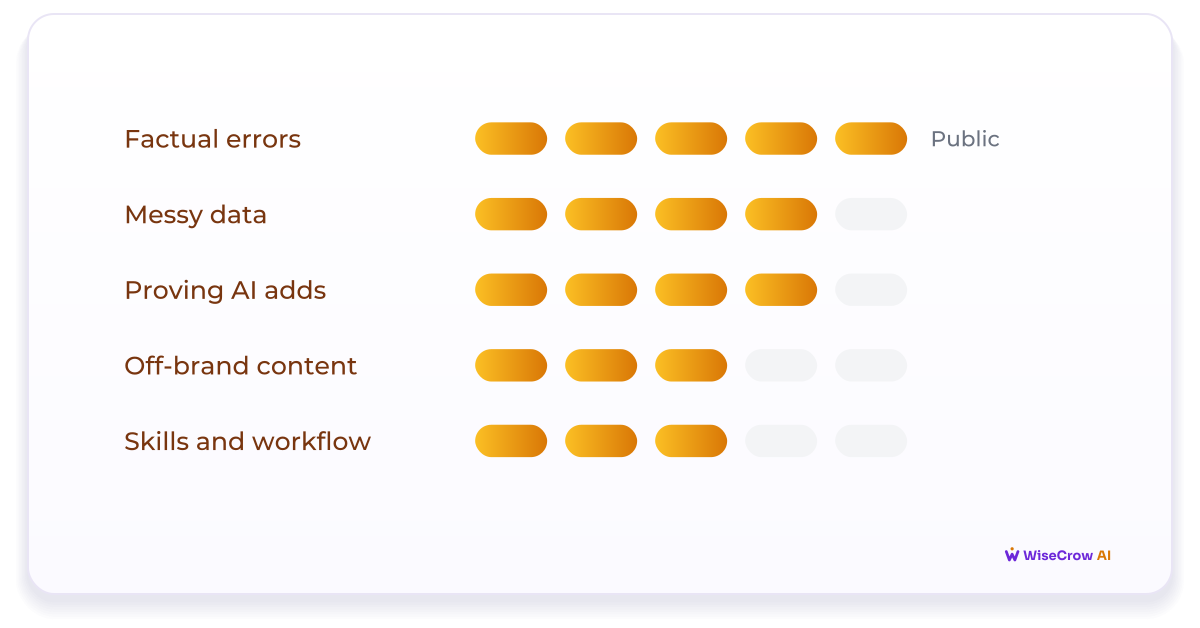
Severity and Effort for Each Challenge
Severity is how much harm the problem causes if you leave it alone, in money, reputation or legal exposure. Effort is how much time and budget a working fix takes. Both ratings come from my client work with mid-sized marketing teams. Rescore them for your own business, since a regulated brand will rate claims and disclosure higher than I have.
| Challenge | Severity | Effort | First move |
|---|---|---|---|
| 1. Messy data and consent | High | High | Audit consent fields |
| 2. Proving what AI adds | High | Medium | Own the test calendar |
| 3. Off-brand content | Medium | Low | Build a voice pack |
| 4. Factual errors and claims | High | Low | Start a claims register |
| 5. Trust and disclosure | Medium | Low | Publish a disclosure rule |
| 6. Copyright and ownership | Medium | Medium | Log human edits |
| 7. Skills and workflow | Medium | High | Map review steps |
The 7 AI Marketing Challenges and Their Fixes
The order follows the table. Each challenge starts with how it shows up in a real team, then why it happens, the fix in steps and the tools or resources that help.
Messy First-Party Data and Consent
Your CRM holds tens of thousands of contacts. A good share have no consent record, the same customer shows up three times under different emails and the purchase history sits in an ecommerce system nobody synced. You connect an AI tool for segmentation or personalized email, and it builds audiences from all of it with total confidence.
AI makes old data problems louder. When a rule-based email misfires, it hits one segment once. A model fed duplicated, half-consented records repeats the error at scale and hides it inside a tidy score. Consent is the sharper edge. Data you collected for order updates may not cover AI profiling or model training, and the FTC warned in 2024 that companies adopting more permissive data practices through quiet policy changes may act unfairly or deceptively. In my client work, the first audit nearly always finds consent stored in three places with three different meanings.
How to Get Your Customer Data AI-Ready
- List every source the AI tool will read: CRM, ecommerce, email platform, ad audiences and support tickets.
- Check which consent each record carries and the purpose it was collected for.
- Merge duplicates with one agreed matching rule, usually email plus customer ID.
- Keep records without a valid consent basis out of AI segmentation and training.
- Name one owner for the customer data model and give them a say over new AI tools.
- Repeat the audit every quarter, since new forms and integrations add mess fast.
Tools That Clean and Govern the Data
A customer data platform such as Segment, or the data tools built into HubSpot and Salesforce, helps you merge profiles and see where each field came from. Consent management platforms like OneTrust or Cookiebot record what each person agreed to, and your AI workflows should read that record before they touch a contact.
Proving What AI Actually Adds
The dashboard looks great. Ad platforms report higher ROAS since you switched on their AI bidding, the content team ships three times as many posts and email open rates held steady. Then someone asks how many extra sales came from AI, and the room goes quiet.
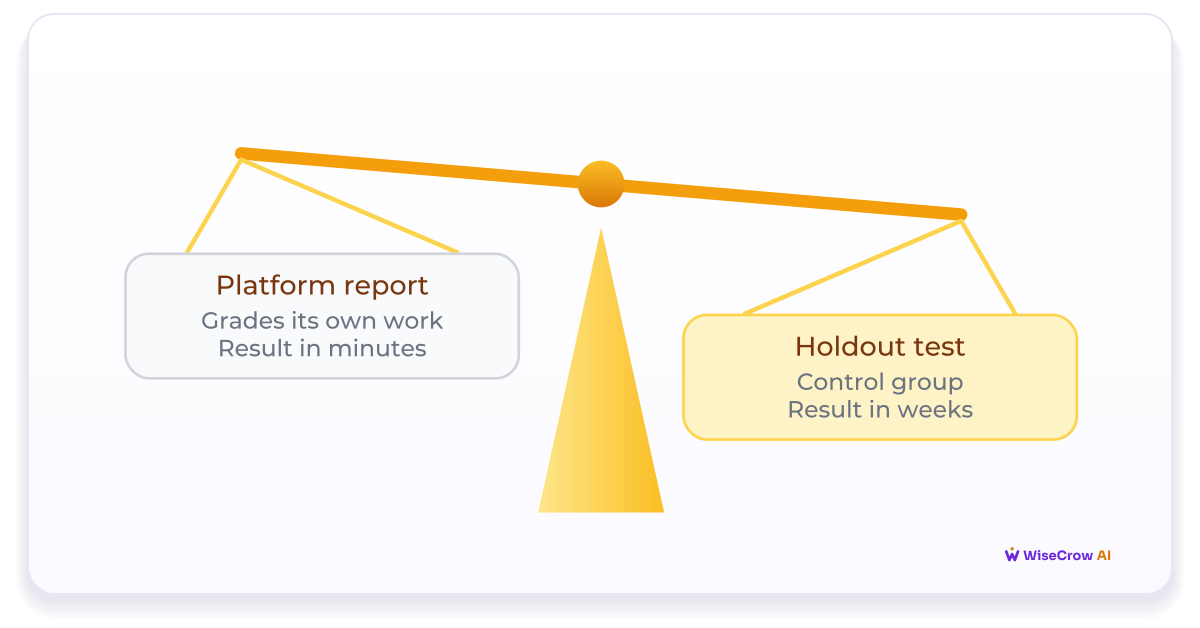
Measurement gets harder from two sides at once. Platform AI such as Google’s Performance Max and Meta’s Advantage+ makes more of the targeting and placement calls and shows you less of how it made them. Your own AI-assisted content also blends into human work, so six months later nobody can say which assets came from where. I cover test designs and the math in my guide to measuring AI marketing ROI. The hard part here is organizational. Someone has to own the question, keep control groups alive and tag AI work so it can be compared at all.
Steps to Make the Lift Provable
- Decide which AI claims need a controlled test before anyone repeats them in a board deck.
- Tag every AI-assisted asset in your asset library or ad naming convention.
- Keep a standing control group, such as a small share of email subscribers, that never gets AI-driven changes.
- Give one person the test calendar, so tests don’t overlap and spoil each other.
- Report platform-claimed results and tested results in separate columns.
Measurement Resources to Lean On
Meta and Google both offer conversion lift studies inside their ad platforms, and they’re the cheapest place to run a first randomized test. For a cross-channel view, Meta’s open-source Robyn marketing mix model can take your lift test results as calibration once you have a couple of years of weekly data.
Generic, Off-Brand Content
Every draft sounds fine, and none of them sound like you. The blog posts open the same way, product pages use the same five adjectives as your competitors and the social captions could belong to any brand in your category. Editors spend more time putting the voice back than the AI saved on the draft.
Generic output is the default setting. A model writes toward the average of what it has seen, and without firm guidance your brand drifts toward that average too. Visuals carry a sharper risk, because people spot odd faces and plastic textures in a second. Coca-Cola’s AI-made Christmas ad in November 2024 drew a wave of criticism, with social media users calling it “creepy” and “soulless”, and that was a brand with a huge budget and top studios. My fix is a voice pack: real examples, banned phrases and a scoring rubric that every draft passes before a human edits it.
Putting Your Voice Back into AI Drafts
- Collect 10 to 20 of your best-performing pieces as reference examples.
- Write a one-page voice guide with words you use, words you never use and sample sentences.
- Load the examples and the guide into your AI tool’s brand voice or custom instructions feature.
- Score each draft on a short rubric before editing: voice, specifics, accuracy and audience fit.
- Ban the stock openers and filler phrases that keep showing up, and update the list monthly.
- Keep human-made visuals for hero campaigns until AI images pass the same rubric.
Where Brand Voice Lives in Your Stack
Writer and Jasper both store brand voice rules and examples that apply to every draft, and ChatGPT and Claude workspaces can hold the same material as shared project instructions. A style checker such as Acrolinx or Grammarly’s business style guides catches off-brand terms across a large team.
Factual Errors and Unchecked Claims
An AI draft says your software integrates with a platform it doesn’t support. A product page promises a battery life the spec sheet never mentions. A support chatbot invents a refund rule on a Sunday night. Each one reads just as smoothly as the truth.
Language models write plausible text, and plausible and accurate are different things. The exposure is real. In 2024, a Canadian tribunal held Air Canada responsible after its website chatbot gave a customer wrong fare information, and it rejected the airline’s argument that the chatbot was a separate legal entity. In the U.S., the FTC’s chair at the time said in 2024 that there is “no AI exemption from the laws on the books”. Advertising claims still need support, no matter who or what drafted them.
How to Stop Errors Before They Ship
- Build a claims register: every product fact, number and comparison you’re allowed to state, with its source.
- Point the AI at that register and your product docs, and tell it to take facts from nowhere else.
- Flag every number, superlative and competitor mention in a draft for a human check.
- Send health, finance, pricing and comparison claims through legal or compliance review.
- Limit customer-facing chatbots to approved answers on refunds, pricing and policy.
- Log each error that slips through and add the correction to the register.
What Helps with Fact-Checking
Features that ground answers in your own documents, such as custom GPTs, Claude Projects or a vendor knowledge base, reduce invented facts, though they don’t remove them. A shared spreadsheet works fine as a first claims register, and most teams move it into their DAM or content platform later.
Customer Trust and AI Disclosure
A customer finds out the friendly “team member” in your chat window is a bot. A follower notices your founder’s LinkedIn posts all read like the same template. Someone screenshots an AI image in your ad with six fingers on one hand. None of these break a law by default, and every one of them costs you trust.
Audiences say plainly that they want to know. In an April 2026 Meltwater and YouGov survey of nearly 10,000 consumers in seven markets, 86% said AI-generated content should be labeled, and 32% said they’d trust a brand less if its content was AI-generated, against 15% who’d trust it more. Rules point the same way. The EU AI Act’s Article 50 transparency obligations cover AI systems that talk with people and certain AI-generated or manipulated content, such as deepfakes. In the U.S., the FTC’s final rule on fake reviews and testimonials also covers AI-generated fake reviews. Check the current scope and timelines with counsel before you set policy.
Setting a Disclosure Policy People Can Trust
- Sort your AI use into tiers: back-office help, AI-assisted content a human edits, and fully AI-made content or conversations.
- Agree a disclosure rule for each tier and write it on one page.
- Label chatbots as automated in the first message, with an easy route to a person.
- Never use AI to write reviews, testimonials or endorsements.
- Label realistic AI images of people every time you publish them.
- Review the policy twice a year as rules and audience expectations shift.
Resources for Disclosure Decisions
The FTC’s business guidance on endorsements and reviews is short and readable, and the official EU AI Act text sets out the transparency duties article by article. Content Credentials, built on the C2PA standard and backed by Adobe and others, attach provenance data to images so viewers can check how they were made.
Copyright and Ownership of AI Assets
Your agency delivers a campaign built on AI-generated images. A few months later, a competitor runs something almost identical, and your lawyer asks what you actually own. Or a designer prompts an image “in the style of” a living illustrator, and the result looks close enough to draw a complaint.
Ownership is the first gap. The U.S. Copyright Office concluded in January 2025 that prompts alone don’t make you the author of an AI output, while human creative arrangements or modifications of the output can be protected. A raw AI image may give you little you can enforce. The second gap is infringement risk, since outputs can resemble existing work, logos or characters. Courts are still working through cases on training data, so I tell clients to plan for uncertainty and keep good records. Ask your counsel about anything you’d need to defend.
Lowering IP Risk in AI-Made Assets
- Keep people in the creative loop for hero assets, logos and characters you’ll want to protect.
- Save the prompts, drafts and human edits behind each key asset.
- Ban prompts that name living artists, competitor brands or trademarked characters.
- Read your AI vendors’ terms on output ownership and IP indemnity, including the conditions.
- Add AI clauses to agency and freelancer contracts: disclosure of AI use, warranties and ownership.
- Run a reverse image search on key visuals before launch.
Where to Check Rights and Provenance
Some enterprise image tools, Adobe Firefly among them, say they train on licensed content and offer IP indemnity on certain plans, so compare those terms before you pick a vendor. The U.S. Copyright Office’s AI page collects its reports and registration guidance in one place.
Team Skills and Review Workflow
Everyone on the team uses AI, and no two people use it the same way. One writer pastes drafts straight into the CMS, another rewrites everything by hand and the designer pays for three image tools on a personal card. Reviews happen when someone remembers, and nobody can say which assets went through one.
Skills trail adoption. In the Marketing AI Institute’s 2024 survey, 67% of marketers named a lack of training as a barrier to AI adoption, and 47% said their organization offered no AI training for marketing teams. Training by itself won’t fix the workflow, though. The teams I see succeed decide who prompts, who reviews and who approves for each type of asset. If you’re still settling on a stack, my ranked list of AI marketing tools helps you narrow it to a few the whole team can learn.
Building Skills and a Workflow That Sticks
- Map each asset type, from social posts to landing pages, and mark where AI enters the process.
- Assign a reviewer per asset type and put the review time in their week.
- Run hands-on sessions with your own briefs and past campaigns.
- Build a shared prompt library from examples that passed review.
- Move everyone onto a short approved tool list and cancel the rest.
- Check the workflow after a month and cut any step people quietly skip.
Training and Workflow Resources
Project tools like Asana, Monday.com or Airtable can hold AI review as a required stage in each content workflow. For training, free courses from Google, HubSpot Academy and the Marketing AI Institute cover the basics, and your own prompt library covers the rest.
How to Choose Which AI Marketing Challenge to Fix First
You’ll probably recognize four or five of these in your own team. Trying to fix them all in one quarter spreads people too thin. I sort them on two questions: how much harm the problem does if it waits another quarter, and how long a working fix takes. The matrix uses the ratings from the first table.
| Effort | High severity | Medium severity |
|---|---|---|
| Low effort | 4. Factual errors and claims | 3. Off-brand content; 5. Trust and disclosure |
| Medium effort | 2. Proving what AI adds | 6. Copyright and ownership |
| High effort | 1. Messy data and consent | 7. Skills and workflow |
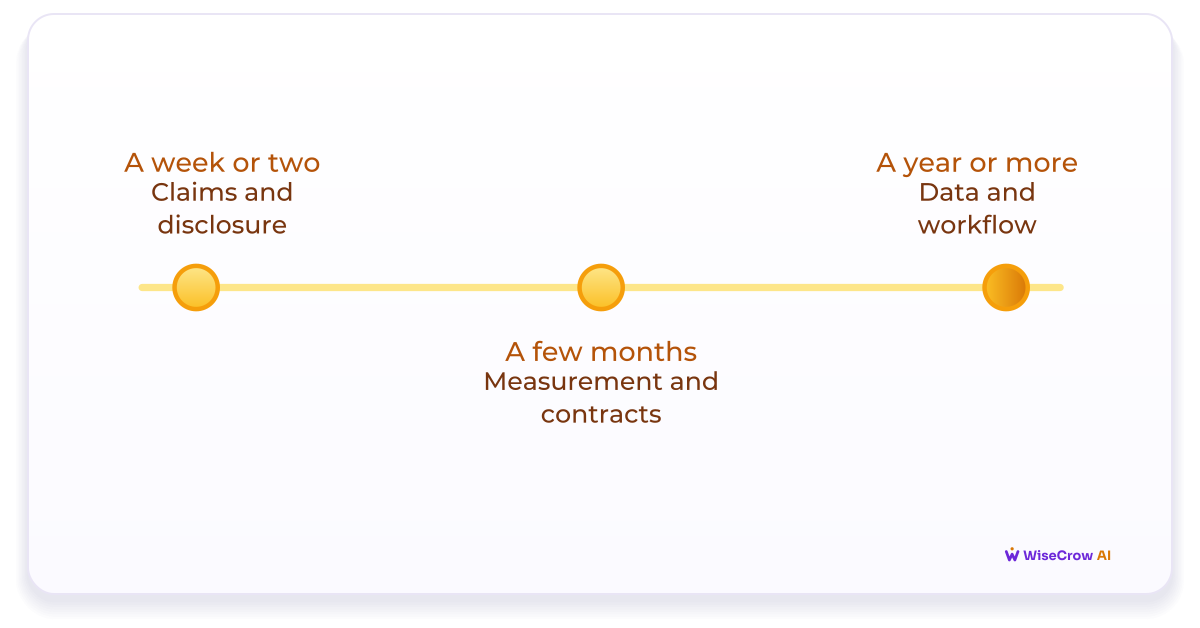
Work from the top left. A claims register and a human check on numbers stop the errors that turn into screenshots and complaints, and they take a week or two. Then clear the rest of the low-effort row with a voice pack and a written disclosure rule.
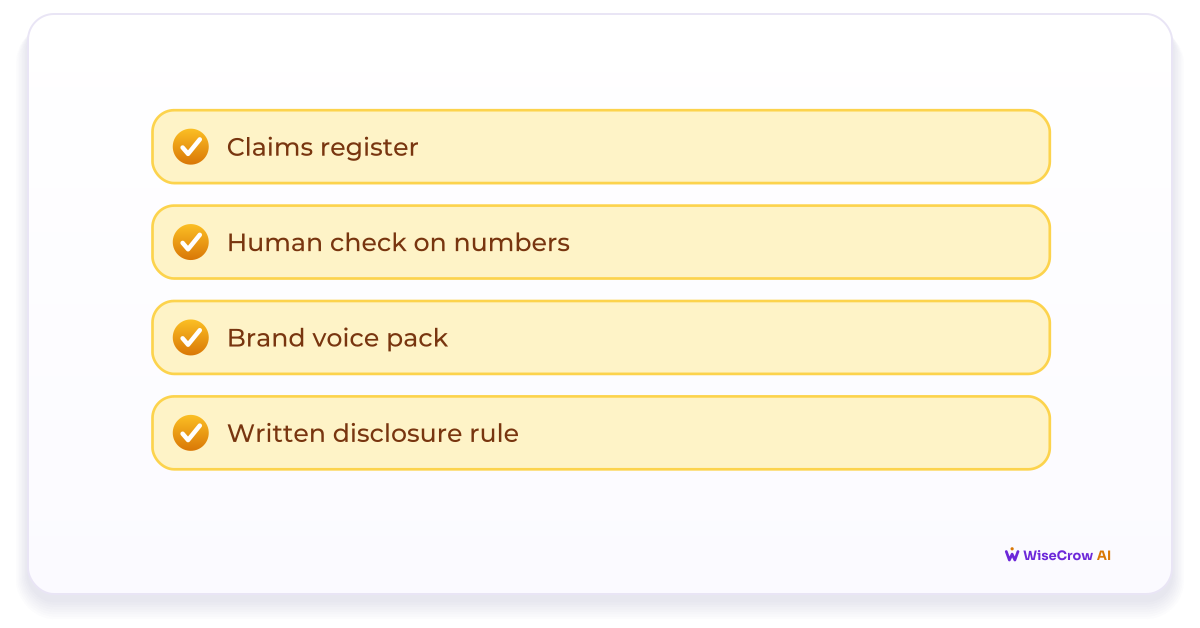
The middle row needs a few months. Start the measurement work early, because tests take weeks to produce a result you can trust. Fix contracts and asset records for AI work as each campaign or agency agreement comes up for renewal.
The bottom row holds the long projects. Data cleanup and workflow change both take a year or more in most teams I’ve worked with. Run them in parallel at small scale, one data source and one asset type, and widen them once the first piece works. I once watched a retail client try to clean its whole CRM before switching on any AI segmentation. Fourteen months later the project was still going, and the email team had quietly started using an AI tool on the messy data anyway.
Questions About AI Marketing Challenges
What Are the Biggest Challenges of AI in Marketing?
In my client work, the biggest are messy customer data, factual errors in AI content and proving what AI adds to revenue. Brand voice, disclosure, copyright and team workflow follow close behind. Most teams face four or five of the seven at the same time.
Do I Have to Disclose That Marketing Content Was Made with AI?
It depends on where you operate, the channel and the type of content. The EU AI Act sets transparency duties for AI systems that talk with people and for certain AI-generated content, and U.S. rules on deception and fake reviews apply to AI content too. Many brands label chatbots and realistic AI images of people as a baseline. Check the specifics with counsel.
Can I Copyright AI-Generated Marketing Images?
In the U.S., the Copyright Office has said that prompts alone don’t make you the author of an AI output. Human creative selection, arrangement or modification can be protected. Keep records of the human work on key assets and ask counsel about anything you plan to defend.
How Do You Keep AI Content on Brand?
Give the AI real examples of your best content, a one-page voice guide and a list of banned phrases. Then score every draft on a short rubric before a human edits it. Most AI writing tools can store these as brand voice settings or shared instructions.
How Do You Stop AI from Making False Claims in Marketing?
Keep a claims register of approved facts with sources, ground the AI in it and flag every number, superlative and comparison for human review. Send regulated claims to legal or compliance. A company stays responsible for what its AI says, as the Air Canada chatbot case showed.
Is Our Customer Data Ready for AI Marketing Tools?
Probably in part. Check for duplicates, missing purchase history and unclear consent before you connect any AI tool. Records without a valid consent basis for the new use should stay out of AI segmentation and training. Start with one clean source and add others as you fix them.
Should a Small Marketing Team Worry About These Challenges?
Yes, though the fixes are lighter. A small team can run a claims register in a spreadsheet, write a one-page voice and disclosure guide and agree on two or three approved tools in a week. The data and measurement work can grow with the team.
Sources
- FTC Technology Blog: AI (and Other) Companies: Quietly Changing Your Terms of Service Could Be Unfair or Deceptive (February 2024)
- Business Today: Coca-Cola Faces Backlash Over AI-Generated Christmas Ad (November 2024)
- CBS News: Air Canada Chatbot Gave a Customer Wrong Information, Airline Ordered to Pay (February 2024)
- FTC: FTC Announces Crackdown on Deceptive AI Claims and Schemes (September 2024)
- Meltwater and YouGov: Trust in the Age of Generative AI, Consumer Perception Report (April 2026)
- EU AI Act, Article 50: Transparency Obligations for Providers and Deployers of Certain AI Systems
- FTC: Final Rule Banning Fake Reviews and Testimonials (August 2024)
- U.S. Copyright Office: Copyright and Artificial Intelligence, Part 2: Copyrightability (January 2025)
- MarTech: 67% of Marketers Say Lack of Training Is Primary Barrier to AI Adoption, 2024 State of Marketing AI Report (July 2024)
Disclaimer: This article is general information and isn’t legal advice. Rules on advertising claims, AI disclosure, privacy and copyright differ by country and change often, so check the current official texts and speak with qualified counsel before you act.
Did you find this helpful?
Thank you for your feedback.
Marlena leads the WiseCrow editorial team and works with our consultants to turn real client projects into practical guides on AI strategy, automation and governance. Before joining WiseCrow, she spent 12 years in B2B operations and SaaS content. She has since edited more than 400 articles on AI and automation and reviewed workflows from over 60 client projects. She is based in Austin, Texas.