Summary
- Name the decision a model will change, who owns it and the business metric it moves.
- Score each idea: value of a better prediction × decisions per year × share improved, minus build and run cost.
- Build a non-ML baseline first, because the model only earns money on the gap above it.
- Pilot against a random holdout, ship with MLOps and watch for drift before you scale.
Most ML projects I’m asked to rescue had a working model and no plan for what came next. The model scored well in a notebook and then sat there, because nobody had worked out which decision it would change or who would pay to run it. A machine learning strategy closes that gap, and it’s the first deliverable in any AI and machine learning consulting project I’d sign off on.
Below you’ll find the whole path from idea to market on one table, a value formula that tells you which problems deserve a model, a worked example and eight short steps. Each step ends with a clear test, so you know when to move on and when to stop.
The Model-to-Market Path on One Page
Read the table from top to bottom. Each row is a gate. If you can’t answer the question in the middle column, the next step will cost more than it should.
| Step | Question you answer | Move on when |
|---|---|---|
| 1. Frame the DecisionBefore training | Which decision gets better, and who makes it? | One decision, one owner, one metric |
| 2. Audit the DataBefore training | Do you have the history and labels to learn from? | Labels exist and the data is there at decision time |
| 3. Set a Non-ML BaselineBefore training | How well do rules or averages already do? | A measured score the model must beat |
| 4. Build, Buy or Fine-TuneBefore training | Which route costs least over the model’s life? | One route with a yearly cost estimate |
| 5. Pilot With a HoldoutAfter the first model | Does the model beat the baseline on live work? | A measured lift against the holdout |
| 6. Deploy With MLOpsAfter the first model | Can you ship, version and roll back safely? | Automated release and rollback in place |
| 7. Watch for DriftAfter the first model | Will you know when performance slips? | Alerts on inputs, outputs and outcomes |
| 8. Scale What Earns MoneyAfter the first model | Where else can the same pieces pay off? | A ranked list of next problems |
The Formula That Decides Which ML Problems Are Worth Solving
Value is the part most teams can’t pin down. In a Gartner survey of 644 organizations, 49% of respondents named estimating and demonstrating the value of AI projects as their top barrier to adoption. Put a number on the value before anyone trains a model, and that barrier gets a lot smaller.
I use one line for every candidate:
Net yearly value = Value of a better prediction × Decisions per year × Share improved − Yearly build and run cost
- Value of a better prediction: what one better decision is worth in money, such as margin kept, stock not written off or a fraud loss avoided.
- Decisions per year: how often the decision gets made. A model that scores 2,000 accounts every month makes 24,000 decisions a year.
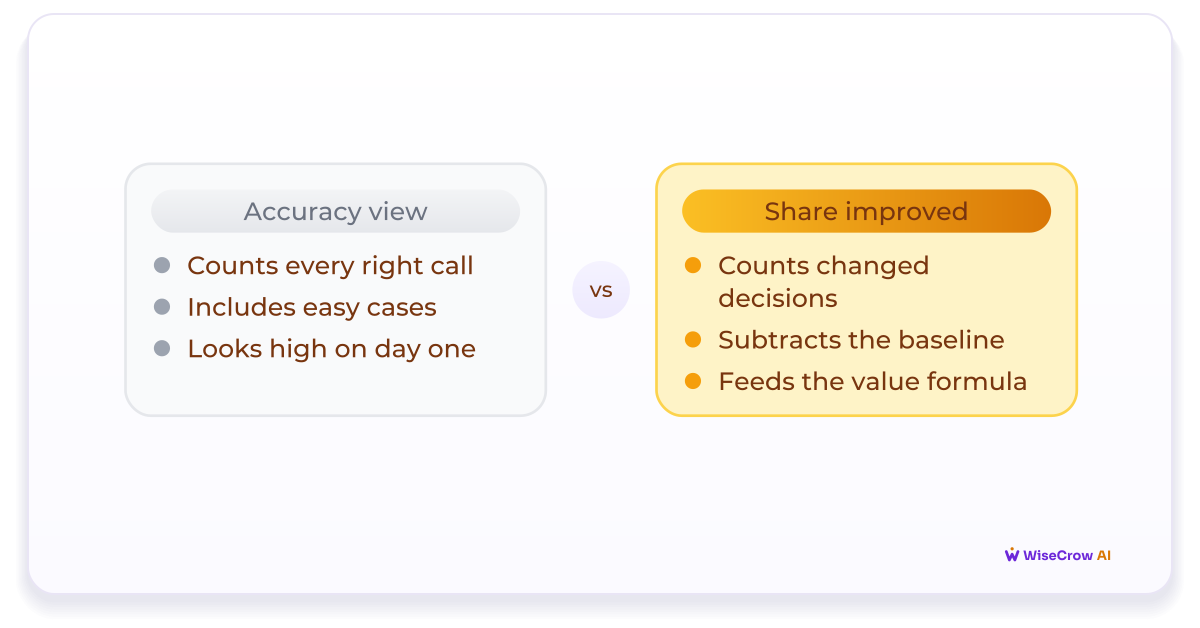
- Share improved: the share of decisions where the model beats your current method. Measure it against your baseline, never against doing nothing.
- Yearly build and run cost: the build cost spread over the years you’ll use the model, plus hosting, data, monitoring and the people who look after it.
Share improved is the number teams inflate most. A model with 90% accuracy sounds impressive until you learn your current rules already get 86% right. The model only earns money on the gap. In my client work, a realistic share improved for a first model sits somewhere in the single digits, and anything far above that gets a second check before it goes into a budget.
Run cost is the one teams forget. Google researchers described the hidden technical debt in ML systems: quick early wins often come with large ongoing maintenance costs, because the model code is a small part of a system full of pipelines, configuration and monitoring. Put those costs in the formula from day one.
Here’s how three common candidates compare for a mid-sized retailer with a subscription arm. The figures are illustrative, so swap in your own:
| Problem | Gross value | Yearly cost | Net value |
|---|---|---|---|
| Churn outreach | $144,000 | $90,000 | $54,000 |
| Reorder forecasting | $145,600 | $70,000 | $75,600 |
| Lead scoring | $27,000 | $45,000 | −$18,000 |
Reorder forecasting: 1,000 products reordered weekly = 52,000 decisions × $35 per better decision × 8% improved = $145,600, minus $70,000 build and run cost. Churn outreach: 40,000 account reviews × $120 × 3%.
Lead scoring loses money here, and that’s a useful answer. With 9,000 leads a year, a small sales team doesn’t make enough decisions for a model to pay back. A plain rule, such as calling leads from larger companies first, gets most of the value for free. For payback periods and the benchmarks to compare against, see my guide to measuring machine learning ROI.
Steps 1 to 4: Before You Train Anything
The first four steps cost little and remove most weak ideas early. Expect at least one candidate to drop out here. Losing it now costs a few days. Losing it after the build costs months.
1. Frame the Decision
Write down the decision the model will change, who makes it today and how often. “Predict churn” describes a model. “Choose which 500 accounts get a retention call each month” describes a decision, and decisions are what earn money.
Pick one metric the business already tracks, such as retained revenue, stock write-offs or fraud losses. Model metrics like accuracy or AUC still matter, but only as early signals of movement in that business number.
The question I ask in the first workshop is blunt: if the model were perfect tomorrow, what would someone do differently on Monday? If nobody in the room can answer, there’s no project yet.
2. Audit the Data You Already Have
Check three things for your top candidate. History: do you have enough past examples of the decision and what happened next? Labels: is the outcome recorded, such as churned or stayed, or will someone have to rebuild it from emails and spreadsheets? Access: will the same data reach the model in production, at the moment the decision gets made?
The third check is where audits usually fail. A field that gets filled in a week after the decision looks brilliant in training and is useless live. Data scientists call it leakage, and in my experience it’s behind most models that test too well to be true.
3. Set a Baseline Without Machine Learning
Martin Zinkevich’s Rules of Machine Learning from Google open with a line worth pinning to the wall: don’t be afraid to launch a product without machine learning. Build the simplest version first. A business rule, a moving average, last year’s figure for the same week or a list sorted by one column all count.
Score it on recent data. The baseline sets the bar for share improved in the formula, and sometimes it closes most of the gap on its own. I once watched a seasonal average match a first forecasting model for a client with very steady demand. They shipped the average and moved the ML budget to a harder problem, which was the right call.
4. Decide to Build, Buy or Fine-Tune
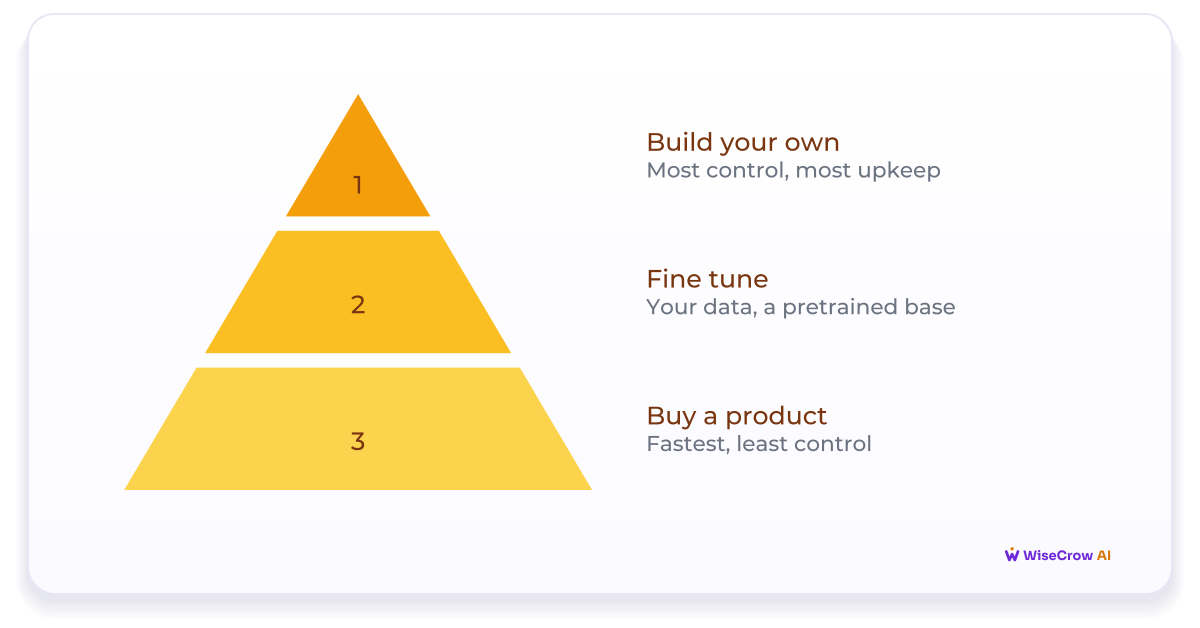
Three routes lead to a working model, and each one puts the cost in a different place:
| Route | Fits when | Watch for |
|---|---|---|
| Buy a product or API | The problem is common, such as fraud checks, forecasting or document reading | Per-call fees at volume, limited control |
| Fine-tune a pretrained model | The task is close to a general one but uses your own language or data | Labeled examples, evaluation, hosting |
| Build your own | The data and the decision are specific to your business | Team skills, MLOps, years of upkeep |
Buy for problems your competitors also have, and build where your own data is the edge. If a vendor’s model performs as well as yours would, you’re paying a team to rebuild a commodity. My comparison of free and paid machine learning tools covers the platforms behind each route.
Fine-tuning sits in the middle and is easy to underestimate. Training is often the cheap part. Collecting clean labeled examples and building an evaluation set you trust takes far longer than most plans allow.
Steps 5 to 8: After the First Model Works
A model that beats the baseline offline has earned a pilot, and that’s all it has earned so far. The next four steps turn it into something that pays every week and keeps paying.
5. Pilot Against a Holdout Group
Run the model on live work and keep a random share of cases on the old method. Somewhere between ten and twenty percent is a common holdout size. The holdout shows what would have happened without the model, under the same season, prices and staffing.
Compare the business metric from step 1 between the two groups, then put the measured lift back into the formula. If the real share improved lands at half your estimate, recompute the net value before anyone asks for a bigger budget.
Give the pilot enough time to cover a busy stretch, such as a month-end or a promotion. The same Gartner survey found that only 48% of AI projects make it into production on average, and the move from prototype to production takes eight months. A clean holdout result is the strongest case you can bring to the approval meeting.
6. Deploy With MLOps From Day One
MLOps is the set of habits that lets you ship a model the way you ship software: versioned data and code, a model registry, automated tests and a release you can roll back in minutes. Rule #4 in Zinkevich’s guide says to keep the first model simple and get the infrastructure right. I’d keep that order.
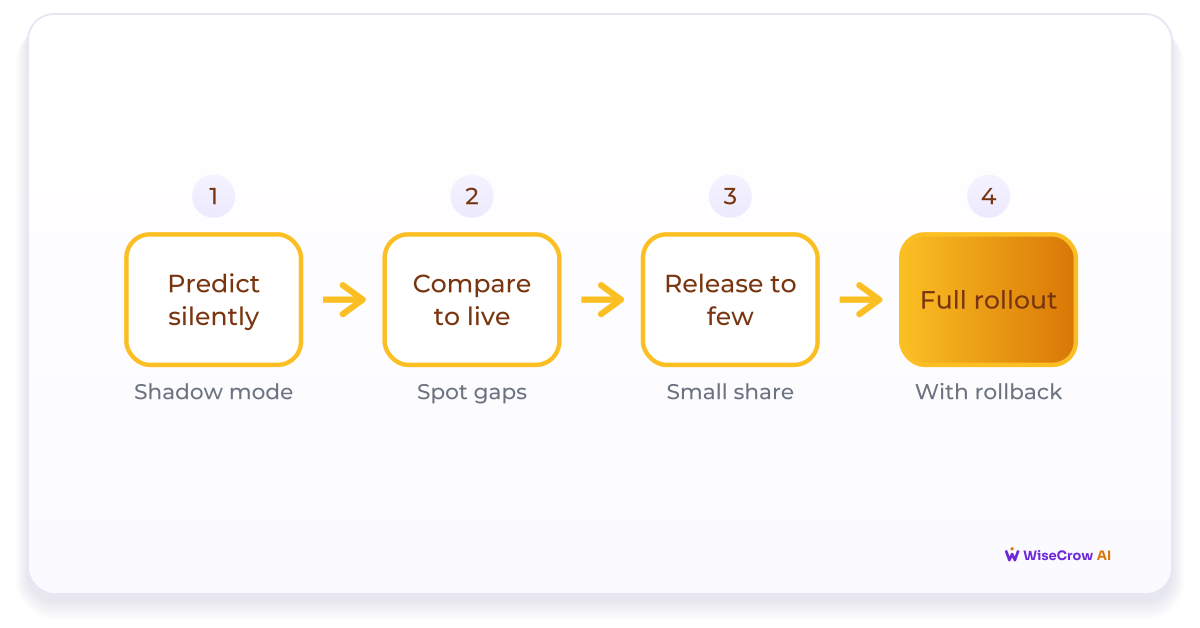
Start in shadow mode, where the model makes predictions next to the live process without acting on them. A week or two of shadow running exposes slow responses, missing fields and odd cases before a customer sees any of them. Then send a small share of traffic to the model and widen it in steps.
7. Watch for Drift After Launch
Models decay because the world they learned from moves on. Prices change, a new product launches, a competitor runs a big promotion. Track three layers: the inputs, to see if the data looks different; the outputs, to see if predictions are shifting; and the outcomes, to see if the business metric still beats the holdout.
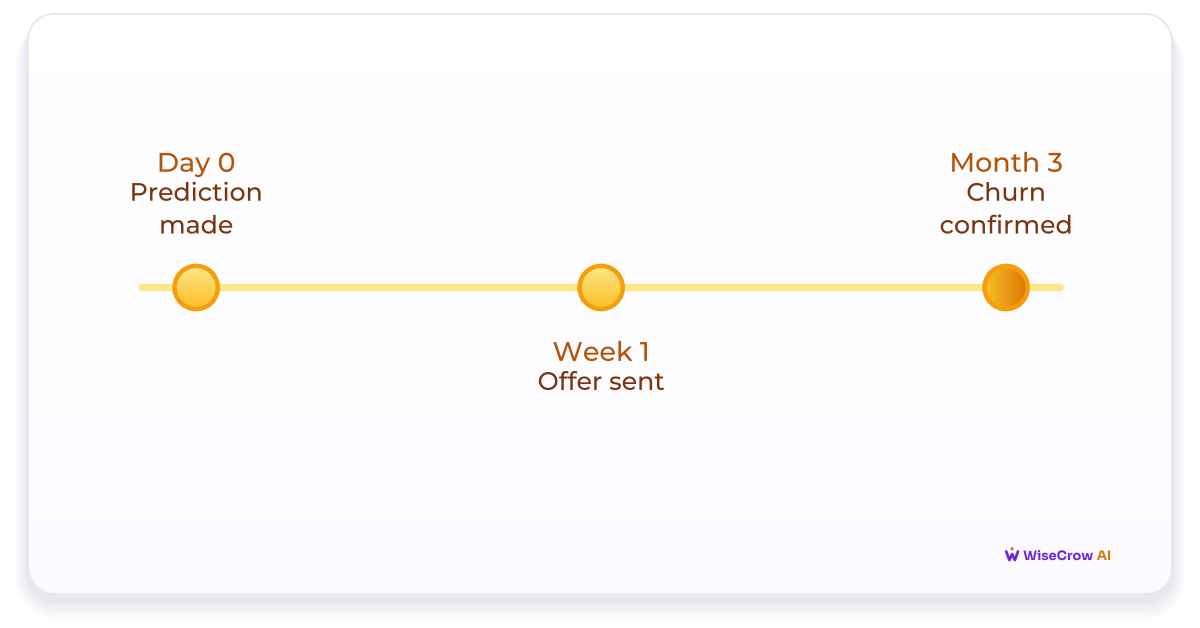
Outcomes often arrive late. A churn label can take months to confirm, so input and output drift are your early warnings. Agree on a retraining trigger in advance, such as the business metric slipping for two reporting periods in a row, and name the person who makes the call.
8. Scale What Earns Money
Once one model pays, look for the next decision that can reuse what you built: the same customer data, the same pipelines, the same monitoring. In my client work, the second model nearly always ships faster than the first, because the expensive plumbing already exists.
Rank new candidates with the same formula, now with real costs from your first project in place of guesses. Track cost per prediction as volume grows. Hosting that looked trivial at pilot scale can become a real line item at ten times the traffic.
Retire models with the same care you put into launching them. A model nobody uses still reads data, still holds access and still needs updates.
Check a Bought Model Against Its Monthly Price
When the buy route looks right for work your team does by hand today, such as sorting documents or reviewing transactions, run the numbers before you sign. Enter the weekly hours the task takes, the share a tool can handle, your hourly staff cost and the monthly price.
Will It Pay for Itself?
Move the sliders to match the work you want to automate and the plan you are considering.
Treat the share as a guess until your holdout pilot confirms it. Vendor demos run on clean data, and your edge cases will pull the real figure down.
How to Choose Your First Machine Learning Problem
Run the formula on three to five candidates, then use these tests to settle close calls:
- The decision happens often, at least hundreds of times a year.
- The outcome gets recorded, so you can label history and measure the pilot.
- A non-ML baseline exists and leaves a visible gap.
- The data the model needs is available at decision time.
- One business owner will act on the predictions every week.
Pick the candidate that passes all five, even if another one scores higher on paper. A first model that ships and pays builds trust and leaves you with infrastructure for bigger bets. A first model that stalls makes the second one much harder to fund.
If two candidates still tie, I’d go with the one whose owner already complains about the decision. People who feel the pain show up to the pilot reviews.
Questions About Machine Learning Strategy
What Is a Machine Learning Strategy?
It’s a plan that decides which business decisions are worth improving with a model, in what order, and how each model gets from an idea to a live process that earns money. A good one covers problem choice, data, the build route, how you prove value and how you keep models healthy after launch.
How Do I Know If a Problem Needs Machine Learning?
Build a simple version first, such as a rule, an average or a sorted list, and measure it. If the gap between that baseline and a perfect result is worth more per year than a model would cost to build and run, machine learning is worth a closer look. If the baseline gets you most of the way, ship it.
How Do You Calculate the Value of a Machine Learning Model?
Multiply the value of one better decision by the number of decisions per year and the share of decisions the model improves over your current method. Subtract the yearly build and run cost. Use pilot results to replace your estimates as soon as you have them.
Should We Build, Buy or Fine-Tune a Model?
Buy for common problems your competitors also face, such as fraud checks or document reading. Fine-tune a pretrained model when the task is close to a general one but uses your own language or data. Build your own when the data and the decision are specific to your business and form part of your edge.
What Is a Holdout Group in an ML Pilot?
It’s a random share of cases that keeps the old method while the model handles the rest. Comparing the two groups over the same period shows the real lift from the model, with season, prices and staffing held equal. Assign cases at random by customer, store or account, never by hand.
What Is Model Drift and How Often Should I Retrain?
Drift is the gradual drop in model performance as the data and the world around it change. There’s no fixed schedule that suits every model. Monitor inputs, predictions and business outcomes, set a retraining trigger in advance and name the person who decides when it fires.
How Long Does It Take to Get an ML Model into Production?
It varies with data quality, the build route and how much infrastructure you already have. In a 2024 Gartner survey, moving an AI project from prototype to production took eight months on average. Bought models and second projects that reuse existing pipelines usually move faster.
Sources
- Gartner, Gartner Survey Finds Generative AI Is Now the Most Frequently Deployed AI Solution in Organizations (May 2024): gartner.com
- Martin Zinkevich, Rules of Machine Learning: Best Practices for ML Engineering: developers.google.com
- D. Sculley et al., Hidden Technical Debt in Machine Learning Systems (NeurIPS 2015): research.google
Disclaimer: This article is for general information only and isn’t financial or legal advice. The figures in the worked example are illustrative, so use your own numbers and check costs with your vendors and advisers before you commit budget.
Did you find this helpful?
Thank you for your feedback.
Marlena leads the WiseCrow editorial team and works with our consultants to turn real client projects into practical guides on AI strategy, automation and governance. Before joining WiseCrow, she spent 12 years in B2B operations and SaaS content. She has since edited more than 400 articles on AI and automation and reviewed workflows from over 60 client projects. She is based in Austin, Texas.