Summary
- Assess each AI system on seven dimensions: fairness, transparency, privacy, oversight, accountability, safety and societal impact.
- Score every dimension from 1 to 4, and accept a score only when someone can show the evidence behind it.
- Measure bias with a metric chosen for the harm at stake, since demographic parity, equal opportunity and calibration can’t all hold at once.
- Treat any 1 on a high-stakes system as a launch blocker, and give every gap an owner and a date.
Most companies I talk to already have AI principles. They’re usually on a slide, they mention fairness and transparency, and nobody can tell me how the loan model or the CV screener measures up against them. An assessment closes that gap. It takes one system, scores it against clear dimensions and asks for proof at every step. It’s also where most of my AI ethics consulting engagements begin.
Below is the scoring framework I use. You get the seven dimensions on one table, a 1 to 4 scale with a rubric, the three bias metrics worth knowing and what to do with the results once the scores are in.
The Seven Dimensions at a Glance
Each dimension answers one plain question. The right-hand column shows the first piece of evidence I ask for. If a team can’t produce it within a day, I already have a good guess at the score.
| Dimension | Core question | First evidence |
|---|---|---|
| Fairness and Bias | Does it treat groups of people evenly? | Error rates by group |
| Transparency | Can people tell AI is involved, and why it decided? | Notices, model docs |
| Privacy | Is personal data used only as promised? | Data map, retention rules |
| Human Oversight | Can a person catch and reverse it? | Override logs |
| Accountability | Who answers when it goes wrong? | Named owner, appeal path |
| Safety and Reliability | Does it hold up under stress and misuse? | Test results, incidents |
| Societal Impact | What happens beyond the direct users? | Impact notes, feedback |
Where the Seven Dimensions Come From
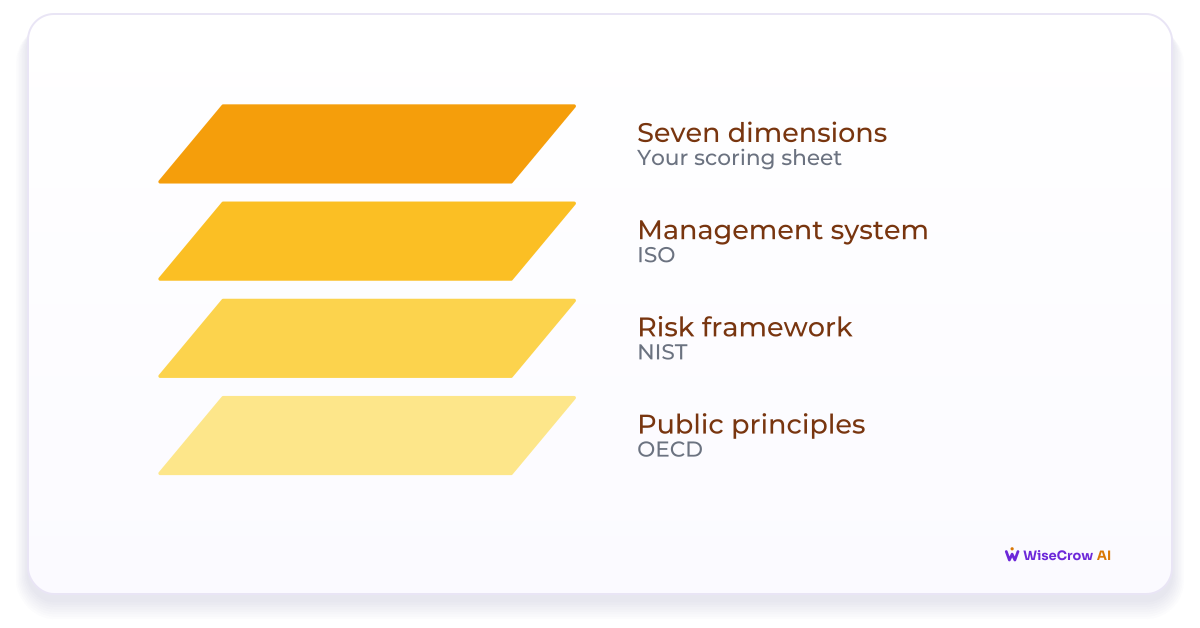
I didn’t invent these categories, and you shouldn’t trust a framework that claims to. They’re a working blend of the public frameworks most clients already reference.
The NIST AI Risk Management Framework organizes AI risk work into four functions: govern, map, measure and manage. The OECD AI Principles, first adopted in 2019 and revised in 2024, cover fairness and privacy, transparency, safety, accountability and broader well-being. The EU AI Act sorts AI uses into risk tiers, and its summary of high-risk uses includes hiring, creditworthiness and insurance pricing. ISO/IEC 42001 adds a management system around all of it, with roles, documented processes and regular review.
My seven dimensions map onto all four without much friction. When legal asks “are we covering NIST?” or a customer’s procurement team asks about ISO/IEC 42001, you can show the mapping on one page. What applies to you legally is a separate question for your legal team, and the status of EU AI Act obligations is worth checking at the source before you plan around it.
The 1 to 4 Scoring Scale
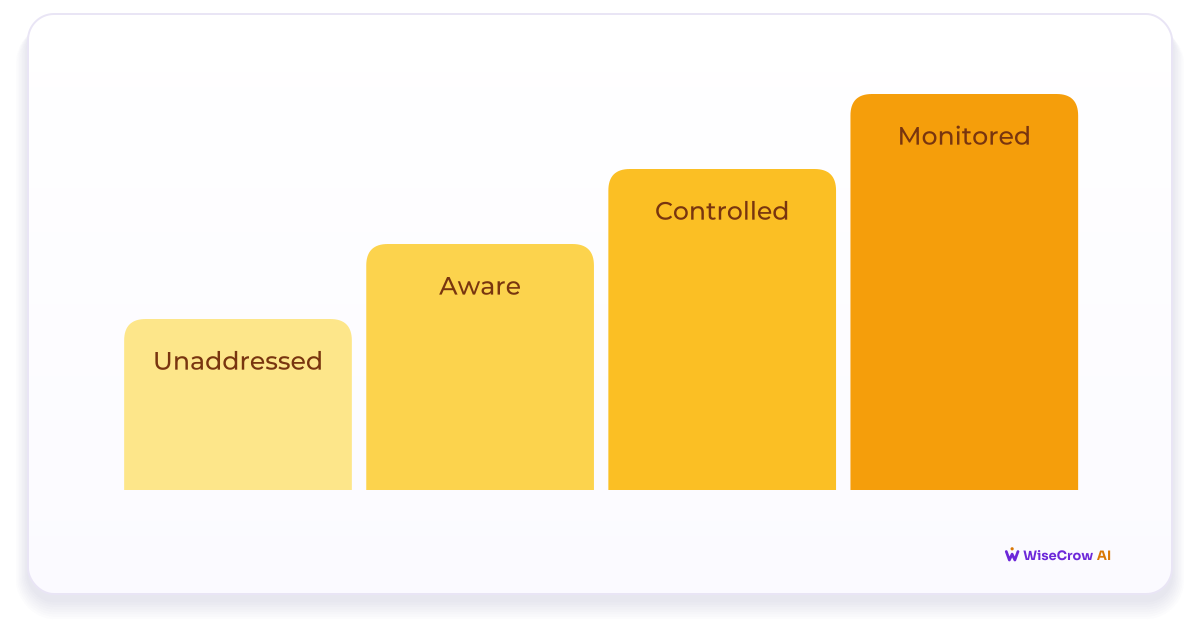
I use four levels on purpose. An odd-numbered scale gives tired committees a comfortable middle to hide in. Four levels force a call: is there a working control or not?
| Score | What it means | Typical evidence |
|---|---|---|
| 1. Unaddressed | Nobody has looked | None, or a promise |
| 2. Aware | Risk named, no controls | A note or a policy |
| 3. Controlled | Controls tested once | A dated test result |
| 4. Monitored | Controls checked on a schedule | Recurring reports |
The jump from 2 to 3 is the one that matters most. A policy that says “we test for bias” is a 2. A dated test result with numbers per group is a 3. A 4 means the same test runs again on a schedule and someone reads the output.
The Scoring Rubric by Dimension
Here’s what a 1 and a 4 look like for each dimension. Scores 2 and 3 sit between them, using the scale above.
| Dimension | What you look at | A 1 looks like | A 4 looks like |
|---|---|---|---|
| Fairness and bias | Outcomes by group | No group data | Gaps tracked monthly |
| Transparency | Notices, explanations | Users unaware | Reasons given per case |
| Privacy | Data inputs, retention | Unknown data sources | Minimal data, audited |
| Human oversight | Review and override | Fully automatic | Overrides used, studied |
| Accountability | Owner, appeals | No owner | Owner, appeals, reviews |
| Safety | Stress tests, incidents | Untested edge cases | Red-teamed, monitored |
| Societal impact | Wider effects | Never discussed | Reviewed with outsiders |
Before anyone scores, write a one-paragraph scope: what the system does, who it affects, what decision it feeds and what happens to a person if it’s wrong. A chatbot that suggests recipes and a model that ranks job applicants need very different levels of proof. The scope paragraph sets that bar for everyone in the room.
Scoring Each Dimension
The sections below are short on purpose. Each one tells you what to inspect and where teams usually lose points.
Fairness and Bias
Look at outcomes and errors per group, for the groups that matter in your context: sex, age, ethnicity, disability, language or region. Check the training data for gaps too. A model trained mostly on one region’s customers will struggle with another’s. Fairness is the dimension where scores drop fastest, so it gets its own section on metrics further down.
Transparency
Two questions. Do people know AI is involved? And can someone explain a single decision in plain words? For an internal summarizer, a note in the interface may be enough. For a credit decline, the person should get the main reasons. Ask for the model documentation as well. If the team can’t say what data the model saw or what it’s known to get wrong, transparency scores a 1 no matter what the user sees.
Privacy
Map every data input, where it comes from and how long it’s kept. Then ask if each one is needed. In my client work, the privacy score usually rises a full level from deletions alone. A field that was “useful for a future model” goes, and so does a log nobody reads. Check what goes to outside model providers and under which terms.
Human Oversight
A person signing off on every decision doesn’t automatically mean oversight works. Look at the override logs. If reviewers accept 99 out of 100 recommendations in under ten seconds each, you have a rubber stamp. Good oversight means reviewers have the time, the information and the authority to say no, and you can see them doing it.
Accountability
Find the name. One person should own the system’s outcomes, with the authority to pause it. Then find the appeal path: how does someone affected by a decision challenge it, and does anyone track those appeals? I once asked a client who would answer a journalist’s question about their pricing model. Four people pointed at each other. That was a 1.
Safety and Reliability
Test the system on the cases it wasn’t built for: missing data, odd inputs, attempts to make it ignore its instructions and sudden shifts in the data it sees. Check how it fails. A system that says “I can’t tell” and passes the case to a person scores higher than one that answers confidently every time. Ask for the incident log too. An empty log on a busy system usually means nobody is recording.
Societal Impact
The hardest dimension to score, and the one most teams skip. Think past the direct users. Could the system push some people out of a service, change how a job is done or be repurposed for something harmful? You won’t get a precise answer. A short written note, reviewed by someone outside the build team and ideally by people the system affects, is enough to reach a 3.
How to Measure Bias: Three Metrics and Their Trade-Offs
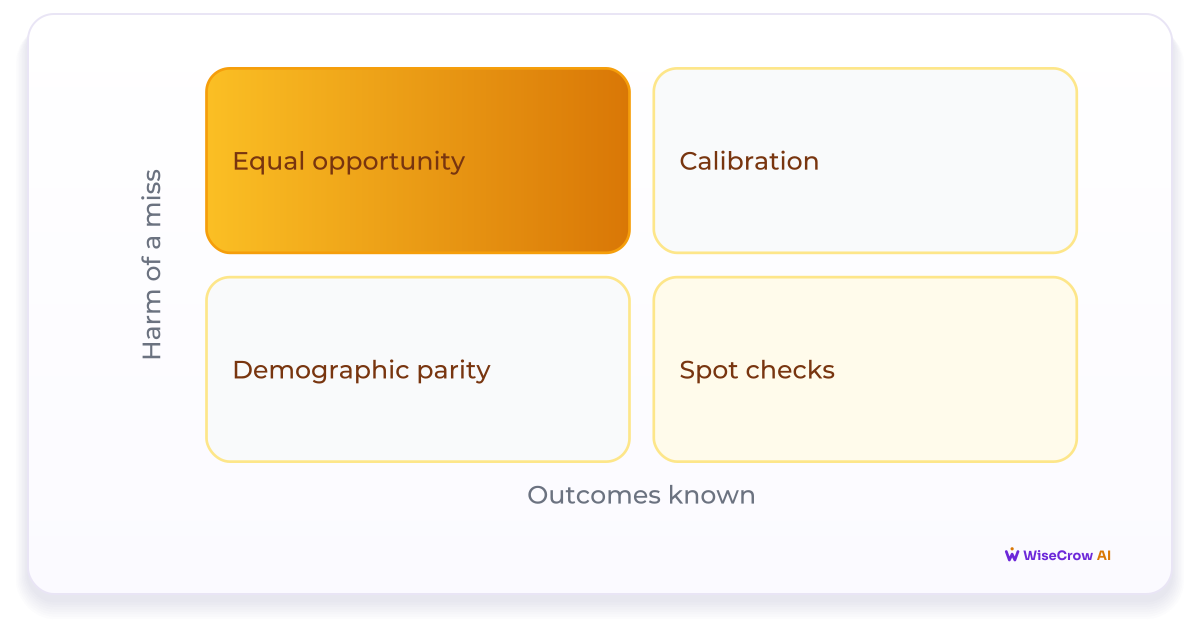
“Is the model biased?” sounds like a yes or no question. It isn’t. Bias has to be measured against a definition of fairness, and there are several. The three below cover most business cases.
| Metric | The question it asks | Fits best when |
|---|---|---|
| Demographic parity | Same approval rate per group? | Access to opportunities |
| Equal opportunity | Same hit rate for qualified people? | Missing a good case hurts |
| Calibration | Same score, same real risk? | Scores drive human decisions |
Demographic Parity
Each group gets a positive outcome at roughly the same rate. If 30% of applicants from one group pass the screen, about 30% from every other group should too. It’s simple to measure and simple to explain. In US hiring, the long-standing four-fifths guideline in the Uniform Guidelines on Employee Selection Procedures flags a selection rate below 80% of the highest group’s rate as a sign of possible adverse impact. I use that ratio as a quick screen in many settings, never as the final word.
The weakness: demographic parity ignores who is actually qualified. If the groups really do differ on the outcome you predict, forcing equal rates means accepting more errors somewhere.
Equal Opportunity
Among the people who truly qualify, each group should be correctly approved at the same rate. Put differently, the model should miss good candidates equally often across groups. Use it when wrongly turning someone down is the harm you care about most, as in hiring, lending or access to care. The catch is that you need reliable outcome data, and in many settings you only see outcomes for people you approved.
Calibration
A score means the same thing for everyone. If the model says 70% risk, about 70% of people with that score should turn out positive, in every group. Calibration matters most when people read the scores and act on them, as underwriters or caseworkers do.
Why You Can’t Have All Three
Here’s the uncomfortable part. When groups have different base rates, the metrics pull against each other. The clearest public example is COMPAS, a criminal risk score. ProPublica’s analysis found that 44.9% of Black defendants labeled higher risk did not reoffend, against 23.5% of white defendants. The vendor answered that the tool’s accuracy was about the same for both groups. Both statements were true. As ProPublica later reported, researchers showed the two fairness definitions can’t both hold when reoffense rates differ.
Kleinberg, Mullainathan and Raghavan made the general case in their paper on inherent trade-offs in risk scores: outside narrow special cases, no score can satisfy all three fairness conditions they define at once. So your assessment has to make a choice and write it down. Which harm matters most here? Who bears the errors? A team that picks equal opportunity and explains why has done better work than one that reports a single “fairness score” and hides the trade-off.
Two practical notes. Small groups produce noisy rates, so report how many people sit behind each number. And bias rarely comes from the model alone. NIST’s report on identifying and managing AI bias points to human and systemic sources as well, which is why the data map and the people in the room matter as much as the math.
Who Should Be in the Room
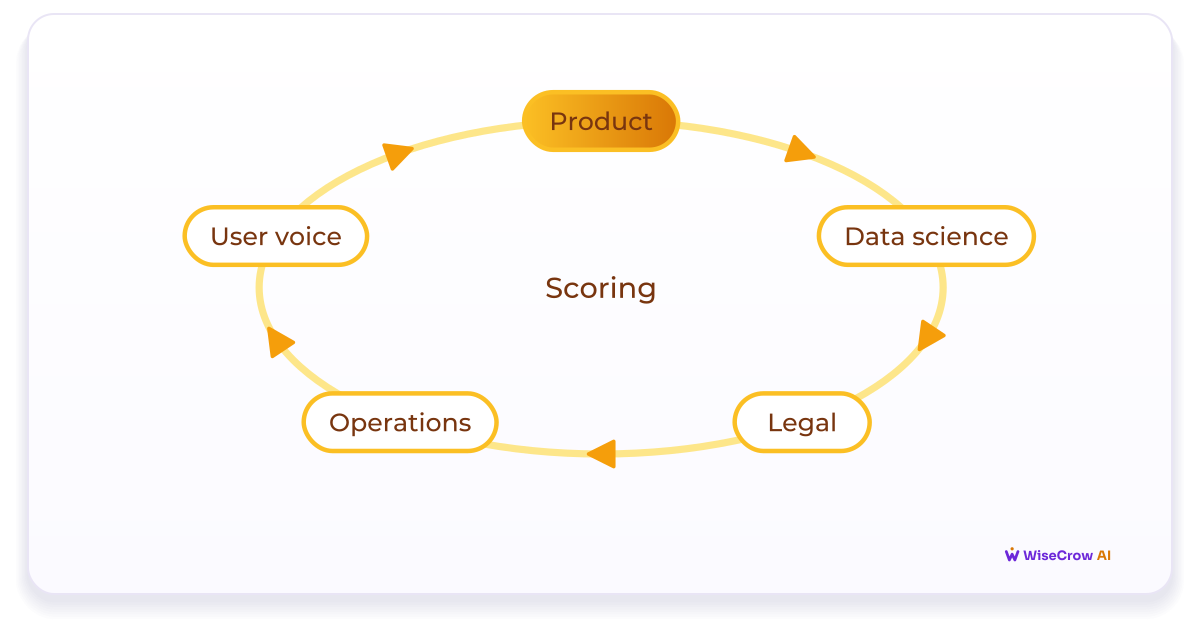
An assessment run by the build team alone tends to score generously. One run only by compliance tends to miss how the system really works. You need both, plus a few others:
- System owner: the business lead who answers for outcomes and signs off on the result.
- Data scientist or engineer: runs the bias tests and explains how the model behaves.
- Legal, compliance and privacy: check the data map, notices and which rules may apply.
- Security: covers misuse, prompt attacks and access to the model and its data.
- Front-line users: the people who act on the output and know where it misleads.
- An independent voice: someone outside the build team, and for high-stakes systems, input from people affected by the decisions.
Keep the core group to five or six people. A scoring workshop with fifteen attendees turns into a debate about wording. Invite the rest for their dimension only.
How to Document the Results
The output is a short record, one per system, that someone outside the team could read and follow. Mine has five parts:
- The scope paragraph, including who is affected and the stakes.
- The score for each dimension, with a link to the evidence behind it.
- The fairness metric you chose, why, and the results per group with sample sizes.
- Each gap with an owner, a fix and a due date.
- The sign-off, plus the date or trigger for the next assessment.
Keep it to four or five pages. Longer records stop being read, and the record is only useful if it gets read before the next model update. If you want a pre-launch version to hand to product teams, my responsible AI launch checklist condenses the same points into yes or no questions.
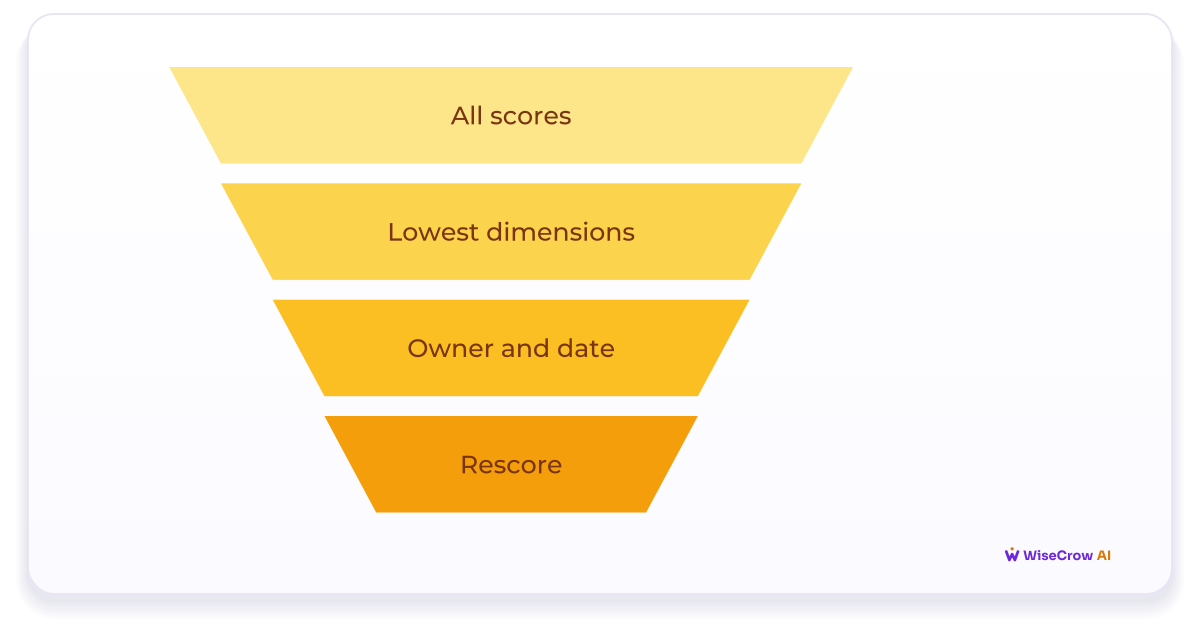
Turning Scores Into Action
A score sheet that nobody acts on is decoration. I set three decision rules before the scoring starts, so the group can’t bend them afterwards:
- Any 1 on a high-stakes system blocks launch, or pauses a live system, until it reaches at least 2 with a dated plan for 3.
- Fairness, oversight and accountability need a 3 or higher before a high-stakes system goes live.
- Every 2 gets an owner and a date, and gets reviewed at the next scheduled assessment.
The fixes themselves vary. A fairness gap might mean rebalancing training data, changing the decision threshold for one segment or adding human review for borderline scores. A transparency gap might mean a better notice and a reason code per decision. Some gaps can’t be fixed cheaply, and then the honest answer is to narrow the system’s scope or switch it off. I’ve recommended that twice. Neither client enjoyed the meeting, and both were glad later.
Rescore after any major change: a new model version, new data sources, a new user group or a new market. When leadership asks how your scores compare with wider trends, my roundup of AI ethics and public trust data gives useful context. And once a system has been live for a while, a formal AI ethics audit checks that the controls you scored still work in practice.
How to Choose the Right Depth for Your Assessment
Not every system needs the full treatment. Use the stakes to decide how deep to go:
- Internal productivity tools with no decisions about people: a light pass on privacy, transparency and safety, done in an afternoon.
- Customer-facing assistants: all seven dimensions, with extra weight on transparency, safety and the handover to a person.
- Systems that rank, approve or reject people, such as hiring, credit, insurance or care: the full assessment, a chosen fairness metric with group results and an independent reviewer.
- Systems bought from a vendor: the same dimensions, with the vendor’s evidence requested in writing. “Our model is fair” is a 2 until you see the numbers.
If you run several AI systems, start with the one that affects the most people in the most serious way. One honest assessment of your riskiest system teaches you more than light passes on ten tools.
Questions About AI Ethics Assessments
What Is an AI Ethics Assessment?
It is a structured review of one AI system against a set of ethical dimensions, such as fairness, transparency, privacy, human oversight, accountability, safety and societal impact. Each dimension gets a score backed by evidence, and the result is a short record of gaps, owners and fixes. It looks at one system in its real use, so the same model can score differently in two settings.
How Is an AI Ethics Assessment Different from an AI Ethics Audit?
An assessment is usually run by the team that owns the system, often before launch, to find and fix gaps. An audit is a more formal check, often by people outside the team, that tests if the controls work as claimed. I treat the assessment as the work and the audit as the proof.
Which Fairness Metric Should I Use?
Pick the metric that matches the harm you most want to avoid. Demographic parity fits when the goal is equal access, equal opportunity fits when wrongly rejecting a qualified person is the main harm, and calibration fits when people act on the scores directly. Write down why you chose it, and report at least one other metric next to it.
Do I Need Demographic Data to Test for Bias?
You need some way to compare groups. Some teams collect self-reported data with consent for testing only, some use a labeled test set and some estimate groups from proxies with care. Each option has privacy trade-offs, so agree on it with your privacy lead before you start, and keep testing data separate from the model’s inputs.
How Long Does an AI Ethics Assessment Take?
For a single system with good documentation, a first pass often takes two to four weeks, most of it spent gathering evidence and running bias tests. A high-stakes system with no documentation takes longer. Reassessments go much faster, because the evidence file already exists.
Who Should Run the AI Ethics Assessment?
One accountable owner, usually the product or business lead for the system, with a small group from data science, legal or compliance, privacy, security and the business team that uses the output. For high-stakes systems, add someone independent of the build team and, where possible, people who are affected by the decisions.
Does a Good Score Mean My AI System Is Legally Compliant?
No. The scoring framework helps you find and fix ethical gaps, and it lines up with frameworks such as the NIST AI RMF and ISO/IEC 42001. Legal compliance depends on the laws that apply to your system and markets, so have your legal team review the result separately.
Sources
- NIST, AI Risk Management Framework: nist.gov
- NIST SP 1270, Towards a Standard for Identifying and Managing Bias in Artificial Intelligence (March 2022): nist.gov
- OECD, AI Principles: oecd.ai
- EU AI Act, high-level summary: artificialintelligenceact.eu
- ISO/IEC 42001, Artificial intelligence management system: iso.org
- ProPublica, Machine Bias (May 2016): propublica.org
- ProPublica, Bias in Criminal Risk Scores Is Mathematically Inevitable, Researchers Say (December 2016): propublica.org
- Kleinberg, Mullainathan and Raghavan, Inherent Trade-Offs in the Fair Determination of Risk Scores (2016): arxiv.org
- Buolamwini and Gebru, Gender Shades, Proceedings of Machine Learning Research (2018): proceedings.mlr.press
- 29 CFR 1607.4, Uniform Guidelines on Employee Selection Procedures, four-fifths rule: law.cornell.edu
Disclaimer: This article is for general information only and isn’t legal advice. Regulations such as the EU AI Act and anti-discrimination rules differ by market and change over time, so check the current status with the original sources and your advisers before you act.
Did you find this helpful?
Thank you for your feedback.
Marlena leads the WiseCrow editorial team and works with our consultants to turn real client projects into practical guides on AI strategy, automation and governance. Before joining WiseCrow, she spent 12 years in B2B operations and SaaS content. She has since edited more than 400 articles on AI and automation and reviewed workflows from over 60 client projects. She is based in Austin, Texas.