Summary
- Fix the scope, criteria and report line in a written charter before you look at any evidence.
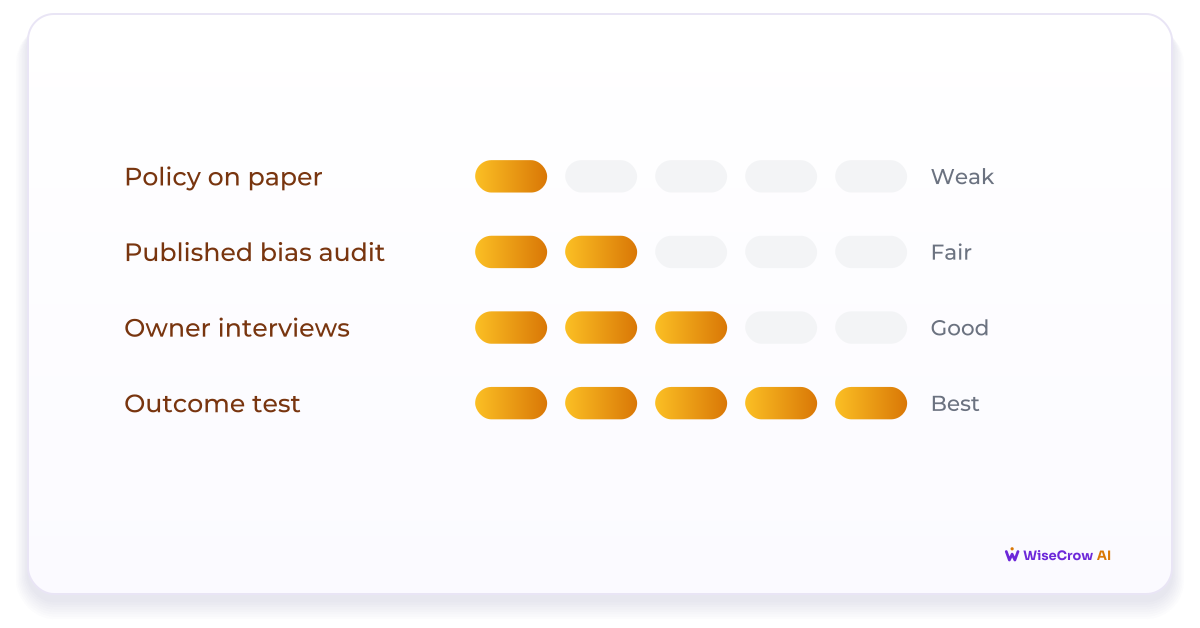
- Compare the documents with practice: interviews, retested outcomes, test appeals and traced decisions.
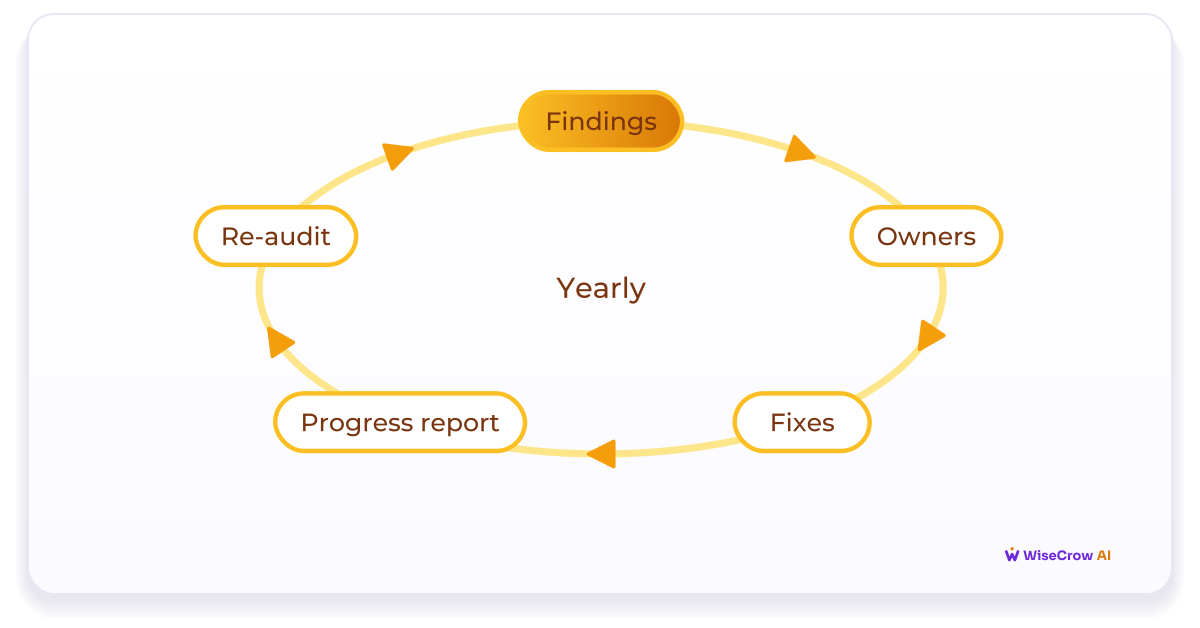
- Rate every finding by severity, give it a business owner and a date, and close it only on new evidence.
- Keep the auditor independent of the build team, and bring in outside auditors for high-stakes systems.
Most AI ethics work I see stops at good intentions. A team writes principles, runs a workshop, maybe scores a system or two. Then a customer, a regulator or a journalist asks a simple question, “who decided this, and how do you know it was fair?”, and nobody can answer with evidence. An audit is how you find that out before they ask. It’s also the part of AI ethics consulting where I ask for proof on every claim.
Below are the nine steps I use, grouped into three stages. The table gives you the whole audit on one screen. The sections after it are short on purpose, so you can use them as a working guide.
The Nine Audit Steps at a Glance
| Step | What you do | Output | Who leads |
|---|---|---|---|
| 1. Define Scope and CriteriaPlan | Set systems, questions, standard | Audit charter | Audit lead, sponsor |
| 2. Inventory the AI Systems in ScopePlan | List every model and AI feature | System register | System owners |
| 3. Gather the DocumentationPlan | Request the evidence file | Evidence file | Audit team |
| 4. Interview Owners and Affected TeamsTest | Compare paper with practice | Interview notes | Auditor |
| 5. Test Outcomes, Explanations and AppealsTest | Check results against claims | Test results | Auditor, data scientist |
| 6. Check the Accountability Chain and Decision LogsTest | Trace decisions to people | Decision trail map | Auditor |
| 7. Report Findings With SeverityReport | Rate and write up each gap | Rated findings | Audit lead |
| 8. Track RemediationReport | Assign owners and dates | Fix tracker | System owners |
| 9. Re-Audit and CloseReport | Verify fixes, set next date | Closure memo | Audit lead |
Internal or External Audit: Who Should Run It
Before step 1, decide who audits. The single most important quality is independence. An auditor who reports to the head of data science won’t write a finding that embarrasses the head of data science, however good their intentions.
| Option | Works best for | Watch for |
|---|---|---|
| Internal audit team | Regular, wide coverage | Thin AI skills |
| External auditor | High stakes, public claims | Scope set too narrow |
| Mixed team | First audit, skill gaps | Unclear sign-off |
Internal audit knows your business and can come back every year at low cost. Its weak spot is technical depth. Plenty of internal auditors can test an access control. Fewer can rerun a fairness analysis or read a model card critically. The IIA’s AI Auditing Framework exists partly to close that gap, and it builds on the IIA’s Three Lines Model, which separates the people who run a system from the people who give independent assurance over it.
External auditors bring distance and, often, deeper testing skills. Their weak spot is the scope. The client writes it, and a scope drawn around the comfortable parts of a system produces a comfortable report. If you hire outside help, have someone other than the system owner approve the scope.
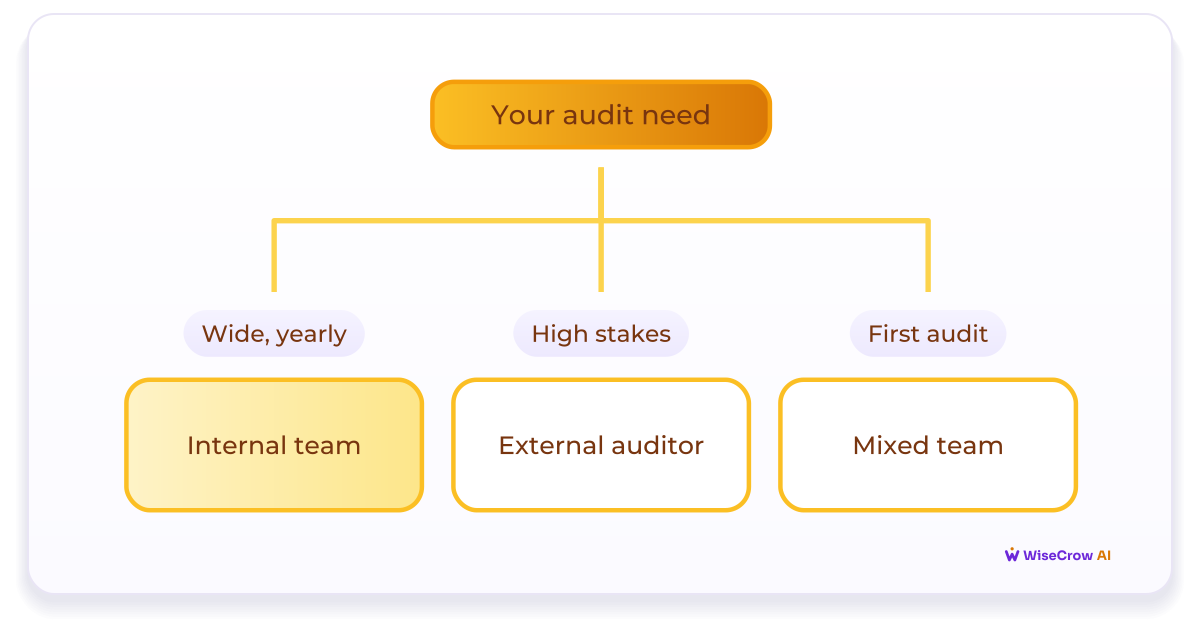
A mixed team works well for a first audit: an outside specialist runs the tests while internal audit learns the method and owns the follow-up. Just agree in writing who signs the final report.
Stage 1: Plan the Audit
Planning decides what counts as a finding. Spend the time here, because every later argument comes back to the charter.
Step 1: Define Scope and Criteria
Write down which systems you’ll audit, which questions you’ll answer and which standard you’ll measure against. The standard can be your own AI policy, a public framework or the results of an earlier AI ethics assessment. An audit without fixed criteria turns into a debate about opinions, and the team being audited will win that debate.
The charter also fixes who gets the report and who can’t edit it. I ask for one sentence that says the auditor’s findings go to the sponsor unchanged. It sounds formal. It saves a lot of awkward conversations in week four.
Step 2: Inventory the AI Systems in Scope
Build a register of every AI system the scope covers: in-house models, vendor tools, AI features switched on inside software you already use, and scripts that call a language model. For each one, note what it decides or suggests, who it affects and who owns it.
The register is almost always longer than the team expects. In my client work, the systems that cause the hardest findings are often the ones nobody listed: a scoring rule a contractor built, or an AI feature a vendor enabled in a routine update.
Step 3: Gather the Documentation
Send one written request for the evidence listed in the table below, with a deadline. Then read it before you talk to anyone. The gaps in the file tell you where to dig in interviews.
| What to request | Why it matters |
|---|---|
| Model card | States intended use and known limits |
| Datasheet for training data | Shows origin, gaps and consent |
| Impact assessment | Shows which harms were expected |
| Earlier ethics assessment | Gives claims you can verify |
| Decision logs | Show what really happened |
| Override and appeal records | Prove people can step in |
| Change log and versions | Ties decisions to a model |
| Vendor contracts and docs | Show who answers for bought AI |
| Complaints and incidents | Point to real-world harm |
Two of these deserve a word. A model card is a short document, proposed by Mitchell and colleagues, that states what a model is for, how it was evaluated and where it performs worse. A datasheet for a dataset, proposed by Gebru and colleagues, does the same for the training data. Many teams don’t have either. Missing documents count as evidence too: they tell you nobody wrote the limits down, so nobody can have checked them.
For vendor systems, ask for the vendor’s own documentation and any independent audit reports. “Proprietary” is a fair answer about model weights. It’s a weak answer about test results.
Stage 2: Test What Really Happens
The middle stage compares the paper version of each system with the running version. Most findings come from the gap between the two.
Step 4: Interview Owners and Affected Teams
Talk to the system owner, the people who built it, the people who use the output every day and, where you can, people on the receiving end of its decisions. Ask each group the same few questions: what is the system for, what does it get wrong and what happens when it does?
The answers rarely match. Owners describe the system as designed. Front-line staff describe the workarounds. On one claims project I worked on, the documented review step existed, but reviewers had learned to approve anything above a certain score because the queue was always full. Nobody had lied. The paper just described a process that no longer ran.
Step 5: Test Outcomes, Explanations and Appeals
Testing is where an audit earns its name. Rerun the fairness tests yourself on a fresh sample, or have someone independent of the build team do it. Compare outcomes and error rates across the groups your scope names. Report sample sizes next to every rate.
Then test the human side. Pick a handful of real decisions and ask for the explanation the affected person would get. Is it accurate, and could a non-expert act on it? File a test appeal, with the owner’s permission, and see where it lands, how long it takes and if anyone can reverse the original decision.
Step 6: Check the Accountability Chain and Decision Logs
Pick a few individual decisions and trace each one back: which model version made it, which data it used, who reviewed it, who could have stopped it and who signed off on the system going live. Every link should point to a log entry or a named person.
Broken chains show up fast. A log that records the score but not the model version means you can’t tell which model made a past decision. A sign-off from someone who has since left, with no successor named, means nobody owns the system today. Both are findings, even when every outcome looks fair.
Stage 3: Report and Follow Through
An audit that ends with a report has done half its job. The last three steps make sure the fixes happen and hold.
Step 7: Report Findings With Severity
Write each finding in the same shape: the criterion, what you found, the evidence, the effect on people and a severity rating. Share the draft with the system owner first and give them a short window to correct facts. They can correct facts. They can’t negotiate severity.
| Severity | What it means | Expected response |
|---|---|---|
| Critical | Ongoing harm, no control | Pause or limit now |
| High | Key control missing | Fix within weeks |
| Medium | Control weak or unproven | Fix by next cycle |
| Low | Documentation gap only | Fix when practical |
| Observation | Improvement idea | Owner decides |
Severity depends on the people affected, more than on how embarrassing the gap is. A missing model card on a meeting summarizer is Low. The same gap on a model that ranks loan applicants, combined with no group testing, is High at least. If people are being harmed right now and no control catches it, the finding is Critical, and the sponsor should hear about it the same day, before the report is written.
Agree the severity definitions in the charter, before any finding exists. Teams argue much harder over a rating once it carries their system’s name.
Keep the report short. A one-page summary for leadership, sorted by severity, then one page per finding. When a board member asks how your results compare with what other companies face, a roundup of AI ethics and public trust statistics gives useful outside context.
Step 8: Track Remediation
Each finding gets one owner, one agreed fix and one date. The owner sits in the business, never in the audit team. Auditors who fix their own findings end up auditing their own work next time.
Report progress to the sponsor on a fixed rhythm, monthly works for most teams. Accept a fix as done only when the evidence arrives: a new test result, an updated log, a revised notice. An email saying “resolved” closes nothing.
Step 9: Re-Audit and Close
Go back and test the fixed controls the same way you tested them the first time. Close the findings that pass, keep the ones that don’t open, and write a short closure memo for the sponsor.
Set the next audit date before you leave. A yearly cycle suits most high-stakes systems, plus a trigger-based audit after a new model version, a new data source or a new group of affected people. Between audits, a pre-release responsible AI checklist keeps product teams honest on the smaller changes.
Frameworks and Rules You Can Audit Against
You don’t need to write your criteria from scratch. Most of the audits I run map to one or two public frameworks, which makes the report easier to defend and easier to compare year to year. Here they are in general terms. None of them replaces advice on the laws that apply to you.
NIST AI Risk Management Framework
The NIST AI RMF is a voluntary US framework built around four functions: govern, map, measure and manage. For an audit, the govern function is the useful one. It covers roles, accountability and policies, which gives you ready criteria for step 6.
ISO/IEC 42001
ISO/IEC 42001 sets requirements for an AI management system. Like other ISO management system standards, it expects internal audits and management review, and organizations can seek certification against it. If you plan to certify, run your ethics audit in a way that its evidence can feed the certification audit later.
Internal Audit Methods
Besides the IIA framework mentioned above, the research paper by Raji and colleagues on closing the AI accountability gap lays out an end-to-end internal audit process, from scoping and mapping to artifact collection, testing and reflection. My nine steps borrow from it, adapted for companies without a research team.
NYC Local Law 144 as a Worked Example
New York City’s rules on automated employment decision tools show what a legally required bias audit can look like. Employers and employment agencies in the city may only use such a tool if it has had a bias audit within one year of use, the audit information is public and candidates get notice. The law asks for an independent auditor.
The law also shows how weak checks can be. A New York State Comptroller audit of the city’s enforcement found that the city agency reviewed 32 companies’ posted bias audits and flagged one issue, while the Comptroller’s team found at least 17 potential issues in the same set, as DLA Piper summarized the findings. Treat any audit, including your own, as something that can be audited. Laws like this one change, so check the current rules at the source.
How to Choose Which AI System to Audit First
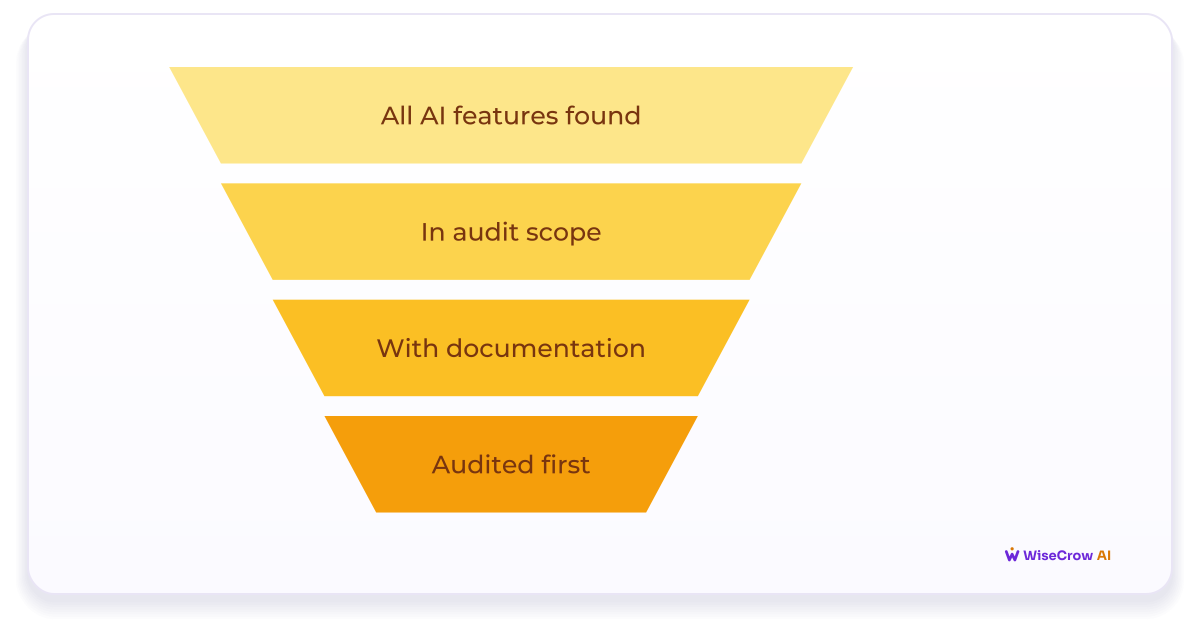
If you run more than a couple of AI systems, you can’t audit them all at once, and you shouldn’t try. Rank the register from step 2 with three questions:
- Stakes: does the system rank, approve, reject or price people, such as job candidates, borrowers, patients or tenants?
- Scale: how many people does it touch each month, and can they see or challenge the result?
- Evidence: has anyone tested it since launch, or is the last proof a vendor slide from the sales process?
Start with the system that scores worst on all three. Then pick the audit model to match. A high-stakes hiring or lending model usually calls for an external or mixed team. A customer service assistant can go to internal audit with outside help on testing. Internal tools that make no decisions about people can wait for a lighter review.
One more point on timing. Don’t audit a system in its first weeks after launch. The logs are too thin to test, and every gap gets blamed on teething problems. A few months of real use gives you a decision trail worth tracing. For your very first audit, pick a system you suspect is in decent shape. You’ll learn the method on friendly ground, and the findings on harder systems later will carry more weight.
Questions About AI Ethics Audits
What Is an AI Ethics Audit?
An AI ethics audit is a structured, evidence-based review that checks if an AI system works the way its owners claim, against agreed criteria such as fairness, transparency, human oversight and accountability. It covers documentation, interviews, outcome testing and the chain of people responsible for decisions. The result is a report of rated findings, each with an owner and a fix date.
How Is an AI Ethics Audit Different from an AI Ethics Assessment?
An assessment is usually run by the team that owns the system to find and score gaps, often before launch. An audit is a more formal check, ideally by someone independent of the build team, that tests if the controls described in the assessment really work. The assessment produces claims, and the audit verifies them.
Who Should Conduct an AI Ethics Audit?
Someone who doesn’t report to the team that built or runs the system. For routine coverage, that’s often internal audit or a second-line risk team. For high-stakes systems, public claims or rules that ask for an independent auditor, bring in an outside firm. Whoever runs it needs both audit discipline and enough technical skill to rerun tests.
How Long Does an AI Ethics Audit Take?
For one system with decent documentation, plan on a few weeks from charter to draft report, with most of the time spent waiting for evidence and running tests. Larger scopes or systems with no documentation take longer. Remediation and the re-audit add more time on top, depending on the fixes.
How Often Should We Audit Our AI Systems?
For systems that make or shape decisions about people, once a year is a sensible baseline, plus an audit after major changes such as a new model version, new data sources or a new group of affected people. Low-stakes internal tools can be covered by lighter checks in between.
Can We Audit an AI Tool We Bought from a Vendor?
Yes, and you should, because you still answer for the decisions it supports. Ask the vendor in writing for model documentation, test results and any independent audit reports. Then test the outcomes in your own setting with your own data, since a vendor’s results reflect its test data and may not match your users.
Does a Clean AI Ethics Audit Mean Our AI Is Legally Compliant?
No. An ethics audit tells you how well your controls meet the criteria you chose. Legal compliance depends on the laws that apply to your system, sector and markets, and some laws set their own audit rules. Have your legal team review those requirements separately and check the current status of any regulation you rely on.
Sources
- NIST, AI Risk Management Framework: nist.gov
- ISO/IEC 42001, Artificial intelligence management system: iso.org
- The Institute of Internal Auditors, The IIA’s Artificial Intelligence Auditing Framework (updated 2024): theiia.org
- Raji et al., Closing the AI Accountability Gap: Defining an End-to-End Framework for Internal Algorithmic Auditing (2020): arxiv.org
- Mitchell et al., Model Cards for Model Reporting (2018): arxiv.org
- Gebru et al., Datasheets for Datasets (2018): arxiv.org
- NYC Department of Consumer and Worker Protection, Automated Employment Decision Tools: nyc.gov
- DLA Piper, Critical Audit of NYC AI Hiring Law Signals Increased Risk for Employers (January 2026): dlapiper.com
Disclaimer: This article is for general information only and isn’t legal advice. Laws and standards on AI audits differ by market and change over time, so check the current status with the original sources and your advisers before you act.
Did you find this helpful?
Thank you for your feedback.
Marlena leads the WiseCrow editorial team and works with our consultants to turn real client projects into practical guides on AI strategy, automation and governance. Before joining WiseCrow, she spent 12 years in B2B operations and SaaS content. She has since edited more than 400 articles on AI and automation and reviewed workflows from over 60 client projects. She is based in Austin, Texas.