Summary
- Most healthcare AI projects stall on fragmented data and weak labels before the model is the problem.
- Any vendor that handles PHI for you generally needs a business associate agreement before real data moves.
- Validate clinical tools on your own patients and set alert thresholds with the clinicians who receive them.
- Measure a baseline before go-live, because few AI tools bring their own reimbursement.
In the healthcare AI consulting projects I review, the model is seldom what holds things back. Physicians have moved fast on their own. The AMA found that 66% of physicians used health AI in 2024, up from 38% the year before. Hospitals and practices move slower, and for decent reasons: patient data is scattered, the rules are strict and a tool that annoys clinicians gets ignored within a week.
I’ve grouped the eight AI in healthcare challenges I see most into three themes: data, regulation and clinical workflow. Each one comes with who feels it, why it happens, the steps that fix it and the resources worth your time.
Who Feels Each Challenge First
Challenges in healthcare AI land on different desks. The data team feels interoperability, the privacy officer feels PHI risk and the night nurse feels a noisy alert. Use the table to find your own row, then jump to it.
| Challenge | Who feels it | First fix |
|---|---|---|
| 1. Fragmented EHR Data and Interoperability | IT and data teams | Map data per use case |
| 2. Data Quality and Labeling | Data scientists and clinicians | Agree a labeling guide |
| 3. PHI, HIPAA and Business Associate Agreements | Privacy and compliance officers | BAA before PHI flows |
| 4. FDA Status of Clinical Software | Product and regulatory leads | Define intended use early |
| 5. Bias and Representativeness | Patients and equity leads | Test results by patient group |
| 6. Clinician Trust and Alert Fatigue | Nurses and physicians | Validate locally, tune alerts |
| 7. Workflow Integration | Clinicians and front desk | Put output in the EHR |
| 8. Proving Value and Reimbursement | CFOs and service line leads | Baseline before go-live |
The challenges also stack. Poor data makes bias harder to see, bias raises compliance questions and a tool that clinicians don’t trust never generates the results finance wants. Fixing one in isolation helps less than you’d hope.
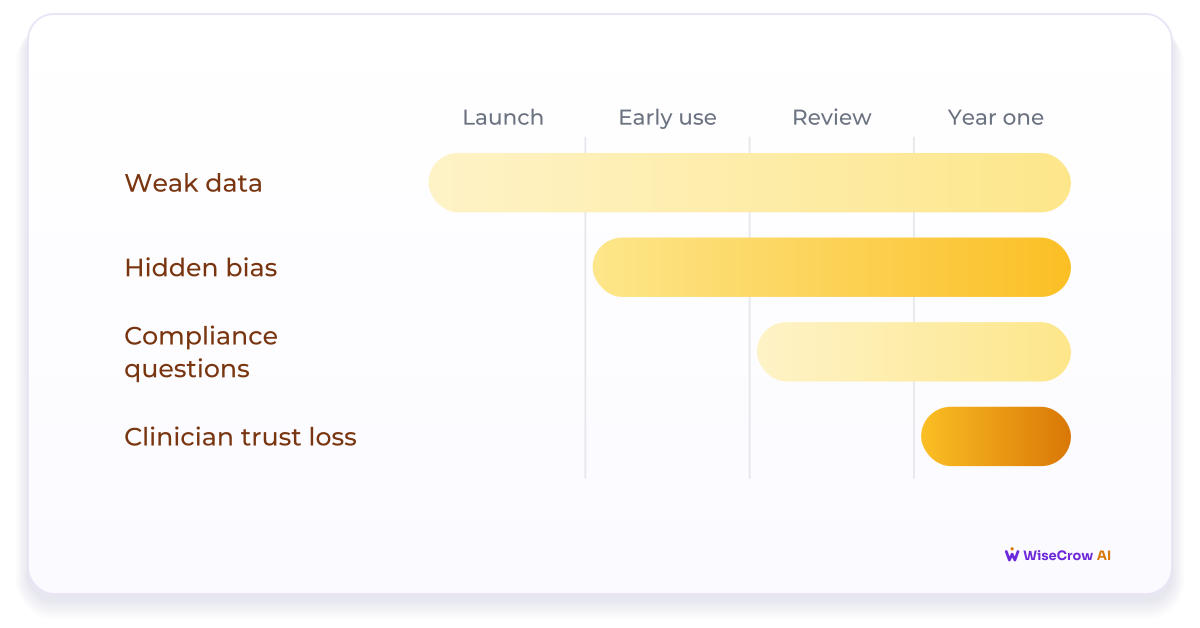
Data Challenges: Scattered Records and Unreliable Labels
Health data is rich and badly organized at the same time. Two problems show up in nearly every project I review, and both start long before anyone trains or buys a model.
Fragmented EHR Data and Interoperability
A patient’s story sits in five places. The EHR holds the visit notes, a separate lab system holds results, imaging lives in PACS, the outside cardiologist sent a faxed PDF and the payer has the claims history. Your AI tool sees whatever it can reach, which is often a slice of the picture, and its output looks confident anyway.
Exchange has improved, but slowly. ONC reports that the share of non-federal acute care hospitals that at least sometimes engaged in all four interoperability domains (find, send, receive and integrate) rose from 46% in 2018 to 70% in 2023. “Sometimes” is the important word. In my client work, the gap shows up when outside records arrive as scanned documents that no model can read reliably, and nobody finds out until the pilot is already running.
How to Pull the Record Together
- List the exact data fields your first use case needs and where each one lives today.
- Mark which sources come in as structured data and which arrive as scans, faxes or free text.
- Use your EHR’s standard interfaces, such as FHIR APIs, before you build custom extracts.
- Match patients across systems with one agreed identity rule and log every mismatch.
- Start with use cases that only need data your EHR already holds.
Standards and Tools Worth Using with Exchange
HL7 FHIR and your EHR vendor’s API program are the first places to look, since most modern EHRs expose core records through them. An integration engine such as Rhapsody or InterSystems HealthShare helps when you have several older systems that still speak HL7 v2.
Data Quality and Labeling
Problem lists go stale, diagnosis codes reflect billing more than biology and the same symptom gets written six ways. When you build or test a model, someone has to decide what counts as the right answer. In healthcare, that someone is usually a clinician with no spare hours.
Labels are where quiet errors creep in. A billing code says a patient had a condition, but the chart says it was ruled out. Two physicians read the same note and disagree. I’ve seen a promising project lose a quarter because its training labels came from claims data, and the clinical team didn’t accept them once they compared a sample to the charts. Agree how you label before you label at scale.
Getting Labels Clinicians Will Stand Behind
- Write a short labeling guide with clear definitions and worked edge cases.
- Have two clinicians label the same sample and measure how often they agree.
- Settle disagreements in a short review meeting and update the guide each time.
- Check a random sample of codes against the full chart before you trust them as labels.
- Record where every label came from, so you can trace errors later.
- Budget paid clinician hours for labeling and protect them on the schedule.
Where Labeling Work Gets Done
Annotation platforms such as Label Studio or Labelbox handle text and image labeling with audit trails and reviewer roles. Make sure any platform that touches identifiable patient data sits under a business associate agreement, or use properly de-identified data.
Regulation and Compliance: HIPAA, FDA and Fairness Rules
Here the rules are real, they overlap and they change. I’m not a lawyer, and nothing below replaces your privacy officer, regulatory lead or counsel. What I can share is where projects tend to trip, and which official pages your team should read first.
PHI, HIPAA and Business Associate Agreements
A clinician pastes a discharge summary into a free chatbot to tidy it up. A vendor demo runs on real patient records. A pilot starts while the contract sits in legal. Each of these puts protected health information somewhere your privacy team never approved.
Under HIPAA, a vendor that creates, receives, maintains or transmits PHI for a covered entity is generally a business associate. HHS explains that the covered entity needs written satisfactory assurances from the business associate, usually a business associate agreement. HHS’s cloud computing guidance adds that a cloud provider storing ePHI counts as a business associate even if the data is encrypted and it has no key. If you want to work outside those rules, the HHS de-identification guidance describes two methods: Safe Harbor and Expert Determination.
Keeping PHI Where It Belongs
- Draw a data flow for each AI use case that shows every system PHI touches.
- Get a signed BAA from every vendor in that flow before real data moves.
- Read the vendor’s terms on model training, retention and staff access to your data.
- Use de-identified or synthetic data for demos, testing and early pilots.
- Publish an approved AI tool list and block consumer chatbots for clinical text.
Official Resources for Privacy Teams
The HHS pages on business associates, cloud computing and de-identification are short, plain and worth reading in full. Enterprise versions of the big cloud and AI platforms offer BAAs for specific services, so check which services the agreement actually covers.
FDA Status of Clinical Software
A team builds a tool that summarizes a chart. Then someone adds a feature that flags likely sepsis or ranks patients for follow-up, and nobody stops to ask whether the product just became a medical device. The question usually surfaces late, when a buyer’s legal team asks for the regulatory status.
Some software functions are medical devices, and some clinical decision support falls outside the device definition. FDA’s clinical decision support software guidance, updated in January 2026, explains how it reads that line. FDA also keeps a list of AI-enabled medical devices authorized for marketing in the U.S., and says itself that the list isn’t comprehensive. What a tool is intended to do, and how it’s labeled and sold, matters a great deal. I’d always get a regulatory opinion on the exact feature in question.
Settling the Regulatory Question Early
- Write one sentence that states the intended use and the intended user of each feature.
- Note whether a clinician can independently review the basis for each recommendation.
- Check the FDA guidance and device list for comparable functions.
- Ask your regulatory adviser for a written view before features reach patients.
- Re-check the status whenever you add a feature that changes the intended use.
- For bought tools, ask the vendor for its regulatory status in writing, feature by feature.
Where to Read Up
FDA’s Digital Health Center of Excellence pages collect the current guidance on software, AI and clinical decision support in one place. For anything close to the line, FDA’s Q-Submission program lets a sponsor ask the agency for feedback before it files.
Bias and Representativeness
A model learns from the patients in its training data. If some groups are underrepresented, or if the target it predicts carries old inequities, the model will repeat them at scale. Nobody notices in the overall accuracy figure, because the average looks fine.
The best-known example is a cost-based risk algorithm studied in Science in 2019. Because it predicted health costs as a proxy for need, Black patients were sicker than White patients at the same score, and the authors estimated that fixing the gap would raise the share of Black patients flagged for extra help from 17.7% to 46.5%. Fairness is also a legal topic now: HHS’s Section 1557 rule covers discrimination through patient care decision support tools. I go deeper on the safety side in my post on AI in healthcare risks.
Checking a Model for Fairness
- Ask what the model predicts and whether that target is a fair proxy for real need.
- Compare the training population with the patients you actually serve.
- Report accuracy and error rates separately by age, sex, race, ethnicity and payer type.
- List which tools use inputs tied to protected characteristics and review each one.
- Repeat the checks after go-live, because patient mix and practice patterns drift.
Frameworks for a Fairness Review
The NIST AI Risk Management Framework gives you a free structure for documenting bias tests and decisions. Open-source libraries such as Fairlearn make the subgroup comparisons quicker, though a clinician still has to judge which gaps matter.
Clinical Workflow and Adoption: Trust, Fit and Payback
The last group decides whether a working, compliant tool gets used. Clinicians are busy, skeptical for good reasons and quick to route around anything that slows them down.
Clinician Trust and Alert Fatigue
The alert fires again. The nurse checks, the patient is fine, and the third false alarm of the shift gets dismissed with one click. A week later, a real one gets dismissed the same way. Clinicians already work through a flood of pop-ups, and an AI alert that cries wolf joins the pile fast.
Trust breaks when a tool performs worse in your hospital than in the vendor’s slides. An external validation in JAMA Internal Medicine found that a widely used proprietary sepsis model reached an AUC of 0.63, missed 67% of sepsis cases and alerted on 18% of all hospitalizations at the threshold tested. My rule from client work: test any predictive tool on your own historical patients before it touches a live workflow, and decide the alert threshold with the nurses who will receive it.
Earning Clinician Trust, One Alert at a Time
- Run the model silently on your own data for several weeks and compare it with real outcomes.
- Agree the alert threshold with frontline clinicians, using the false alarm count they can live with.
- Show the reason behind each alert in plain language next to the score.
- Give clinicians a one-click way to flag a wrong alert and review those flags weekly.
- Retire or retune any alert that most users dismiss without acting.
What Supports Local Validation
Your EHR’s reporting tools and a data warehouse are usually enough to run a silent trial and measure sensitivity, false alarms and timing. Some EHR vendors also offer model monitoring dashboards, so ask yours before you buy a separate product.
Workflow Integration
The AI tool lives in a separate browser tab with its own login. Clinicians have to copy a patient ID across, wait, then paste the result back into the chart. Usage peaks in the first week, then fades, and the project gets labeled a failure even though the model worked.
Every extra click is a vote against the tool. The projects I’ve seen stick show the AI output inside the screen people already use, at the moment they need it, and they cut a task out of the day without adding one. When you compare vendors, weigh EHR integration as heavily as accuracy. My ranking of AI tools for healthcare notes which EHRs each product says it supports.
Fitting AI into the Clinical Day
- Shadow the clinicians or front-desk staff for half a day before you design anything.
- Mark the exact moment in the workflow where the AI output is needed.
- Deliver that output inside the EHR or the system staff already have open.
- Remove at least one manual step for every new step the tool adds.
- Train at the elbow in the first week of go-live, with a named go-to person per unit.
- Check usage per user after a month and talk to the people who stopped.
Options for Tighter Integration
SMART on FHIR apps and CDS Hooks let outside tools appear inside many EHRs at the right step in the workflow. Where neither is available, your EHR vendor’s app marketplace or an integration engine is the next place to look.
Proving Value and Reimbursement
The pilot ends, clinicians like it and the renewal invoice arrives. Then finance asks what it saved, and the honest answer is a set of satisfaction quotes. Unless a tool brings in revenue or clearly cuts cost, it competes with every other line in a tight budget.
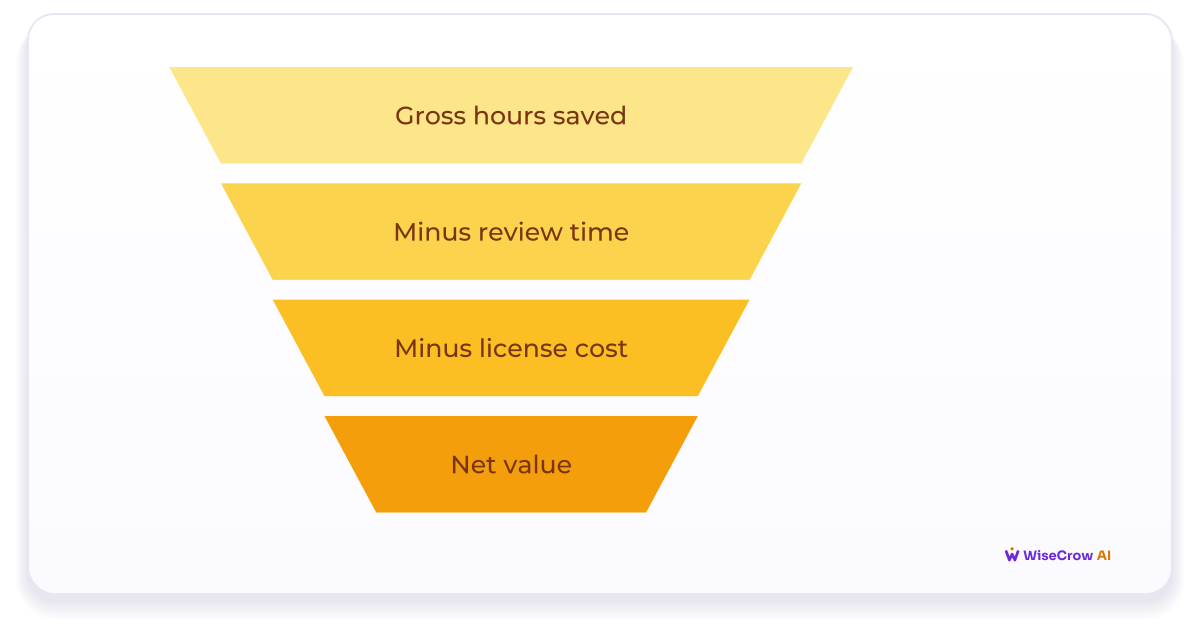
Most AI tools in healthcare don’t come with their own payment. Their value has to show up in staff time, throughput, fewer denials or avoided overtime, and that only works if you measured those things before launch. Physicians see the same priority. In the AMA’s survey, 57% of physicians named reducing administrative burden as the biggest opportunity for AI. Admin work is also where I find value easiest to prove, because the before and after are visible in the logs.
Building a Value Case Finance Will Accept
- Pick two or three measures per use case, such as minutes per note or days to authorization.
- Record a baseline for at least a few weeks before go-live.
- Count all costs: licenses, integration, clinician review time and support.
- Agree with finance upfront how saved time will be counted and used.
- Report results every quarter, including the use cases that missed.
Ways to Track the Numbers
EHR audit logs and revenue cycle reports already hold most of the timing and denial data you need. A simple dashboard in Power BI or Tableau on top of them is enough for a quarterly review.
Put a Number on the Admin Work First
Value is easiest to prove where the work is repetitive and logged. Pick one admin task, such as drafting prior authorization requests, checking claim status or preparing referral packets. Enter how long it takes and how often it happens, and the calculator gives you a rough yearly figure to set against license and integration costs.
How Much Time Could You Save?
Move the sliders to match one repetitive task in your business.
Treat the result as an upper bound. Clinicians and staff still review AI output, and that review time belongs on the cost side of your case. In my client work, the projects that kept their funding were the ones that reported the review time honestly from the start.
How to Choose Which Healthcare AI Challenge to Fix First
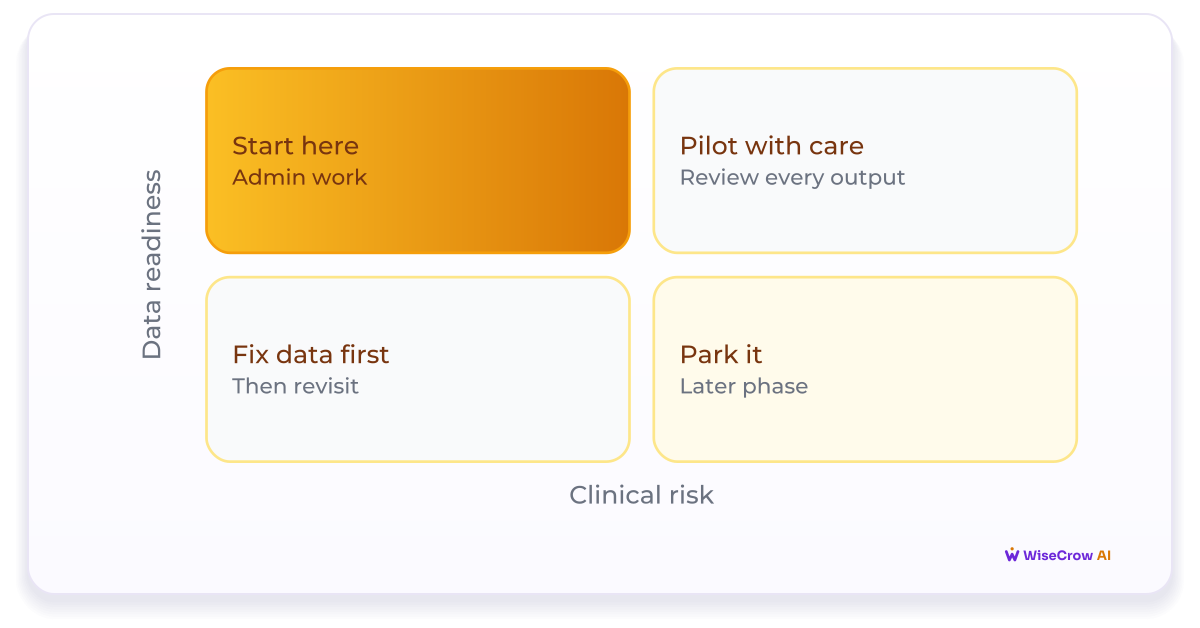
You won’t fix all eight at once, and you don’t need to. I start with one use case and work out which challenges block it. A good first use case passes most of the checks below:
- The data it needs already sits in your EHR or one other system.
- Every vendor in the data flow can sign a BAA, or the work runs on de-identified data.
- The output supports staff and a person reviews it before anything reaches a patient.
- It removes a step from someone’s day without adding a new screen.
- You can measure a clear before and after within one quarter.
If a use case fails two or more checks, park it and pick another. Admin work tends to pass first, which is why so many health systems start there. Clinical prediction usually fails the FDA and validation checks early on, and that’s fine. It belongs in a later phase, once your data, governance and review habits have been tested on lower-risk work.
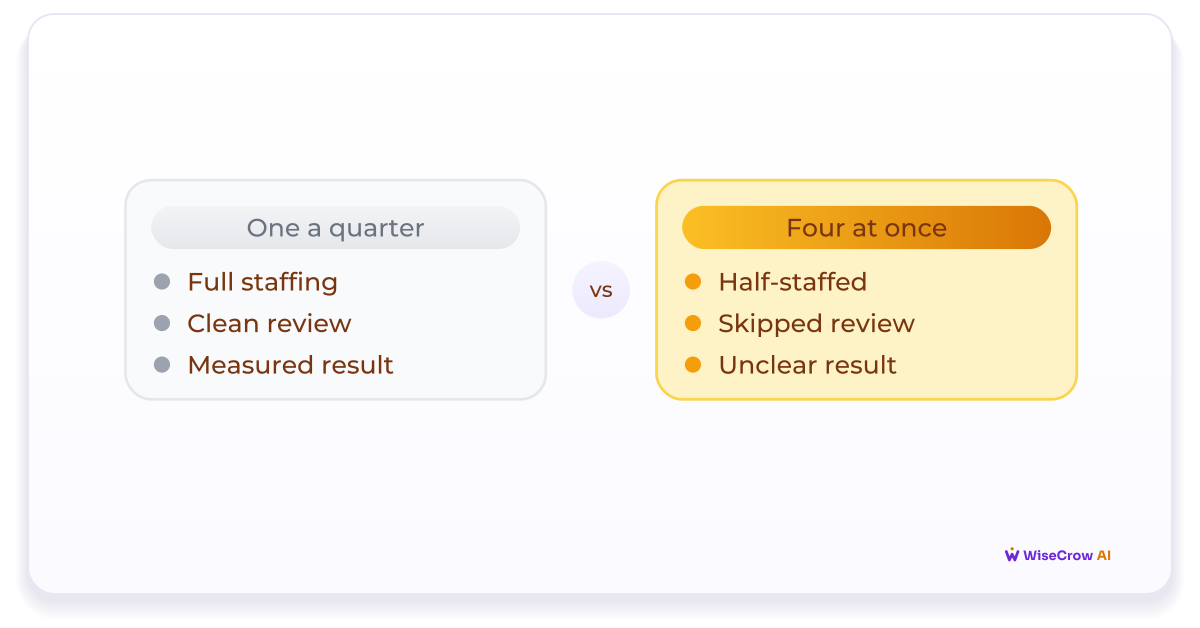
Last, be honest about capacity. Clinical informatics teams are small, and every AI project competes with EHR upgrades and regulatory reporting for the same people. One well-run project a quarter beats four half-staffed ones.
Questions About AI in Healthcare Challenges
What Is the Biggest Challenge of AI in Healthcare?
In my client work, data comes first. Fragmented records and unreliable labels sink more projects than any model choice, and they also make bias harder to spot. Close behind is workflow fit: a tool that works on paper but sits outside the EHR rarely survives its first quarter.
Do AI Vendors Need to Sign a Business Associate Agreement?
If a vendor creates, receives, maintains or transmits PHI on your behalf, HIPAA generally treats it as a business associate, and you need written assurances, usually a BAA. Check which of the vendor’s services the BAA covers. Your privacy officer and counsel should confirm the details for your situation.
Is Every Clinical AI Tool Regulated by the FDA?
No. Some software functions are medical devices and some clinical decision support falls outside the device definition. FDA’s clinical decision support guidance explains how it draws that line. The answer depends on the intended use of each feature, so get a regulatory opinion and ask vendors for their status in writing.
Can We Use De-Identified Data to Train or Test Healthcare AI?
Yes, and it’s often the easiest way to start. HHS describes two methods for de-identifying data under HIPAA: Safe Harbor, which removes a defined list of identifiers, and Expert Determination. Data that’s only partly stripped of identifiers is still PHI, so check which method your team uses.
How Do You Reduce Alert Fatigue from AI Tools?
Validate the model on your own patients before go-live, set the threshold with the clinicians who receive the alerts and show the reason behind each one. Then track how often alerts get dismissed. Any alert that most people ignore needs retuning or removal.
How Do You Check a Healthcare AI Model for Bias?
Start with what the model predicts, since a biased target produces biased results even with balanced data. Then compare accuracy and error rates across patient groups and check that your own population looks like the training data. Repeat the checks after launch, because patient mix changes.
Where Should a Hospital Start with AI Despite These Challenges?
Administrative work is usually the safest first step: documentation, prior authorization, scheduling and denials. It’s high volume, easy to measure and further from clinical decisions, so the regulatory and safety questions are simpler. Prove value there, then move toward clinical use with stronger validation.
Sources
- American Medical Association: 2 in 3 Physicians Are Using Health AI, Up 78% From 2023 (2025)
- ONC (HealthIT.gov): 70% of Hospitals Participate in Healthcare Interoperability (2024)
- HHS: Business Associates, HIPAA Privacy Rule Guidance
- HHS: Guidance on HIPAA and Cloud Computing
- HHS: Methods for De-identification of Protected Health Information
- FDA: Clinical Decision Support Software Guidance (January 2026)
- FDA: List of Artificial Intelligence-Enabled Medical Devices
- ONC: HTI-1 Final Rule, Health Data, Technology and Interoperability
- Federal Register: Nondiscrimination in Health Programs and Activities, Section 1557 Final Rule (2024)
- Obermeyer et al., Science: Dissecting Racial Bias in an Algorithm Used to Manage the Health of Populations (2019)
- Wong et al., JAMA Internal Medicine: External Validation of a Widely Implemented Proprietary Sepsis Prediction Model (2021)
Disclaimer: The information in this article is general and isn’t medical, legal or compliance advice. HIPAA, FDA, ONC and other rules and guidance change, so confirm the current requirements on official HHS, FDA and ONC pages and with qualified counsel before you act. AI output used in patient care must be reviewed by a qualified clinician.
Did you find this helpful?
Thank you for your feedback.
Marlena leads the WiseCrow editorial team and works with our consultants to turn real client projects into practical guides on AI strategy, automation and governance. Before joining WiseCrow, she spent 12 years in B2B operations and SaaS content. She has since edited more than 400 articles on AI and automation and reviewed workflows from over 60 client projects. She is based in Austin, Texas.