Summary
- The risks that reach patients first are wrong or invented output, staff trusting AI too much and models that work worse for some groups.
- Published studies show real gaps, such as a widely used sepsis model that missed two-thirds of sepsis cases at one academic hospital.
- Privacy, security and drift risks grow after go-live, so monitoring needs a budget line and a named owner.
- Write down who signs, who monitors and who can switch a tool off before any AI touches patient care.
Every AI tool that touches patient care has a way to fail, and some failures reach a patient before anyone spots them. In my healthcare AI consulting work, the risk talk usually starts too late. The contract is signed, the pilot date is set and nobody wants to slow things down by asking what happens when the tool is wrong.
Below are the seven AI in healthcare risks I check on every project. You’ll get a risk register first, then a short section per risk with a scenario and the safeguard that does the most work. Where a point rests on a study, I link it. I’m not a clinician or a lawyer, so use this as a map for the talk with your clinical, privacy and legal leads.
AI in Healthcare Risk Register
I keep a version of this table in every healthcare project folder. It fits on one slide for a governance committee. When you copy it, add a column with a named owner for each row, since a risk nobody owns tends to stay on the slide.
| Risk | What can go wrong | Main safeguard |
|---|---|---|
| 1. Wrong clinical output | False facts, missed findings | Clinician review before use |
| 2. Automation bias | Staff accept wrong suggestions | Training, override tracking |
| 3. Algorithmic bias | Worse care for some groups | Subgroup tests on local data |
| 4. PHI leakage | Patient data in unapproved tools | Approved tools with BAAs |
| 5. Injection and poisoning | Hidden inputs steer output | Input limits, red teaming |
| 6. Model drift | Accuracy slips after go-live | Monthly monitoring, thresholds |
| 7. Accountability gaps | No owner when harm occurs | Named owners, audit trails |
The safeguard column shows the main control, and one control is seldom enough. Most of these risks need two or three layers. A clinician reviewing AI notes catches invented facts, but only when the review isn’t rushed and someone tracks how often notes get corrected.
Risks That Reach the Patient First
The first three risks sit closest to the bedside. They show up in notes, alerts and suggestions a clinician sees during a visit or a shift, and when they go wrong, a patient feels it.
Wrong or Invented Output in Clinical Work
Generative AI writes fluent text, and fluent text reads as true. In the “Careless Whisper” study presented at FAccT 2024, about 1% of transcriptions from OpenAI’s Whisper speech model held whole phrases or sentences that weren’t in the audio, and 38% of those inventions included explicit harms. Speakers with aphasia, who pause more, were hit harder. The authors note the model has improved since, but the lesson holds for any speech or note tool. ECRI ranked misuse of AI chatbots as the top health technology hazard for 2026. In one of its tests, a chatbot said an electrosurgical return electrode could go on the shoulder blade, a placement ECRI says could cause burns. Prediction models fail too. An external validation in JAMA Internal Medicine found the Epic Sepsis Model missed 67% of sepsis cases at Michigan Medicine while alerting on 18% of hospitalizations, well below the performance its developer reported.
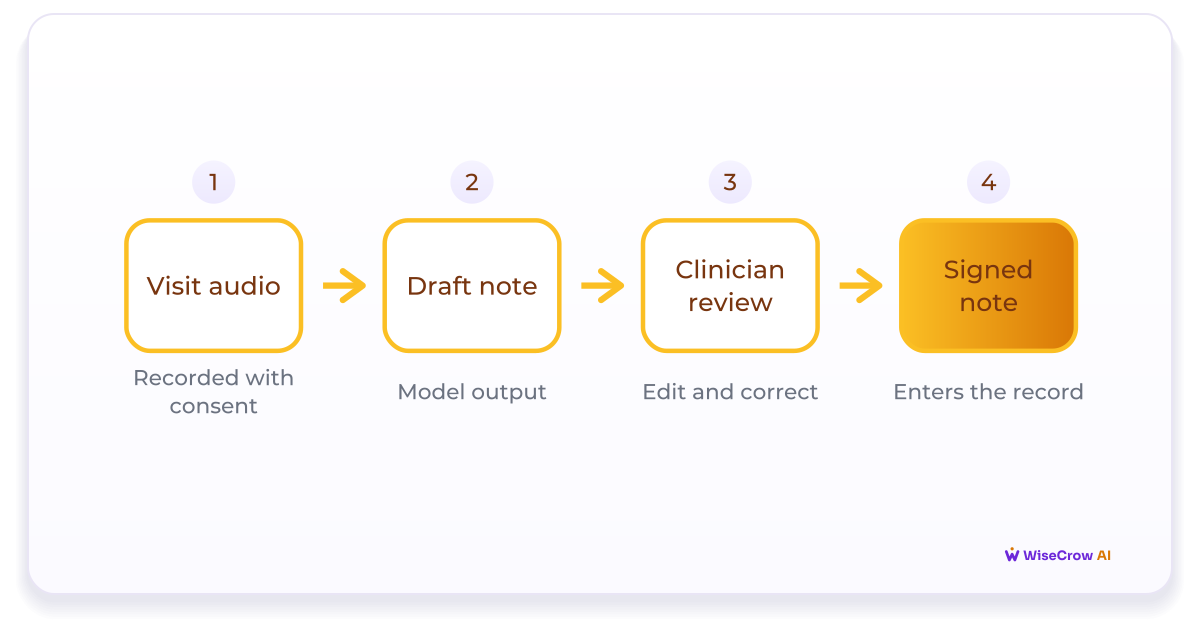
Picture an ambient scribe that writes “denies chest pain” when the patient described exactly that pain. The clinic is running late, the draft looks clean and the note gets signed. The safeguard is a clinician who reviews and signs every AI draft, with the parts that carry the most risk, like medications, allergies and pertinent negatives, easy to check. Track edit rates per clinician and per note type. For prediction models, test on your own patients before go-live, whatever the vendor’s brochure says. If you’re still comparing scribe and imaging vendors, my review of AI tools for healthcare covers the main options.
Automation Bias at the Point of Care
Human review only protects patients if the human still thinks for themselves. In a 2023 Radiology study, 27 radiologists read mammograms with AI-suggested BI-RADS categories, and some suggestions were wrong on purpose. According to RSNA’s summary, inexperienced readers chose the right category 79.7% of the time when the AI was right and 19.8% when it was wrong. Very experienced readers dropped from 82.3% to 45.5%. Experience helped, and it still didn’t make anyone immune.
Here’s how it plays out on a ward. A deterioration score shows low risk, a newer nurse feels uneasy about the patient and decides the score knows better. Training is the first fix, and it should show real failure cases, so staff have seen the tool be wrong before it happens on shift. Keep people accountable for their own call, and where the workflow allows, I prefer having clinicians form a first view before the AI suggestion appears. Then track override rates by unit and role.
Algorithmic Bias and Unequal Performance
The best-known case is still the 2019 Science study by Obermeyer and colleagues. A widely used algorithm picked patients for extra care programs based on predicted cost. Less money had been spent on Black patients with the same needs, so the algorithm rated them as healthier than equally sick White patients. The authors found that fixing the gap would raise the share of Black patients getting extra help from 17.7% to 46.5%. The flaw was in the label, the thing the model was told to predict. WHO’s guidance on large multi-modal models makes a related point: it calls for audits after release with results broken down by groups such as age, race or disability.
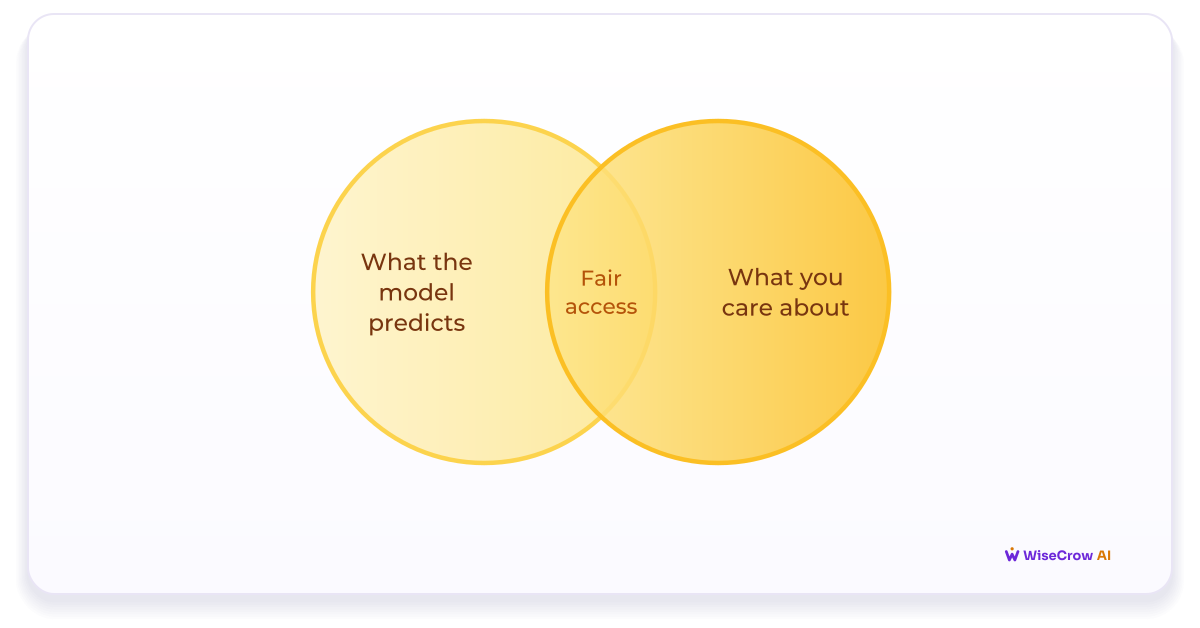
A smaller version shows up in clinics all the time. A no-show model drives double-booking, and patients from areas with poor transit get flagged most. They end up in crowded slots with longer waits, which makes the next no-show more likely. The safeguard starts with one question: what exactly is this model predicting, and is that the thing you care about? Then test performance by subgroup on your own data, before go-live and on a schedule after. Ask every vendor for subgroup results, and treat “we don’t break it down” as an answer.
Risks Hidden in Data, Systems and Time
The next three risks rarely show up in a demo. They build in the background, in data flows, inputs and patient mix, and they surface weeks or months after launch.
Privacy Breaches and PHI Leakage
The PHI leak I see most often is low-tech. Someone pastes a patient’s history into a public chatbot to draft a referral letter or summarize a long chart. Under HIPAA, vendors that create, receive, maintain or transmit protected health information for you generally need a business associate agreement, and consumer chatbot accounts usually don’t come with one. Ambient tools add their own questions: where the audio is stored, how long it’s kept and if your data trains the vendor’s models.
At one physician group I worked with, a quick survey showed staff were already using two unapproved AI tools for patient letters. A ban alone would have pushed the habit out of sight. The group picked one approved tool with a BAA, turned off training on customer data, set retention limits and wrote a one-page rule on what never goes in. Every workflow got a data map showing which PHI it touches. Messy, scattered data is a separate headache, and I cover it in my post on AI in healthcare challenges. Your privacy officer makes the final call on any tool.
Prompt Injection and Data Poisoning
AI brings attacks that ordinary security reviews miss. Prompt injection hides instructions inside content the model reads. In a 2025 Nature Communications study, researchers hid barely visible prompts inside medical images and ran 594 attacks on four vision-language models, including GPT-4o and two Claude models. All four were open to the attack. Data poisoning goes after the training data. A 2025 Nature Medicine study found that replacing 0.001% of training tokens with medical misinformation produced models more likely to repeat medical errors, and the poisoned models scored like clean ones on common medical benchmarks.
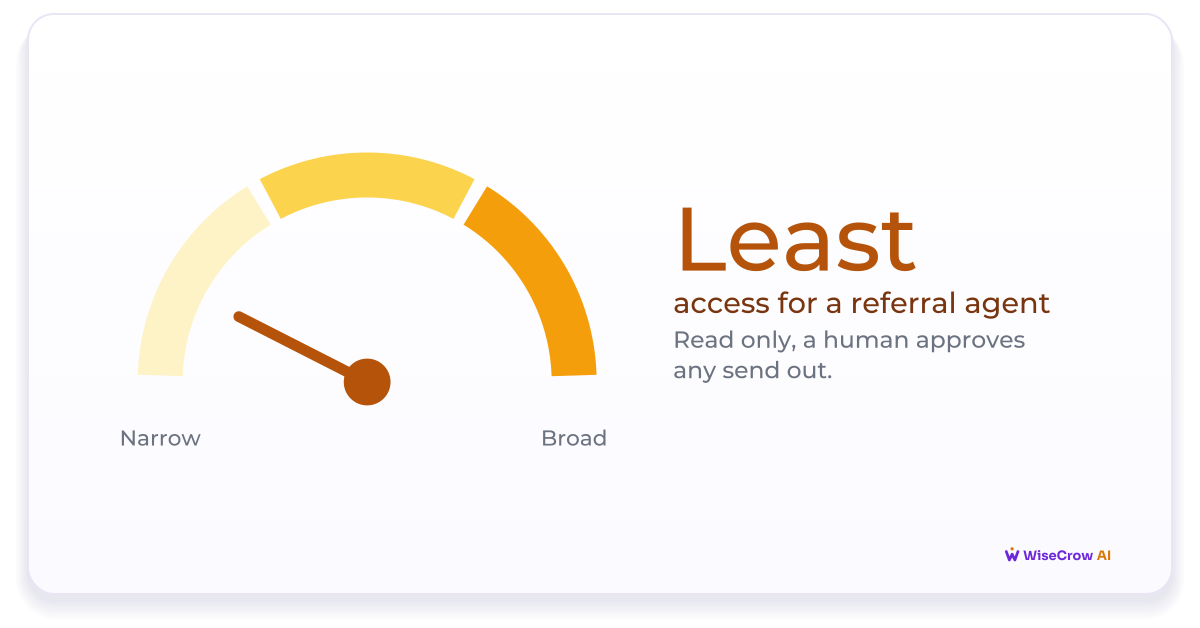
Think of an AI agent that reads incoming referral documents and fills in the intake queue. One file carries hidden text telling the agent to mark it urgent or copy the record somewhere else. Treat every outside document, image and message as untrusted input. Give agents the fewest permissions that still let them work, and require a human to approve anything that sends data out. Red-team the tool before go-live, ask vendors where their training data comes from and add AI tools to your incident response plan.
Model Drift After Deployment
A model learns from the past, and hospitals don’t stand still. A 2021 JAMA Network Open study of 24 US hospitals found daily Epic sepsis alerts rose 43% in the three weeks after each system’s first COVID-19 case, while total census fell 35%. The share of patients triggering an alert more than doubled, from 9% to 21%. The University of Michigan paused the alerts in April 2020 after nurses reported overalerting. The authors name dataset shift as a possible cause, a change in the patients the model sees. Quieter shifts happen too: a new EHR template, a changed lab assay, a new coding rule.
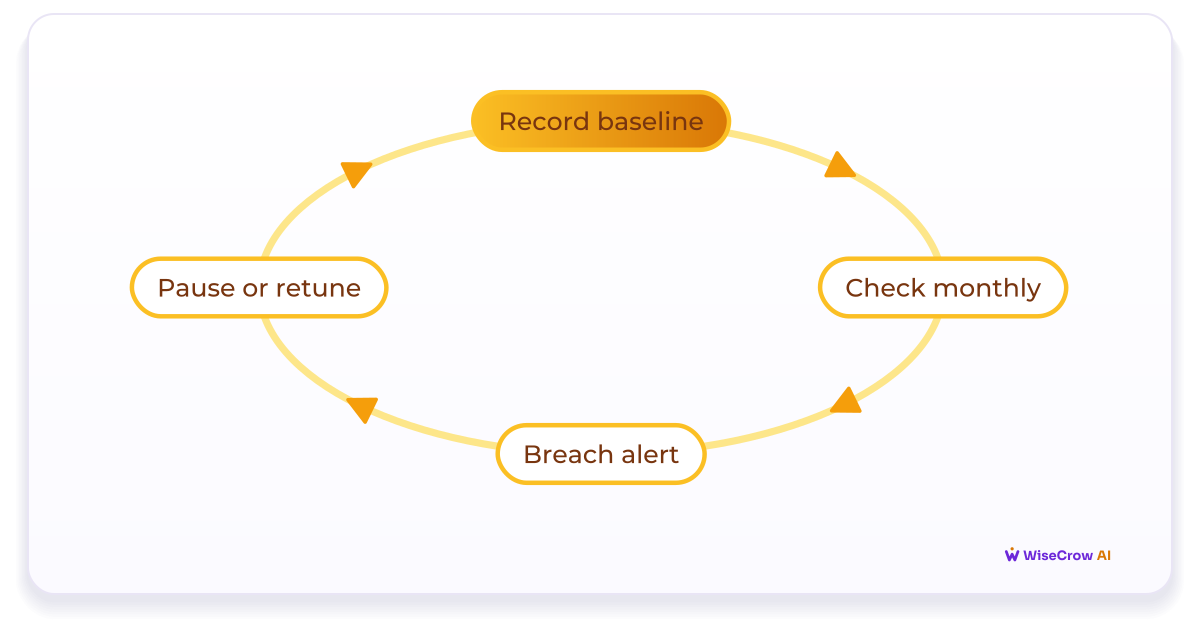
The safeguard is boring and it works. Record baseline numbers at go-live, then review alert volume, accuracy against chart review, edit rates and subgroup results every month. Set thresholds that trigger a review, and agree in advance who can switch the tool off. Ask vendors how they tell you about model updates. For FDA-regulated devices, the FDA’s guidance on predetermined change control plans describes how makers can plan certain AI changes ahead of time, so ask if your vendor’s product has one.
The Risk That Sits With People and Paperwork
The last risk lives in sign-offs, contracts and org charts. It decides who answers for a result, and it’s the one I see skipped most.
Accountability Gaps and Documentation Integrity
When AI drafts a note, suggests a code or flags a scan, someone has to own the outcome. If that isn’t written down, everyone assumes someone else has it. Documentation adds a second layer. AI-drafted notes can carry copied-forward errors, and notes that sound more complete than the visit was can lead to codes the care doesn’t support. Neither problem shows up in a pilot report that only counts minutes saved.
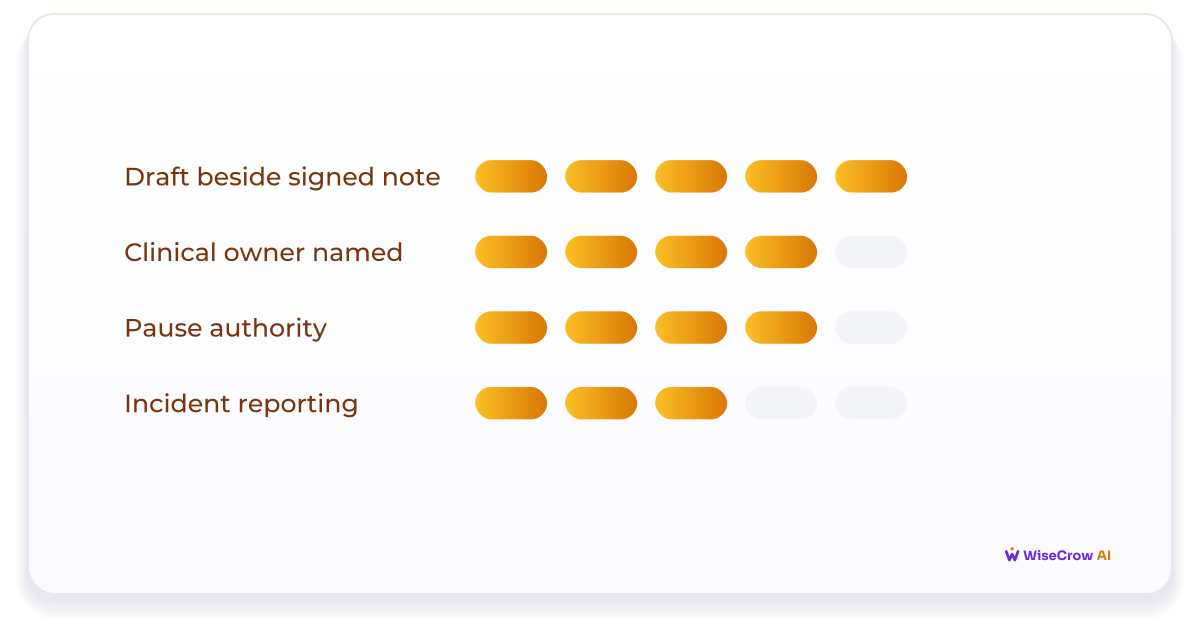
A typical version: a patient disputes a diagnosis in their portal note. The clinician says the scribe wrote it, the vendor says the clinician signed it and IT calls it a clinical matter. Avoid that by naming a clinical owner, a technical owner and the person who can pause each tool. Keep an audit trail that shows the AI draft next to the signed version, add AI to your incident reporting form and agree how you’ll tell patients when AI is used. Liability depends on your contracts and your state, so bring your legal counsel in early.
How Much Review Each Use Needs
You don’t need the same controls on a scheduling bot and a sepsis alert. I sort every AI use into tiers by how close it sits to a clinical decision, then set the human check and the monitoring to match. The table shows the defaults I start from before adjusting them with each client’s clinical and compliance leads.
| Use type | Example | Human check | Monitoring |
|---|---|---|---|
| Back office | Claims status, scheduling | Sample spot checks | Quarterly review |
| Patient messages | Portal reply drafts | Staff approve each send | Monthly review |
| Clinical notes | Ambient visit notes | Clinician signs each note | Monthly edit rates |
| Clinical decisions | Sepsis or imaging alerts | Clinician decides every case | Ongoing, by subgroup |
Tiers move. A patient message tool that starts with staff approving every reply can move to sampling once edit rates stay low for a few months. A clinical tool never drops below a clinician deciding each case. The mistake I see most is the reverse: a tool launched as back office that slowly takes on clinical work, like an intake assistant that starts suggesting triage levels, with no one updating its tier.
How to Choose Which Risks to Tackle First
You can’t fix all seven at once, and you don’t have to. Start from what you run today:
- Staff use public chatbots with patient details: close the PHI gap first (risk 4).
- An ambient scribe is live or planned: set up note review and edit tracking (risks 1 and 7).
- A risk score or alert drives care decisions: test by subgroup and start monthly monitoring (risks 3 and 6).
- Clinicians rarely override the AI: sample accepted suggestions and add failure-case training (risk 2).
- AI agents read outside documents or act in your systems: limit permissions and red-team them (risk 5).
- Nobody can say who owns a tool: name owners before anything else (risk 7).
If you can only do one thing this month, build the risk register with a named owner on every row. It takes an afternoon, and it shows you quickly which tools nobody is watching. One trade-off worth naming: tighter review slows the time savings that sold the tool. Accept that for clinical uses, and relax it for low-risk admin work once the numbers support it.
Questions About AI in Healthcare Risks
What Are the Biggest Risks of AI in Healthcare?
The seven I check on every project are wrong or invented output in clinical work, automation bias, algorithmic bias, leaks of protected health information, security attacks such as prompt injection, model drift after go-live and unclear accountability. The first three reach patients most directly. The last four tend to stay hidden until something breaks, so they need owners and monitoring from day one.
Can AI in Healthcare Be Biased Against Certain Patients?
Yes, and it has been documented. A 2019 study in Science found that a widely used risk algorithm rated Black patients as healthier than equally sick White patients because it used past costs as a stand-in for need. Test any model on your own patients, broken down by groups such as age, sex, race and ethnicity, language and payer, before go-live and again on a schedule after it.
Is It Safe to Put Patient Data into ChatGPT or Other Chatbots?
Not into a consumer account. Under HIPAA, vendors that handle protected health information for you generally need a business associate agreement, and consumer chatbot accounts usually don’t come with one. Some vendors offer business or enterprise plans with a BAA and settings that keep your data out of model training. Your privacy officer should approve the specific tool and plan before anyone uses real patient data.
Who Is Responsible When Healthcare AI Makes a Mistake?
That depends on your contracts, your state and the facts of the case, so ask your legal counsel. What you can control is clarity inside your organization. Write down who owns each tool clinically and technically, who signs AI-drafted output and who can switch the tool off. Keep an audit trail that shows the AI draft next to the final version, so you can see what happened if a complaint comes in.
What Is Automation Bias in Healthcare?
It’s the habit of trusting a machine’s suggestion more than you should. In a 2023 Radiology study, radiologists reading mammograms were far less accurate when the AI suggested a wrong category, and even very experienced readers were affected. Training that shows real failure cases, tracking how often staff override the AI and reviewing samples of accepted suggestions all help keep human judgment active.
How Often Should a Healthcare AI Model Be Monitored?
Set a baseline at go-live and review the core numbers at least monthly for anything that touches clinical work, such as alert volume, accuracy against chart review, edit rates and results by patient group. Add a review trigger for big changes like a new EHR template, a new lab assay or a shift in patient mix. Back-office tools with low patient risk can often move to a quarterly check once they’re stable.
Does the FDA Regulate AI Used in Healthcare?
Some of it. Certain AI software that supports diagnosis or treatment can be regulated as a medical device, and the FDA has issued guidance on how makers of AI-enabled devices can plan for model updates. Many administrative tools, such as scheduling or billing assistants, fall outside device rules. Where a specific product sits depends on its intended use, so check with the vendor and your regulatory adviser.
Sources
- Koenecke et al., Careless Whisper: Speech-to-Text Hallucination Harms (FAccT 2024): arxiv.org
- ECRI, Misuse of AI chatbots tops annual list of health technology hazards: ecri.org
- Wong et al., External Validation of a Widely Implemented Proprietary Sepsis Prediction Model in Hospitalized Patients, JAMA Internal Medicine (2021): jamanetwork.com
- Dratsch et al., Automation Bias in Mammography, Radiology (2023): pubs.rsna.org and RSNA news summary: rsna.org
- Obermeyer et al., Dissecting racial bias in an algorithm used to manage the health of populations, Science (2019): science.org
- WHO, AI ethics and governance guidance for large multi-modal models: who.int
- Clusmann et al., Prompt injection attacks on vision language models in oncology, Nature Communications (2025): nature.com
- Alber et al., Medical large language models are vulnerable to data-poisoning attacks, Nature Medicine (2025): nature.com
- Quantification of Sepsis Model Alerts in 24 US Hospitals Before and During the COVID-19 Pandemic, JAMA Network Open (2021): pmc.ncbi.nlm.nih.gov
- FDA, Marketing Submission Recommendations for a Predetermined Change Control Plan for AI-Enabled Device Software Functions: fda.gov
Disclaimer: This article is for general information only and isn’t medical, legal or compliance advice. Study results describe specific settings and may not apply to your tools or patients. Rules such as HIPAA and FDA guidance change, so check the current position with your clinical, privacy, legal and regulatory advisers before you act.
Did you find this helpful?
Thank you for your feedback.
Marlena leads the WiseCrow editorial team and works with our consultants to turn real client projects into practical guides on AI strategy, automation and governance. Before joining WiseCrow, she spent 12 years in B2B operations and SaaS content. She has since edited more than 400 articles on AI and automation and reviewed workflows from over 60 client projects. She is based in Austin, Texas.