Summary
- Score each of the 12 points as ready (2), partly (1) or not yet (0) for a total out of 24.
- A clear business goal and a named sponsor matter more than any data or tool decision.
- Check data for one use case at a time, since company-wide data readiness never arrives.
- Your total tells you the next move, from groundwork to a first pilot to scaling.
The most common AI question I get from leadership teams sounds simple: “Are we ready?” The honest answer is usually “partly,” and the useful work is finding out which part. When I run AI readiness consulting projects, I start with the same 12 points every time, split across data, people and process. They take an afternoon to score and they show where the next dollar should go.
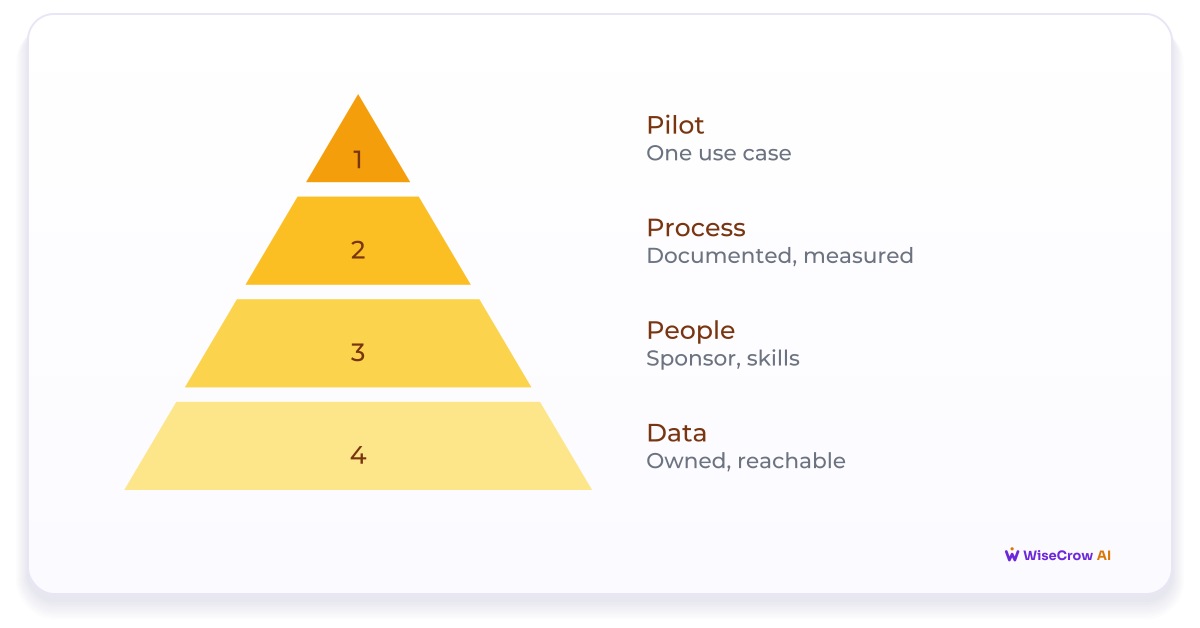
Below you’ll find all 12 points in one table with what ready and not yet look like, a short section on each point and a scoring guide that turns your total into a next step. Score it with your team. You’ll get a truer number.
Score All 12 AI Readiness Points in One Table
Read each row and pick the column that sounds most like your company today. If you land between the two, score it as partly. Ready earns 2 points, partly earns 1 and not yet earns 0, so the best possible total is 24.
| Point | Ready looks like | Not yet looks like |
|---|---|---|
| 1. Data access and quality | Clean, reachable, refreshed | Scattered exports, gaps |
| 2. Data ownership | Named owner per dataset | “IT owns it all” |
| 3. Integration paths | APIs or connectors known | Copy and paste only |
| 4. Security basics | SSO, roles, data tiers | Shared logins, no tiers |
| 5. Clear business goals | One problem, one metric | “We need AI” |
| 6. Leadership sponsor | Exec owns budget and calls | Interest, no owner |
| 7. Skills and training | Role-based plan in place | Self-taught, ad hoc |
| 8. Change readiness | Team asked, champions named | Rumors and pushback |
| 9. Process documentation | Steps and exceptions written | Lives in one head |
| 10. Measurable baselines | Time, cost, errors tracked | Gut feel only |
| 11. Governance and policy | AI use policy, approvals | No rules on tools |
| 12. Budget and vendor approach | Budget plus buy-or-build call | Tool picked first |
Don’t be discouraged by a low first score. In Cisco’s 2024 AI Readiness Index, a survey of 7,985 senior business leaders, only 13% of companies said they were fully ready to capture AI’s potential, down from 14% the year before. Most companies sit in the middle. The goal is to know which points pull your score down.
The checklist is the quick version. If you want the deeper model behind it, my six-dimension readiness framework breaks the same ground into maturity levels you can track over years.
Data Readiness: Points 1 to 4
Data is where most AI plans stall, so it goes first. Score these four points for the use case you have in mind. Asking if your whole company has good data is a question with no useful answer.
Data Access and Quality for One Use Case
AI needs data it can reach and trust. Ready means the records for your use case sit in a system you can query, they’re refreshed on a known schedule and the obvious gaps are known. Not yet means the data lives in personal spreadsheets, exports from three tools and a shared inbox. Gartner predicted in February 2025 that through 2026, companies will abandon 60% of AI projects that aren’t supported by AI-ready data.
To score it, pull 100 real records for the use case and look at them with the person who uses them every day. Count missing fields, duplicates and values that mean different things in different teams. When a finance client of mine did it, a quarter of the vendor records had no category at all, which ruled out the invoice coding pilot they wanted until the gaps were filled.
Named Owners for Every Key Dataset
Somebody has to decide what “correct” means for each dataset, approve who can use it and fix it when it breaks. In companies that score low here, the answer to “who owns customer data?” is “IT,” and IT says it only runs the servers. AI makes the gap visible fast, because a model trained or prompted on data nobody owns produces answers nobody can vouch for.
List the three to five datasets your use case needs and write one business owner next to each. Then ask each owner two questions: how do you know the data is right, and who may use it for AI? If they can answer both, score ready. If you get a name but no answers, score partly.
Integration Paths Into Your Core Systems
An AI tool that can’t read from or write to your systems turns into a copy-and-paste job. Ready means you know how data gets in and out: an API, a native connector, a database view or at least a scheduled export. Not yet means the main system has no API, the vendor charges extra for one or nobody has checked.
Check the admin docs for each system in the use case and note the access method, any limits and the cost. Then ask IT how long a test connection would take. A healthcare client once found that their scheduling system’s API was a paid add-on with a three-month lead time, which reshaped their whole pilot plan in a single meeting.
Security Basics Before Any Data Moves
You don’t need a full AI security program to be ready, but you do need the basics. Single sign-on for business tools, role-based access, a simple data classification and a rule on which data may go into outside AI tools. Without those, the first pilot either stalls in a security review or goes ahead without one, and the second outcome is worse.
Ask IT for three things: the SSO coverage list, the data classification document and the current rule on AI tools. If two of the three exist and people know about them, score partly. Score ready when all three exist and the AI rule names actual tools and data types.
People Readiness: Points 5 to 8
These four points decide if anyone will use what you build. In my experience they also predict outcomes better than the data points. A team with messy data and a strong sponsor fixes the data. A team with clean data and no sponsor rarely ships.
Clear Business Goals Tied to a Metric
“Use AI” is a direction. A goal sounds like “cut first-response time on support tickets from six hours to two” or “reduce manual invoice coding by half.” Ready means you have one or two goals like that, each tied to a number the business already tracks. Not yet means the main driver is a board member asking what the AI plan is.
Write the goal in one sentence with a metric and a date, then show it to the person who would own the result. If they agree it matters and the metric is right, score ready. If people argue about which problem to solve first, score partly and settle that before anything else.
A Leadership Sponsor With Real Authority
A sponsor holds the budget, clears blockers between departments and makes the call when the pilot hits a trade-off. Interest is cheap. Ready means one named executive has AI in their goals for the year and shows up to the review meetings. A steering group with six members and no single owner scores partly at best.
The quick test is to ask who can approve a spend of a few thousand dollars on the pilot without another meeting. If the answer is a name, you’re close. I worked with a manufacturer whose AI working group met monthly for most of a year with nothing shipped. The day the COO took ownership, the first pilot had a budget within two weeks.
Skills and Training Matched to Roles
Cisco’s 2024 index found that only 31% of organizations rated their talent as highly ready for AI. Skills gaps come in layers. Most staff need to know how to use approved tools well and what not to paste into them. A smaller group needs to review AI output in their field. One or two people need enough technical depth to work with vendors and judge a demo.
Map those three layers against your team and mark who has each skill today. Ready means there’s a plan for every layer, even a short one. Not yet means people learned from YouTube on their own time. If your gaps are wide, my plan for closing skills gaps walks through the order I’d tackle them in.
Change Readiness on the Front Line
The people whose work will change need to hear about it early, from their managers, with honest answers about what happens to their jobs. When they don’t, rumors fill the gap and pilots get quietly ignored. Ready means the affected team has been asked what slows them down and a few of them have volunteered to test the first version.
Run a 30-minute session with the team that would use the AI and ask two questions: which tasks would you happily hand off, and what worries you? Score ready if you leave with named champions and a list of tasks. If the room goes silent or the questions are all about layoffs, score not yet and plan the communication before the tool.
Process Readiness: Points 9 to 12
The last four points make sure there’s a defined process for AI to improve, a way to prove it worked, rules for using it and money to pay for it. They’re the least exciting part of the list and the easiest to fix.
Process Documentation You Can Hand to a Stranger
You can’t automate a process nobody can describe. Ready means the steps, decisions and exceptions of the target workflow are written down, and the written version matches what people do. Not yet means the process lives in one senior person’s head and changes depending on who’s on shift.
Ask two people who do the work to walk you through it separately, then compare. If both versions match the document, score ready. If they differ on the exceptions, you’ve found exactly where an AI system would make mistakes. A logistics client had a returns process documented in eight steps. In practice it had fourteen, and the six missing ones were all exceptions.
Measurable Baselines Before the Pilot Starts
If you don’t know how long a task takes today, you can’t prove AI made it faster. Ready means you track time per task, volume, cost or error rate for the target process, ideally for a few weeks before anything changes. Gut feel such as “it takes forever” scores not yet.
Pick two numbers for the process and collect them for at least two weeks. A simple tally sheet works. Teams skip it because it feels slow, and then can’t defend the pilot’s results when budget season comes. The calculator further down helps you turn a rough baseline into hours and dollars.
Governance and an AI Use Policy
Staff are already using AI tools, approved or not. A short AI use policy says which tools are allowed, what data may go into them, who reviews output before it reaches customers and who approves new use cases. The NIST AI Risk Management Framework is a solid free reference if you want a structure for the bigger version later.
Ready means a policy exists, staff have seen it and there’s a named person who approves new AI tools. Partly means a draft sits in legal review. For regulated work, check which rules apply to your use case and their current status with your compliance team before you score this point as ready.
Budget and a Vendor Approach
Ready means there’s a budget for the first pilot that covers licenses, integration work and people’s time, plus a decision on how you’ll source it. You can buy a tool, add AI features to software you already own or build on a model platform. Not yet means someone already signed a contract and now looks for a problem the tool can solve.
Write down the pilot budget, who approved it and which of the three routes you’re taking and why. Ask any vendor for a test on your own data before you sign. If they won’t run one, treat that as a finding. In my work, adding AI to existing software is the cheapest first step more often than teams expect.
Your 12 Readiness Checks at a Glance
Copy these into your planning doc and mark each one ready, partly or not yet.
- Use-case data is reachable, refreshed and spot-checked.
- Each key dataset has a business owner.
- Every system in scope has a known way in and out.
- SSO, roles and a data rule for AI tools exist.
- The goal fits in one sentence with a metric.
- One executive owns the budget and the decisions.
- Training covers users, reviewers and a technical lead.
- The affected team has been asked and has champions.
- The workflow and its exceptions are written down.
- Two baseline numbers have been tracked for weeks.
- An AI use policy is published and has an approver.
- The pilot has a budget and a chosen sourcing route.
What Your Readiness Score Means
Add up your points. The ranges below are the ones I use with clients. Treat them as a guide for your next move.
| Score | What it means | What to do next |
|---|---|---|
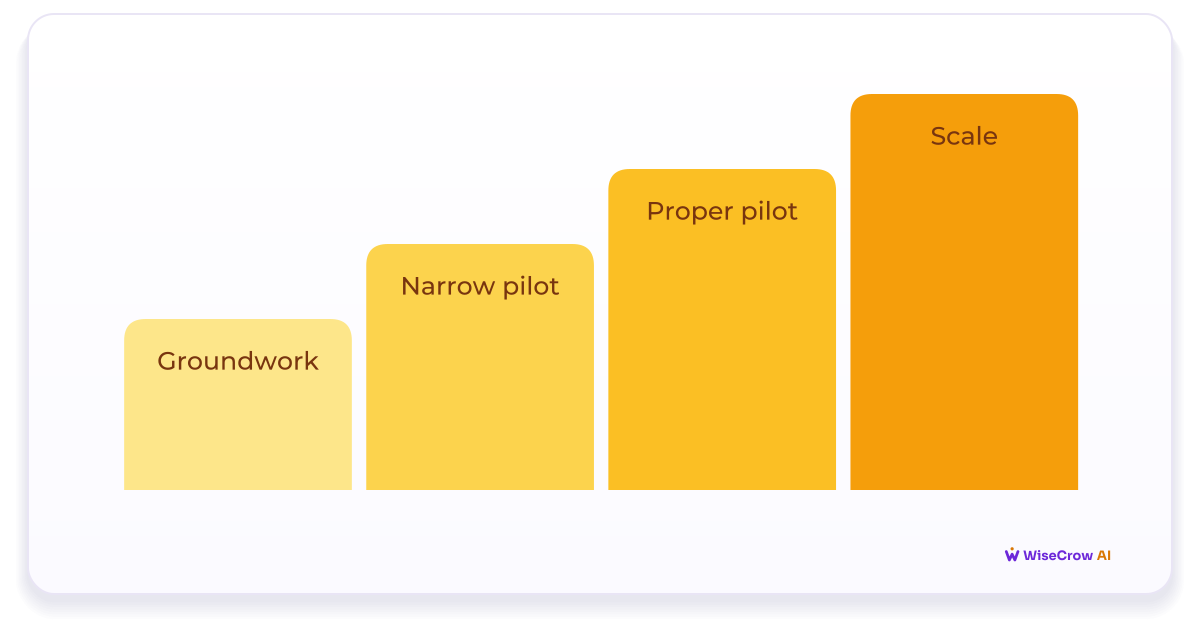
| 0 to 8 | Groundwork stage | Fix goals, sponsor, data owners |
| 9 to 14 | Pilot-ready in one area | One narrow, low-risk pilot |
| 15 to 19 | Ready to pilot properly | Pilot with baseline and policy |
| 20 to 24 | Ready to scale | Second use case, shared platform |
0 to 8. Pause any tool shopping. Spend the next month on points 5 and 6, then name data owners. A goal and a sponsor will lift several other scores on their own, because people start asking the right questions.
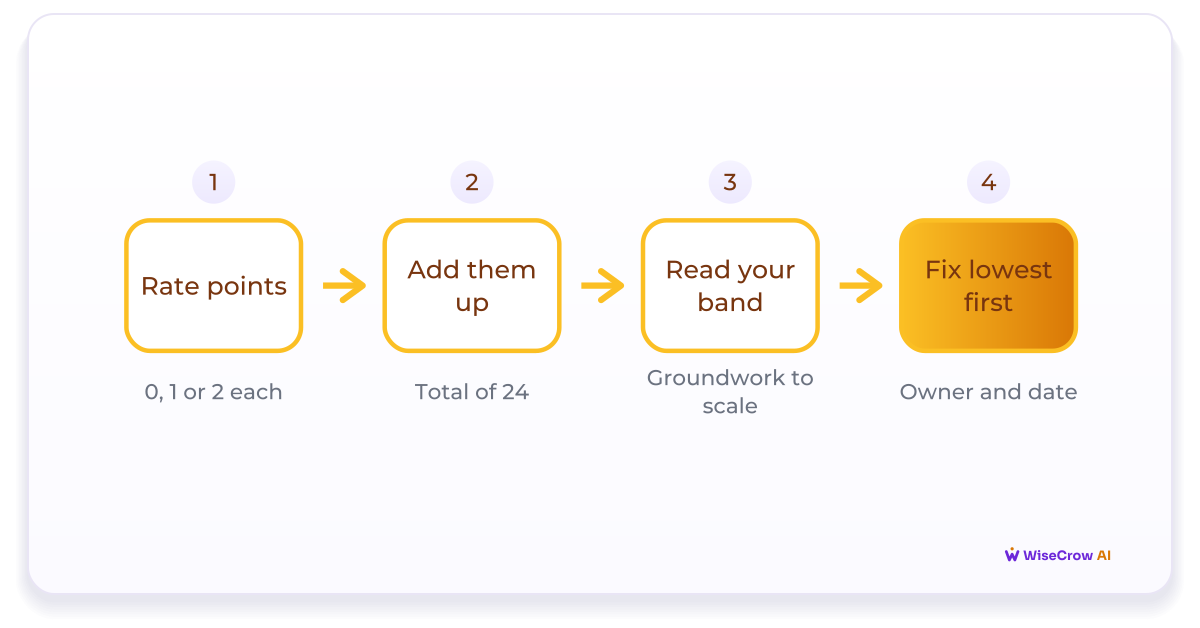
9 to 14. You can run a small pilot where the data is already in decent shape, such as drafting internal summaries or sorting incoming requests. Keep it low-risk and inside one team while you raise the weakest group.
15 to 19. Run a proper pilot with a baseline, a policy and a sponsor review at the end. Most companies I work with land here after a few months of groundwork.
20 to 24. Plan the second and third use cases and look for shared pieces, such as one integration layer or one review process. If you want a weighted maturity score you can report to a board, my AI readiness audit formula goes deeper than a 24-point total.
Turn Your Baseline Into Hours and Dollars
Point 10 is easier to score once you see what the target process costs today. Enter how long the task takes, how often it runs and what an hour of that work costs. The result gives your sponsor a number to weigh against the pilot budget from point 12.
How Much Time Could You Save?
Move the sliders to match one repetitive task in your business.
How to Choose What to Fix First
You won’t raise every point at once. Use your scores and pick by pattern:
- Zeros on points 5 or 6: fix those before anything else. No other work sticks without them.
- Strong people scores, weak data: narrow the use case to data that’s already in good shape.
- Good data, weak process: document the workflow and start the baseline this week.
- Everything partly: pick one team and push its points to ready, then copy what worked.
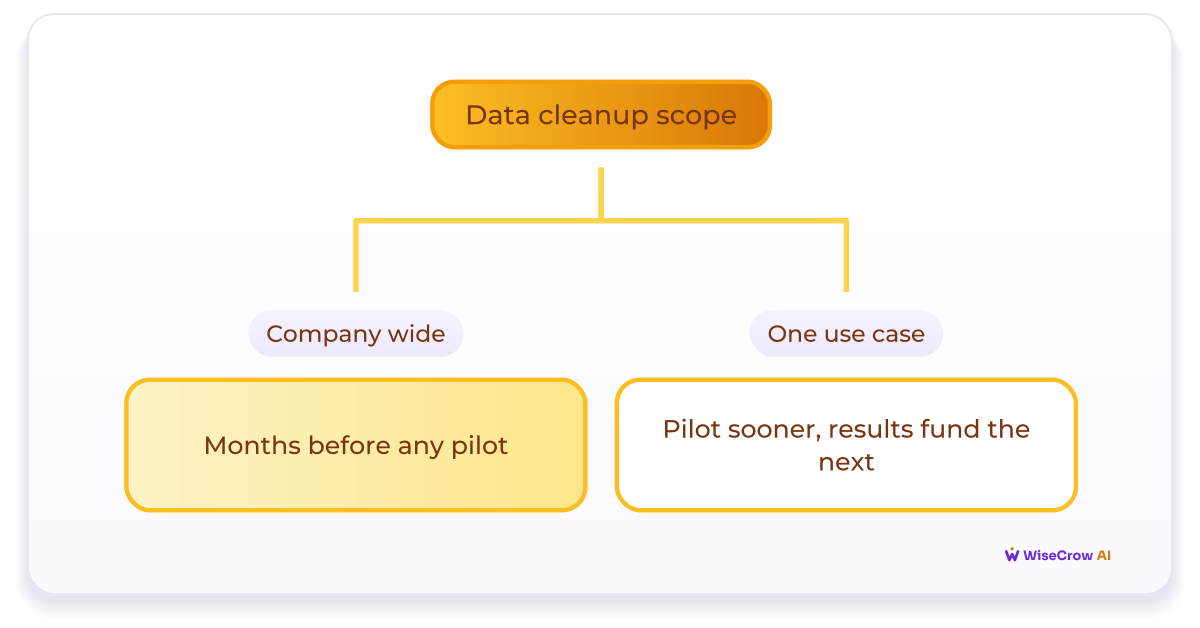
One trade-off I see teams get wrong is spending months on a company-wide data cleanup before any pilot. Clean the data one use case needs, prove the value and let the results fund the next round. WiseCrow has run 80+ readiness assessments, and the projects that moved fastest picked one narrow goal and scored the checklist for that goal alone.
Questions About the AI Readiness Checklist
What Is an AI Readiness Checklist?
It’s a short list of conditions your company should meet before it spends real money on AI. A good one covers data (can AI reach clean, owned, secure data), people (is there a goal, a sponsor, skills and buy-in) and process (are workflows documented, measured, governed and budgeted). You score each point honestly and fix the weakest ones before you pick tools.
How Do I Score the 12 Points?
Give each point 2 if it’s ready, 1 if it’s partly there and 0 if it’s not yet in place, then add them up for a score out of 24. Score as a group with someone from the business, IT and the team that would use the AI. A point only counts as ready if someone can show you proof, such as a document, a dashboard or a named owner.
Which Checklist Points Matter Most?
In my client work, a clear business goal and a real sponsor matter most, because every other gap can be fixed once those two exist. After that, data access and quality for the specific use case carries the most weight. A low score on training or governance slows you down. A low score on goals or data usually stops the project.
Do Small Businesses Need an AI Readiness Checklist?
Yes, though the bar is lower. A 20-person company won’t have a data catalog or a governance board, and it doesn’t need one. It still needs one owner, one clear goal, a rough baseline, a short policy on what data goes into AI tools and a budget limit. Most small teams can work through all 12 points in an afternoon.
How Long Does It Take to Become AI Ready?
It depends on where you start. A team that scores in the middle range can often close the gaps for one pilot within a few weeks. A low score with messy data and no sponsor can take a few months of groundwork. Aim for readiness in one use case first, since company-wide readiness is a moving target.
Should We Buy AI Tools Before Finishing the Checklist?
Small trial licenses for learning are fine, as long as your policy says what data people may use with them. Large contracts should wait until you’ve scored the checklist and chosen a use case. Buying first is the most common pattern I see behind shelfware, because the tool then shapes the goal.
How Often Should We Re-Run the Checklist?
Re-score after each pilot and at least twice a year. Your score will move as people change roles, data sources change and new tools arrive. Re-running it also shows leadership progress in plain numbers, which helps when you ask for budget for the next use case.
Sources
- Cisco, 2024 AI Readiness Index (November 19, 2024): newsroom.cisco.com
- Gartner, Lack of AI-Ready Data Puts AI Projects at Risk (February 26, 2025): gartner.com
- NIST AI Risk Management Framework: nist.gov
General information only: this is not legal, financial or tax advice. Examples and numbers reflect typical projects; check the specifics with your advisers before deciding.
Did you find this helpful?
Thank you for your feedback.
Marlena leads the WiseCrow editorial team and works with our consultants to turn real client projects into practical guides on AI strategy, automation and governance. Before joining WiseCrow, she spent 12 years in B2B operations and SaaS content. She has since edited more than 400 articles on AI and automation and reviewed workflows from over 60 client projects. She is based in Austin, Texas.