Summary
- Score six dimensions on four levels: strategy, data, technology, people, governance and your use-case pipeline.
- Each dimension has a clear level 1 and level 4 picture, and most companies sit at different levels in each.
- Build in dependency order: strategy and use cases set the target, data and governance make it safe, technology and people make it run.
- Close the gaps your first use case depends on and leave the rest for later rounds.
Most readiness reviews I’m shown end with a long list of gaps and no order to fix them in. A framework solves the order problem. It gives you a fixed set of dimensions to score, a clear picture of what good looks like in each and a view of which gaps hold up the others. In my AI readiness consulting work, I use six dimensions, and the same six appear in every scorecard I hand to a leadership team.
Below you’ll find the six dimensions in one table, the four maturity levels, a short section on each dimension with its blockers and first moves, a grid that fits it all on one page and a blueprint of how the dimensions depend on each other.
The Six Readiness Dimensions in One Table
Each row links to its section. The blocker column shows the gap I run into most often in that dimension. It’s usually the fastest clue to where you stand.
| Dimension | What it covers | Most common blocker |
|---|---|---|
| 1. Strategy and Leadership | Goals, sponsor, budget | No single owner |
| 2. Data Foundations | Quality, access, ownership | Data nobody owns |
| 3. Technology and Integration | Systems, APIs, security | No way into core systems |
| 4. People and Skills | Skills, roles, adoption | Training left to chance |
| 5. Governance and Risk | Policy, approvals, oversight | Rules written after launch |
| 6. Use-Case Pipeline | Ideas, scoring, baselines | Ideas ranked on hype |
Four Levels, From Ad Hoc to Built In
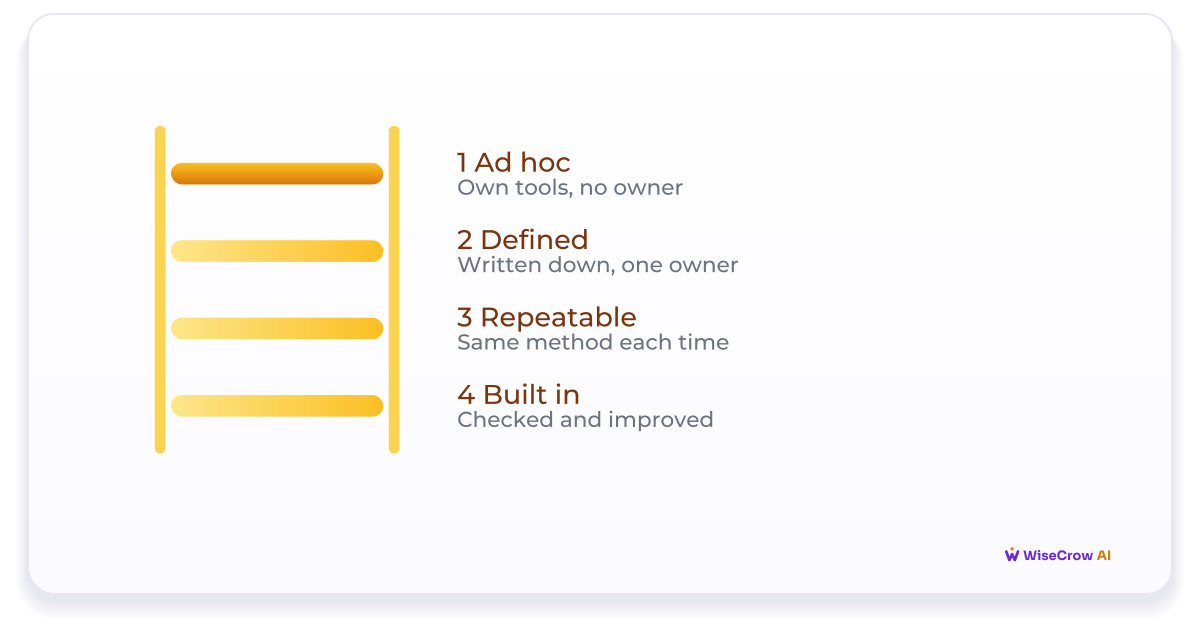
I score every dimension on the same four levels, so you can lay the six side by side:
- Level 1, ad hoc: individuals try things on their own. Nothing is written down, owned or measured.
- Level 2, defined: there’s an owner and a first set of rules or standards, used by one or two teams.
- Level 3, repeatable: the same approach works across teams, and results get tracked.
- Level 4, built in: AI readiness is part of normal planning, budgeting and review. Nobody runs it as a side project.
Four levels are enough. Scales with five or seven steps look precise, but in scoring workshops people burn the hour arguing between neighboring steps. Published models differ in the details. Gartner’s AI Maturity Assessment rates seven AI pillars through a guided questionnaire. MIT CISR’s enterprise AI maturity model uses four stages, and in its survey of 721 companies, 28% sat in the first stage, 34% in the second, 31% in the third and only 7% in the fourth.
If you want a quick read before you score levels, my 12-point AI readiness checklist takes an afternoon and covers the same ground in less depth.
1. Strategy and Leadership
Strategy and leadership covers why your company wants AI, who owns the outcome and how much money stands behind it. Leaders score themselves highest here, and it’s the dimension I most often mark down. A slide about AI vision counts for little without an owner and a budget line.
What a Weak and a Strong Strategy Score Look Like
At level 1, AI comes up in board meetings as a question, and different managers give different answers. There’s no budget line, so pilots get funded from whichever team has money left over. At level 4, two or three AI outcomes sit inside the business plan, each with an executive owner, a metric and a review date. Cisco’s 2025 AI Readiness Index found that 99% of its most ready companies, the roughly 13% it calls Pacesetters, have a defined AI roadmap, against 58% of companies overall.
Where Strategy Gets Stuck
The usual blocker is a committee. Six people share AI, so nobody can approve spend or stop a weak project. The second is a goal that reads like a mood, such as “become AI-first.” A third one surprises people: the sponsor changes jobs halfway through the year and takes the mandate along.
First Moves on Goals and Ownership
Write one sentence per outcome, with a metric and a date. Name one executive who owns each outcome. Then ask who can approve a small pilot budget without another meeting. If nobody can, you’re at level 1, whatever the slides say.
2. Data Foundations
Data foundations covers the quality, access and ownership of the data your AI ideas need. I score it per use case. Company-wide data readiness is a target that keeps moving, and I’ve never seen anyone reach it.
From Scattered Exports to Owned, Documented Data
Level 1 looks like key records in personal spreadsheets, exports from several tools and definitions that change by team. “Revenue” means one thing in finance and another in sales. Level 4 looks like a named owner for every key dataset, written definitions, quality checks that run on a schedule and access granted through a request with an audit trail.
The Data Gaps That Show Up First
Ownership comes first. When nobody decides what correct means, nobody fixes errors either. Centralization comes second: the same Cisco index reported that 64% of organizations struggle to centralize their data. Gartner’s February 2025 research on AI-ready data found that 63% of organizations either lack the right data management practices for AI or aren’t sure they have them.
Starting Moves for Your Data
Pick your top use case and write a one-page data sheet for it: source systems, the fields it needs, the owner of each field and the known gaps. Fix the gaps for that use case only. A distribution client of mine spent a full quarter on a warehouse-wide cleanup and still had no pilot. The next quarter, they narrowed the work to the order data one forecasting model needed, and a test was running six weeks later.
3. Technology and Integration
Technology and integration covers the systems AI has to read from and write to, the way they connect and the security around them, such as single sign-on, roles and logging.
Copy and Paste at Level 1, Shared Connections at Level 4
At level 1, AI tools sit outside your core systems. People copy text into a chat window and paste the answer back. At level 4, approved AI tools reach your systems through APIs or one shared integration layer, with access tied to roles and every call logged. Cisco’s 2025 index also reported that only 26% of organizations have strong GPU capacity. For most mid-sized companies, compute is the vendor’s problem. The connections are yours.
Why Integration Holds Up More Projects Than Compute
The blocker I see most is an older core system with no API, or an API sold as a paid add-on with a long lead time. Security reviews come next. A new connection to a finance or HR system can wait weeks for a service account and a sign-off.
Opening Moves on Systems and Access
Map each system in your top use cases: how data gets in and out, what access costs and who signs off. File the access requests the day you pick a use case. Where you can, route new tools through one integration layer, so each new idea doesn’t need its own set of connectors.
4. People and Skills
People and skills covers what your staff can do with AI today, who can review its output and how ready teams are for their work to change. It predicts adoption better than any tool choice.
Self-Taught Users Versus Skills Defined by Role
Level 1 means a few enthusiasts learned from videos on their own time, and most staff either avoid AI or use it quietly. Level 4 means every role has a defined AI skill set, managers can judge AI output in their field, a small group can work with vendors and test models, and new hires get trained in their first month.
What Keeps People Scores Low
Training gets bought as a one-off course with no link to real tasks, and usage fades within weeks. Frontline teams hear about AI through rumors, assume it’s about headcount and keep away from the pilot. Both problems are cheap to fix and expensive to ignore.
Where to Start With Skills
Split skills into three layers: everyday users, reviewers and a technical lead. Mark who has each one today. Train one team on the exact tasks of your first use case and let them show the next team. My skills and data gap plan sets out the order in more detail.
5. Governance and Risk
Governance and risk covers the rules for AI use: approved tools, the data that may go into them, who checks output and who approves new use cases. Privacy, security and regulatory review belong here too.
No Rules at Level 1, Tiered Reviews at Level 4
At level 1, staff use whatever tools they like, and legal hears about a project the week before launch. At level 4, a short policy is published and known, use cases sit in risk tiers, high-risk ones get a formal review before launch and monitoring after, and there’s a clear path for reporting a problem. The free NIST AI Risk Management Framework gives you a solid structure for the higher levels.
Governance Blockers on Both Ends
Two opposite blockers show up. Some companies have no rules, so every pilot hits a late security review. Others run a heavy review board with almost nothing to review, and each request waits months. Both stall progress. For regulated work, check which rules apply to each use case, and their current status, with your compliance team.
First Steps Toward a Workable Policy
Publish a one-page policy within a month, name one approver for new tools and sort current use cases into low and high risk. Give low-risk uses a fast lane measured in days.
6. Use-Case Pipeline
The use-case pipeline covers how AI ideas get collected, scored and turned into projects. It includes baselines too, the numbers you record before a use case starts so you can prove what changed.
From a Wish List to a Ranked Register
Level 1 is a list of ideas from vendor demos and conference talks, with no scores. Level 4 is one register for every idea, ranked on value and readiness and reviewed every quarter, with a baseline recorded before each pilot and results reported after.
How Pipelines Go Wrong
Ideas get ranked on excitement. The flashiest one wins, and it often depends on data or systems sitting at level 1. Baselines get skipped because they feel slow, and then nobody can defend the result at budget time.
Getting the Pipeline Moving
Score each idea twice: once for business value and once for readiness, using the levels of the dimensions it depends on. A high-value idea with low readiness goes on the roadmap with its blockers listed. A medium-value idea with high readiness is often the right first pilot.
The Maturity Grid on One Page
The grid condenses the six sections. I merge levels 2 and 3 into one column because the difference between them is scope: level 2 works in one team, level 3 works across many.
| Dimension | Level 1 | Levels 2–3 | Level 4 |
|---|---|---|---|
| Strategy and Leadership | Interest, no owner | Sponsor and budget | Goals in business plan |
| Data Foundations | Scattered, unowned | Owned for key uses | Owned and monitored |
| Technology and Integration | Copy and paste | APIs for top systems | Shared, logged layer |
| People and Skills | A self-taught few | Role training in teams | Skills set per role |
| Governance and Risk | No rules | Policy and approver | Risk tiers, monitoring |
| Use-Case Pipeline | Unranked idea list | Scored, with baselines | Ranked, value tracked |
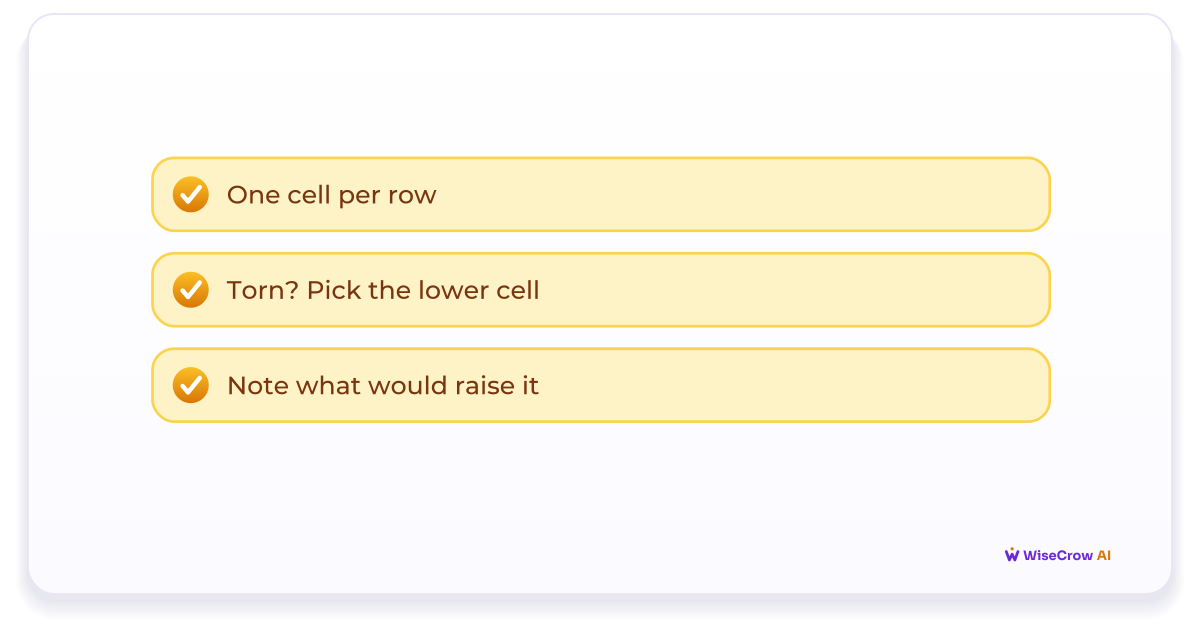
Mark one cell per row. If you hesitate between two cells, pick the lower one and write down what would move it up. For a weighted score you can track over time, my AI readiness audit formula turns the grid into numbers.
The Blueprint: How the Six Dimensions Depend on Each Other
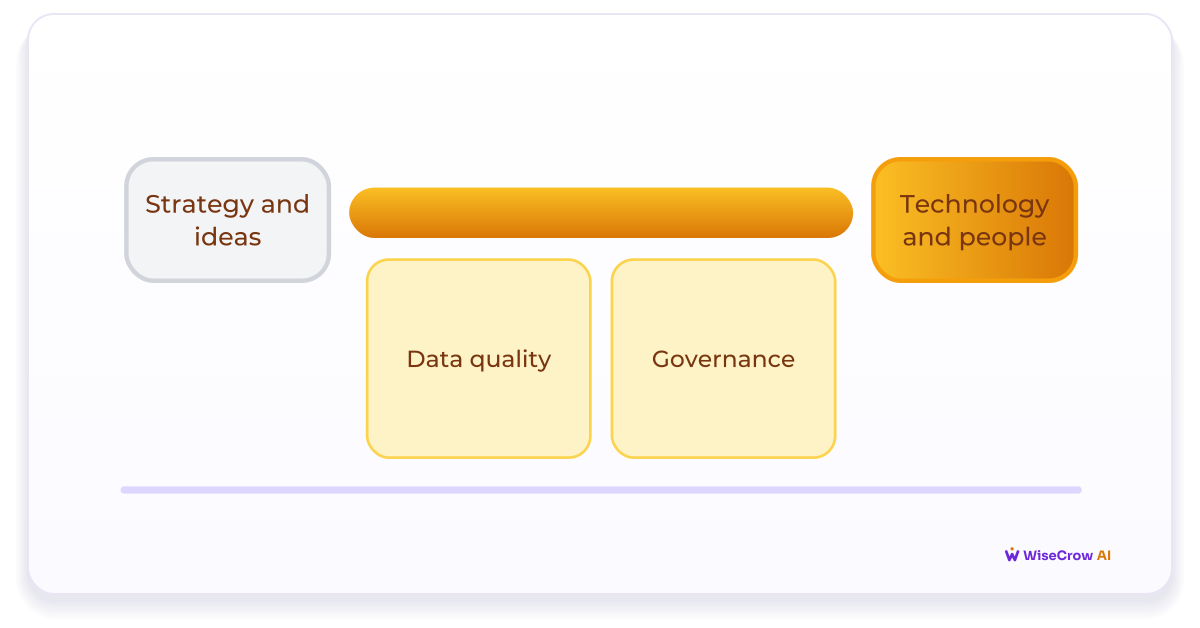
The dimensions don’t move on their own. Some set the ceiling for others, and pushing one far ahead of its neighbors wastes money. I group them in three layers.
Direction: Strategy and the Use-Case Pipeline
Strategy says what AI should change. The pipeline turns that into ranked projects. Together they decide which data, systems and skills matter. Without them, data and technology work has no target, and teams try to clean or connect everything at once.
Foundations: Data and Governance
Data and governance decide what AI may touch and how safely. Both depend on the direction layer, because you can only judge data quality or risk for a specific use. They also move as a pair. The rule on which data may go into AI tools is a data rule and a governance rule at once.
Delivery: Technology and People
Technology connects AI to your systems. People make sure it gets used. Both rest on the foundations. A strong integration layer over unowned data moves bad data faster, and trained staff with no approved tools drift back to personal accounts.
The working rule: a dimension can sit one level above the dimensions it depends on, rarely two. A company at level 1 in strategy gets little from level 3 technology. In my client work, the most expensive gap is technology two levels ahead of data, because licenses and integrations cost money long before anything useful flows through them.
Size Your First Use Case Before You Fund the Foundations
Readiness work competes with other budget lines, so it helps to know what your first use case is worth. Enter how long the task takes today, how often it runs and what an hour of that work costs. The result shows how much foundation work the first use case can carry.
How Much Time Could You Save?
Move the sliders to match one repetitive task in your business.
How to Choose Which Dimension to Build First
Look at your grid and pick by pattern:
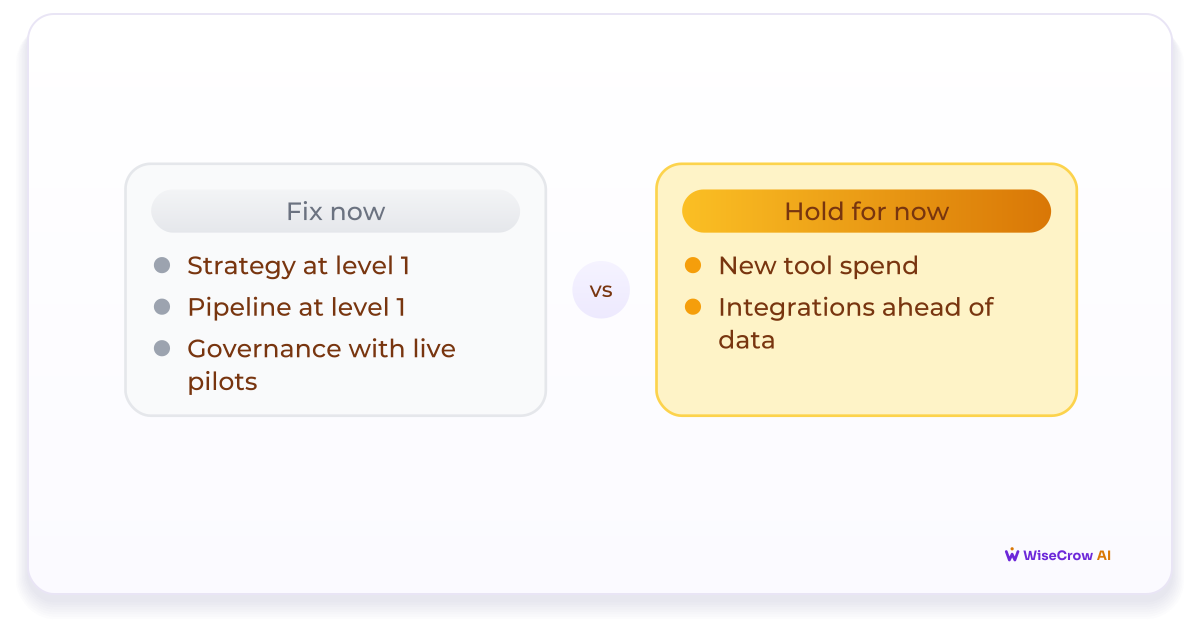
- Strategy or the pipeline at level 1: start there. A few weeks is enough to name an owner and rank five ideas.
- Data below what your top use case needs: fix that use case’s data and leave the rest for later.
- Governance at level 1 with pilots already running: publish the one-page policy this month.
- Technology ahead of data and people: hold new tool spend for a quarter and put the money into owners and training.
- Level 2 or higher everywhere: take the idea with the best mix of value and readiness and run a proper pilot.
WiseCrow has run 80+ readiness assessments, and the pattern I trust most is a plain one: one owner, one ranked list and one use case with its data fixed. Rescore the grid after every pilot, with the same people in the room, and let the movement guide the next round.
Questions About the AI Readiness Framework
What Is an AI Readiness Framework?
It’s a fixed set of areas you score to see how prepared your company is to use AI, plus a description of what weak and strong look like in each. Mine has six dimensions: strategy and leadership, data foundations, technology and integration, people and skills, governance and risk, and the use-case pipeline. Each one gets a level from 1 to 4.
What Are the Six Dimensions of AI Readiness?
Strategy and leadership covers goals, sponsor and budget. Data foundations covers quality, access and ownership. Technology and integration covers how AI connects to your systems. People and skills covers what staff can do and how ready they are for change. Governance and risk covers policy and approvals. The use-case pipeline covers how ideas get ranked and measured.
How Is a Readiness Framework Different from an AI Maturity Model?
They overlap a lot. A maturity model describes stages a company passes through over years. A readiness framework asks a narrower question: with what you have today, which AI ideas can succeed, and what must change first for the rest? I use maturity levels inside the framework, scored per dimension.
How Many Maturity Levels Should a Readiness Framework Have?
Four is enough for most companies. With five or more steps, scoring workshops tend to stall on the difference between neighboring levels. Four levels, from ad hoc to built in, give a clear picture and still show progress when you rescore.
Which Readiness Dimension Matters Most?
Strategy and leadership, followed closely by the use-case pipeline. Together they decide which data, systems and skills you need. In my client work, a company with a clear owner and a ranked list of ideas fixes its data gaps much faster than one with good data and no direction.
How Long Does It Take to Move Up One Level?
It depends on the dimension. Strategy and governance can move a level in weeks, because an owner, a ranked list or a short policy is mostly a decision. Data and integration usually take months, since they involve system access, cleanup and security reviews.
How Often Should We Rescore the Framework?
Rescore after every pilot and at least twice a year, with the same people in the room. Scores move as people change roles, systems change and new tools arrive. The change between two scores tells leadership more than any single result.
Sources
- MIT CISR, Enterprise AI Maturity Model press release (December 2024): cisr.mit.edu
- Gartner, AI Maturity Assessment: gartner.com
- Cisco, The Most AI-Ready Companies Outpace Peers in the Race to Value, 2025 AI Readiness Index (October 2025): newsroom.cisco.com
- Gartner, Lack of AI-Ready Data Puts AI Projects at Risk (February 26, 2025): gartner.com
- NIST, AI Risk Management Framework: nist.gov
General information only: this is not legal, financial or tax advice. Examples and numbers reflect typical projects; check the specifics with your advisers before deciding.
Did you find this helpful?
Thank you for your feedback.
Marlena leads the WiseCrow editorial team and works with our consultants to turn real client projects into practical guides on AI strategy, automation and governance. Before joining WiseCrow, she spent 12 years in B2B operations and SaaS content. She has since edited more than 400 articles on AI and automation and reviewed workflows from over 60 client projects. She is based in Austin, Texas.