Summary
- Spend Q1 on a short policy, an approved tools list, one intake form and early data access requests.
- Give every Q2 pilot a test set of real questions before anyone writes a prompt.
- Build shared retrieval, a model gateway and per-team cost limits in Q3, once pilots have proven the need.
- Close Q4 with a keep, fix or stop review and renew licenses on measured usage.
Most enterprise GenAI plans I’m asked to review have the same shape: a vision slide, a list of thirty use cases and a vendor shortlist. What they’re missing is the order of work. Who writes the policy, which three pilots go first, when the shared platform gets built and what proof you need before buying seats for everyone. Getting that order right is most of what enterprise generative AI consulting comes down to in the first year.
Below is the plan I hand clients as a starting draft. Copy the table into your planning tool, swap the roles for names and change the weeks to fit your calendar. Each quarter then gets a short section with the owners, the exit criteria and the work I’d leave out.
The Quarter-by-Quarter Plan to Copy
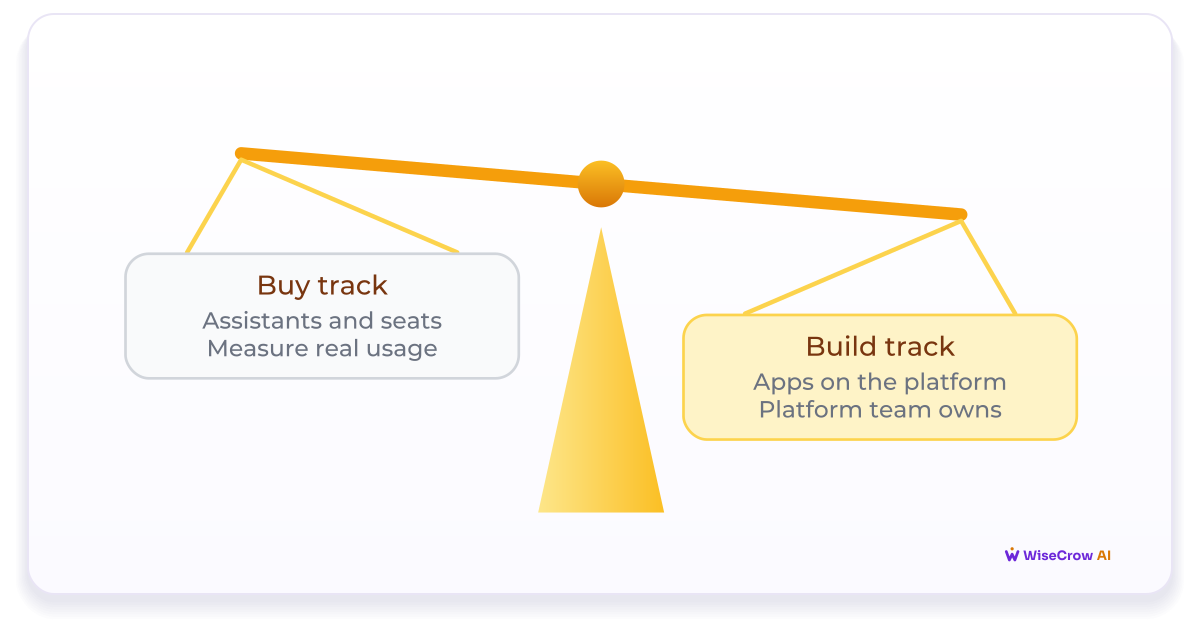
Each quarter is split into two halves. The middle columns are the two tracks that run all year: the assistants you buy, like chat tools and office copilots, and the apps you build on your own data.
| Period | Assistants you buy | Apps you build | Lead roles |
|---|---|---|---|
| Q1Weeks 1 to 6 | Usage policy and approved tools | Use case intake opens | CIO, legal, CISO |
| Q1Weeks 7 to 13 | Seat pilot scoped | Top three picked, data requested | GenAI program lead |
| Q2Weeks 1 to 6 | Seat pilot live | Test sets built, pilots start | Pilot product owners |
| Q2Weeks 7 to 13 | Seat results measured | Pilots scored on test sets | GenAI program lead |
| Q3Weeks 1 to 6 | Seats bought for proven teams | Shared retrieval and gateway | Platform lead |
| Q3Weeks 7 to 13 | Usage reported per team | First apps in production | Product owners, FinOps |
| Q4Weeks 1 to 6 | Champions and role training | Second batch from backlog | HR and program lead |
| Q4Weeks 7 to 13 | Renewal on real usage | Keep, fix or stop review | Sponsor and finance |
Treat the weeks as a default. A bank with a long security review will stretch Q1. A company that already runs a chat tool under a signed contract can fold the first six weeks into a month.
Why the Plan Runs on Two Tracks
Bought assistants and built apps have different risks, owners and cost models. Seats are a license line with a per-user price, and the main risk is that people don’t use them. Built apps are software. They need test sets, retrieval, monitoring and someone on call, and the main risk is that they give wrong answers with confidence.
When both sit in one undivided plan, one of them gets neglected. Usually the seats roll out with no measurement, or the built apps stall because the platform team is busy setting up licenses. Two tracks with separate owners keep both moving, and the table shows where they meet: the Q2 results decide where Q3 money goes.
The stakes of a weak plan are known. In mid-2024, Gartner predicted that at least 30% of generative AI projects would be abandoned after proof of concept by the end of 2025, and it named poor data quality, weak risk controls, rising costs and unclear business value as the causes. Each quarter below goes after one or two of those causes on purpose.
Q1: Policy, Tools, Intake and Data Access
The first quarter ships no AI. It sets the rules and opens the doors that take longest to open. The CIO sponsors it, legal and the CISO write the policy together, and a GenAI program lead runs the intake. If you don’t have that program lead yet, naming one is the first job of week one.
A Usage Policy People Can Read in Five Minutes
Staff are already pasting work into public chat tools. Your policy has to tell them, on one or two pages, which tools are allowed, which data must never go into any of them and which uses need a review first. Write it for the person in accounts payable, and keep the legal reasoning in an appendix.
The NIST Generative AI Profile (AI 600-1) is a free, detailed list of GenAI risks. Legal can use it as a checklist without turning the policy itself into a forty-page document.
An Approved Tools List With a Way to Ask for More
IT procurement and security agree on two or three approved tools with enterprise terms: no training on your data, retention you control and single sign-on. Publish the list next to a simple request form. Without the form, people quietly go back to their personal accounts the first time a tool they want isn’t on the list.
One Intake Form for Every Use Case Idea
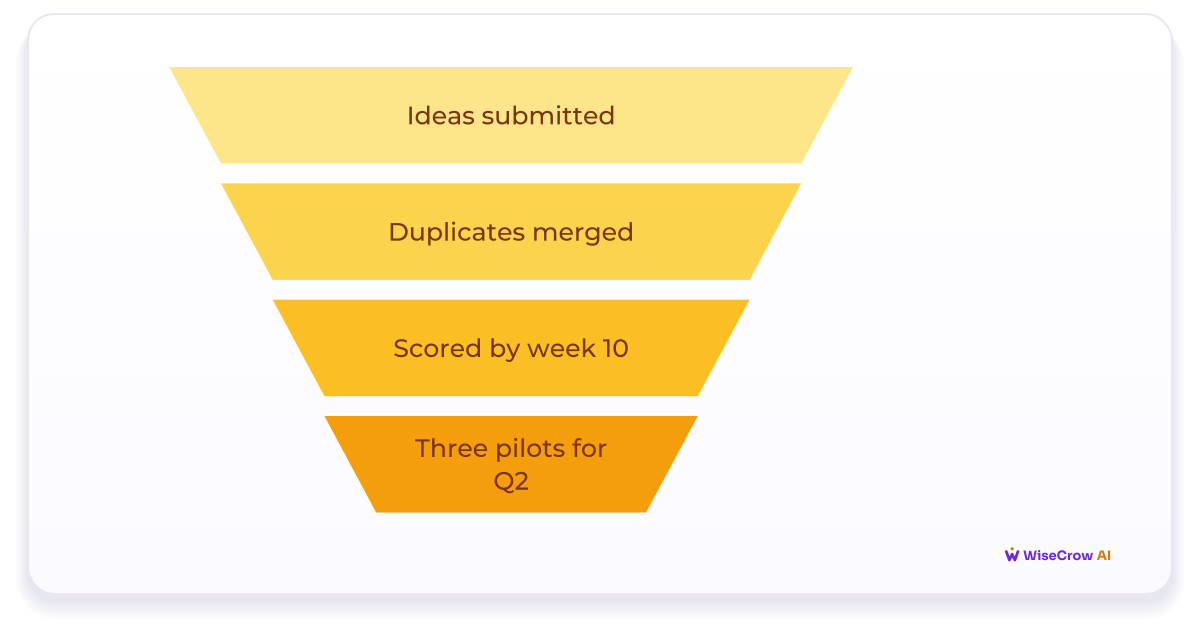
The program lead opens a single form for GenAI ideas. Keep it to a handful of questions: the task, how often it happens, who does it today, which data it needs and what a wrong answer would cost. In my client work, the first month of intake usually brings in forty to eighty ideas in a mid-sized company, and many of them are the same idea from different teams.
Score them by the end of week 10 and pick three for Q2. Merge the duplicates first, because a request that came from five departments is a strong signal.
Data Access Requests Filed Before the Pilots Are Final
The data platform owner files access requests for the likely pilot sources as soon as the top ten ideas are visible, often in week 7. SharePoint sites, ticket histories and contract folders each have their own owner and their own review. Access almost always takes longer than the build, so start the clock early, even if one or two requests turn out to be for ideas you drop.
Q1 is done when the policy is published and acknowledged by staff, the approved tools work with single sign-on, three pilots have a named business owner and a baseline for the task, and data access for those three is granted or has a firm date. If access for one pilot is still open, swap that pilot for the next idea on the list. Don’t wait.
Skip Platform Shopping in Q1
Vendors will offer you an all-in-one GenAI platform in week two. Don’t buy one yet. You don’t know which retrieval, logging or model needs your pilots will have, and a platform chosen before the first test set usually gets replaced. A long AI ethics charter can wait too. The short policy does the job for now.
Q2: Three Pilots, Each Scored Against a Test Set
Each pilot gets a product owner from the business, an engineer and one or two domain experts who grade answers. The program lead holds the scorecard. The seat pilot runs in parallel under the IT end-user lead, with a group large enough to show real usage patterns, usually a few dozen people across two or three teams.
Pick Pilots Where Errors Show Up Quickly
Good first pilots have outputs a person reviews anyway: draft replies to support tickets, first-pass contract summaries, answers from an internal policy library. A wrong answer gets caught in the normal flow, so you learn fast and nothing reaches a customer unchecked. Leave anything that sends text straight to customers, or decides about people, for later in the year.
Write the Test Set Before the First Prompt
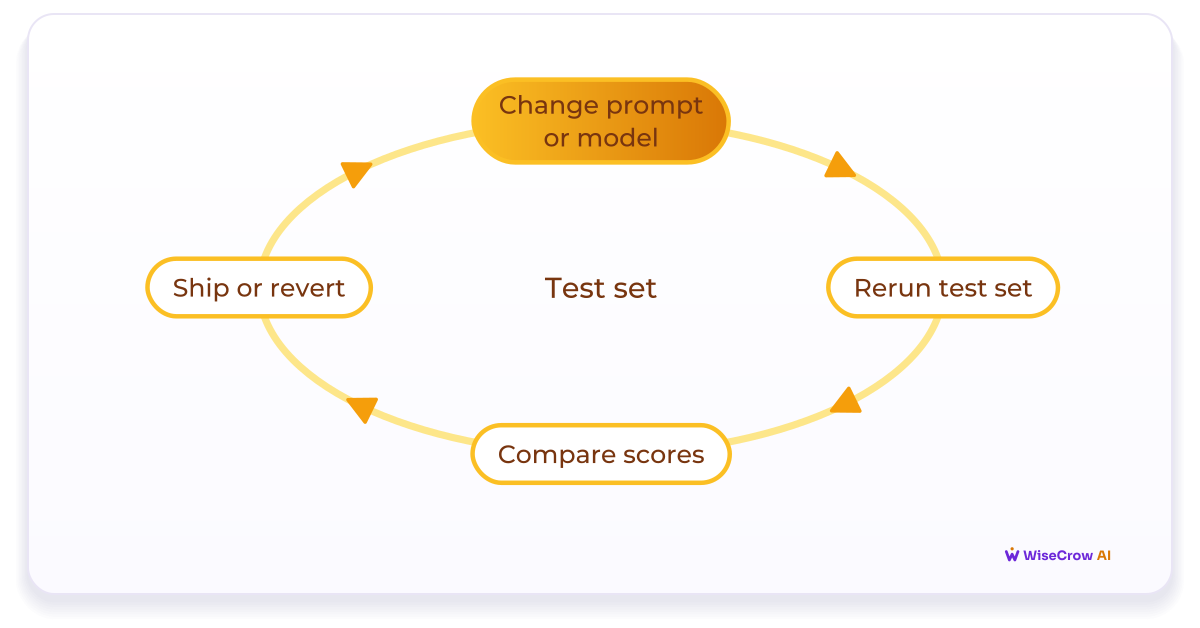
The domain experts collect real questions or tasks from recent weeks, often 50 to 150 of them, and write down what a good answer looks like. Agree on a passing score with the product owner before the build starts. I’ve sat in too many pilot reviews where the team set the bar after seeing the results.
The test set outlives the pilot. Every prompt change, model update and new document source gets run against it from now on, so keep it in version control next to the code.
A Seat Pilot With a Number Attached
Before the seat pilot starts, ask each team how many hours a week go into drafting, summarizing and searching. After six weeks, ask again and check the usage logs. Seats that are opened twice a month won’t pay for themselves, however well they demo. My ranking of the best generative AI tools compares the main assistants if your approved list still has gaps.
Put your own figures into the calculator: weekly hours on the task, the share the assistant takes off people’s plates, staff cost and the monthly cost of the seats. If the result is thin at pilot scale, it won’t improve when you buy a thousand licenses.
Will It Pay for Itself?
Move the sliders to match the work you want to automate and the plan you are considering.
Q2 is done when each pilot has a final score against its test set, a measured time saving on the real task and a cost per answer at pilot volume. Expect one of the three to miss. Write down why it missed, return it to the backlog with a note and move on with the others. The seat pilot is done when you know which teams use the assistant weekly and which don’t.
Leave Fine-Tuning Off the Q2 Plan
Fine-tuning sounds like the serious option, and teams love to propose it here. For most enterprise pilots, better retrieval and clearer prompts close the gap at a fraction of the effort. Revisit it only when a passing pilot hits a wall that retrieval can’t fix, such as a strict output format or a very specialized vocabulary.
Q3: Production, Shared Platform and Cost Controls
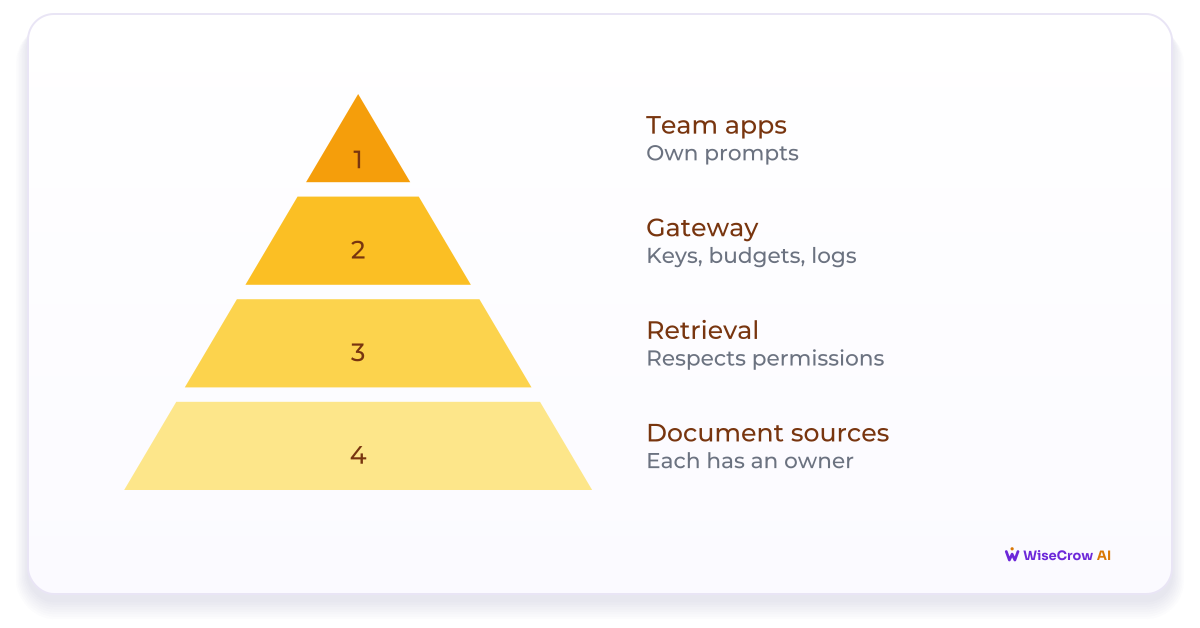
Two or three passing pilots now need the same things: search over company documents, access control, logs and a budget limit. The platform lead owns that shared layer, a security architect reviews it and someone in FinOps sets up the cost reports. Product owners keep their apps and move them into production on top of it. My guide to taking GenAI to production covers the release steps in more depth.
Retrieval That Respects Document Permissions
Retrieval-augmented generation, or RAG, finds the relevant passages in your documents and hands them to the model with the question. The hard part is permissions. If a person can’t open a file in SharePoint, the app mustn’t quote it to them. Build that check into the shared retrieval layer once, and every later app inherits it.
Assign a content owner for each source as well. Stale policy documents produce confident, outdated answers, and only the owner of a library knows which files should have been archived years ago.
A Gateway Between Every App and Every Model
An AI gateway is a single entry point that all apps call before reaching any model. It handles keys, logging, rate limits and routing in one place. When a provider changes a model or raises a price, you switch it in the gateway and leave the apps alone. A gateway also gives you one log to search when someone asks what the AI told a customer last Tuesday.
Budgets and Alerts per Team
FinOps sets a monthly budget per app and per team in the gateway, with an alert at 80% and a hard limit for test environments. Report cost per answer next to usage, since a rising bill is fine when answers rise with it. The surprise bills I’ve seen came from a test script left running over a weekend, and the hard limit catches exactly that.
Security Tests Before Each App Goes Live
The security architect tests each app against the OWASP Top 10 for LLM Applications, which covers prompt injection, sensitive data disclosure, excessive agency and unbounded consumption, among others. Run the tests on the production setup, with the real retrieval sources connected, because most injection risks come in through documents.
Q3 is done when at least two apps run in production on the shared platform, each with an owner on call, a passing score on its test set after the move and cost reports per team. On the seat track, licenses go to the teams that used them in the pilot, and nobody else yet.
Hold Back Agents That Act on Their Own
By Q3, someone will propose an agent that books, files or sends things without a person approving each step. Keep it for next year. Your logs, permissions and test sets are a few weeks old. Agents need all three to be boring and reliable before they get write access to anything.
Q4: Adoption, Training and the Portfolio Review
The last quarter turns pilots into habits and decides what gets money next year. HR and the program lead own adoption. The sponsor and a finance partner own the portfolio review. Procurement joins for the license renewal.
Champions in Every Team With Seats
Pick one person per team who already uses the assistant every day. Give them an hour a week to answer questions and share the prompts that work for their role. Training by role works better than one company-wide course: a recruiter and a contract manager need different examples, and generic sessions are forgotten within a month.
A Second Batch From the Backlog
The Q1 backlog is still there, now with an extra filter: does the idea reuse the shared retrieval layer and gateway? Ideas that do go first, because they skip most of the Q3 work. Take two or three, run them through the same test-set routine and plan their production dates for early next year.
Keep, Fix or Stop for Every Live App
The sponsor reviews each live app on four numbers: test-set score, weekly users, time saved against the Q1 baseline and cost per answer. Each app gets one of three outcomes. Keep it and fund it, fix one named problem by a set date or switch it off and remove its access. To get the time-saved figures into a form finance accepts, my breakdown of how to measure generative AI ROI walks through the math.
Renew seat licenses on real usage. In the year-one renewals I’ve worked on, a noticeable share of seats had sat unused for months, and cutting them paid for most of the champions’ time.
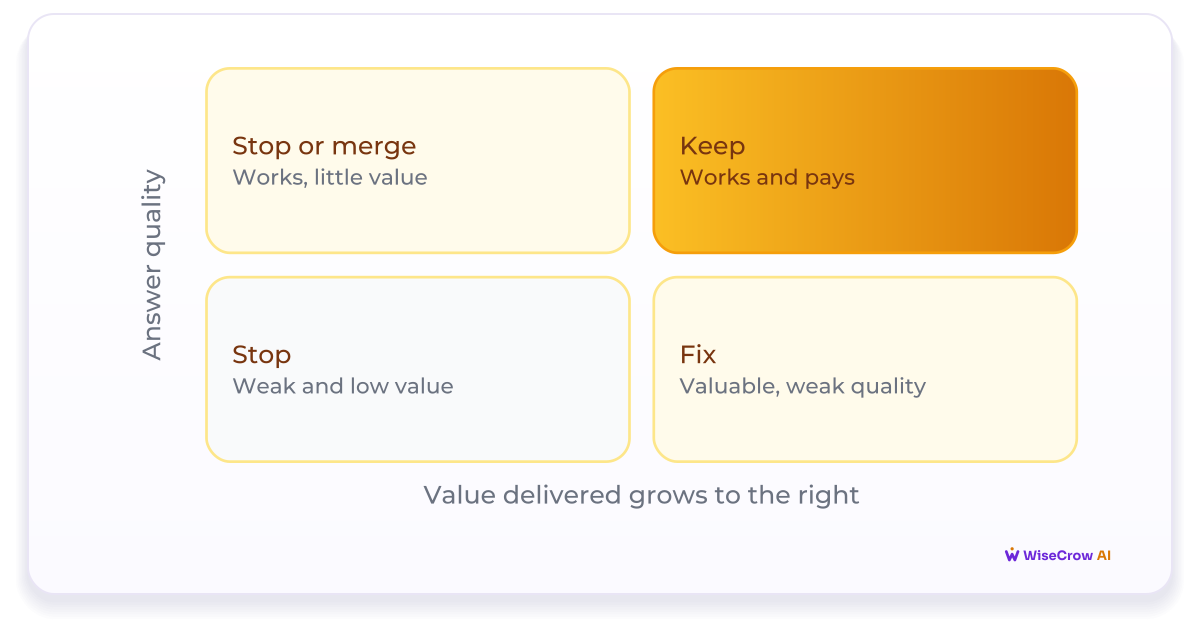
Q4 is done when every live app has a keep, fix or stop decision on record, the license count matches weekly usage, champions are named in every team with seats and next year’s plan has a budget agreed with finance.
Don’t Rewrite the Strategy
The year-end temptation is a fresh strategy deck with a new vision. Skip it. Update the roadmap table with what you learned, move the stopped apps to the archive and carry the backlog forward. Year two should feel like the second loop of a working routine.
Where Regulation Fits in the Calendar
Rules for AI differ by market and keep changing, so I don’t pin legal milestones to specific weeks in the plan. What I do is give legal two fixed checkpoints: during the Q1 policy work and at the Q2 pilot selection, before any use case touches decisions about people.
If you operate in the EU or serve EU users, the EU AI Act applies. It sorts AI uses into risk levels, bans a short list of practices and sets transparency duties, for example telling people when they’re talking to a chatbot. Obligations for general-purpose AI model providers already apply. The timeline for high-risk uses has since been amended, so check the current status before you plan anything in hiring, credit, education or other sensitive areas. In the US, the picture is a patchwork of state laws and sector rules, which is one more reason to keep the high-risk uses out of the first year.
How to Choose Your Starting Quarter
Few companies start from zero. Find the first quarter whose exit criteria you can’t yet meet, and start there.
If staff use public chat tools with no policy, you’re in Q1, even if a team has already built something impressive. Publish the policy and approved tools within weeks, and treat the existing build as one of your three pilots.
If you have a policy and a handful of demos but no test sets, start in Q2. Demos that never faced a test set are ideas with a nice interface. Score them before you fund them.
If several apps already passed testing and each team built its own retrieval and keys, jump to Q3 and consolidate. Moving three apps onto one gateway is cheaper now than moving ten next year.
If apps are live and seats are bought but nobody can say what they deliver, start with the Q4 portfolio review. It tells you what to keep before you spend another dollar. Then go back to Q1 for anything that was skipped, usually the intake form and the baselines.
Questions About Generative AI Roadmaps
What Is a Generative AI Roadmap?
It’s a dated plan for bringing generative AI into a company: which rules come first, which use cases get piloted, when shared infrastructure gets built and how you decide what to keep. A useful one names an owner for every line and the evidence needed before the next quarter starts.
How Long Does an Enterprise Generative AI Roadmap Take?
The plan on this page covers one year. Foundations take a quarter, pilots take a quarter, production and the shared platform take a quarter and the last quarter goes to adoption and a portfolio review. Smaller companies with fewer approvals can often move faster through the first two quarters.
Who Should Own the Generative AI Roadmap?
One executive sponsor with budget authority, usually the CIO or a business leader, with a named GenAI program lead running it week to week. Legal, security, data and HR each own specific lines. If every line has the same owner, nobody outside that team will feel responsible for it.
Should We Buy Assistant Seats or Build Our Own Apps First?
Run both, on two tracks. Bought assistants give quick, broad value for drafting and summarizing. Built apps answer questions from your own data and fit specific workflows. Pilot a small group of seats in Q2 while the first built apps go through testing, then let the results decide where money goes in Q3.
When Do We Need a RAG Platform and an AI Gateway?
Usually in the third quarter, once two or three pilots have passed their tests and need the same things: search over company documents, access control, logging and cost limits. Building it earlier means guessing at requirements. Building it later means each team builds its own version.
How Do We Measure Whether a Generative AI Pilot Worked?
Agree on a test set of real questions or tasks before the pilot starts, with expected answers and a passing score. Then add a business measure, such as minutes saved per case, and a cost per answer. A pilot passes when quality, time saved and cost all meet the targets set at the start.
Does the EU AI Act Change Our Generative AI Roadmap?
If you operate in the EU or serve EU users, it can. The act sorts AI uses by risk, and rules for general-purpose AI models already apply to their providers. Parts of the timeline for high-risk uses have been amended, so check the current status before you plan any use case that touches hiring, credit or other sensitive decisions.
Sources
- Gartner: Gartner Predicts 30% of Generative AI Projects Will Be Abandoned After Proof of Concept by End of 2025 (July 2024)
- NIST: AI 600-1, Artificial Intelligence Risk Management Framework, Generative Artificial Intelligence Profile (July 2024)
- OWASP Gen AI Security Project: Top 10 for LLM Applications (2025)
- European Commission: AI Act, Shaping Europe’s Digital Future
General information only: this is not legal, financial or tax advice. Examples and numbers reflect typical projects; check the specifics with your advisers before deciding.
Did you find this helpful?
Thank you for your feedback.
Marlena leads the WiseCrow editorial team and works with our consultants to turn real client projects into practical guides on AI strategy, automation and governance. Before joining WiseCrow, she spent 12 years in B2B operations and SaaS content. She has since edited more than 400 articles on AI and automation and reviewed workflows from over 60 client projects. She is based in Austin, Texas.