Summary
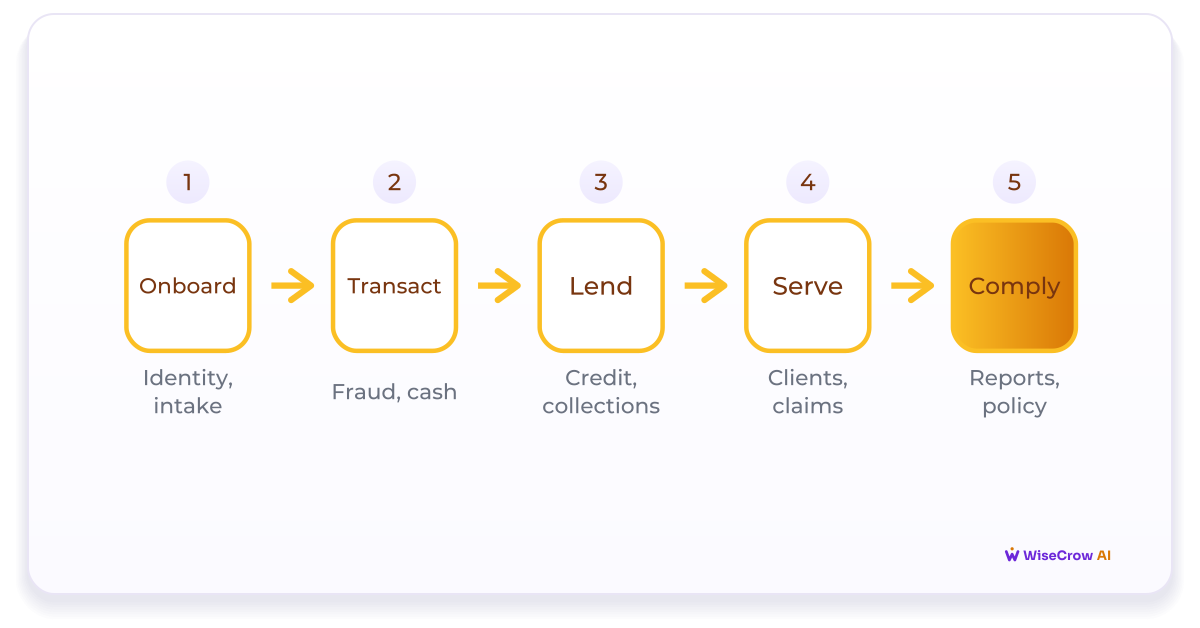
- Grouping AI use cases by the customer journey (onboard, transact, lend, serve, comply) shows where each queue and each risk sits.
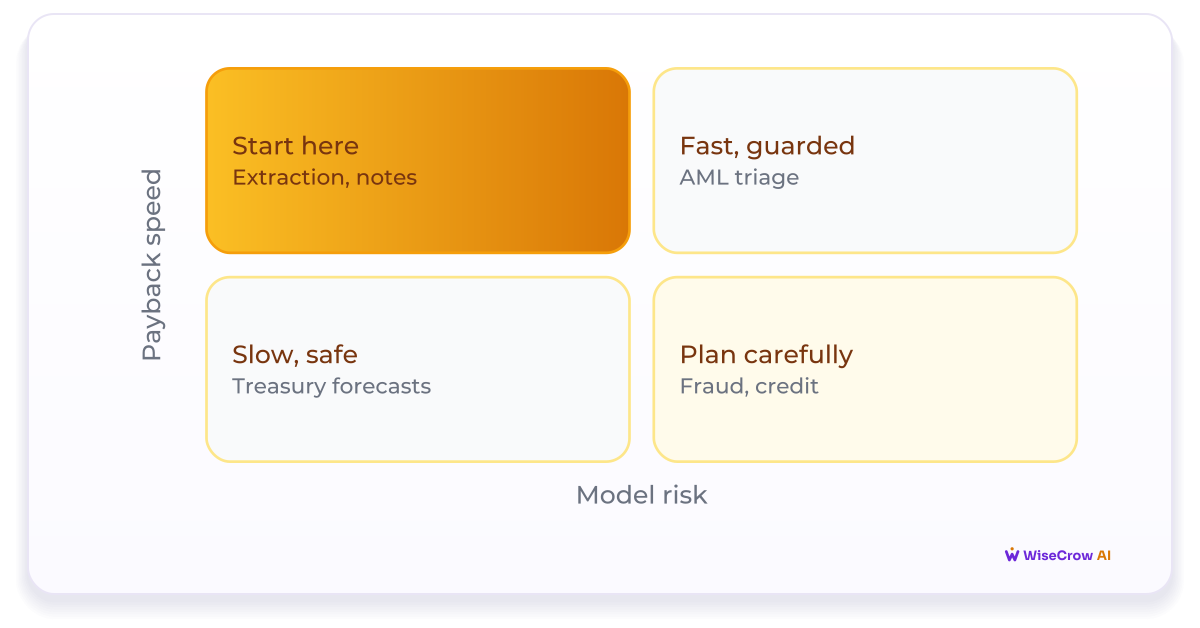
- Document and drafting use cases pay back fastest and carry the lowest model risk.
- Fraud, AML and credit models return the most, and they need full validation and fairness testing.
- Start with a low-risk queue that hurts today, then reuse its controls for the higher-risk cases.
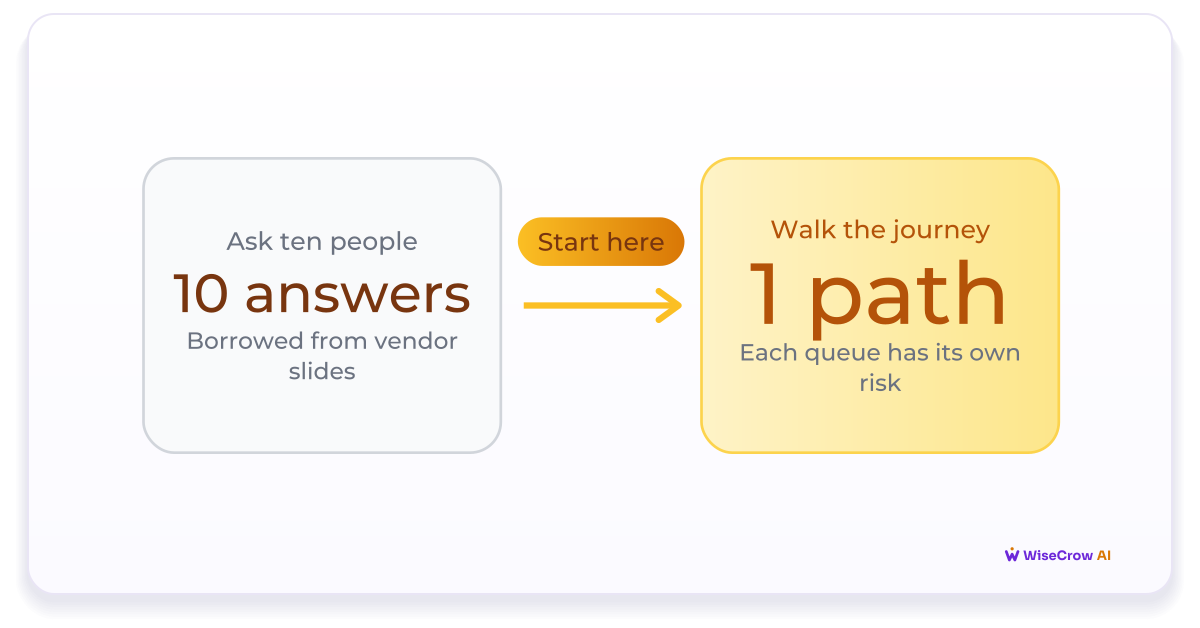
Ask ten people at a bank where AI should go first and you’ll get ten answers, most of them borrowed from a vendor’s slide. When a lender or insurer brings me in for financial services AI consulting, I put the slides aside and walk the customer’s path: how someone opens an account, moves money, borrows, asks for help and, now and then, complains. Every step has a queue, and every queue has its own risk profile.
You’ll find twelve use cases below, grouped by those five stages. For each one I cover how it runs, where it breaks and the kind of software that handles it. The table scores all twelve first, because in finance the model risk column often decides what you can launch.
Twelve Use Cases Scored on Effort, Payback and Model Risk
Effort covers data work, integration and approvals. Payback is the range I see in my client work from kickoff to a measurable result, so treat it as a planning guide. Model risk reflects how much a wrong output could hurt a customer or break a rule, and it drives how much validation your second line will ask for.
| Use case | Effort | Payback I see | Model risk |
|---|---|---|---|
| 1. KYC and Identity Document Checks | Medium | 3 to 6 months | Medium |
| 2. Underwriting Document Extraction | Low | 2 to 4 months | Low |
| 3. Card Fraud Scoring | High | 6 to 12 months | High |
| 4. AML Alert Triage | Medium | 4 to 8 months | High |
| 5. Treasury and Liquidity Forecasting | Medium | 6 to 9 months | Medium |
| 6. Credit Decision Support With Reason Codes | High | 9 to 18 months | High |
| 7. Collections Prioritization | Medium | 3 to 6 months | Medium |
| 8. Customer Service Assistant | Medium | 3 to 6 months | Medium |
| 9. Advisor Copilot and Meeting Notes | Low | 1 to 3 months | Low |
| 10. Insurance Claims Triage | Medium | 4 to 8 months | Medium |
| 11. Complaint Analysis | Low | 2 to 4 months | Low |
| 12. Regulatory Reporting and Policy Q&A | Medium | 4 to 8 months | Medium |
Two patterns stand out. The low-risk rows mostly read and summarize documents, and a person still makes every decision. The high-risk rows score or rank customers, and they bring the biggest payoff along with the longest review. Most firms I work with start low and earn the right to go high.
Onboard: Identity Checks and Application Intake
The first contact with a new customer is a pile of documents. Both use cases here read those documents faster and more consistently than a person retyping them, and both keep the actual decision with your analysts and underwriters.
KYC and Identity Document Checks
Opening an account means checking an ID, a proof of address and, for business clients, a stack of ownership papers. AI reads each document, pulls the fields, compares them with the application and flags mismatches such as a name spelled two ways or an expired passport. Clean files go straight through. Analysts see only the ones with a problem, and applicants wait less.
Business onboarding is where the hours hide. A single company file can include formation papers, a shareholder register and IDs for every owner above your threshold. In my client work, the first win usually comes from extraction and cross-checks alone, before any risk scoring. Keep liveness and forged-document detection with a specialist provider, because fake IDs change faster than an in-house team can retrain a model.
How an Application Moves Through Checks
- The applicant uploads an ID, proof of address and any business documents.
- AI classifies each file and extracts names, dates, addresses and ID numbers.
- Extracted fields are matched against the application and the sanctions and PEP screening results.
- Mismatches, expired documents and low-confidence reads go to an analyst queue.
- The analyst resolves the exception, and the decision is logged with the evidence.
- Clean files are approved under your policy, and QA checks a sample each week.
Where KYC Extraction Comes From
Identity verification providers bundle document checks, liveness tests and database lookups behind one API. For business files, a document AI service connected to your onboarding workflow handles the extraction, while your screening vendor keeps running the watchlist checks.
Underwriting Document Extraction
Loan and insurance applications arrive with bank statements, tax returns, pay stubs, medical forms or inspection reports. Underwriters still retype much of that into their systems before they can weigh the risk. AI extraction reads the pack, fills the fields and builds a short summary with page references. The underwriter opens a file that’s already complete and spends the time on the decision.
Model risk stays low because a person checks every field that feeds a decision, and the AI makes no call of its own. Bank statements are the tricky input. Layouts differ by bank, scans arrive crooked and some applicants send phone screenshots. I ask for a confidence score on every extracted field and route anything below the threshold to a person, which keeps quiet errors out of the file.
From Application Pack to Underwriter’s Desk
- Documents arrive by upload, email or broker portal and are split into separate files.
- Each file is classified, such as statement, tax return or survey report.
- AI extracts the fields your underwriting system needs, with a confidence score per field.
- Calculated figures, like average monthly income, show the source lines behind them.
- Low-confidence fields are highlighted for the underwriter to confirm.
- The completed record and a one-page summary land in the underwriting queue.
Extraction Software That Fits Underwriting
Intelligent document processing platforms and the document AI services from the big cloud providers both handle statements and forms well. Test them on your ugliest scans, since the clean samples in a vendor demo tell you little.
Transact: Fraud, Financial Crime and Cash
Money moving is where fraud and financial crime show up, and where AI has the longest track record in finance. In their 2024 survey, the Bank of England and the FCA found that 75% of responding UK firms already used AI. Those firms named anti-money laundering and fighting fraud among the areas with the highest current benefit. The third use case in this stage looks after your own cash.
Card Fraud Scoring
Every card payment gets a score in milliseconds, and the score decides what happens next: the payment goes through, gets declined or triggers a check with the customer. Machine learning models read the amount, merchant, device, location and the cardholder’s usual pattern. Good scoring cuts losses. It also cuts the false declines that embarrass a customer at the till and push them toward another card in their wallet.
Public sector results show the scale machine learning can reach: the US Treasury credited it with about $1 billion in check fraud recovery in fiscal year 2024. For a card issuer, the hard parts are speed and feedback. The model must answer inside the authorization window, and confirmed fraud labels arrive weeks later through chargebacks, so retraining always runs a little behind the criminals.
What Happens in the Authorization Window
- The authorization request arrives with amount, merchant, device and location data.
- Features such as spend velocity and distance from the last purchase are calculated on the fly.
- The model returns a fraud score, and your rules combine it with hard limits.
- Low scores pass, high scores decline, and the middle band triggers an app or text check.
- Customer answers and chargebacks flow back as labels for the next retraining cycle.
Who Supplies Real-Time Scoring
Card networks and processors offer fraud scores you can add to your own rules, and specialist fraud platforms let you train on your own portfolio. Larger issuers often run both and compare them in a champion and challenger setup.
Fraud numbers like the Treasury figure change every year, and I keep the latest ones in my AI in finance statistics roundup, each with its date and source.
AML Alert Triage
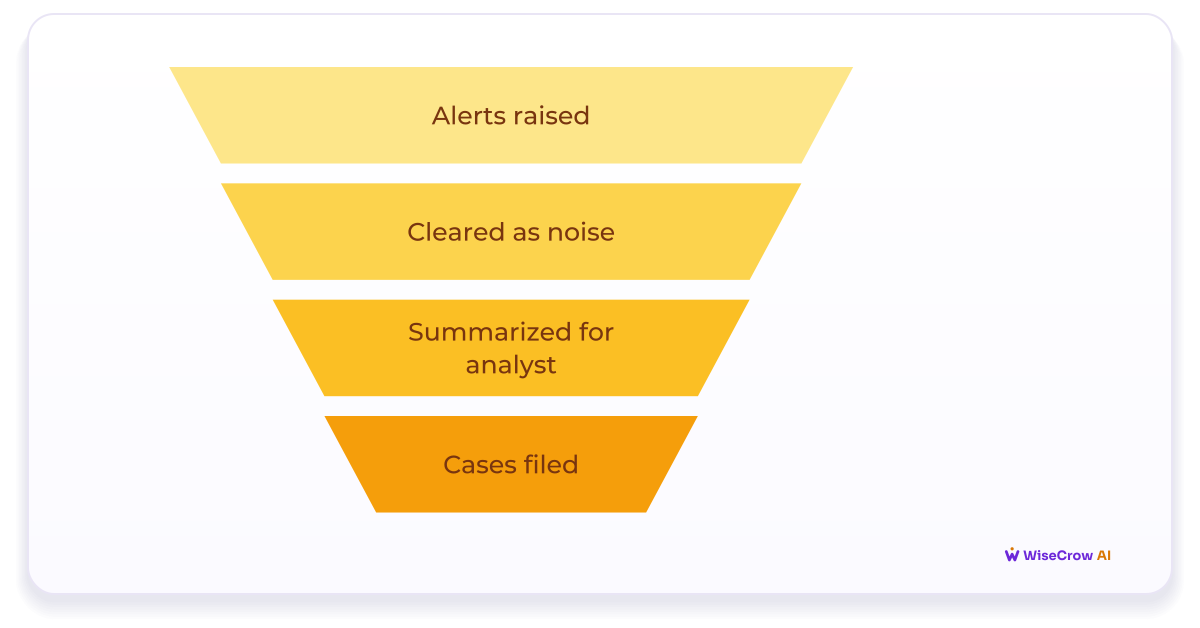
Transaction monitoring rules cast a wide net, and most of what they catch turns out to be ordinary customer behavior. AI triage sits on top of your existing rules. It scores each alert by how likely it is to end in a suspicious activity report, gathers the customer’s history and drafts a case summary. Investigators work the riskiest alerts first and close the obvious ones in minutes.
Model risk here is high even though a person makes every call. If the score pushes a real case to the bottom of the pile, nobody notices until an examiner does. I insist on two controls from day one: no alert closes without the chance of a sampled human review, and the team tracks how many low-scored alerts later become reports. In my client work, the drafted summary pays off sooner than the score, because it helps on every alert from the first week.
Steps Between an Alert and a Decision
- Your monitoring system raises an alert and sends it to the case platform.
- AI pulls the customer profile, past alerts, linked accounts and recent transactions.
- The alert gets a priority score with the main factors behind it.
- A draft narrative summarizes the activity for the investigator.
- The investigator closes, escalates or files, and edits the narrative as needed.
- A second analyst reviews a sample of low-priority closures each month.
- Outcomes feed back to retrain the score and tune the underlying rules.
Platforms Built for Alert Triage
Established financial crime suites now ship AI scoring and narrative drafting inside their case managers. If your monitoring vendor lacks it, an overlay model connected through the case platform’s API works, provided your model risk team can validate it like any other model.
Treasury and Liquidity Forecasting
Treasury teams still build cash forecasts in spreadsheets fed by emails from every business line. AI forecasting reads bank balances, receivables, payables, payroll and loan schedules, learns the seasonal patterns and projects daily cash by entity and currency. Better forecasts mean less idle cash in low-yield accounts and fewer surprise short-term borrowings at month end.
For banks, the same methods support intraday liquidity monitoring, though the regulatory metrics themselves stay rule-based. I’d start with a 13-week cash forecast for one entity and compare the model with the treasurer’s own numbers for a quarter. When the model wins most weeks, people stop sending spreadsheets. When it loses, the misses usually point to a data feed nobody knew was late.
Building the Daily Cash View
- Bank statements and balances load each morning through bank APIs or file feeds.
- Open receivables, payables, payroll and debt payments come from the ERP and treasury system.
- The model forecasts inflows and outflows per entity, currency and day.
- Treasurers adjust for known one-offs such as an acquisition or a tax payment.
- Forecast accuracy is compared with actual cash every week and shown by category.
Software for Cash Forecasting
Treasury management systems and receivables platforms increasingly include AI cash forecasting modules. My ranking of AI in finance tools compares several that finance teams use for forecasting, collections and the monthly close.
Lend: Credit Decisions and Collections
Lending is where AI can earn the most and where it draws the closest scrutiny. Both use cases below rank or score people, so expect your model risk, fair lending and compliance teams to review them more than once.
Credit Decision Support With Reason Codes
Credit models predict how likely an applicant is to repay and suggest an approve, decline or refer decision under your policy. Machine learning can find signals a classic scorecard misses, such as cash-flow patterns in bank data, which helps lenders say yes to thin-file applicants they used to turn away. Every suggestion comes with reason codes that name the main factors behind it.
Reason codes carry legal weight. US lenders must give declined applicants the specific principal reasons under Regulation B, and a complex model doesn’t make that duty go away. The CFPB spelled it out in a 2022 circular, then withdrew that circular in 2025 with dozens of other guidance documents, so check the current position with your compliance team. I build reason codes and fairness testing into the first prototype, because adding them after the model is tuned usually means tuning it again.
How a Credit Suggestion Is Produced
- The application, bureau data and, with consent, bank transaction data are pulled together.
- The model estimates the probability of default and maps it to your policy bands.
- Reason codes list the top factors in plain language for each suggestion.
- Policy rules and hard cutoffs apply on top, and edge cases go to an underwriter.
- Approvals, declines and overrides are logged with the reasons used.
- Fairness and performance are tested across groups before launch and monitored after.
Credit Platforms with Explainability
Decision engines from credit bureaus and specialist lending platforms let you deploy custom models with built-in reason codes. Pick one that stores every decision with its inputs, since you’ll need that record for validation and for any complaint.
Collections Prioritization
Collectors can’t call everyone on day one, so most teams work accounts in order of balance or days past due. AI predicts which customers will pay on their own, which need a reminder and which need a conversation about a payment plan. Contact goes where it changes the outcome, and customers who were always going to pay stop getting calls that annoy them.
The best results I’ve seen come from timing and channel more than from the score itself. A text on payday works better for some customers than a call at noon. Keep strict guardrails: contact limits under debt collection rules, hardship flags that override the model and a person reviewing any account marked for legal action. Collections reaches people in financial trouble, so tone matters as much as the model does.
Setting Each Day’s Contact List
- Accounts entering arrears load with balance, history and past contact attempts.
- AI predicts the chance of self-cure and the best channel and time for each account.
- Hardship flags, contact limits and do-not-contact rules filter the list.
- Collectors and automated reminders work their queues in priority order.
- Promises to pay and payment results update the predictions every night.
Collections Software to Consider
Collections platforms and dialer systems often include AI prioritization and channel optimization. Ask how each one enforces contact limits per customer, because a model that ignores them creates compliance risk quickly.
Serve: Customers, Advisors and Claimants
Service use cases sit closest to the customer and move fastest from pilot to production. They also produce most of the headlines. To see how named banks and insurers fared, my collection of AI in finance examples looks at what they built and what came back.
Customer Service Assistant
A chat or voice assistant answers questions about balances, card freezes, payment dates, policy details and claim status at any hour. It works from your own help content and, once connected, from live account data. Anything involving a dispute, a vulnerable customer or a complaint goes to a person with the conversation attached.
In finance, the assistant has to know where to stop. A wrong answer about a fee or a coverage limit can turn into a complaint or a regulatory finding. I set narrow boundaries at launch, with a list of topics the assistant may answer and a hard handoff for everything else, and widen them only after reviewing a few hundred real transcripts. Customers forgive a handoff. They don’t forgive a confident wrong answer about their money.
What the Assistant Does with a Question
- The customer signs in, and the assistant confirms identity for account-specific questions.
- It finds the answer in approved help content or live account data.
- Questions outside the approved topic list go to an agent.
- Complaints, disputes and signs of vulnerability trigger an immediate transfer.
- Transcripts are sampled weekly for accuracy, tone and missed handoffs.
Assistant Options for Banks and Insurers
Contact center platforms and banking app vendors offer AI assistants that connect to core systems through APIs. Check where conversation data is stored and who can see it before a single customer chats with one.
Advisor Copilot and Meeting Notes
Financial advisors and relationship managers lose a big slice of their week to notes, follow-up emails and CRM updates. A copilot records the client meeting with consent, drafts the summary and action items, updates the CRM and prepares the next meeting brief from past notes and portfolio data. The advisor reviews and signs off before anything is saved or sent.
Model risk is low because nothing reaches the client without the advisor’s approval, though recordkeeping rules still apply to every note. The quick payoff surprises people. Advisors I work with feel the difference within weeks and often ask for the next feature before the pilot ends. Watch suitability language closely. A draft that sounds like a recommendation the advisor never made needs fixing before it lands in the file.
The Copilot’s Work Around a Client Meeting
- The client agrees to recording at the start of the meeting.
- The copilot transcribes the call and drafts a summary with decisions and action items.
- The advisor edits the summary and approves it for the CRM.
- Follow-up emails are drafted for the advisor to send under their own name.
- Before the next meeting, a brief pulls together past notes, open tasks and portfolio changes.
Copilots Built for Advisors
Wealth platforms and CRM vendors now offer meeting assistants tuned to advisor workflows, and general meeting tools can work with the right retention settings. Your compliance team should confirm the archive meets your recordkeeping obligations before the first recorded call.
Insurance Claims Triage
A new claim arrives as a form, photos, a police report or a call transcript. AI reads the intake and sorts the claim by type, severity and complexity. Simple claims go to a fast track, and complex ones go to an experienced adjuster. The model also flags signals worth a fraud review, such as a policy bought days before the loss.
Speed is the visible gain, because small claims can be paid in days. The quieter gain is better use of your adjusters’ time. In my client work, a triage model is right most of the time and badly wrong in a few cases, so routing rules matter more than raw accuracy. Any claim with an injury, signs of litigation or a vulnerable claimant should skip the fast track whatever its score says.
Routing a Claim from First Notice
- First notice of loss arrives through the app, phone, broker or email.
- AI extracts the policy number, loss type, date and amounts from the intake.
- Coverage is checked against the policy, and missing documents are requested automatically.
- The claim gets a complexity score and, where relevant, a fraud-signal flag.
- Simple claims go to fast-track handling, and complex ones to an experienced adjuster.
- Reopened and appealed claims are reviewed to catch triage mistakes.
Claims Software with Triage Built In
Core claims systems increasingly offer AI intake and triage modules, and insurtech vendors sell them as add-ons. Run any model on last year’s closed claims first, so you can see how its routing compares with what actually happened.
Comply: Complaints, Reporting and Policy
The last two use cases point AI at your own obligations. Neither touches a customer decision directly, which makes them easier to approve, and both save hours in teams that rarely get new headcount.
Complaint Analysis
Complaints arrive through calls, emails, branch visits, social media and regulator portals. AI reads every one, tags the product, issue and root cause, and flags complaints that may involve a rule breach or a vulnerable customer. Your complaints team gets a daily view of what’s rising, and product owners see the issues that keep coming back.
Many firms review only a sample of complaints by hand, so patterns can hide for months. Reading all of them closes that gap. In my experience, the most useful output is a weekly root-cause trend product teams can act on, like a confusing fee letter that drives hundreds of calls. Keep a person deciding on redress and on whether a complaint must be reported, and check what your regulator expects on handling times.
Turning Complaints into Themes
- Complaints from every channel are collected in one case system.
- AI tags product, issue, root cause and sentiment, and flags possible breaches.
- Urgent and vulnerable-customer cases jump to the top of the queue.
- Weekly theme reports go to product owners with sample complaints attached.
Tools for Reading Every Complaint
Complaint management and customer feedback platforms include AI tagging, and a language model can handle a custom taxonomy through an API. Validate the tags against a hand-coded sample every quarter, because product names and issues change faster than taxonomies do.
Regulatory Reporting and Policy Q&A
Compliance teams answer the same questions every week: which policy applies, what a procedure says, how a field in a regulatory return is defined. A policy assistant searches your approved policies, procedures and regulatory texts and answers with the exact passage cited. For reporting, AI checks returns for breaks between periods, ties figures back to source systems and drafts the commentary that explains movements.
The citation is what makes it usable. Staff need to see the paragraph an answer came from, so they can judge it and auditors can follow it. I keep regulatory interpretation with your compliance experts and use AI to find and draft. On reporting, the gain comes from catching breaks early, before the deadline squeezes the team into a long week. When rules change, update the source library first, or the assistant will quote a superseded rule with full confidence.
How a Policy Question Gets a Cited Answer
- Approved policies, procedures and regulatory texts are loaded with version dates.
- A staff member asks a question in plain language.
- The assistant finds the relevant passages and answers with a citation for each one.
- Questions it can’t answer from the library go to the compliance team.
- Source documents are refreshed whenever a policy or rule changes, and old versions are archived.
Software Behind Policy Search and Reporting Checks
Enterprise search tools with retrieval-augmented generation handle the policy side, and regulatory reporting platforms are adding AI checks for breaks and variances. Keep both inside your own environment, since policy libraries often contain material you wouldn’t share with a public model.
Count the Analyst Hours an Alert Queue Could Give Back
Most of the use cases above save review time before they change a loss rate, and AML alerts are the easiest place to measure it. Enter the minutes an investigator spends on a typical alert, your weekly alert volume and the share of that work AI can take over, such as gathering history and drafting the narrative. Keep the share modest. A person still reads every alert, so I’d test somewhere between 30% and 50%.
How Much Time Could You Save?
Move the sliders to match one repetitive task in your business.
The result counts hours only. Lower fraud losses, faster onboarding and fewer complaints come on top, and each one needs its own baseline, measured before launch.
How to Choose Your First Financial Services AI Use Case
I use the scorecard as a starting grid and then ask three questions. Together they narrow twelve options to one or two in a single workshop.
Find the Queue That Hurts
Look for the backlog everyone already complains about: onboarding files waiting days, alerts piling up past their service level, claims sitting untouched. A long queue with a clear cost per item makes the business case easy to write and easy to check a year later.
Match the Risk to Your Governance
If your model risk team has never validated a machine learning model, don’t open with credit decisions. Begin with a document or drafting use case from the low-risk rows, and use it to build the inventory entry, validation pack and monitoring your second line will want for the bigger ones. The Bank of England and FCA survey found that only 2% of UK use cases ran with fully autonomous decisions, and a person in the loop is the norm for good reason.
Check the Outcome Data You Already Hold
Every use case needs history with outcomes: alerts with their final dispositions, claims with their settled amounts, loans with their repayment record. Pull a sample and look at how outcomes were recorded. If dispositions sit in free-text notes, plan a few weeks to structure them before any model work starts.
Questions About AI Financial Services Use Cases
What Are the Most Common AI Use Cases in Financial Services?
Fraud detection, AML alert triage, KYC document checks, customer service assistants and credit decision support come up most often. In the Bank of England and FCA survey, firms named AML and fighting fraud among the areas with the highest current benefit. Document and drafting use cases are spreading fastest, because they need a lighter approval.
Which Financial Services AI Use Case Pays Back Fastest?
In my client work, advisor meeting notes, underwriting document extraction and complaint tagging show results within a few months. They save hours from the first week and carry low model risk. Fraud scoring and credit models return more over time, and they take longer to build, validate and approve.
How Do Regulators View AI in Banking and Insurance?
Most supervisors apply their existing rules on model risk, consumer protection, fair lending and operational resilience to AI. The EU AI Act classes AI used for creditworthiness checks and for pricing life and health insurance as high-risk, with extra duties for documentation and human oversight. Timelines for some of those duties have moved, so check the current status for each market you serve.
Does AI Make Credit Decisions on Its Own?
In most firms it doesn’t. AI suggests a decision with reason codes, and policy rules plus an underwriter handle edge cases and overrides. Some lenders automate approvals for small, simple loans within strict limits, while declines usually get a human review or at least a sampled check.
What Data Do I Need for AML Alert Triage?
You need past alerts with their final outcome, the customer profile, transaction history and any linked accounts. Outcomes matter most, because the model learns from which alerts became reports and which were closed. If dispositions sit in free-text notes, structure them first.
Can a Small Bank or Credit Union Use These Use Cases?
Yes. Smaller institutions often get AI through their core banking, card processing or case management vendors, which lowers the build cost. Start with a feature your vendor already offers, run it next to your current process for a few months and compare the results before you switch.
How Do I Keep Customer Data Safe in an AI Project?
Map which data each use case needs and keep only that. Mask account numbers and personal details where the model doesn’t need them, limit access by role and check where every vendor stores and processes data. Add the AI system to your vendor risk and model inventories before go-live.
Sources
- Bank of England and Financial Conduct Authority, Artificial intelligence in UK financial services 2024 (November 2024): bankofengland.co.uk
- US Department of the Treasury, fiscal year 2024 fraud prevention and recovery press release (October 2024): home.treasury.gov
- Electronic Code of Federal Regulations, 12 CFR 1002.9 (Regulation B): Notifications: ecfr.gov
Disclaimer: This article is for general information only and isn’t financial, legal or compliance advice. Effort, payback and risk ratings reflect typical projects, and regulations change, so check the current rules and your own data before you decide.
Did you find this helpful?
Thank you for your feedback.
Marlena leads the WiseCrow editorial team and works with our consultants to turn real client projects into practical guides on AI strategy, automation and governance. Before joining WiseCrow, she spent 12 years in B2B operations and SaaS content. She has since edited more than 400 articles on AI and automation and reviewed workflows from over 60 client projects. She is based in Austin, Texas.