Summary
- Most financial firms now use AI: 75% in the UK regulator survey and 65% in NVIDIA’s 2026 survey, up from 45% a year earlier.
- Fraud is the busiest front. AI recovered about $1 billion in US Treasury check fraud in 2024, while Deloitte forecasts gen AI fraud losses of $40 billion by 2027.
- Agents are early: 21% of firms have deployed them, and only 2% of UK use cases run fully on their own.
- Oversight lags use. Nearly half of UK firms say they only partly understand the AI they run, and a third of their use cases come from outside vendors.
Finance has more AI statistics in circulation than almost any other industry, and plenty of them are vendor claims with the year quietly removed. When a bank or insurer brings me in for financial services AI consulting, the first deck I review usually holds at least one number nobody on the team can trace. So I built this list only from pages I could open and check myself.
You get 45 figures in seven groups, numbered from 1 to 45 so you can cite them easily. Each one has a year and a link. I also say what kind of source it is, because a central bank survey of 118 firms and a vendor poll of 800 professionals answer different questions, even when the headline looks the same.
Six Finance AI Numbers Worth a Slide
If you only have room for six, use these. I picked one from each source type so a skeptical CFO can see that the story holds up across regulators, vendors, forecasters and government data.
| Stat | What it shows | Source | Type |
|---|---|---|---|
| 75% | UK finance firms using AI | Bank of England, 2024 | Regulator survey |
| 65% | Firms actively using AI | NVIDIA, 2026 | Vendor survey |
| 21% | Firms with AI agents live | NVIDIA, 2026 | Vendor survey |
| $40B | US gen AI fraud losses, 2027 | Deloitte, 2024 | Forecast |
| $1B | Check fraud recovered with ML | US Treasury, 2024 | Government data |
| 2% | Use cases fully autonomous | Bank of England, 2024 | Regulator survey |
Read the last row next to the third. A fifth of firms have AI agents running, yet in the one regulator dataset that counts autonomy, almost nothing runs without a person in the loop. Most finance AI today still drafts, scores or flags, and a human makes the call.
How Many Financial Firms Use AI
Adoption is the most quoted figure and the one with the widest spread between sources. The first seven numbers show how far use has moved and how deep it goes.
- 75% of UK financial services firms already use AI, up from 58% in 2022, in a joint survey of 118 firms (Bank of England and FCA, 2024, regulator survey).
- 95% of insurers and 94% of international banks in the same survey use AI, the two highest rates of any sector (Bank of England and FCA, 2024).
- 65% of financial services professionals say their company actively uses AI, up from 45% in the previous year’s report (NVIDIA State of AI in Financial Services, 2026, vendor survey).
- 59% of finance leaders say their finance function uses AI, almost flat on 58% in 2024 and up from 37% in 2023 (Gartner, via CPA Practice Advisor, 2025, analyst survey).
- 16% of finance leaders report no planned AI implementations for the coming year (Gartner, 2025).
- 9 use cases is the median per UK firm today, and firms expect that to reach 21 within three years (Bank of England and FCA, 2024).
- 22% of all reported AI use cases sit in operations and IT, about twice the share of the next area, retail banking at 11% (Bank of England and FCA, 2024).
Three Adoption Surveys Side by Side
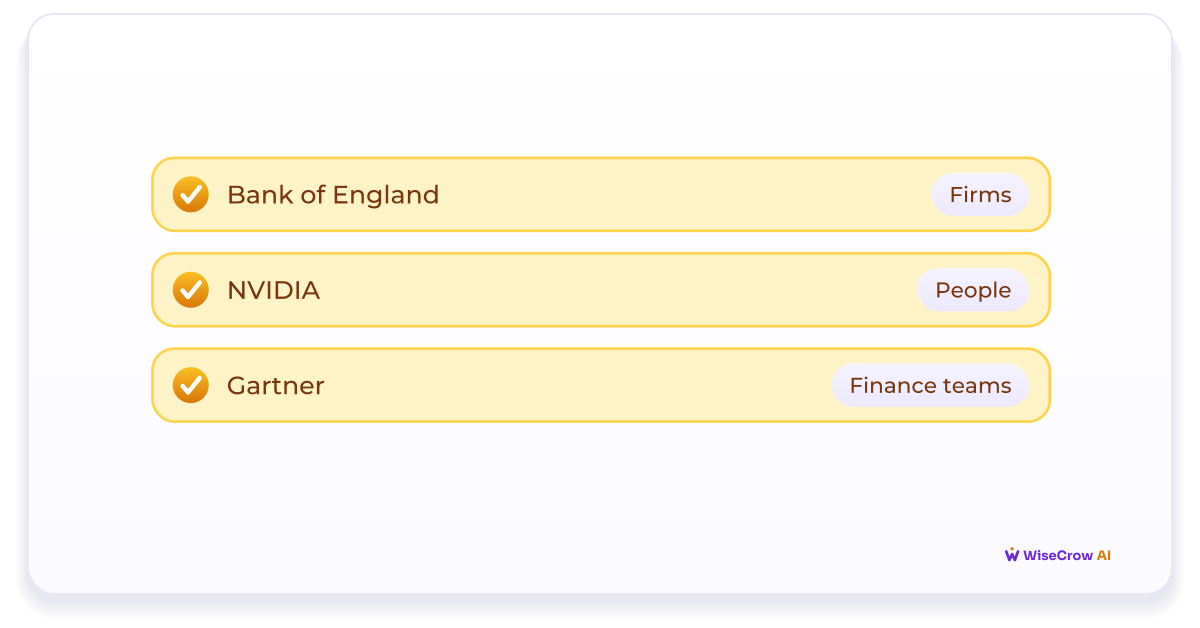
The three headline adoption rates differ by 16 points, and the gap comes mostly from who answered.
| Survey | Who answered | Result |
|---|---|---|
| Bank of England and FCA, 2024 | 118 UK regulated firms | 75% use AI |
| NVIDIA, 2026 | 800+ industry professionals | 65% actively use AI |
| Gartner, 2025 | 183 finance leaders | 59% use AI |
The Bank of England counts firms, and the firm answers once. NVIDIA counts people, so a data scientist at a big bank and a manager at a small credit union each get one vote. Gartner asks about corporate finance teams in every industry, which means a retailer’s accounts payable team counts as much as a bank. All three are honest. They just measure different things.
AI Budgets, Investment and Expected Value in Banking
Hard spend totals for banking AI are scarce, because few banks report AI as its own budget line. The figures below show budget intent, the value forecasts behind it, and the small group of banks that publish a return.
- Nearly 100% of respondents expect their AI budgets to increase or stay the same over the next year (NVIDIA, 2026, vendor survey).
- 41% plan to put their AI investment into optimizing AI workflows and production, ahead of finding new use cases at 34% and AI infrastructure at 30% (NVIDIA, 2026).
- 73% of executives in the survey say AI is key to their company’s future success (NVIDIA, 2026).
- $200 billion to $340 billion a year is the value McKinsey estimates generative AI could add to banking, equal to 9% to 15% of operating profits (McKinsey forecast, 2023).
- 8 banks out of the 50 in the Evident AI Index disclose group-level estimates of AI return on investment (Evident AI Index, via IT Brief, 2025, independent index).
- About $2 billion is JPMorganChase’s updated projection for AI-driven benefits, raised from $1 billion (Evident AI Index, via IT Brief, 2025).
The gap between number 8 and number 12 is the one I talk about most with clients. Almost everyone is spending more, and only eight of the world’s fifty largest banks will put a group-level return in public. Some of that is caution. A lot of it, in my experience, is that the bank never set a baseline before the project started, so there’s nothing to compare against a year later.
Number 9 is quietly the most useful. More money is going into getting existing models into production than into new ideas, which matches what I see. Pilots are cheap. Wiring a model into a core banking system, with logging, access control and model risk review, is where budgets actually go.
Fraud, AML and Cybersecurity Statistics
Fraud is where AI earns its keep in finance, and also where criminals use it hardest. The Bank of England survey found that firms see the highest current benefit from AI in data and analytical insights, anti-money laundering and fighting fraud. The numbers below cover both sides.
- 33% of UK respondents use AI for fraud detection, behind cybersecurity at 37% and optimisation of internal processes at 41% (Bank of England and FCA, 2024).
- 31% more respondents expect to add AI for fraud detection within three years (Bank of England and FCA, 2024).
- About $1 billion in Treasury check fraud was recovered in fiscal year 2024 with the help of machine learning AI (US Department of the Treasury, 2024, government data).
- Over $4 billion in fraud and improper payments was prevented and recovered by the Treasury in fiscal year 2024, up from $652.7 million the year before. The release doesn’t split this total by technology (US Department of the Treasury, 2024).
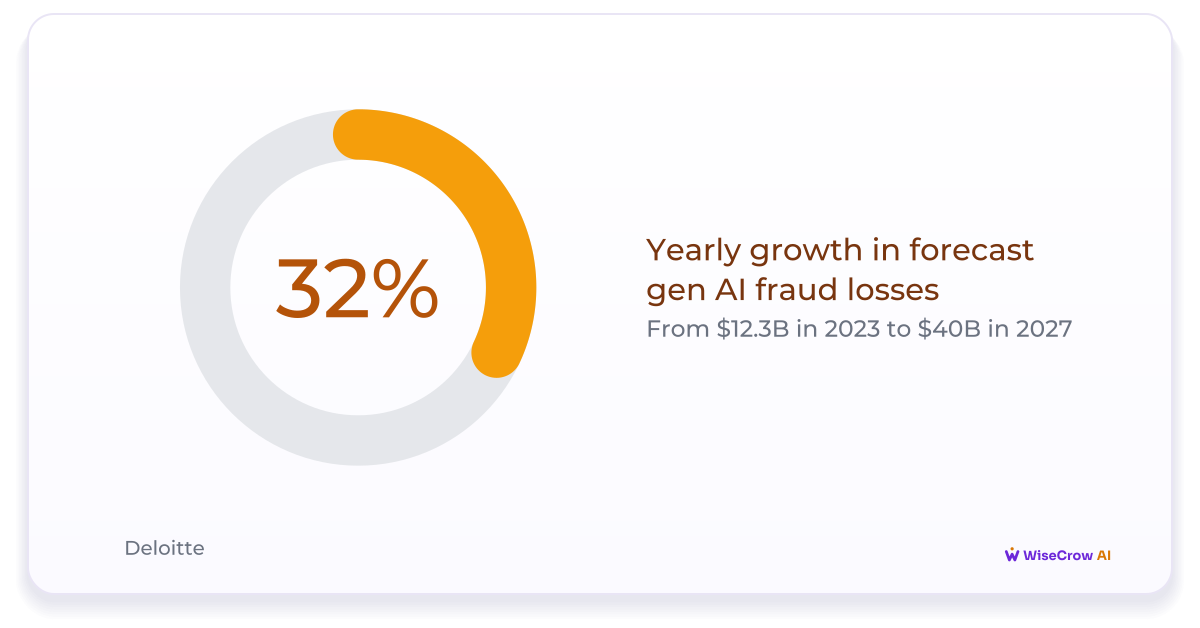
- $40 billion in US fraud losses could be enabled by generative AI by 2027, up from $12.3 billion in 2023, a 32% compound annual growth rate (Deloitte Center for Financial Services forecast, 2024).
- 20 times: deepfake attacks grew twentyfold over three years, according to Federal Reserve Governor Michael Barr, who cited data from identity firm Signicat (Federal Reserve speech, 2025).
- $25 million was transferred to criminals in a 2024 case where a deepfake of engineering firm Arup’s chief financial officer fooled an employee (Federal Reserve speech, 2025).
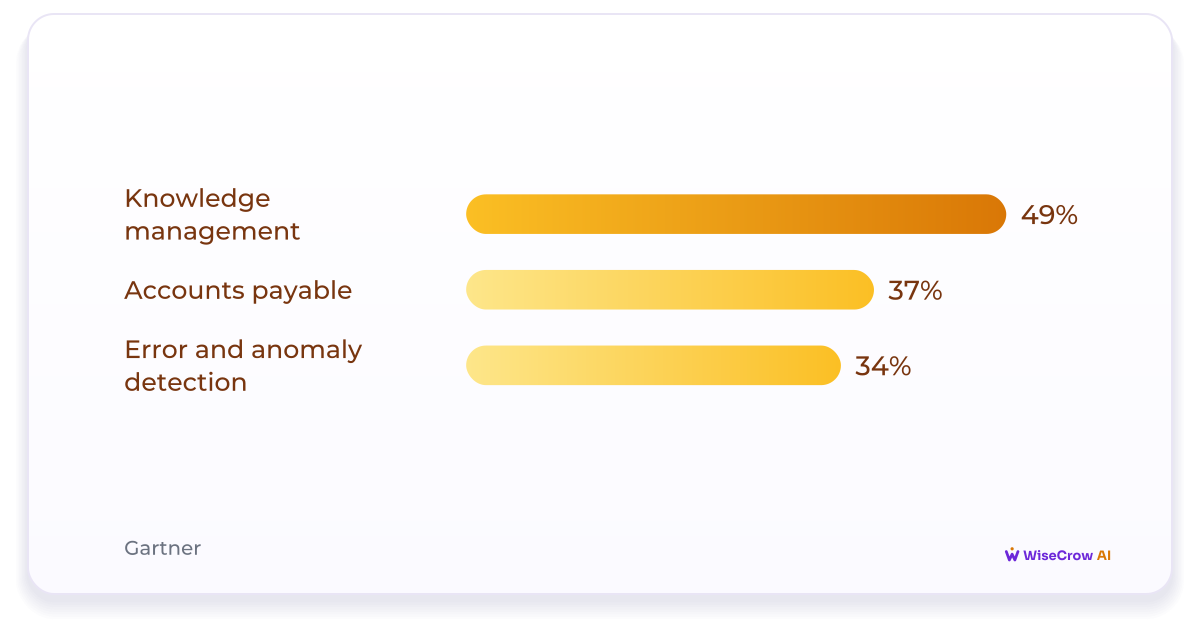
- 34% of finance teams using AI apply it to error and anomaly detection (Gartner, 2025).
Numbers 16 and 18 belong on the same slide. One shows a defender getting a billion dollars back with machine learning. The other shows the attacker’s side growing at a third a year. The deepfake case in number 20 is the one I use with finance teams, because the attack beat a person on a video call and left the models out of it entirely. Since that case, most finance teams I work with have added a call-back rule for large or unusual payment requests.
Anti-money laundering is the gap in public data. Firms rank it among the areas where AI helps most today, yet none of the sources I trust publish a clean figure for alert reduction or false positives across the sector. Vendor case studies fill that space with big percentages from single banks. I cover the fraud, AML and KYC workflows banks fund first in my list of financial services AI use cases.
Customer Service and Back-Office Automation
Customer service bots get the press, and back-office work gets the quiet savings. These six figures come from two companies’ own data and two surveys, so weigh them accordingly.
- 2.3 million conversations were handled by Klarna’s AI assistant in its first month, about two-thirds of the company’s customer service chats (Klarna press release, 2024, company data).
- 700 full-time agents is the work Klarna said the assistant did in that month (Klarna, 2024).
- $40 million is Klarna’s own estimate of the assistant’s profit improvement for 2024, alongside a 25% drop in repeat inquiries (Klarna, 2024).
- 3 billion client interactions have run through Bank of America’s virtual assistant Erica, which has served nearly 50 million users since launch (Bank of America newsroom, 2025, company data).
- 36% more UK respondents expect to use AI for customer support within three years, the biggest planned increase of any use (Bank of England and FCA, 2024).
- 49% of finance teams using AI apply it to knowledge management, the most common use, with accounts payable automation next at 37% (Gartner, 2025).
Klarna’s numbers are a launch-month snapshot from the company itself, and I treat them as the upper bound of what a well-funded fintech can do with clean data and simple requests. Erica is the steadier story: a decade of gradual growth on routine banking requests, inside an app people already use. You can find more of these bank and insurer stories in my roundup of AI in finance examples.
The Gartner use cases are the ones I’d bet on for a mid-sized firm. Knowledge search over policies and past audits, plus invoice matching, don’t touch customers, don’t need a regulator’s blessing and show savings inside a quarter.
Productivity, Returns and the AI Workforce
Results data in finance is mostly self-reported, so read it for direction. The more useful detail is how many firms report gains above 5% and 10%, because those thresholds separate a pilot from a budget line.
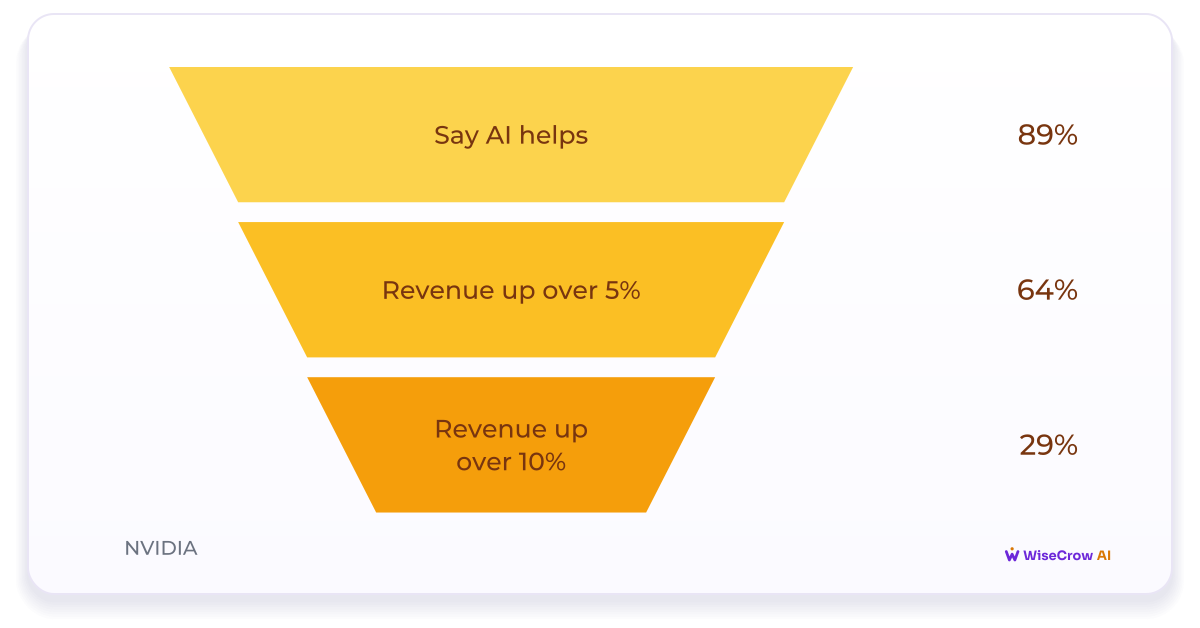
- 89% of respondents say AI is helping increase annual revenue and decrease annual costs (NVIDIA, 2026, vendor survey).
- 64% say AI has raised annual revenue by more than 5%, and 29% by more than 10% (NVIDIA, 2026).
- 61% say AI has cut annual costs by more than 5%, and 25% by more than 10% (NVIDIA, 2026).
- 52% name operational efficiency as the biggest improvement from AI, with employee productivity at 48% (NVIDIA, 2026).
- 91% of finance leaders using AI report only low or moderate impact at first (Gartner, 2025).
- 25% growth in AI talent at the 50 Index banks in one year, the fastest on record and nearly five times the rate of overall headcount growth (Evident AI Index, via IT Brief, 2025).
Put number 28 next to number 32 and you’ll see why finance AI arguments go in circles. Nearly nine in ten professionals report gains, and nine in ten finance leaders say the early impact was low or moderate. Both are true. The gains are real and small at first, and they compound only once the work moves from one team’s pilot into shared systems.
On jobs, the verified data points to hiring and retraining before cuts. Banks are adding AI builders faster than any other role, and the Evident data shows 38 of the 50 banks now disclose some form of AI training for staff. In my client work, the first thing that shrinks is overtime in month-end close and in review queues. Headcount decisions come later, if at all.
Generative AI and AI Agents in Financial Services
Generative AI arrived in finance fast, and agents are following. The five figures below show how far each has gone.
- 61% of financial services professionals are using or assessing generative AI (NVIDIA, 2026).
- 21% say AI agents are already deployed at their company, another 22% expect to deploy them within the next year or later, and 42% are using or assessing agentic AI (NVIDIA, 2026).
- 17% of all AI use cases at UK financial firms run on foundation models, with the highest share in legal functions at 29% (Bank of England and FCA, 2024).
- 83% of respondents call open-source models and software important to their AI strategy, and 43% call it very to extremely important (NVIDIA, 2026).
- Nearly 3 times faster: AI deployment across the 50 banks in the 2026 Evident AI Index moved nearly three times faster than in previous years, with JPMorganChase ranked first again (Evident AI Index, 2026, independent index).
The open-source figure surprises people outside the industry. Banks like open models because they can run them inside their own walls, inspect them and keep customer data away from a third party. That control matters more to a model risk team than a few points of benchmark accuracy.
On agents, I’d hold the 21% loosely. An “agent” in one bank is a chatbot that can reset a password, and in another it is a system that drafts a credit memo and files it for review. If you’re comparing platforms for either job, my ranked list of AI in finance tools shows which ones support audit trails and human approval steps.
Risk, Oversight and Regulation
The UK survey is the best public data on how financial firms control AI, and it shows a sector that adopted faster than it learned to explain. The IMF adds the market view.
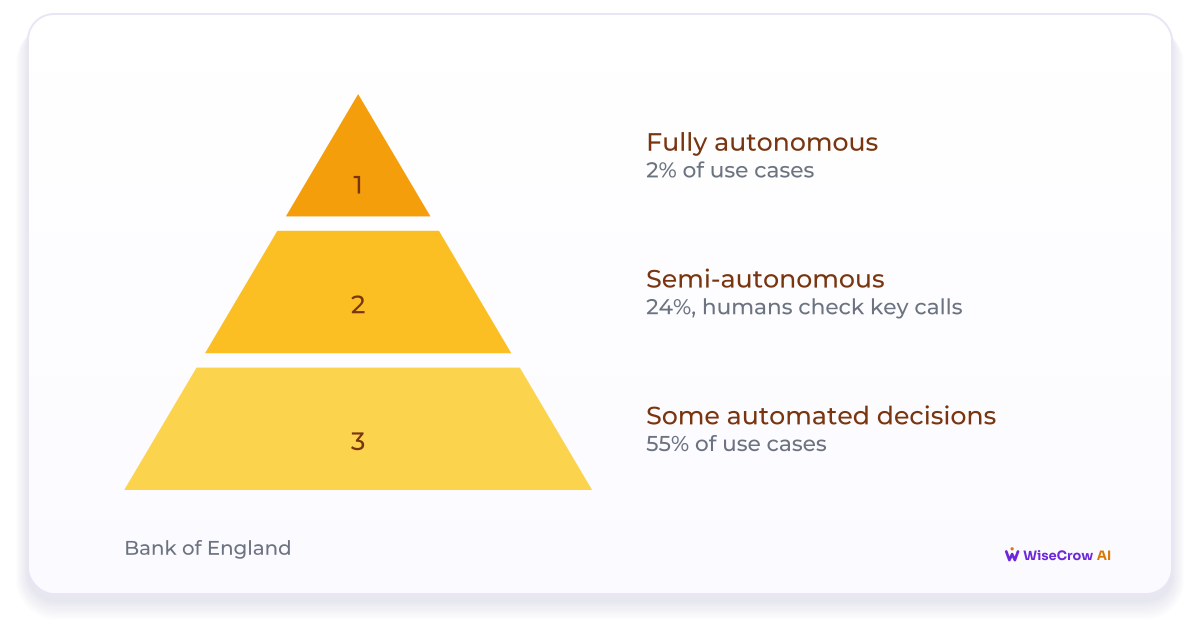
- 55% of AI use cases involve some automated decision-making, 24% are semi-autonomous with human oversight for critical calls, and only 2% are fully autonomous (Bank of England and FCA, 2024).
- 46% of firms say they have only partial understanding of the AI technologies they use, and 34% claim complete understanding (Bank of England and FCA, 2024).
- About a third of AI use cases are third-party implementations, up from 17% in 2022 (Bank of England and FCA, 2024).
- 73% of reported cloud providers are the top three firms, and the top three also account for 44% of model providers and 33% of data providers (Bank of England and FCA, 2024).
- 84% of firms have a named accountable person for their AI framework (Bank of England and FCA, 2024).
- 34% of firms use AI-specific practices for data ethics, bias and fairness, the highest share of any data management area, while only 19% do so for data privacy and security (Bank of England and FCA, 2024).
- From 19% to over 50%: the share of AI content in algorithmic trading patent applications, from 2017 to every year since 2020 (IMF blog on the Global Financial Stability Report, 2024).
Numbers 40 and 41 together explain most of the risk conversation in finance today. A third of AI comes from vendors, and nearly half of firms admit they only partly understand what they run. When a model sits inside a vendor’s product, your team often can’t see its training data or test it the way a model risk policy expects. Number 42 adds concentration: if one of three cloud providers goes down, many firms go down with it.
On regulation, stick to what has been decided. The EU AI Act classes AI used to assess people’s creditworthiness, and to price life and health insurance, as high-risk, with extra duties for testing, documentation and human oversight. Some dates for those duties have already shifted, so check the current status before you plan around one. In the US and UK, supervisors mostly apply existing rules on model risk, consumer protection and operational resilience to AI.
How I Sourced, Dated and Labeled the 45 Figures
I started with primary publishers: the Bank of England and FCA survey, the US Treasury, a Federal Reserve speech, the IMF and the Evident AI Index. Then I added NVIDIA’s yearly financial services survey and Gartner’s finance survey for trend lines, plus company data from Klarna and Bank of America. Each figure links to the publisher or, where the original sits behind a wall, to trade coverage that quotes it.
The year in each item is the year the source came out, as of November 2026. Fieldwork often ran months earlier, so the Bank of England’s 2024 report describes firms in 2024 and NVIDIA’s January 2026 report describes late 2025. Every forecast carries the word “forecast”, and every vendor or company figure says so. I dropped popular figures I couldn’t trace to a working page, including a widely shared spending projection whose original publisher I couldn’t confirm.
How to Choose Finance AI Statistics for a Business Case
Forty-five numbers are too many for a board pack. Pick three or four that answer the question in front of you, and test each one first:
- Is it a bank figure or a finance-team figure? Gartner and NVIDIA measure different populations.
- Who published it, and do they sell the thing being measured? Label vendor data as vendor data.
- Is it a count of firms, people or use cases? “75% of firms” and “2% of use cases” can both be true.
- Is it measured or projected? A Treasury recovery figure happened. A 2027 loss figure is a forecast.
- Does your regulator recognize the source? A risk committee will trust the Bank of England over a blog survey.
For a fraud case, I pair number 16 with number 18 and one internal figure, such as last year’s write-offs. For an operations case, numbers 7, 27 and 31 work well with your own hours spent on reconciliations. Your own figure is what moves the room. Outside figures show that peers have already moved.
Questions About AI in Finance Statistics
What Percentage of Financial Institutions Use AI?
It depends on the survey. The Bank of England and FCA found that 75% of the UK financial firms they surveyed used AI in 2024, up from 58% in 2022. NVIDIA’s 2026 survey of more than 800 financial services professionals put active use at 65%, up from 45% a year earlier. Both count any production use, so a firm with one small model counts the same as a firm with hundreds.
How Much Are Banks Spending on AI?
No single verified total exists for bank AI spend, because most banks don’t report it as a separate line. What the surveys do show is direction: nearly all of NVIDIA’s respondents expect their AI budgets to rise or stay the same in 2026. On the value side, McKinsey estimated in 2023 that generative AI could add $200 billion to $340 billion a year to banking, which is a forecast.
How Is AI Used in Fraud Detection in Banking?
Models score transactions, payments and account activity for patterns that look like fraud, then send risky cases to a person or block them. In the Bank of England and FCA survey, 33% of respondents used AI for fraud detection and a further 31% expected to within three years. The US Treasury credits machine learning with about $1 billion in check fraud recovery in fiscal year 2024.
Is AI Making Financial Fraud Worse?
It is adding new kinds of fraud. Federal Reserve Governor Michael Barr said in 2025 that deepfake attacks had grown twentyfold over three years, based on data from identity firm Signicat. Deloitte forecasts that generative AI could push US fraud losses to $40 billion by 2027. Banks are answering with AI of their own, so both sides of the fight now use the same tools.
How Many Banks Use AI Agents?
In NVIDIA’s 2026 financial services survey, 21% of respondents said their company had already deployed AI agents, and another 22% expected to deploy them within the next year or later. A total of 42% were using or assessing agentic AI. In the UK regulator survey from 2024, only 2% of all AI use cases ran fully autonomously.
Will AI Replace Jobs in Banking?
The verified figures here point to job change first. Banks in the Evident AI Index grew their AI talent by about 25% in a year, nearly five times faster than overall headcount, and 38 of the 50 banks disclose AI training for staff. Klarna said its assistant did the work of 700 full-time agents in its first month, but it’s one company and a launch snapshot.
Where Can I Find Reliable AI in Finance Statistics?
Start with surveys that publish their method: the Bank of England and FCA survey, the IMF’s Global Financial Stability Report, Federal Reserve speeches and the Evident AI Index. Vendor surveys such as NVIDIA’s are useful for trend lines, so quote them with the publisher’s name. Treat any figure without a year or a reachable source as unverified.
Sources
- Bank of England and Financial Conduct Authority, Artificial intelligence in UK financial services 2024 (November 2024): bankofengland.co.uk
- NVIDIA, State of AI in Financial Services: 2026 Trends (January 2026): blogs.nvidia.com
- Gartner, Survey Shows Finance AI Adoption Remains Steady in 2025 (November 2025): gartner.com
- Coverage of the Gartner 2025 finance AI survey: CPA Practice Advisor
- McKinsey, Capturing the full value of generative AI in banking (December 2023): mckinsey.com
- Evident AI Index 2025 results, as reported by IT Brief (October 2025): itbrief.news
- Evident AI Index for Banks, 2026 edition (October 2026): evidentinsights.com
- US Department of the Treasury, fiscal year 2024 fraud prevention and recovery press release (October 2024): home.treasury.gov
- Deloitte Center for Financial Services, Generative AI is expected to magnify the risk of deepfakes and other fraud in banking (May 2024): deloitte.com
- Michael S. Barr, Deepfakes and the AI Arms Race in Bank Cybersecurity, speech at the Federal Reserve Bank of New York (April 2025): federalreserve.gov
- Klarna, AI assistant handles two-thirds of customer service chats in its first month (February 2024): klarna.com
- Bank of America, A Decade of AI Innovation: Erica Surpasses 3 Billion Client Interactions (August 2025): newsroom.bankofamerica.com
- IMF Blog, Artificial Intelligence Can Make Markets More Efficient and More Volatile (October 2024): imf.org
Disclaimer: This article is for general information only and isn’t financial, investment or legal advice. Survey results, forecasts and regulations change with each edition, and forecasts are estimates, so check the original sources for the latest figures before you rely on them.
Did you find this helpful?
Thank you for your feedback.
Marlena leads the WiseCrow editorial team and works with our consultants to turn real client projects into practical guides on AI strategy, automation and governance. Before joining WiseCrow, she spent 12 years in B2B operations and SaaS content. She has since edited more than 400 articles on AI and automation and reviewed workflows from over 60 client projects. She is based in Austin, Texas.