Summary
- HSBC found two to four times as much suspicious activity with 60% fewer alerts, measured over 12 months.
- Most banks here started with tools for their own staff, from JPMorgan’s LLM Suite to BBVA’s 3,000 custom assistants.
- Insurers went straight to claims: Allianz says it cut processing and settlement time on small food spoilage claims by 80%.
- Nearly every figure is company-reported, so check what each one measures before you quote it.
Bank and insurer AI stories travel fast and lose their sources on the way. By the time a figure reaches a conference slide, nobody remembers who measured it or how. So I went back to the originals: ten named organizations, their reported results and a link to the page that published each one. It’s the same groundwork I do at the start of any financial services AI consulting project, because a risk committee’s first question is always who has done it already.
Seven of the ten are banks, two are insurers and one is a payments company, and they’re grouped that way below. Each example covers what the company did, how it works as far as it’s public and what you can copy. Where I fill a gap with my own inference, I mark it “my reading.” If you’d rather see the ideas sorted by function, my list of AI financial services use cases runs from fraud to credit.
Ten Financial Firms and What They Reported
The table gives one headline figure per organization. Every figure is company-reported in some form, and further down I sort them by how much weight each one can carry. Click a name to jump to the details.
| Organization | Sector | Use case | Reported result |
|---|---|---|---|
| 1. JPMorgan Chase | Bank | Staff gen AI portal | ~$2B benefit estimate |
| 2. Morgan Stanley | Wealth manager | Advisor assistant | 98% of advisor teams |
| 3. BBVA | Bank | ChatGPT Enterprise | 2.8 hours saved a week |
| 4. NatWest | Bank | Assistant and staff AI | 12.9M Cora chats in 2025 |
| 5. DBS Bank | Bank | Bank-wide AI and ML | S$750M value in 2024 |
| 6. Commonwealth Bank | Bank | Scam and fraud alerts | 50% lower scam losses |
| 7. HSBC | Bank | Anti-money laundering | 60% fewer alerts |
| 8. Allianz | Insurer | Agentic claims | 80% faster settlement |
| 9. Lemonade | Insurer | AI claims handling | 5% LAE ratio |
| 10. Stripe | Payments | Fraud detection | +64% card-testing detection |
Seven Banks, From Advisor Notes to Money Laundering Alerts
The bank examples split into two kinds. JPMorgan, Morgan Stanley, BBVA and NatWest put generative AI in the hands of staff and customers, mostly since 2023. DBS, Commonwealth Bank and HSBC run machine learning at huge scale for personalization, scams and money laundering. The second group tends to have the firmer numbers, because those systems have run for longer and touch money directly.
JPMorgan Chase: One AI Front Door for the Whole Bank
JPMorgan Chase didn’t build its own large language model. It built LLM Suite, a portal that lets employees use outside models inside the bank’s own controls, and launched it with OpenAI’s model. By August 2024 the tool was available to more than 60,000 employees for writing, summarizing long documents, solving problems in Excel and generating ideas, NBC News reported. Teresa Heitsenrether, who leads data and analytics at the bank, said the plan was to avoid being beholden to any one model provider.
The money figure comes from the top. In October 2025, president and COO Daniel Pinto said the bank’s estimate of AI benefits was heading toward $2 billion, up from $1 billion, according to IT Brief’s coverage of the Evident AI Index. It’s the bank’s own estimate, and it covers all of its AI, from fraud models to LLM Suite, so you can’t pin it on one tool. What I take from JPMorgan is the order of work: tens of thousands of people got one safe front door first, and the individual use cases came after.
How LLM Suite Is Set Up
- Employees open LLM Suite inside the bank’s own environment.
- The portal sends requests to outside large language models, starting with OpenAI’s.
- Staff use it to draft text, summarize long documents, work through Excel problems and brainstorm.
- Engineers can call functions from external models inside their own programs.
- My reading: because the portal sits in front of the models, the bank can switch providers without retraining every user.
The Part a Mid-Sized Firm Can Copy
Give your staff one approved AI tool with logging, so nobody pastes client data into a free chatbot. Keep the model behind it replaceable, because the best model for your work will probably change within a year.
Morgan Stanley: Meeting Notes Advisors Don’t Have to Write
Morgan Stanley Wealth Management fully rolled out the AI @ Morgan Stanley Assistant in September 2023. It’s a chatbot built on OpenAI models that gives financial advisors quick access to the firm’s research and internal knowledge. By June 2024, 98% of advisor teams had adopted it, the firm said in its Debrief launch release. Adoption like that is rare. In my client work, an internal tool that reaches half its target users in the first year is doing well.
The same release launched AI @ Morgan Stanley Debrief. With the client’s consent, it takes notes in advisor meetings, flags action items, drafts a follow-up email for the advisor to edit and send, and saves a note into Salesforce. One advisor quoted in the release said it saves him about half an hour per meeting. Read that as one person’s estimate, chosen by the firm. Multiply it across a full book of client meetings, though, and the reason for building Debrief is plain.
What Happens Around a Client Meeting
- The advisor asks the client for consent to use Debrief.
- Debrief takes notes during the meeting and flags action items.
- After the call, it summarizes the key points.
- It drafts a follow-up email that the advisor edits and sends at their discretion.
- A note is saved into Salesforce automatically.
- My reading: the Assistant’s earlier rollout had already taught advisors to trust AI answers, which made Debrief an easier sell.
What Your Client-Facing Team Can Borrow
Start with the admin your advisors dislike most, such as meeting notes and CRM updates, and keep a human send button on every client email. Ask for client consent up front and record it, since your compliance team will raise it first.
BBVA: 3,000 Assistants Built by Employees
BBVA signed with OpenAI in May 2024 and gave 3,300 employees ChatGPT Enterprise licenses. A year later it nearly quadrupled the deal to 11,000 licenses, and the bank’s May 2025 announcement explains why. Employees who use it to automate tasks report saving an average of 2.8 hours a week, and 83% of licensed users open it at least once a day.
The more telling number is what staff built for themselves. Employees created more than 3,000 custom assistants, and about 1,000 were judged useful across the bank and listed in an internal GPT store. They range from translation and report writing to analyzing financial information to answer customers’ legal questions. A hackathon in Mexico drew over 170 ideas, and the winners targeted commercial service, SME loan underwriting and spotting fraud attempts in emails and text messages. Time savings are self-reported, so I’d treat 2.8 hours as the high end.
How the Rollout Spread Through the Bank
- BBVA started with 3,300 licenses in May 2024.
- Employees built their own GPTs for tasks like translation, summaries and reports.
- Assistants with bank-wide value were listed in an internal GPT store.
- A hackathon surfaced bigger ideas, such as faster SME loan underwriting.
- Usage and time-saved data from the first group made the case for 11,000 licenses.
Run Your Pilot the Way BBVA Did
Give a few hundred people licenses, let them build small assistants and publish the best ones for everyone. Track daily use from week one, because an 83% daily rate makes a far stronger budget case than a satisfaction survey.
NatWest: Cora at Scale and 70,000 Hours Back
NatWest launched Cora, its digital assistant, about nine years ago. In 2025 Cora handled 12.9 million conversations with retail banking customers, and the number of customer journeys powered by generative AI grew from four to 21, according to NatWest Group’s tech, data and AI page. NatWest also calls itself the first UK bank with a strategic collaboration with OpenAI.
The staff-side numbers are less flashy and more useful. NatWest says AI tools have saved 70,000 hours in retail banking through automated call summaries and simpler complaint responses. More than 12,000 coders use AI in software development, and private banking and wealth relationship managers who use AI tools spend 30% more time with customers. All of these are the bank’s own figures. I like that the hours are tied to two named tasks, which makes them far easier to sanity-check than a bank-wide productivity claim.
Where AI Shows Up in a NatWest Working Day
- Customers ask Cora questions in the app and online.
- Generative AI now powers 21 customer journeys, up from four.
- After a service call, AI writes the call summary for the agent.
- Complaint handlers get help drafting simpler responses.
- Relationship managers in private banking use AI tools to prepare faster and spend more time with clients.
A Lesson for Your Contact Center
Automate the call summary before you automate the call, because every agent writes one and nobody enjoys it. Report hours saved per named task, as NatWest does, so your finance team can check the math.
DBS Bank: A Dollar Value Across 370 Use Cases
DBS, Southeast Asia’s largest bank, is one of the few banks that publishes a yearly dollar figure for its AI work. Its 2024 annual report says data analytics and AI/ML delivered over S$750 million of economic value in 2024, more than double the year before. That value came from more than 1,500 models running across over 370 use cases.
The customer-facing piece is personalization. DBS sent more than 1.2 billion personalized nudges to over 13 million customers across the region, and the report says customers who engaged with the nudges and used its AI-powered financial planning tool saved twice as much. Keep two caveats in mind. DBS defines and measures “economic value” itself, and people who act on savings nudges are probably keener savers to begin with. Even so, a bank that counts value per use case every year is ahead of most I talk to.
How a Nudge Reaches a DBS Customer
- Models read a customer’s transactions and account patterns.
- A model picks a relevant prompt, such as a savings or spending tip.
- The nudge appears in the customer’s banking app.
- Customers can act on it, for example in the AI-powered financial planning tool.
- My reading: each use case reports its value to a central team, which is how DBS arrives at one bank-wide figure.
Count Value the DBS Way
Give every AI use case an owner and a value metric before it goes live, then add them up once a year. Your total will be rough, but it beats arguing about AI spend with no number at all.
Commonwealth Bank: Scam Losses Cut in Half
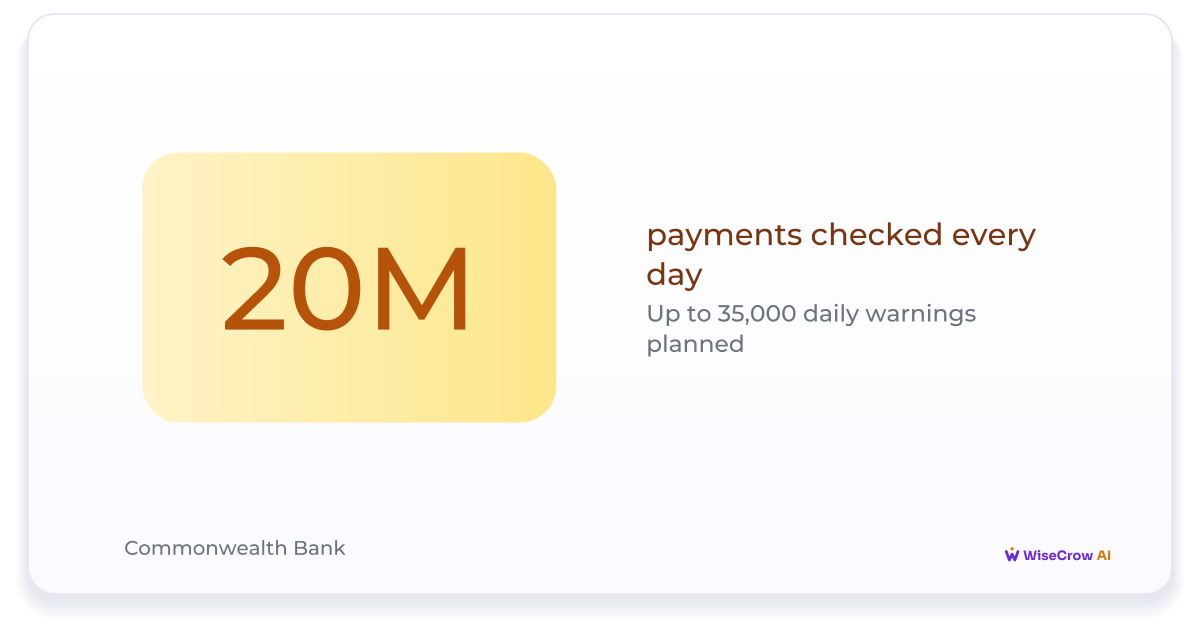
Commonwealth Bank of Australia (CBA) processes and analyses more than 20 million payments a day. In November 2024, it reported a 50% reduction in customer scam losses, aided by its safety and security features, and a 30% drop in customer-reported fraud thanks to measures like generative AI-powered suspicious transaction alerts. The bank was sending 20,000 proactive warning alerts a day to retail customers through its app and planned to scale to 35,000.
The same update said AI-powered messaging in the app helped cut call center wait times by 40% over the financial year, with customers making more than 50,000 messaging inquiries a day. CBA also listed 11 guardrails that protect its models from malicious inputs. Be careful with attribution here. The bank credits the scam result to a set of safety and security features, and AI is one part of that set.
What Happens When a Payment Looks Wrong
- Models check the 20 million-plus daily payments for scam and fraud signals.
- A suspicious transaction triggers a warning alert in the customer’s app.
- My reading: generative AI helps word each alert for the situation the customer is in.
- The customer can stop or confirm the payment.
- Follow-up questions go to in-app messaging, which CBA says can’t yet answer about 10% of inquiries.
Where to Start If Scams Hit Your Customers
Warn the customer at the moment of payment, because a scam caught after the money leaves is mostly a loss. Track scam losses and customer-reported fraud separately, as CBA did, so you can see which control moved which number.
HSBC: Fewer Alerts and More Money Laundering Found
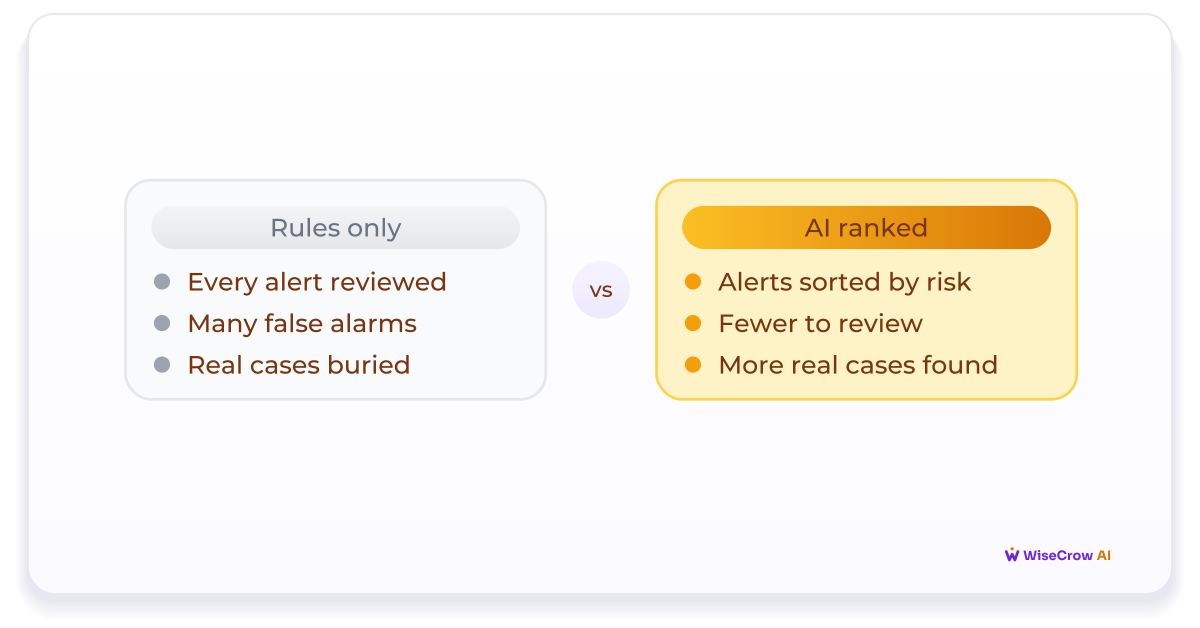
HSBC screens over 1.2 billion transactions a month for signs of financial crime. Its old monitoring was rules-based: staff set parameters, the system flagged matches and investigators worked each case by hand. With Google Cloud, the bank built AML AI, a model trained on its customer data to spot suspicious activity without being told what to look for. Writing on Google Cloud’s blog in November 2023, Richard May, HSBC’s group head of financial crime for global banking and markets and commercial banking, said it finds two to four times as much suspicious activity while cutting alerts by 60%.
The method note is why HSBC is one of my favorite examples. The comparison covers the 12 months after go-live against the 12 months of rules before, adjusted for seasonality, with the first month dropped to avoid backlog effects. Investigators now find twice as much financial crime in commercial banking and almost four times as much in retail, and suspicious accounts are detected within eight days of the first alert. It’s still self-reported and published on a vendor’s blog. Few banks publish their measuring method at all, though.
How a Transaction Gets Reviewed Now
- Transactions feed into AML AI alongside customer data.
- The model looks for patterns like rapid movement of funds or sudden changes in behavior.
- It links accounts that act together, which can expose whole criminal networks.
- Alerts go to investigators, 60% fewer than under the old rules.
- Investigators spend the freed time on cases more likely to be real.
Worth Copying Before Your Next AML Review
Write down the before-and-after method before you switch models, with matching time windows and seasonality, so the result survives an audit. Measure confirmed findings next to alert volume, since fewer alerts only count if you catch more.
Two Insurers Rebuilding the Claims Desk
Insurers have one obvious place to start: claims. Both examples aim AI at small, frequent claims that follow a pattern, and both send anything that needs judgment to a person. They differ in age. Lemonade was built around automation from its first year, while Allianz added agents to an existing claims operation.
Allianz: Seven AI Agents for Storm Claims
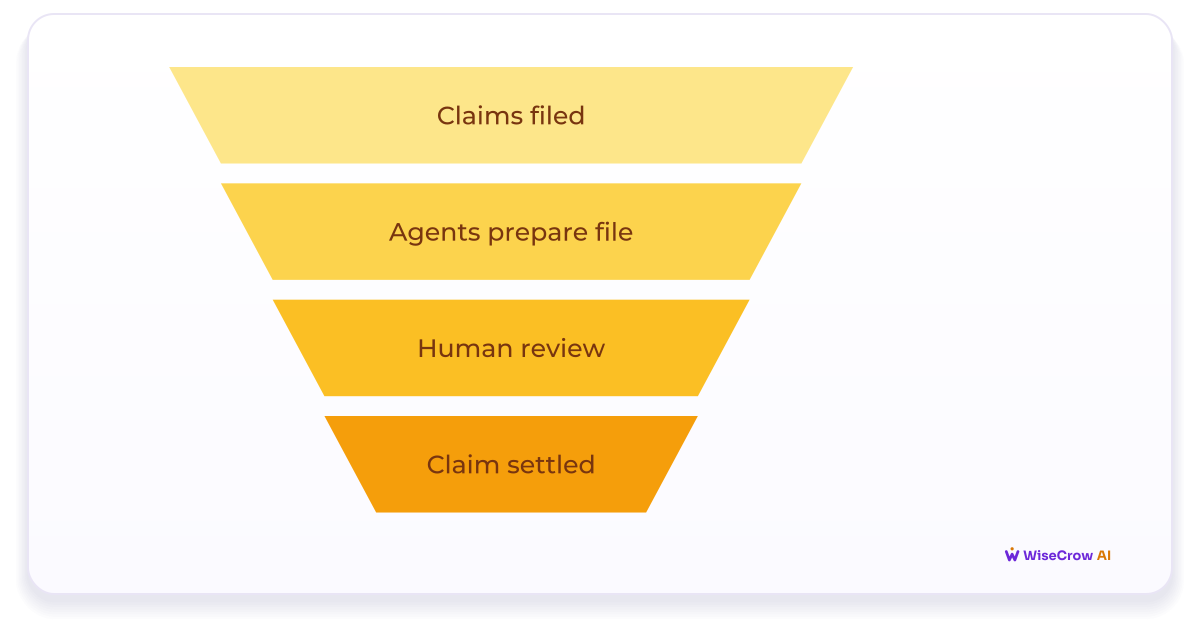
When storms knock out power in Australia, Allianz gets a wave of small claims for spoiled food. In July 2025 it launched Project Nemo there, a system of seven AI agents built in under 100 days. For food spoilage claims under AUD 500, Allianz says processing time has dropped from several days to one day or even hours, and Maria Janssen, Chief Transformation Officer at Allianz Services, puts the cut in processing and settlement time at 80%.
From filing to human review now takes less than five minutes, where it used to take four days or more. A planner agent runs the flow while a cyber agent watches data security, and separate agents check coverage, confirm the weather event, screen for fraud and calculate the payout. An audit agent writes up every decision for a person. By design, payout decisions are never automated, and I think that one rule explains how a regulated insurer could ship the system in 100 days.
The Path of One Food Spoilage Claim
- A customer files a claim for food lost in a storm-related power outage.
- The planner agent starts the workflow, overseen by the cyber agent.
- The coverage agent checks the policy covers food spoilage in severe weather.
- The weather agent confirms a matching event, and the fraud agent checks for warning signs.
- The payout agent calculates the amount.
- The audit agent summarizes every decision for a claims professional, who decides on the payment.
Pick Your Own Small, Frequent Claim
Look for a claim type that is high in volume, low in value and easy to check against outside data, like weather records. Keep the payout decision with a person at first, and note that Allianz is now exploring the same setup for travel delays, simple auto claims and property damage.
Lemonade: Claims Handling at 5% of Premium
Lemonade built its insurance business around AI from the start. In December 2016, its claims bot AI Jim paid a stolen coat claim in three seconds after running 18 anti-fraud algorithms, according to Lemonade’s blog. That was a publicity moment with a real claim behind it. The better evidence sits in the company’s shareholder letters.
In its Q2 2026 shareholder letter, Lemonade reported a loss adjustment expense (LAE) ratio of 5%, a record low, as in-force premium reached $1.43 billion. The LAE ratio is the share of premium an insurer spends on handling claims. Lemonade puts the industry average at about 9%, says its ratio had already improved from 13% to 7% a year earlier and credits higher instant claim rates in pet and renters plus AI-assisted workflows. LAE is a standard insurance metric, so you can set it against other insurers’ numbers. Note that Lemonade’s version excludes prior period development.
How an Instant Claim Gets Paid
- The customer files the claim in the Lemonade app.
- AI checks the claim against the policy.
- Anti-fraud checks run automatically, 18 of them in the 2016 coat claim.
- Simple claims that pass are approved and paid instantly.
- In car insurance, crash detection in the app often starts the claim.
- Claims that need judgment go to people, supported by AI-assisted workflows.
What an Established Insurer Can Take From It
Track your LAE ratio by product line and set a target before you buy claims AI, so any vendor has a number to hit. Start instant settlement with your simplest line, the way Lemonade leans on renters and pet claims.
One Payments Company Screening Fraud Upstream
The last example sits one layer below banks and insurers. Payment companies see a fraud attempt early, and their models screen a lot of payments before a bank or insurer is involved at all.
Stripe: A Foundation Model for Payment Fraud
Stripe announced a payments foundation model at its Sessions conference in May 2025. It’s trained on billions of transactions and weighs hundreds of subtle signals for every payment, according to Stripe’s newsroom. Its earlier models had already cut card-testing attacks, where fraudsters try stolen card numbers in bulk, by 80% over two years.
Stripe said first results showed the new model should raise detection of card-testing attacks on large users by 64% practically overnight. Note the wording: it’s an early, company-reported expectation, and a year of measured results would tell you more. The same announcement opened Radar for ACH and SEPA payments to all Stripe users, where it blocks on average 20% and 42% of fraud attempts. I include Stripe because a lot of fraud screening now happens at the payments layer, before money ever reaches a bank or an insurer.
How the Model Screens a Payment
- A payment arrives at Stripe.
- The foundation model scores it using hundreds of signals.
- Radar uses the score to block, review or allow the payment.
- Card-testing patterns, many small attempts with different cards, get caught earlier.
- My reading: one shared model across products means patterns learned on cards can help on other payment methods.
What to Ask Your Payments Provider
Ask your payment provider which fraud signals its models use and if you can see the risk scores. You may get most of the fraud screening you need without building a model yourself.
How Much Weight Each Result Can Carry
Every number above is real and published. They still aren’t equal. When a client wants to put one of these figures in a business case, I sort it by who measured it and how, and the sorting changes what I’ll let them claim.
| Evidence type | Examples here | How I use it |
|---|---|---|
| Standard industry metric | Lemonade | Compare with peers |
| Before-and-after with method | HSBC | Plan around it |
| Annual report, own definition | DBS | Track the trend |
| Company announcement | Five firms | Proof it can work |
| Estimate or projection | JPMorgan, Stripe | Direction only |
The five company announcements are Morgan Stanley, BBVA, NatWest, CBA and Allianz. They’re specific and dated, and some, like CBA’s, mix the effect of AI with other controls. JPMorgan’s $2 billion is an executive estimate across all its AI, and Stripe’s 64% is an early expectation. Lemonade sits at the top because LAE is a standard insurance metric. HSBC comes next because it published its comparison window and adjustments.
Single-company results also hide the base rate. For the wider picture, such as how many firms use AI at all and where they spend, my roundup of AI in finance statistics pulls the regulator and survey data together.
Where Banks, Insurers and Payments Firms Started
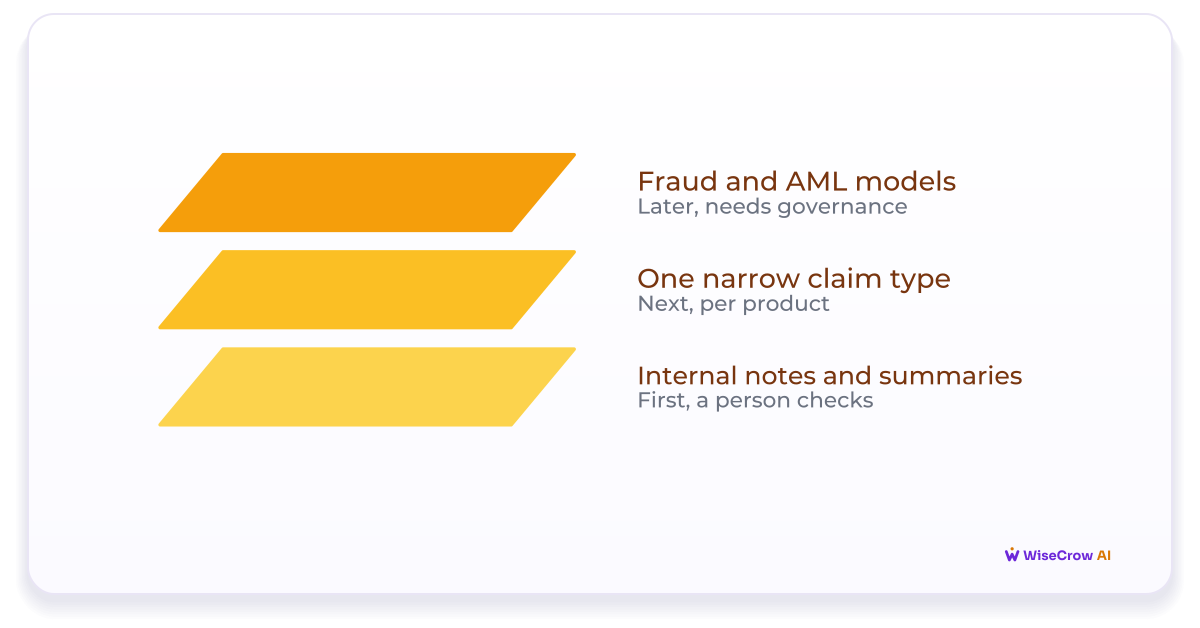
Banks mostly started inside. JPMorgan, Morgan Stanley, BBVA and NatWest gave their own people AI tools before they let it speak to customers in new ways. The risk is lower, because a person reads every output before a client sees it, and the time saved shows up within weeks.
Insurers went straight to claims, but narrowly. Allianz picked one claim type, in one country, under AUD 500. Lemonade began with renters claims and only later took on car insurance, where it says claims are more complex. Neither started with large or disputed claims.
Fraud and financial crime are the oldest AI work in finance, and HSBC, CBA and Stripe show they still produce the most measurable money results. The catch is the setup cost. You need years of labeled data, a model risk process and a method a regulator will accept, which is why I rarely suggest them as a first project for a mid-sized firm.
Estimate the Hours AI Could Hand Back to Your Team
Several results above are measured in time: half an hour per advisor meeting, 2.8 hours a week per BBVA user, 70,000 hours across NatWest retail banking. Pick one task your team repeats, like writing call summaries or drafting client follow-ups, and see what cutting it down could be worth.
How Much Time Could You Save?
Move the sliders to match one repetitive task in your business.
How to Choose Which Finance Example to Copy First
You won’t copy all ten, and you shouldn’t try. When I help a bank, credit union or insurer pick a starting point from a list like this, I run each candidate through five questions:
- Does a person check the output before it reaches a customer or a regulator?
- Can you measure the task today, in hours, losses, alerts or cost per claim?
- Do you already hold the data it needs, with the right consent?
- Could you test it on one team, one product or one claim type first?
- Will your model risk and compliance teams sign off within a quarter?
For most mid-sized firms, the answer is an internal tool first. Meeting notes like Morgan Stanley’s or call summaries like NatWest’s keep a person between the AI and the customer, and they produce an hours figure quickly. For insurers, a narrow claim type like Allianz’s food spoilage claims is the natural first step. Fraud and AML models like HSBC’s pay the most, and they come later, once your data and governance can carry them.
Before you build anything, check what your current vendors already include. My ranking of AI in finance tools compares platforms for the back-office side, from invoice coding to reconciliations, so you can see where buying beats building.
Questions About AI in Finance Examples
What Is the Best Example of AI in Finance?
For hard evidence, I’d pick HSBC. Its AML AI finds two to four times as much suspicious activity with 60% fewer alerts, and HSBC published how it measured that over 12 months. For scale, JPMorgan Chase stands out, with an AI benefit estimate heading toward $2 billion.
How Do Banks Use AI Today?
The examples here fall into four groups: assistants for staff, like JPMorgan’s LLM Suite and BBVA’s ChatGPT rollout; assistants for customers, like NatWest’s Cora; personalization, like DBS’s nudges; and fraud and crime detection, like CBA’s scam alerts and HSBC’s AML AI.
How Do Insurers Use AI in Claims?
Mostly on small, frequent claims that follow a pattern. Allianz uses seven AI agents to check coverage, weather, fraud and payout on food spoilage claims, with a person approving every payment. Lemonade pays simple claims instantly and supports its claims staff with AI-assisted workflows.
Are These AI Results Independently Verified?
Not as far as I can find. They come from company releases, an annual report, a shareholder letter and a vendor-hosted blog. Lemonade’s LAE ratio and HSBC’s published method are the easiest to check. Treat the rest as proof that something can work, then measure your own pilot.
Can a Smaller Bank, Credit Union or Insurer Copy These Examples?
Yes, at a smaller scale. Meeting notes, call summaries and a staff AI assistant now come as standard software, and many fraud models sit inside your payment or core banking provider. Your result depends more on clean data and a clear before-and-after measure than on size.
Does AI in Finance Replace Staff?
The results in this list are mostly about time handed back: half an hour per advisor meeting at Morgan Stanley, 70,000 hours in NatWest retail banking, 30% more client time for NatWest relationship managers. What a firm does with that time is a management decision, so plan it before launch.
How Long Does an AI Project Take at a Bank or Insurer?
It varies widely. Allianz built Project Nemo in under 100 days for one narrow claim type. BBVA took a year to go from 3,300 to 11,000 licenses, and DBS has built up more than 370 use cases over several years. Start narrow and measure early.
Sources
- JPMorgan Chase LLM Suite rollout (August 2024): NBC News
- JPMorgan Chase AI benefit estimate, Evident AI Index (October 2025): IT Brief
- Morgan Stanley AI @ Morgan Stanley Assistant and Debrief (June 2024): Morgan Stanley press release via Silicon UK
- BBVA expands its agreement with OpenAI to 11,000 ChatGPT licenses (May 2025): bbva.com
- NatWest Group tech, data and AI figures (2025): natwestgroup.com
- DBS Annual Report 2024, innovating impactful solutions for customers: dbs.com
- Commonwealth Bank, reimagining banking update (November 2024): commbank.com.au
- HSBC AML AI results (November 2023): Google Cloud blog
- Allianz Project Nemo (November 2025): allianz.com
- Lemonade AI Jim claim (December 2016): Lemonade blog
- Lemonade Q2 2026 shareholder letter: lemonade.com (PDF)
- Stripe Sessions 2025 announcements (May 2025): Stripe newsroom
Disclaimer: This article is for general information only and isn’t financial, investment or legal advice. The results come from company announcements, an annual report, a shareholder letter and vendor-hosted articles, are mostly not independently audited and may have changed since publication, so check the original sources before you rely on them.
Did you find this helpful?
Thank you for your feedback.
Marlena leads the WiseCrow editorial team and works with our consultants to turn real client projects into practical guides on AI strategy, automation and governance. Before joining WiseCrow, she spent 12 years in B2B operations and SaaS content. She has since edited more than 400 articles on AI and automation and reviewed workflows from over 60 client projects. She is based in Austin, Texas.