Summary
- Score nine audit areas twice, once for design and once for operation, each from 0 to 3. Weighted area points add up to a score out of 100.
- Weight AI inventory and risk assessment highest. Every other control depends on knowing which systems you run and how risky they are.
- Apply a gate rule: if inventory, risk assessment or incident response scores 0 for operation, the rating drops one band.
- Pick your own samples from full lists. Operation scores come from records you pulled, never from examples the owner chose.
An AI governance audit answers one blunt question. If someone asked you to prove how your company controls its AI, could you? Most companies I work with have a policy. Fewer have a list of every AI system they run. Very few can show a log, a sign-off or a test result for each control the policy promises. When I run these audits as part of AI data governance consulting, nearly every finding sits in the gap between what’s written and what happens.
Below is the scoring model I use. It covers nine audit areas and scores each one twice, for design and for operation. The scores are weighted into one number out of 100, and a gate rule stops a decent average from hiding a missing control. You’ll also get a worked example for a fictional insurer, the evidence to request per area and the five stages of running the audit.
Nine Audit Areas and How Much Each One Counts
I audit the same nine areas every time. The weights are my starting point for a company that uses AI in decisions about customers or staff. They add up to 100, so the final score reads like a percentage.
- Policies and accountability, 10 points: the AI policy, named owners and an approval path for new AI.
- AI inventory, 15 points: a current register of every AI system, including AI features vendors switched on inside software you already use.
- Risk assessment, 15 points: a method to rate each system’s risk before launch and after big changes.
- Data and privacy, 12 points: which data each system uses, on what legal basis, who can access it and how long it’s kept.
- Model lifecycle and monitoring, 12 points: version control, testing before release, and checks on drift and errors once the system is live.
- Third-party and vendor AI, 10 points: due diligence, contract terms and ongoing review of the AI you buy.
- Human oversight, 10 points: who can review, override or stop an AI output, and proof that they do.
- Incident response, 8 points: how AI failures get reported, sorted, fixed and learned from.
- Documentation and evidence, 8 points: if the records exist to prove all of the above to an outsider.
Inventory and risk assessment carry the most weight because every other area leans on them. You can’t check oversight on a system nobody listed. You also can’t decide how much oversight a system needs until it has a risk rating. Incident response and documentation get fewer points, but incident response carries a gate rule that matters more than its weight, as you’ll see below.
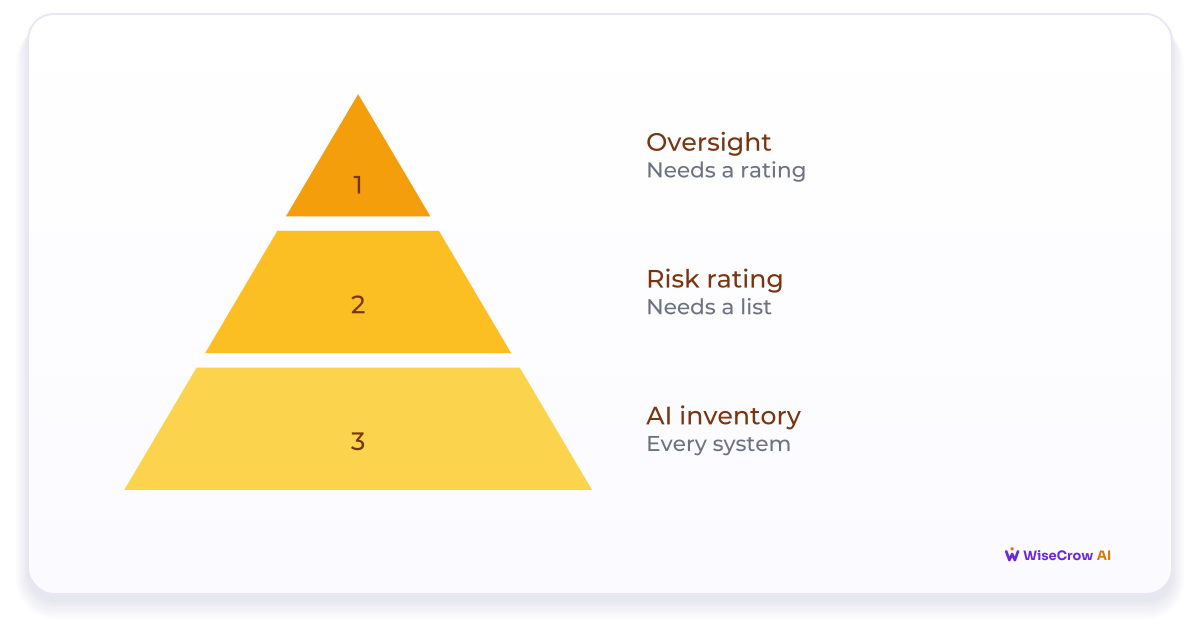
Shift the weights for your own situation in steps of five. A company that builds its own models might move points from vendor AI to lifecycle. A company that buys almost all of its AI should do the opposite. In my client work, vendor AI is the area companies underweight most often. The tools came in through procurement or a team budget, and nobody thought of them as AI systems.
The Governance Audit Score Formula
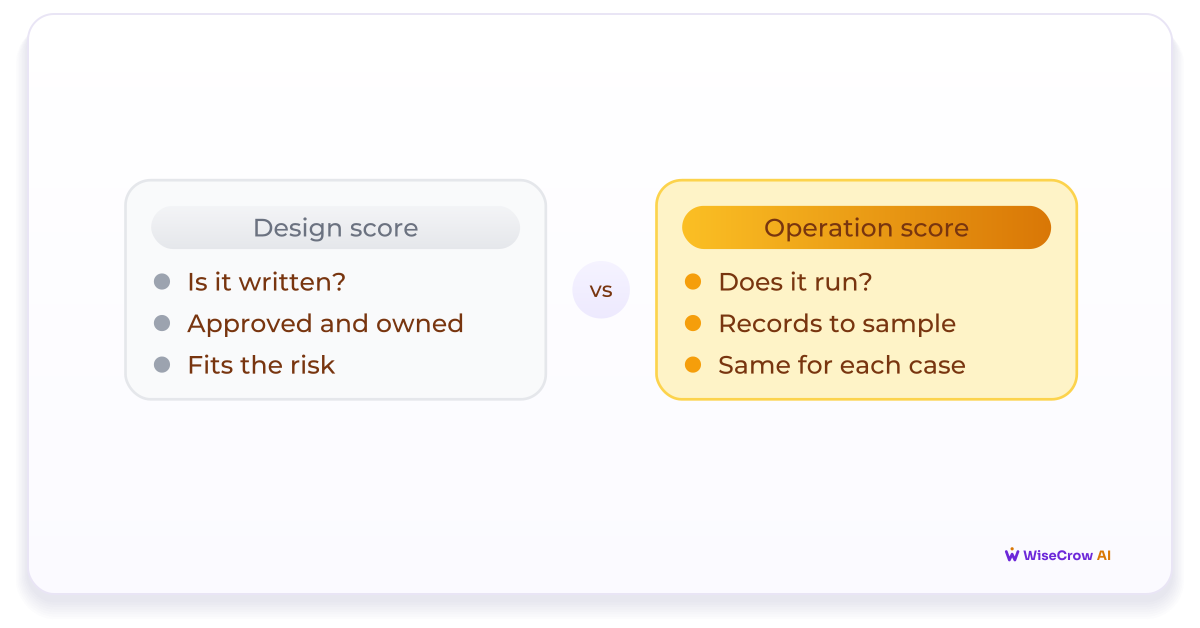
Each area gets two scores from 0 to 3. Design asks if the control exists on paper: written, approved, owned and fit for the risk. Operation asks if the control runs in practice, proven by records you can sample. Add the two, divide by the maximum of 6, and multiply by the area’s weight.
Area points = weight × (design + operation) ÷ 6
Governance score = sum of the nine area points, from 0 to 100
The split between design and operation is the heart of the model. A well-written human oversight procedure that nobody follows scores 3 for design and 0 for operation, so the area earns half its points. Financial auditors have tested controls in these two steps for a long time: first if the control is designed well, then if it worked over a period. I use the same split because AI governance fails in the same two ways.
| Score | Label | Design | Operation |
|---|---|---|---|
| 0 | Absent | Nothing written | No records at all |
| 1 | Informal | Draft or verbal rule | Some runs, few records |
| 2 | Defined | Approved, partial scope | Records for most samples |
| 3 | Embedded | Approved, all systems | Records for every sample |
The rubric I use for all nine areas. Write area-specific examples under each level before the audit starts, then keep the wording fixed.
Two Scoring Rules That Keep the Numbers Honest
First, operation can’t score more than one point above design. A team can run a good informal habit without a written rule, so a design score of 0 still allows a 1 for operation. It can’t earn a 3, because nobody can say what the habit is meant to achieve or check that it does.
Second, no evidence means no points. If an owner says the monitoring dashboard exists but can’t show it during the audit, operation scores 0 until it turns up. A score built on promises falls apart the first time a customer, a certification body or a regulator asks for proof.
Score Bands and the Gate Rule
I read the total in four bands. A score of 80 to 100 is Strong, 60 to 79 is Managed with gaps, 40 to 59 is Partial, and anything under 40 is Weak.
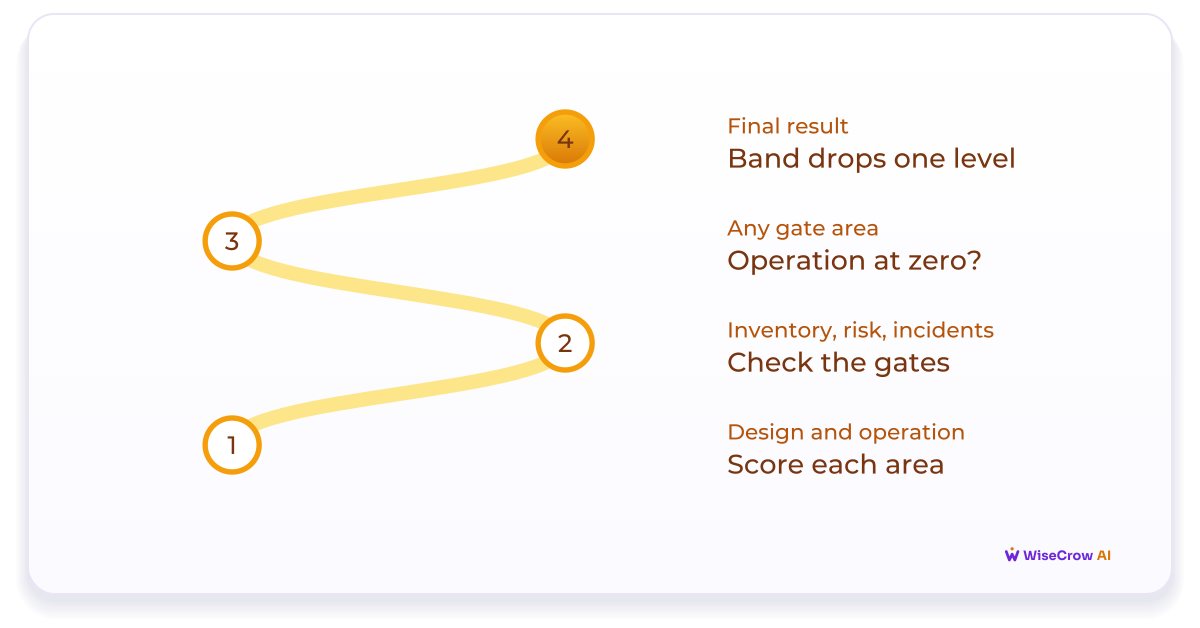
Then comes the gate. Three areas act as gates: AI inventory, risk assessment and incident response. If any of them scores 0 for operation, the rating drops one band, whatever the total says. A company with no working incident process can still score 70 on paper. It shouldn’t get to call itself Managed, because the first serious AI failure will show exactly what’s missing.
Worked Example: Scoring a Fictional Regional Insurer
The company below is fictional. Harbor Lane Insurance is a composite I use for teaching, and every number in its scorecard is made up to show how the formula behaves.
Harbor Lane has about 900 staff. Its own register listed six AI systems. The audit found eleven. Two are built in-house: a claims triage model and a fraud flagging model. The rest are bought: a website chatbot, an AI note-taker, a document reader in underwriting and AI features inside its CRM and HR software. The board asked for the audit after a director posed a simple question nobody could answer: how many AI systems does the company run?
| Area | Weight | D + O | Points |
|---|---|---|---|
| Policies and accountability | 10 | 3 + 2 | 8.3 |
| AI inventory | 15 | 2 + 1 | 7.5 |
| Risk assessment | 15 | 2 + 1 | 7.5 |
| Data and privacy | 12 | 3 + 2 | 10.0 |
| Lifecycle and monitoring | 12 | 1 + 1 | 4.0 |
| Vendor AI | 10 | 1 + 0 | 1.7 |
| Human oversight | 10 | 2 + 2 | 6.7 |
| Incident response | 8 | 2 + 0 | 2.7 |
| Documentation and evidence | 8 | 2 + 1 | 4.0 |
| Governance score | 100 | 28 of 54 | 52.3 |
Fictional example. D = design, O = operation, each scored 0 to 3. Points = weight × (D + O) ÷ 6, rounded to one decimal.
What the Scorecard Showed
A total of 52.3 lands in the Partial band. Then the gate rule kicks in, because incident response scored 0 for operation. Harbor Lane had a written AI incident procedure. The audit pulled twelve months of help desk tickets and found three complaints about wrong chatbot answers. None had reached the procedure or been logged as an AI incident. One band down, so the final rating is Weak.
Data and privacy scored best. The privacy team already ran impact assessments and kept good records, so the AI systems inherited a working process. Vendor AI scored worst. Procurement had no AI questions in its vendor review, and the note-taker had been switched on by a team lead with a company card.
The inventory gap told the clearest story. Five of the eleven systems were missing from the register, mostly AI features that vendors had added in routine updates. Risk assessment scored 1 for operation for the same reason. A system nobody listed never gets a risk rating.
Ranking the Fixes by Points Lost
Points lost is the weight minus the points earned. It shows where the score has the most room to grow. For Harbor Lane, the list looked like this:
- Vendor AI: 8.3 points lost
- Lifecycle and monitoring: 8.0 points lost
- AI inventory and risk assessment: 7.5 points lost each
- Incident response: 5.3 points lost, plus the gate penalty
- Documentation, human oversight, data and policies: 4.0 points lost or less each
I don’t follow the ranking blindly. The gate goes first, because clearing it lifts the rating a full band for modest effort. Inventory goes next, since risk ratings, vendor reviews and monitoring all need the complete list. Vendor AI follows. Lifecycle comes last in the first round, even with the second-highest loss, because new monitoring takes months to produce records an auditor can sample.
The Rescore After the First Round of Fixes
At the follow-up audit, incident response had moved to 3 + 2, worth 6.7 points. The help desk now tags AI complaints and routes them to a named owner. Inventory reached 3 + 2 for 12.5 points after IT matched the register against the software list and card spend. Vendor AI rose to 2 + 1 for 5.0 points.
The total went from 52.3 to 64.7. The gate cleared, and the rating rose two bands, from Weak to Managed with gaps. Lifecycle and monitoring didn’t move, and it now tops the list of points lost.
Evidence to Collect for Each Audit Area
Send the evidence request two weeks before the first interview, to one named owner per area. The middle column is what you ask for. The right column is what you pull yourself, to check that the paper matches practice.
| Area | Ask for | Sample to test |
|---|---|---|
| Policies and accountability | AI policy, owner list | Last 5 AI approvals |
| AI inventory | AI system register | Software list, card spend |
| Risk assessment | Method, completed ratings | 3 recent launches |
| Data and privacy | Data maps, impact assessments | Prompts and stored logs |
| Lifecycle and monitoring | Version log, test reports | Last 2 releases |
| Vendor AI | Due diligence, contracts | 3 vendor tools |
| Human oversight | Review procedure, roles | 20 reviewed outputs |
| Incident response | Procedure, incident log | Help desk tickets |
| Documentation and evidence | Records index | One system end to end |
Documents set the design score. The samples in the right column set the operation score.
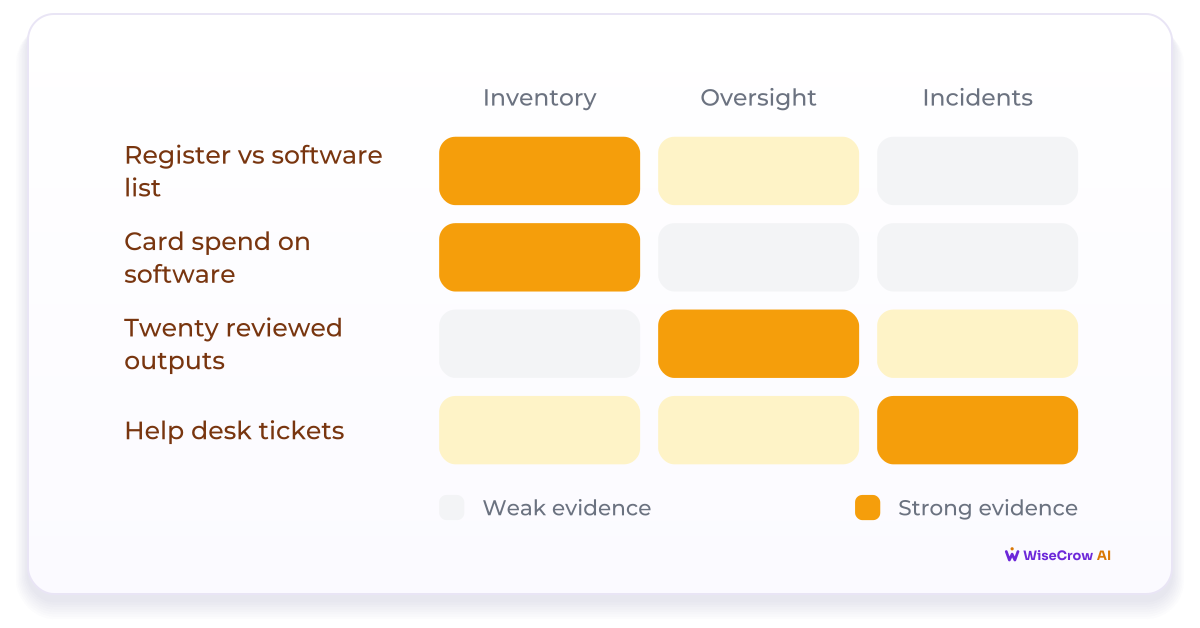
The right column is where audits find things. For inventory, compare the register with IT’s software list and with company card spend on software. In my client work, the card statement turns up an unlisted AI tool more often than any other source. For oversight, pick twenty outputs a person was supposed to review and check each one for a name, a time stamp and an outcome. A reviewer who approved all twenty in under a minute each is a finding of its own.
For data and privacy, read a handful of real prompts and stored logs from your busiest AI tool. Look for customer names, account numbers or health details that the data map says never go there. For lifecycle, take the last two releases of an in-house model and ask for the test results that came before each one. A release with no test report scores operation down, however good the test plan looks.
For vendor AI, send each vendor three written questions. Which models sit behind the feature? Is your data used to train them? How will you hear about model changes? Weak answers don’t fail the vendor. They tell you how much monitoring you need on your side. Most of the gaps this table uncovers trace back to the common AI governance accountability gaps: an owner nobody named, an approval nobody logged.
How to Run the Audit in Five Stages
A first audit of one business unit fits in a few weeks of elapsed time, most of it spent waiting for evidence. The stages below keep the work in order.
Stage 1: Scope and Criteria
Decide which business units and systems are in scope, and what you’ll measure against. That can be your own AI policy, the NIST AI RMF, ISO/IEC 42001 or a mix. Lock the weights, the rubric and the gate rule in writing with your sponsor before any evidence arrives. Once a team has seen its scores, every weight turns into a negotiation.
If you’re starting close to zero, run a short nine-point governance checklist first. It shows which areas will score near nothing, so you can save the audit’s testing time for areas with something to test.
Stage 2: Evidence Request
Send the request from the table above, with a deadline and one owner per area. Read everything before you talk to anyone. Missing documents set the design score on their own, and they tell you where to aim the interviews.
Stage 3: Interviews
Book short sessions with each area owner, the owners of two or three higher-risk systems, someone from legal or privacy, and a few people who use AI outputs every day. I open every interview with the same request: “Walk me through the last time this system got something wrong.”
Owners tend to answer from the procedure. Front-line staff answer from memory. When the two stories match, operation scores well. When the staff story involves a workaround, a personal account or a complaint that went nowhere, you know which records to sample next.
Stage 4: Sampling and Scoring
Operation scores come from samples, and you pick them yourself from full lists: all approvals, all releases, all reviewed outputs. Never let an owner choose the examples. For small populations, such as AI launches in the past year, check every one. For large ones, such as reviewed claims decisions, 20 to 25 items are enough to see if a control runs.
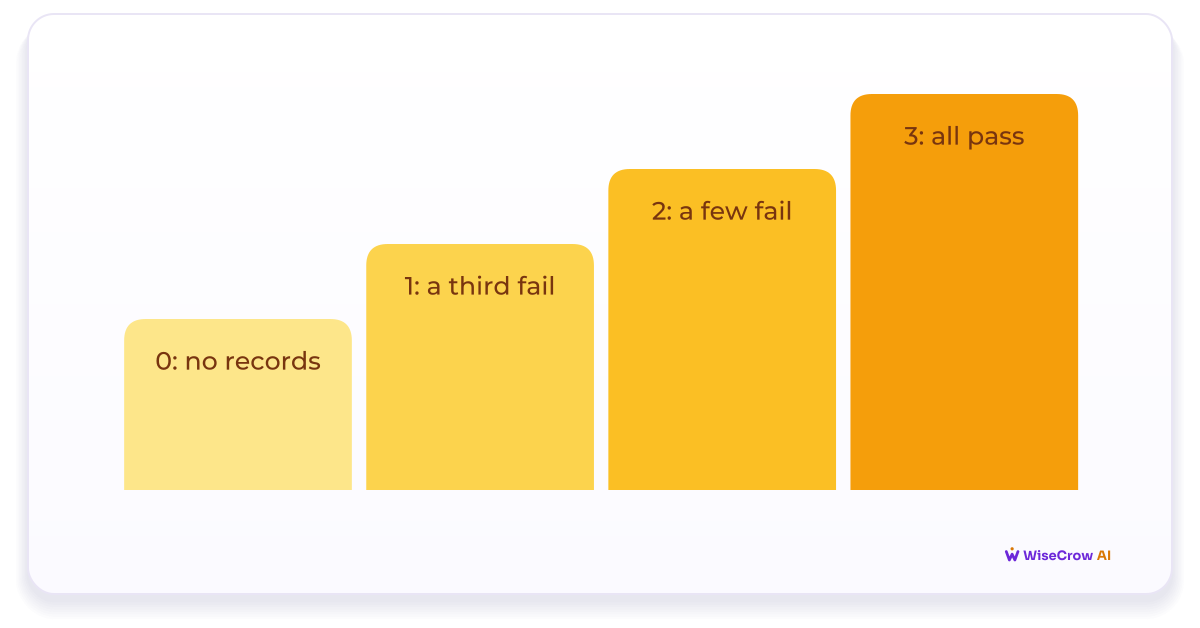
Mark each item pass or fail with a one-line reason. As a working guide, a control that passes every sample scores 3, one that fails a few scores 2, and one that fails about a third of the time scores 1. Then score each area in one session with the owners. They can challenge a score only with evidence they hadn’t shown you yet.
Stage 5: Report and Re-Audit
The report opens with the total, the band, any gate failure and the nine area scores. One page per area follows, with both scores, the evidence, the sample results and the fix. Each fix gets an owner in the business, a date and the points it should recover.
Track points recovered as your progress measure. Closing ten small findings can move the score less than fixing one gate. Bigger fixes need sequencing over months, and my 12-month AI governance roadmap shows how I phase them. Rescore the areas under repair every quarter with fresh samples, run the full audit once a year, and keep the weights and rubric unchanged between audits so the trend means something.
Mapping the Score to NIST, ISO/IEC 42001 and the EU AI Act
The nine areas aren’t a standard of their own. They’re a way to test against the frameworks you already answer to. Mapping each area to a framework makes the report easier to defend and easier to reuse.
The NIST AI Risk Management Framework is voluntary and built on four functions: govern, map, measure and manage. Its govern function covers policies, accountability, an inventory of AI systems and risks from third parties. That lines up with my policy, inventory and vendor areas. Map and measure line up with risk assessment and monitoring.
ISO/IEC 42001 sets requirements for an AI management system, and organizations can seek certification against it. Like other ISO management system standards, it expects internal audits and management review. If certification is on your plan, store your samples so a certification auditor can reuse them.
The EU AI Act, Regulation (EU) 2024/1689, has been adopted and is in force. It sorts AI by risk, bans some practices outright and places duties on providers and deployers of high-risk systems, among them risk management, logging, human oversight and technical documentation. Parts of its timeline have been revisited since adoption, so check the current status of each obligation before you plan around a date. For the audit, flag any system that might count as high-risk under the Act and give it a deeper sample.
How to Choose the Depth of Your Governance Audit
Not every company needs the full nine-area audit with heavy sampling right away. Pick the depth from where you stand today:
- No AI policy or register yet: skip the audit, build the basics and score them in six months.
- Policy and register exist but were never tested: run all nine areas with light samples of 5 to 10 per area.
- Any AI in hiring, lending, insurance or health decisions: full samples for those systems and all three gates.
- ISO/IEC 42001 certification on the plan: use the standard’s clauses as criteria and keep evidence reusable.
- A recent AI incident or customer complaint: start with incident response and oversight, then widen the scope.
Then decide who scores. An internal team can run the audit well once the rubric is fixed, as long as nobody scores their own area. For a first audit, or one a board or regulator will read, an outside reviewer adds independence. WiseCrow has run 50+ governance and security reviews. In my client work, the most common surprise is how much bigger the real AI inventory is than the official one.
One trade-off to weigh. Light samples give you a score fast and cheaply, but a control that passes five samples can still fail on the sixth. Heavy samples take longer and give you a score that holds up under questioning. I use light samples for the first round and heavy ones for the gates and the highest-risk systems.
Questions About AI Governance Audits
What Is an AI Governance Audit?
An AI governance audit is an evidence-based review of how your company controls the AI it builds and buys. It checks policies, the AI inventory, risk assessment, data and privacy, model monitoring, vendor AI, human oversight, incident response and documentation. Each area is tested on paper and in practice, and the result is a scored report with owners and dates for every fix.
How Is an AI Governance Audit Different from an AI Security Audit?
A security audit tests one AI app for ways it can be attacked or made to leak data. A governance audit looks across all your AI systems at the controls around them: who approves them, who watches them, how risks are rated and what happens when something goes wrong. Most companies need both, and the governance audit usually tells you which apps deserve a security audit first.
How Do I Calculate an AI Governance Audit Score?
Give each of the nine areas a weight so the weights add up to 100. Score every area from 0 to 3 for design and from 0 to 3 for operation. Area points equal the weight times design plus operation, divided by 6. Add the nine results for a score out of 100, then drop one band if inventory, risk assessment or incident response scored 0 for operation.
What Evidence Does an AI Governance Audit Need?
You need two kinds. Documents show design: the AI policy, the system register, risk ratings, data maps, vendor contracts and procedures. Records show operation: approvals, release notes, reviewed outputs, incident tickets and logs. Pick the records yourself from full lists, because a sample chosen by the owner proves very little.
Who Should Conduct an AI Governance Audit?
Anyone who doesn’t own the area being scored. Internal audit or a second-line risk team can run routine audits well once the rubric is fixed. For a first audit, a certification project or a report a board or regulator will read, an outside reviewer adds independence and a wider view of what good looks like.
How Often Should We Audit AI Governance?
Run a full audit once a year, with quarterly rescores of the areas you’re actively fixing. Audit sooner after a big change, such as a new high-risk AI system, an acquisition, a major vendor switch or a new law that applies to you. Keep the weights and the rubric stable so the scores stay comparable over time.
Does an AI Governance Audit Prove Compliance with the EU AI Act?
No. A governance audit shows how well your controls work against the criteria you chose. Compliance depends on which systems fall under the Act, your role as provider or deployer and the obligations that apply at the time. Parts of the Act’s timeline have been revisited since adoption, so check the current status of each obligation and get legal advice for your situation.
Sources
- NIST, AI Risk Management Framework: nist.gov
- ISO/IEC 42001, Artificial intelligence management system: iso.org
- Regulation (EU) 2024/1689, the EU Artificial Intelligence Act, Official Journal of the European Union: eur-lex.europa.eu
Disclaimer: This article is for general information only and isn’t legal advice. The worked example is fictional and its numbers are made up to show how the formula behaves. Frameworks and laws such as the EU AI Act change over time, so check the current status with the original sources and your advisers before you act.
Did you find this helpful?
Thank you for your feedback.
Marlena leads the WiseCrow editorial team and works with our consultants to turn real client projects into practical guides on AI strategy, automation and governance. Before joining WiseCrow, she spent 12 years in B2B operations and SaaS content. She has since edited more than 400 articles on AI and automation and reviewed workflows from over 60 client projects. She is based in Austin, Texas.