Summary
- Every AI system needs one named business owner and a deputy. Without a name, no other control sticks.
- Shadow AI grows when approval is slow. A short approved list and a fast intake beat a ban.
- Vendor models are governed through contracts and your own tests, since you can’t inspect the model itself.
- Tier systems by risk and publish review times, so low-risk tools clear in days and high-risk ones get real scrutiny.
Most AI governance programs start with a policy. Few start with a list of names. Yet the failures I get called in for almost always trace back to the same moment: something went wrong with an AI system, and nobody could say who was accountable for it. If you want help setting up that structure, AI data governance consulting covers it from the first register to ongoing reviews.
Below are the eight AI governance challenges I see most often, all of them accountability gaps of one kind or another. For each one you get how it looks inside a real company, why it happens, the steps that close it and the tools or resources that help. A RACI table near the end shows who should answer for which decision.
Eight Accountability Gaps at a Glance
The middle column is the uncomfortable one. It shows who tends to inherit each gap by default, which is rarely the person best placed to close it.
| Challenge | Who usually owns the gap | First fix |
|---|---|---|
| 1. No named owner | Nobody, by default | One owner per system |
| 2. Shadow AI | IT and security | Approved list, fast intake |
| 3. Unused policies | Legal or compliance | One-page rules per role |
| 4. Opaque vendor models | Procurement | AI terms in contracts |
| 5. Unclear risk tiers | Risk management | Three tiers, written criteria |
| 6. No audit trail | The build team | Logs plus monthly review |
| 7. Moving regulation | Legal, often alone | One watch list owner |
| 8. Slow reviews | The review board | Fast lane for low risk |
Why Accountability Slips Through the Cracks
AI systems cross more team lines than most software. A single model can depend on data from one department, code from another, a vendor contract signed by procurement and decisions made by people in a fourth team. Each group sees its own slice. When the output goes wrong, each can honestly say the problem sits somewhere else.
Larger companies are starting to respond with structure. Flexera’s 2026 State of the Cloud report, a survey of more than 750 cloud decision-makers and users, found that 47% of large enterprises are establishing dedicated AI governance teams or leaders. A central team helps, but it can’t own every system itself. The gaps below show up even in companies that already have a governance lead.
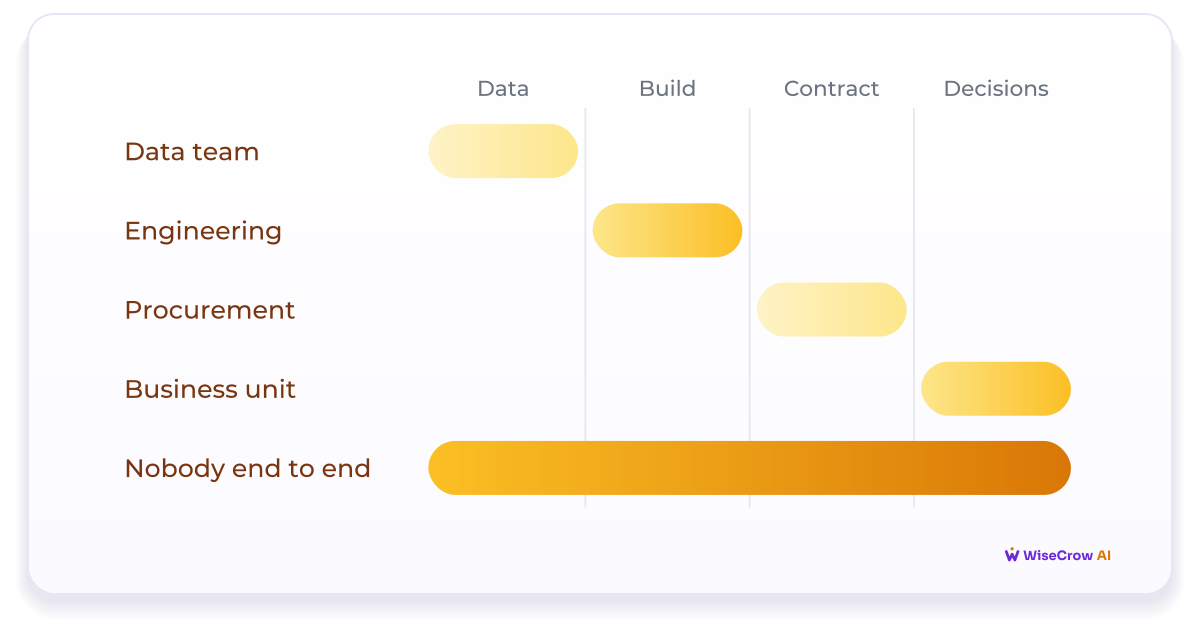
Gaps in Who Owns the Decision
The first three are about names. If nobody owns a system, a tool or a rule, every later control has nobody to report to.
No Named Owner per AI System
A claims triage model has run for fourteen months. Data science built it, operations uses it and IT hosts it. When it starts flagging twice as many claims for manual review, three teams open tickets, and each one assigns the ticket to another team.
Ownership dissolves at handoffs. The builder moves on to the next project, the business team assumes IT watches the model, and IT assumes the business signed off on how it behaves. The first question I ask in any governance review is “who would you call if this system made a bad decision tonight?” More often than not, the room goes quiet or names someone who left in the spring. Accountability needs a name, a deputy and a written scope, and the name belongs in the business unit that lives with the outcome.
How to Put a Name on Every System
- Build a register of every AI system in production with its purpose, the data it uses and the business unit it serves.
- Assign one accountable owner per system from the business side, plus a technical owner who runs it.
- Write down what the owner signs off: launch, major changes and retirement.
- Name a deputy for each owner, so parental leave or a job change doesn’t leave the system orphaned.
- Review the register every quarter and reassign systems whose owner has moved on.
Where to Keep the Register
A shared spreadsheet works for your first twenty or so systems, as long as one person keeps it current. Past that point, governance platforms such as Credo AI, OneTrust or IBM watsonx.governance hold the inventory, owners and approvals in one place.
Shadow AI and Unregistered Tools
A sales team pastes customer contracts into a free chatbot to draft summaries. Finance pays for an AI note-taker on a corporate card. Marketing connects an AI plugin to the CRM with an admin token. None of it shows up in any register, and nobody has checked where the data goes.
The scale surprises most leadership teams. Microsoft and LinkedIn’s 2024 Work Trend Index, based on a survey of about 31,000 knowledge workers, found that 78% of AI users bring their own AI tools to work. Bans tend to push the same work onto personal phones, where you see even less. What works better in my client work is a quick, friendly path to yes: a short approved list, an intake review that answers within days and one clear line on which data never goes into an outside tool.
Bringing Shadow AI into the Open
- Sweep expense reports, single sign-on logs and browser extensions for AI tools already in use.
- Publish a short list of approved tools with the data classes each one may handle.
- Set up an intake form that returns a yes or no within a few working days.
- Block uploads of restricted data to unapproved AI sites at the network or browser level.
- Add every approved tool to the AI system register with a named owner.
- Repeat the discovery sweep twice a year.
Tools That Surface Unsanctioned AI
Cloud access security brokers such as Microsoft Defender for Cloud Apps, Netskope or Zscaler show which AI services your staff actually reach. Your expense system and identity provider logs cost nothing extra and often find the paid tools nobody registered.
Policies Nobody Follows
The AI policy runs 23 pages, legal approved it last year and it sits on the intranet. Ask five engineers what it says about customer data in prompts and you get five different answers. Two of them have never opened it.
Policies fail when they describe values and skip decisions. Staff need to know three things: which tools they may use, which data they may put in and who approves a new use case. I write those rules as one page per role and link the full policy underneath. Then I check if the rules show up in real work, such as a review step in the release process or a data rule in the browser. My AI governance checklist lists the controls worth testing in that check.
Turning the Policy into Daily Practice
- Cut the policy into one page of rules per role: builders, buyers and everyday users.
- Tie each rule to a control that enforces it, such as a release gate or a data loss rule.
- Train with real examples from your own company, ten minutes once a quarter.
- Ask for a short attestation when someone gets access to an AI tool.
- Sample five use cases each quarter and check them against the rules.
- Retire any rule nobody can enforce or measure.
Resources for Writing Rules People Use
The NIST AI Risk Management Framework and its companion Playbook give you plain actions you can lift straight into role sheets. Your existing learning platform and the access request flow in your identity system handle training and attestation without buying anything new.
Gaps in What You Can See and Prove
The next three are about evidence. An owner who can’t see inside a model, can’t tell how risky it is or can’t show what it did last spring is accountable on paper only.
Vendor Models You Can’t Inspect
Your HR team buys a screening tool that ranks applicants. The vendor calls the model proprietary. You don’t know what data trained it, when it changes or if your applicant data feeds the next version.
Most AI in a mid-sized company arrives inside software you buy, so a large share of your risk sits in contracts you didn’t write. You can’t audit the model weights, but you can demand evidence: system documentation, results from bias and accuracy tests, notice before major model changes and a straight answer on training with your data. In my client work, vendors answer these questions far more often than buyers expect, once the questions sit in the RFP. A vendor who refuses has told you something useful too.
Getting Real Answers from Vendors
- Add an AI section to your vendor questionnaire on training data, testing, model updates and data use.
- Ask for model or system cards and the latest evaluation results.
- Write change notice, audit rights and a no-training-on-your-data clause into the contract.
- Run your own test cases through the tool before rollout, using examples from your business.
- Review the vendor again whenever they announce a new model version.
Questionnaires and Standards to Borrow From
Standard vendor risk questionnaires such as the Shared Assessments SIG give you a structure, and you can add your AI questions on top. If a vendor claims ISO/IEC 42001 certification for its AI management system, read the certificate’s scope before you treat it as proof for the product you’re buying.
Unclear Risk Tiers
A meeting summarizer and a credit decision model go through the same 40-question review. The summarizer waits six weeks for approval. The credit model passes in the same six weeks with the same depth of review, which is far too little for a system that decides who gets a loan.
Without tiers, every review lands in the middle. Harmless tools get stuck, and high-stakes systems get checked like any other software. I use three tiers with written criteria: who’s affected, if the output decides something about a person and how easily a wrong result can be undone. Each tier carries its own controls, from a short self-assessment up to a full impact assessment with sign-off from legal and the risk owner. Once the criteria are on paper, most teams can tier their whole register in an afternoon.
Sorting Systems by Risk
- Write three or four tiers with plain criteria: people affected, decisions made and reversibility.
- Map each tier to its required controls, reviewers and depth of review.
- Tier every system in the register, starting with the ones that touch customers or staff.
- Give low-tier tools a fast lane with a self-assessment.
- Re-tier a system whenever its use, users or data change.
Frameworks for Setting the Tiers
The EU AI Act’s risk categories and the NIST AI RMF give you starting definitions that you can adapt to your own business. A short decision tree in any form tool, four or five questions that suggest a tier, keeps tiering consistent from one team to the next.
No Audit Trail or Monitoring After Launch
A pricing model went live after a careful review. Eight months later, an auditor asks why it raised prices in one region. Nobody kept the inputs, the model version or the approval record, so the only honest answer is a guess.
A launch approval says little about how a system behaves a year later. Data drifts, vendors update models and someone tweaks a prompt on a Friday afternoon. Accountability needs evidence: who approved what, which version ran when and what it decided. I set up a monthly review of a few core metrics per high-risk system, with the business owner in the room. A formal AI governance audit then tests once a year that the evidence holds up.
Building Evidence That Holds Up Later
- Log model version, inputs, outputs and the human decision for every high-tier system.
- Keep approvals and change history in one place, linked to the register entry.
- Pick two to four metrics per system, such as accuracy, override rate and complaints.
- Set alert thresholds and name the person who receives each alert.
- Hold a monthly review for high-tier systems and a quarterly one for the rest.
- Set log retention rules that match your legal and privacy duties.
Monitoring Options Worth Comparing
Model monitoring platforms such as Arize, Fiddler or the open-source Evidently track drift and performance after launch. A model registry like MLflow keeps each version next to its approval, so the audit trail builds itself as you ship.
Gaps That Open as Things Change
The last two come from speed. Rules shift outside your company, and inside it, a slow review process quietly pushes people to skip it.
Regulation That Keeps Moving
Your legal team follows the EU AI Act. Product teams in the US learn about a new state law from a customer questionnaire. Nobody has mapped which of your systems falls under which rule, so every headline starts a fresh scramble.
Some things are settled. The EU AI Act has been adopted and applies in stages, with the strictest duties for high-risk uses. The EU has also proposed changes to when some of those duties apply, so check the current status before you plan around any deadline. In the US, rules come from states and sector regulators, and they keep shifting. My advice is to stop chasing each law on its own. Build the controls most rules ask for, such as an inventory, risk tiers, impact assessments, human oversight and logs, and map each new rule onto them.
Keeping Up Without Starting Over
- Name one owner for an AI regulation watch list covering every market you sell in.
- Map each rule to the systems and risk tiers it touches.
- Match requirements to controls you already run, and add only what’s missing.
- Brief system owners when a change affects their system.
- Confirm the current status of any rule with counsel before committing to a date.
Sources That Track the Rules
The European Commission’s AI Act pages and the IAPP’s legislation trackers summarize what has passed and what’s still pending. Compliance platforms with regulatory feeds can route changes to the right owner, though a person still has to read them and decide.
Governance That Slows Delivery
A product team waits nine weeks for a review board that meets once a month. By the time approval arrives, the team has built a workaround with a tool nobody reviewed. Governance created the shadow AI it was set up to stop.
When the approval path is slow, people route around it. I watched one bank’s AI committee approve four use cases in a year while staff quietly ran dozens of unreviewed ones. Review speed is a control in its own right. Set a target review time per tier, publish it and measure it like any internal service. Low-risk tools should clear in days. High-risk systems deserve weeks, with reviewers involved from design so nothing surprises them at the end. My AI governance roadmap shows how to phase that in over a year.
Making Review Fast Enough to Follow
- Set and publish a target review time for each risk tier.
- Pre-approve common patterns, such as a chatbot on public documents, with standard controls.
- Bring a governance reviewer into design for high-tier projects.
- Swap the monthly board for weekly async reviews on low and medium tiers.
- Track actual review times and share them each quarter.
- Ask teams that skipped review why, and fix the cause.
What Keeps Reviews Moving
A ticket workflow in Jira or ServiceNow with fields for tier, owner and decision makes every review visible and timed. Reusable impact assessment templates cut the writing time for the teams that have to file them.
A RACI Split for Every AI System
Most of the eight gaps close faster once each decision has a clear home. I use a plain RACI split: one person accountable, the people who do the work, and the people consulted before the call is made. Everyone else is informed. The table shows the default I start from with clients, and I adjust the titles to fit each company.
| Decision | Accountable | Responsible | Consulted |
|---|---|---|---|
| Approve a new use case | Business owner | Product team | Risk, legal |
| Set the risk tier | Risk lead | System owner | Legal |
| Buy a vendor AI tool | Business owner | Procurement | Security, legal |
| Approve launch | Business owner | Technical owner | Risk, security |
| Monitor in production | Technical owner | ML or ops team | Business owner |
| Handle an incident | Business owner | Technical owner | Legal, comms |
| Track new rules | Legal lead | Compliance team | System owners |
| Retire a system | Business owner | Technical owner | Data owner |
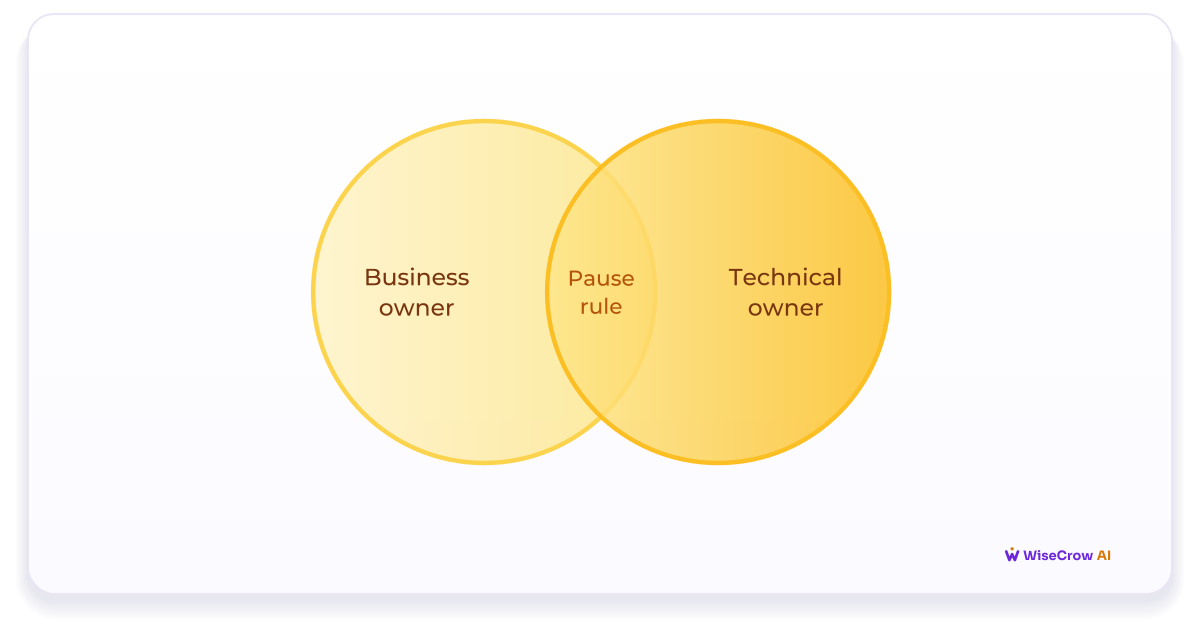
Notice how often the business owner sits in the accountable column. Teams push back on that at first, since the business owner rarely understands the model. They don’t need to. They need to understand the outcome and have the authority to pause the system, and the technical owner supplies the detail.
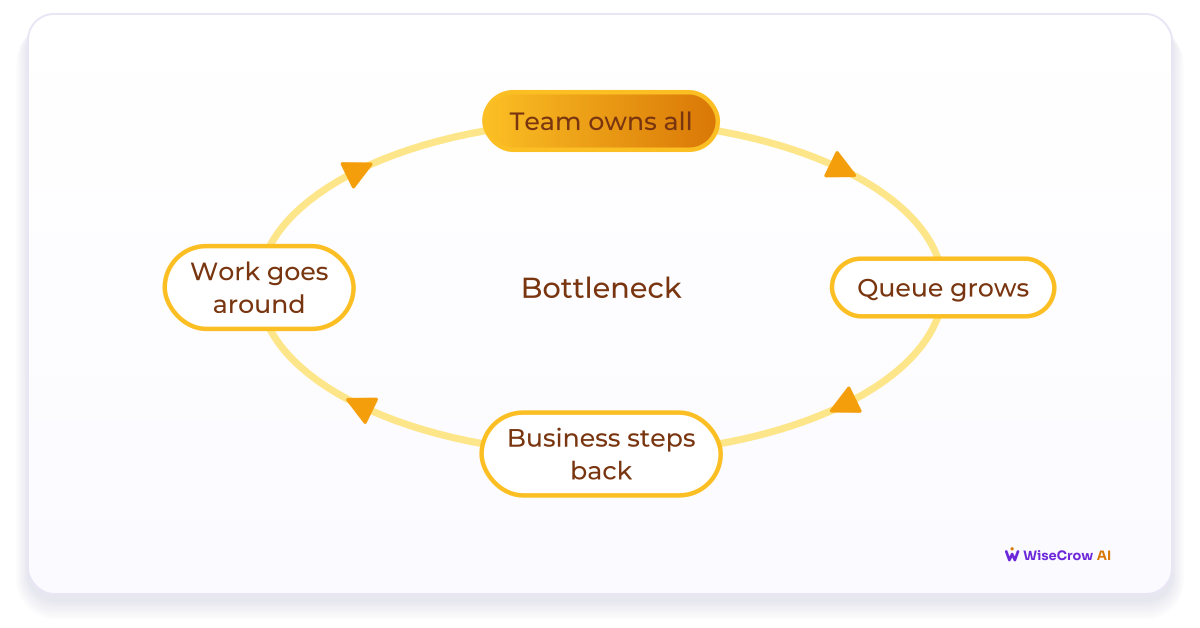
The second pattern is that risk and legal sit mostly in the consulted column. They shape decisions without owning them. When a governance team ends up accountable for every system, it becomes a bottleneck, and the business teams stop feeling responsible for what their AI does.
How to Choose Which Governance Gap to Close First
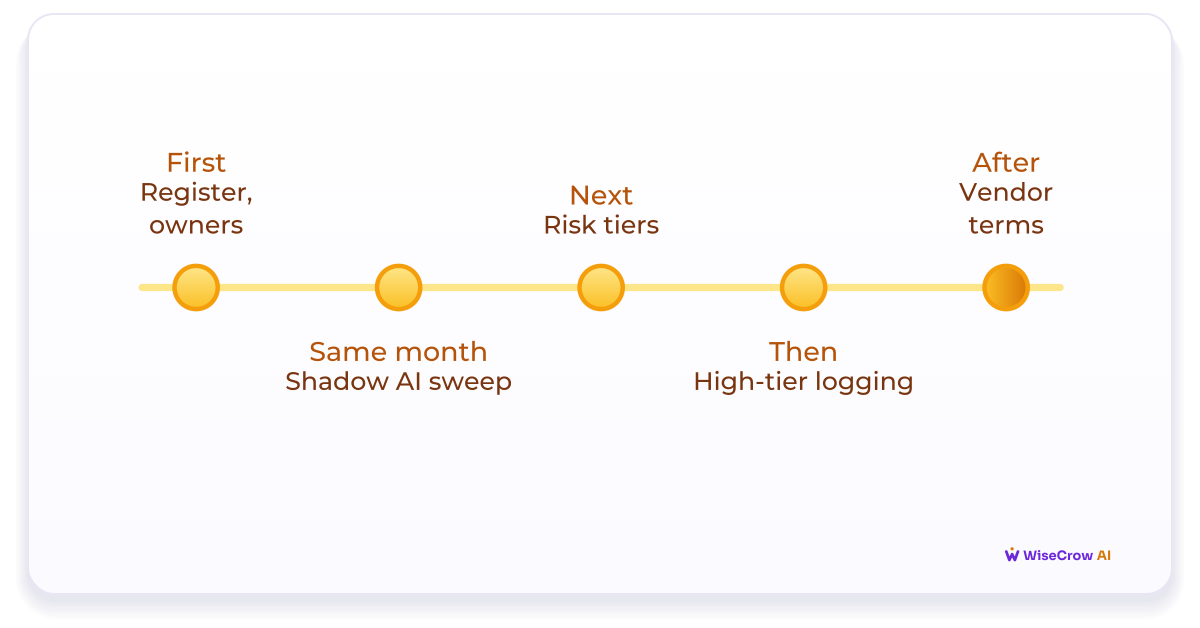
You’ll probably recognize most of the eight. Trying to fix them all in one quarter tends to produce another long policy and little change in practice. I sequence the work by dependency, because some fixes only work once others are in place.
- Start with the register and owners. Without a list of systems and a name on each, you can’t tier risk, monitor anything or answer an auditor.
- Run the shadow AI sweep in the same month. It feeds the register and usually turns up the riskiest tools in the company.
- Set risk tiers next. Tiers decide where your limited review time goes, and they make the fast lane for low-risk tools possible.
- Add logging and monitoring to the high tier. Leave the rest for later. A few systems with real evidence beat thin coverage of all of them.
- Fold vendor terms into procurement. New contracts pick them up from then on, and renewals catch the rest.
Rewriting the policy and tracking regulation run alongside all of it. One caution from experience: don’t buy a governance platform before step three. I’ve seen a mid-sized lender spend most of a year configuring a tool for a register that held eleven systems, three of them already retired. A spreadsheet would have shown that in a week.
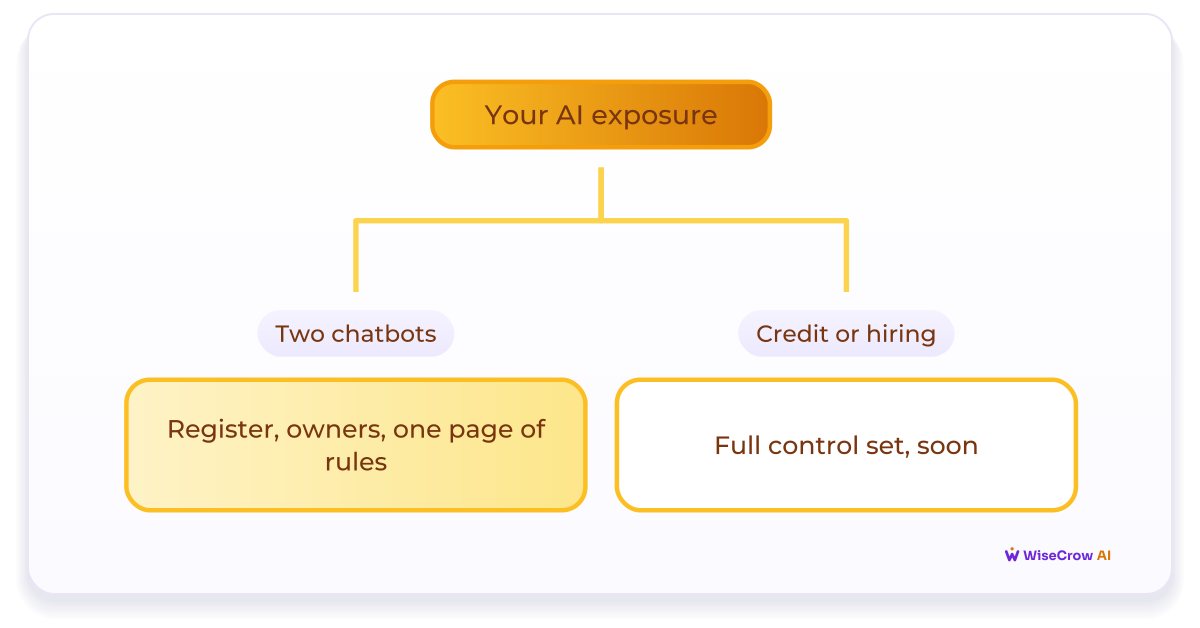
Match the effort to your exposure, too. A company with two internal chatbots needs a register, owners and a one-page rule sheet. A company using AI to make credit, hiring or medical decisions needs the full set, and soon.
Questions About AI Governance Challenges
What Are the Biggest AI Governance Challenges?
In my client work, missing ownership and shadow AI cause the most trouble, because every other control depends on knowing which systems exist and who answers for them. Opaque vendor models and missing audit trails come next. Most companies face five or six of the eight at once.
Who Should Own AI Governance in a Company?
Split it. A central lead, often in risk, compliance or the CIO’s office, owns the framework, the register and the review process. Each AI system then gets an accountable owner in the business unit that uses it. Central teams set the rules, and business owners answer for outcomes.
What Is Shadow AI and Why Does It Matter?
Shadow AI is any AI tool staff use without approval or registration, such as a free chatbot or a plugin added with a personal account. It matters because company data can leave your control and decisions can rest on tools nobody has checked. A fast approval path finds and fixes more of it than a ban.
How Do You Hold a Vendor Accountable for Its AI Model?
Through the contract and your own testing. Ask for documentation and test results before you buy, write change notice, audit rights and data use limits into the agreement and run your own test cases before rollout. Then check the vendor again whenever the model changes.
Do Small and Mid-Sized Companies Need AI Governance?
Yes, scaled to size. A register, named owners, three risk tiers and a one-page rule sheet per role cover most of the risk for a company with a handful of AI systems. You can add formal audits and dedicated tools once the number of systems grows.
How Do You Keep AI Governance from Slowing Projects Down?
Tier the reviews by risk and publish a target time for each tier. Pre-approve common patterns, review low-risk tools asynchronously and bring reviewers into design for high-risk systems. Measure review time like a service, and teams stop routing around it.
How Should We Prepare for AI Regulation Like the EU AI Act?
Build the controls most rules share: an inventory, risk tiers, impact assessments, human oversight and logs. Map each regulation onto those controls and note the gaps. Timelines for some obligations are still subject to change, so check the current status of each rule before you commit to a date.
Sources
- Microsoft and LinkedIn: 2024 Work Trend Index Annual Report, AI at Work Is Here. Now Comes the Hard Part (May 2024)
- Flexera: Flexera Finds Cloud Value Is Rising While AI Waste Grows, 2026 State of the Cloud Report
Disclaimer: This article is general information and not legal advice. AI regulations, their timelines and survey figures change, so check the current status of any rule with qualified counsel before you rely on it.
Did you find this helpful?
Thank you for your feedback.
Marlena leads the WiseCrow editorial team and works with our consultants to turn real client projects into practical guides on AI strategy, automation and governance. Before joining WiseCrow, she spent 12 years in B2B operations and SaaS content. She has since edited more than 400 articles on AI and automation and reviewed workflows from over 60 client projects. She is based in Austin, Texas.