Summary
- Spend the first two months on a named owner, a one-page interim policy and an inventory built from logs and receipts.
- Write risk tiers in month 3 and open one intake door in month 4, with a published answer time for each tier.
- Put full controls on high-risk systems only, then test them with monitoring, a traced audit trail and an incident drill.
- Close the year with an independent internal audit, a one-page board report and a policy rewritten from what you learned.
Most companies I work with already have some AI governance. There’s a policy on the intranet, a committee that met twice and a spreadsheet someone started last spring. What they lack is a sequence: which control comes first, who owns it and how you’d prove it works. When I build that sequence as part of AI data governance consulting, it almost always lands on the same 12-month shape.
Below is that shape as one table you can copy, one row per month. Each block of months then gets a short section with what to do, what to skip and where teams get stuck. The plan assumes a mid-sized company with a handful to a few dozen AI systems, most of them bought.
The Month-by-Month Plan to Copy
The last column matters most. A month counts as done once the proof exists and someone outside the project could find it.
| Month | Milestone | Owner role | Proof it’s done |
|---|---|---|---|
| Month 1Ownership | Accountable lead named | Executive sponsor | Signed mandate memo |
| Month 2Ownership | Interim policy, first inventory | Governance lead | Register with owners |
| Month 3Triage | Risk tiers written | Risk lead | Criteria approved |
| Month 4Triage | Intake form live | Governance lead | First requests decided |
| Month 5Controls | High-risk controls set | System owners | Control sheet per system |
| Month 6Controls | Vendor AI review | Procurement lead | AI terms in contracts |
| Month 7Evidence | Monitoring switched on | Technical owners | First monthly review |
| Month 8Evidence | Audit trail tested | Technical owners | One decision traced |
| Month 9Evidence | Incident drill | Incident lead | Drill notes, fixes logged |
| Month 10Assurance | First internal audit | Internal audit | Scored audit report |
| Month 11Assurance | Board report | Executive sponsor | Recorded in minutes |
| Month 12Assurance | Policy and tiers refreshed | Governance lead | Year-two plan signed |
What Has to Be True Before Month 1
Two people, mostly. You need an executive sponsor who can pause an AI system when it misbehaves, even one a revenue team loves. You also need a governance lead with real time on the calendar. In my client work, a day or two a week is enough for a company with fewer than thirty AI systems. Less than that, and the roadmap turns into a side project that loses every fight with a deadline.
Hold off on tools. A spreadsheet, a form and your ticket system will carry you through month 6. The budget question for year one is people’s time, and the sponsor should agree to it in writing before anything starts.
Months 1 and 2: Owner, Interim Policy and First Inventory
The opening block builds almost nothing visible. It decides who answers for AI and what AI you actually run.
Month 1: A Mandate With a Name on It
The sponsor signs a one-page mandate. It names the governance lead, sets the scope to AI you build and AI you buy, says who the lead reports to and grants the right to stop a system pending review. That last line is the one people try to cut. Keep it.
I learned why at a logistics company where the governance lead had a title and no authority. A route planning tool kept sending drivers past weight limits on two bridges. The lead flagged it three times. The operations director said no each time, and nothing in writing let anyone overrule him.
Month 2: A One-Page Policy and a Register Built From Receipts
Publish an interim policy that fits on one page: the approved tools, the data that never goes into an outside tool and the uses that need a review first. Call it interim on purpose. You’ll rewrite it in month 12 with a year of evidence behind it.
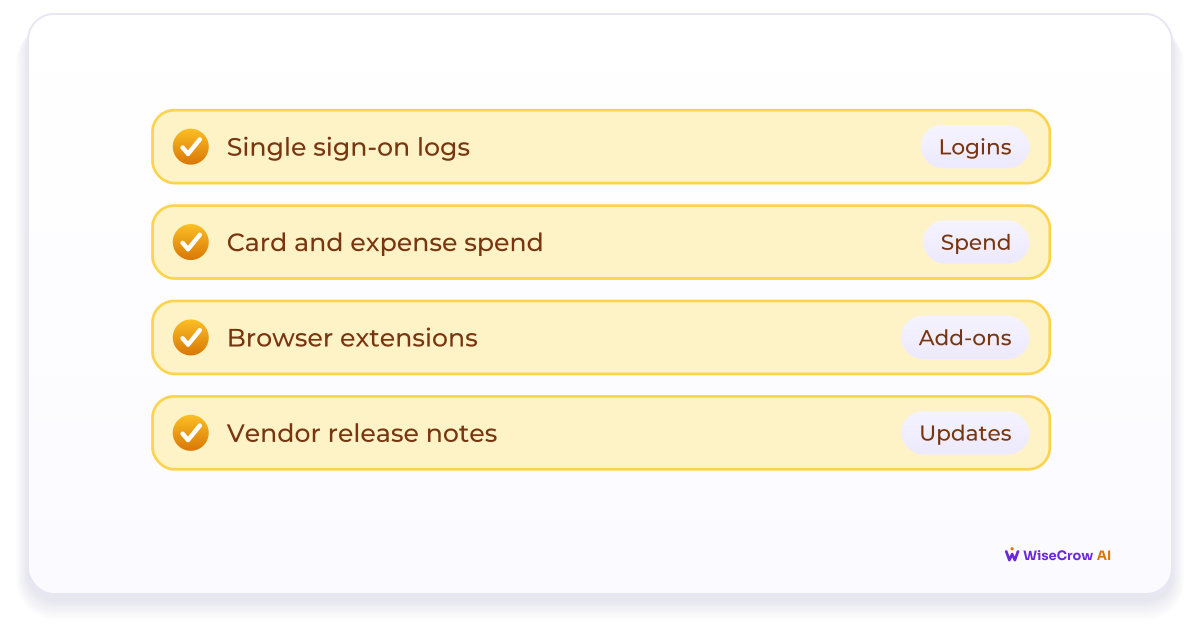
Then build the register. Asking teams what AI they use gets you half the answer. Pull single sign-on logs, card and expense spend on software, browser extensions and the release notes of the tools you already license, where vendors quietly add AI features. Give every entry a business owner and a deputy. The gaps you find here tend to match the accountability gaps I see most often, starting with systems nobody claims.
Months 3 and 4: Risk Tiers and One Front Door
With a register in hand, you can decide where review time goes. Tiers make that call once, in writing, so nobody argues it system by system.
Month 3: Tiers Tested on Real Systems
Write tier criteria around three questions. Does the output decide something about a person? How many people does it touch? How easily can a wrong result be undone? Then tier ten real systems from the register before anyone approves the criteria. Drafts that look sensible on paper often put a meeting summarizer and a pricing model in the same bucket, and the test run shows it.
| Tier | Typical example | Review path | Target answer |
|---|---|---|---|
| Not allowed | Covert staff monitoring | Declined at intake | Within days |
| High | Credit or hiring decisions | Full assessment, sign-off | A few weeks |
| Medium | Customer-facing chatbot | Reviewer checklist | About two weeks |
| Low | Internal drafting help | Self-assessment | Two or three days |
A starting point I adapt per client. The examples shift by industry, so a medium-tier tool at a retailer may be high tier at a hospital.
Month 4: An Intake Form With Published Answer Times
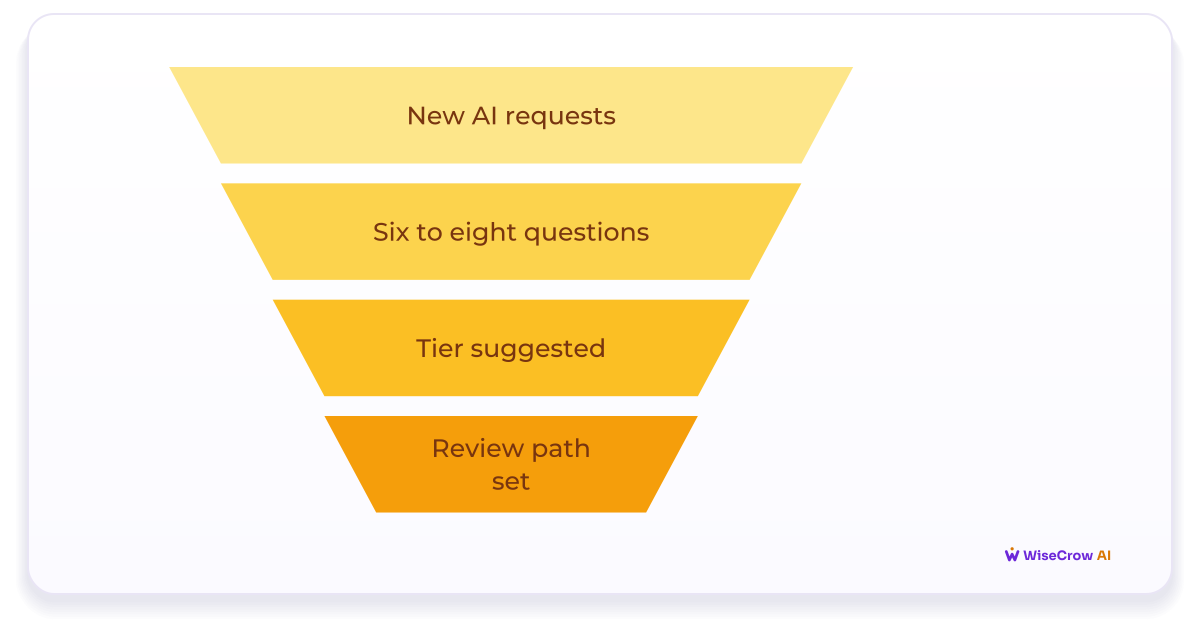
Open one front door for every new AI tool, feature or use case. Six to eight questions are enough: what it does, who it affects, which data it uses, who owns it and if a vendor is involved. The answers suggest a tier, and the tier sets the review path from the table above.
Publish the target answer time per tier and track it. Staff route around slow reviews, and the work you never see is the work that hurts you. If low-tier requests wait longer than a week, fix the queue before you add more questions.
Months 5 and 6: Controls for High-Risk Systems and Vendor Review
Now the plan narrows. Full controls go on the high tier only, which in most mid-sized companies means somewhere between two and eight systems. Spreading the same depth across everything is how governance teams burn out by summer.
Month 5: A Control Sheet for Each High-Tier System
Each high-tier system gets one control sheet, kept next to its register entry. Mine covers six items:
- The purpose and the uses that are out of bounds, in plain words.
- Test results from before the last release, on cases from your own business.
- The point where a person reviews or overrides the output, and who that person is.
- What gets logged: model version, inputs, outputs and the human decision.
- A fallback for when the system is paused, so stopping it doesn’t stop the business.
- The data it uses and the legal basis your privacy team signed off on.
The fallback is the item teams skip. Without one, the right to stop a system from month 1 is a right nobody will use.
Month 6: Vendor AI Folded Into Procurement
Most of your AI arrives inside software you buy, so move the vendor review into procurement and stop running it as a governance side task. New contracts get AI questions and terms from now on. For existing tools, put each renewal date on a calendar and review them as they come up. You won’t renegotiate thirty contracts in one month, and you don’t need to. To check the controls from both months in one pass, I use a nine-point AI governance checklist at the end of month 6.
Months 7 to 9: Monitoring, Audit Trail and an Incident Drill
The third block turns controls into evidence. It runs three months, one more than the others, because records take time to pile up and the first drill always finds something to fix.
Month 7: Two to Four Numbers per System, Reviewed Monthly
Pick a few metrics per high-tier system: accuracy on a sample, the share of outputs people override, complaints and drift in the input data. Set a threshold for each one and name the person who gets the alert. Then hold a monthly review with the business owner in the room. The technical owner brings the numbers. The business owner decides what they mean.
Month 8: Trace One Decision From Months Ago
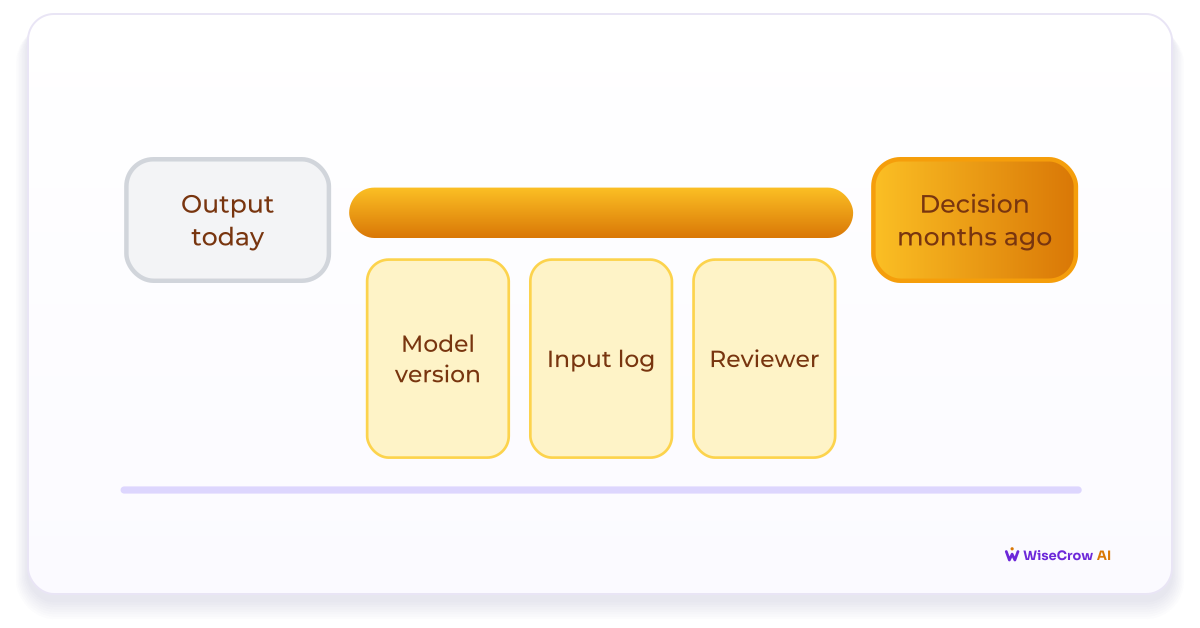
Pick a single decision a high-tier system made at least three months back. Try to reconstruct it: the model version that ran, the input, the output, the person who reviewed it and the approval that put that version live. Time how long it takes.
If the answer is “we can’t,” you’ve found your month 8 work. If it takes two days and four people, you’ve found it too. A trail an auditor can follow in under an hour is a fair target for the high tier.
Month 9: A Tabletop Drill Before the Real Thing
Run a short tabletop exercise with the people who would handle a real AI incident. My script runs in about ninety minutes:
- Read out a plausible scenario, such as a customer chatbot quoting a refund policy you don’t have.
- Ask who hears about it first, and how. Help desk, social media and a sales rep are all fair answers.
- Walk through who decides to pause the system and how long the pause takes in practice.
- Check if the logs from month 8 would show what happened and to how many customers.
- Agree on who talks to affected customers and who checks if a regulator needs to know.
- Write down every gap with an owner and a date before anyone leaves.
In the drills I’ve run, the weakest step is nearly always the second one. Complaints about AI land in a general help desk queue, get treated as normal tickets and never reach the system owner.
Months 10 to 12: First Internal Audit, Board Report and Refresh
The last block checks the year’s work with someone who didn’t do it, reports it upward and resets the plan.
Month 10: An Audit by Someone Who Didn’t Build It
Ask internal audit or a second-line risk team to test what you’ve built. The governance lead can’t audit their own work, however honest they are. Ask for scores per area, split between what’s written and what actually runs, so you see where the paper is ahead of practice. A scored AI governance audit gives you a number to track from year to year.
Expect a middling first score. Monitoring will be a few months old, and some vendor contracts won’t have come up for renewal yet. Neither is a failure. Both belong in the year-two plan.
Month 11: One Page for the Board
Boards ask about AI more often now, and a governance lead with a clear page gets far better questions than one with a slide deck. Mine follows the same order every time:
- How many AI systems you run, and the change since the last report.
- How many sit in each risk tier.
- Incidents and near misses, with what changed after each.
- The internal audit score and its three biggest gaps.
- Rule changes to watch in the markets you sell in.
- Decisions you need from the board, such as budget or a risk you propose to accept.
Month 12: Rewrite the Policy From What You Learned
Retire the interim policy. Rewrite it from the year’s evidence: the intake questions people misread, the tier calls that caused arguments, the gaps the drill and the audit found. Re-tier any system whose use or data changed. Then write the year-two plan, which usually means widening monitoring to the medium tier and finishing the vendor renewals.
Where Frameworks and the EU AI Act Fit the Calendar
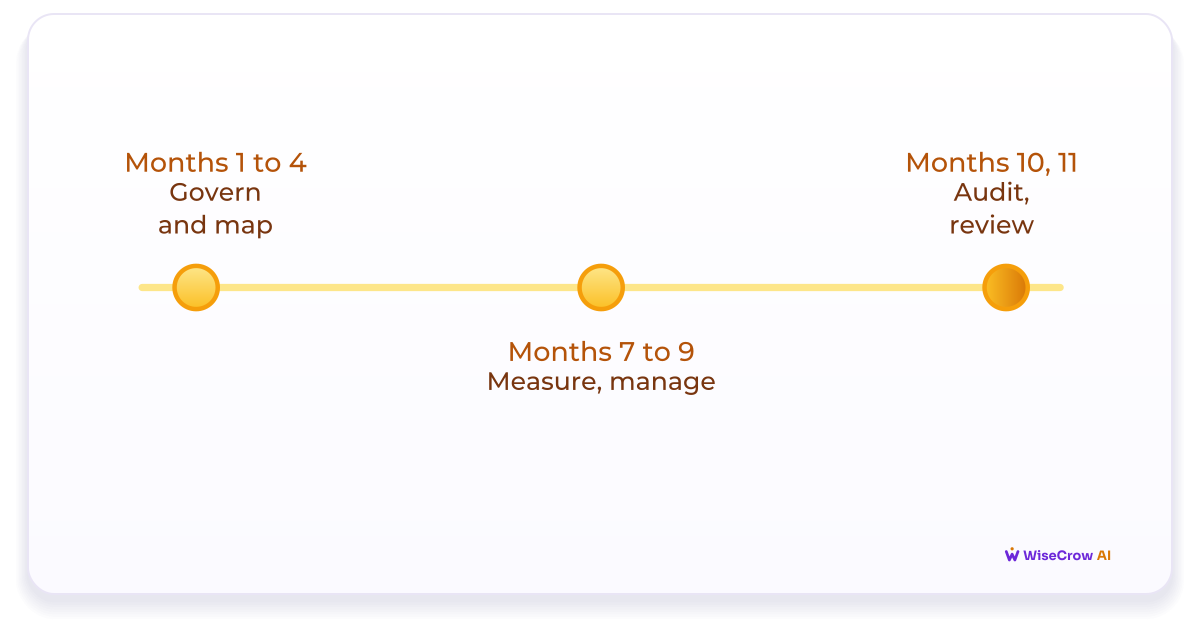
You don’t need a framework to start, but picking one reference early stops long debates later. The NIST AI Risk Management Framework is voluntary and built on four functions: govern, map, measure and manage. Months 1 to 4 sit mostly under govern and map. Months 7 to 9 are measure and manage in practice.
ISO/IEC 42001 sets requirements for an AI management system, and companies can seek certification against it. It expects internal audits and management reviews, which line up with months 10 and 11. If certification is on your horizon, keep the audit evidence in a form a certification body can reuse.
The EU AI Act has been adopted and is in force. It applies in stages, bans some practices outright and places the heaviest duties on high-risk systems, among them risk management, logging, human oversight and documentation. Changes to when some of those duties apply have been proposed, so check the current status before you plan around any date. For the roadmap, the practical step is simple: flag in the month 2 register any system that might count as high-risk under the Act, and give it the high tier in month 3.
Running the Plan With a Part-Time Team
Very few mid-sized companies hire a full governance team in year one, and they don’t need to. The plan above runs on one governance lead, a sponsor who shows up monthly and an hour or two a month from each system owner. The busy months are 2, 5 and 10. Book extra time for the lead in those months before the year starts.
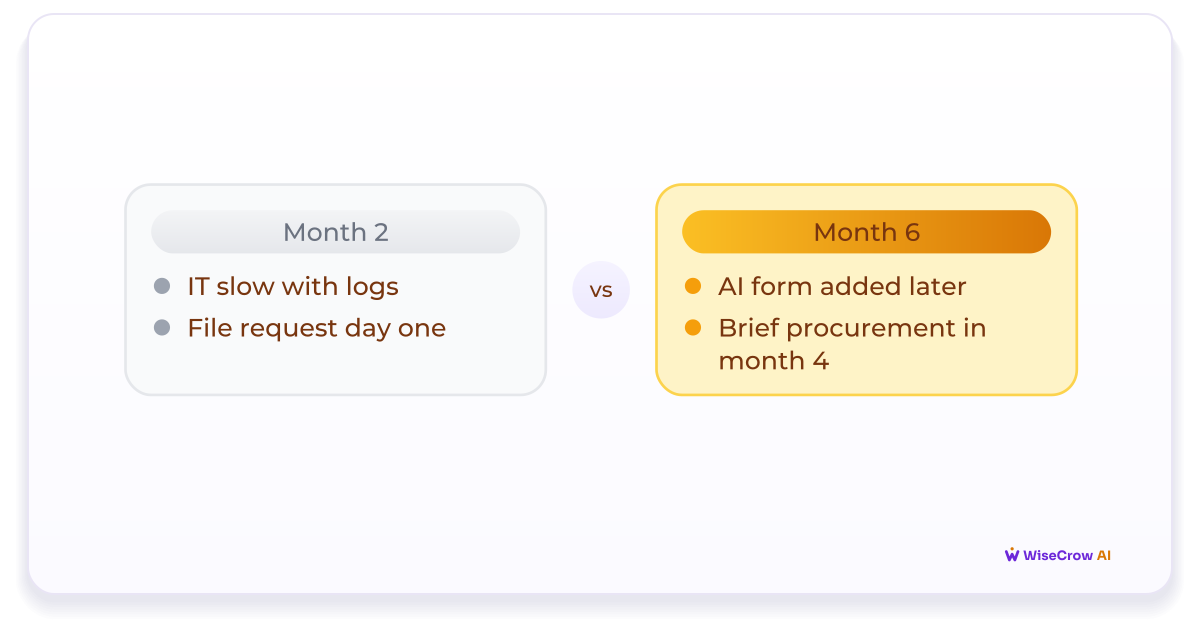
Expect slippage in two places. Month 2 stretches when IT takes weeks to hand over sign-on logs, so file that request on day one. Month 6 stretches when procurement treats AI questions as one more form to add later. A ten-minute meeting with the procurement lead in month 4 saves most of that delay.
One honest trade-off: the plan front-loads paperwork, and some teams find the first quarter slow. You can run months 3 and 4 side by side if the register is small. I wouldn’t compress months 7 to 9, though. Monitoring needs time to produce records, and an audit in month 10 with two weeks of logs tells you very little.
How to Choose Your Starting Month
Few companies start from zero. Find the row that matches where you stand and begin there, then go back and confirm the earlier months’ proof exists.
| Where you are today | Start at | What you can shorten |
|---|---|---|
| No owner, no list of AI systems | Month 1 | Nothing yet |
| Policy exists, no inventory | Month 2 | Policy work |
| Inventory and policy, no tiers | Month 3 | Months 1 and 2 |
| Tiers in use, no monitoring | Month 7 | Intake setup |
| Controls run, never audited | Month 10 | Most of the year |
If you sit between two rows, take the earlier one. The most expensive pattern I see is a company that jumps to monitoring tools while its register is missing a third of its AI. The dashboards look great, and they watch the wrong systems.
Match the depth to your exposure as well. A company with two internal assistants can run the whole plan lightly in six months. A company using AI in lending, hiring or patient care should run every month in full and treat the month 10 audit as the minimum.
Questions About AI Governance Roadmaps
What Is an AI Governance Roadmap?
It’s a dated plan that takes a company from no formal control over its AI to a working oversight system. Mine runs 12 months: ownership and an inventory first, then risk tiers and intake, controls for high-risk systems, monitoring and incident drills, and finally an internal audit and a board report.
How Long Does It Take to Set Up AI Governance?
A basic setup with an owner, an interim policy and an inventory fits in about two months. Getting to controls that produce evidence an auditor can test takes most of a year, because monitoring needs a few months of records before anyone can check it. Smaller companies with few AI systems can move faster.
Who Should Own the AI Governance Roadmap?
An executive sponsor owns the mandate and the budget, and a named governance lead runs the plan day to day. Each AI system also needs its own business owner. In smaller companies the governance lead is often someone in risk, compliance or IT with a day or two a week set aside.
What Should Come First, the AI Policy or the AI Inventory?
Write a short interim policy and start the inventory in the same month. The policy tells staff what’s allowed while you look. The inventory shows what you actually run, and the final policy should be written from what it finds, in month 12.
Do We Need an AI Governance Platform in Year One?
Usually not before month 6. A spreadsheet register, a form tool for intake and your existing ticket system cover the first half of the year for most mid-sized companies. Buy a platform once you know how many systems you have and which workflows you repeat every month.
How Does the EU AI Act Fit into an AI Governance Roadmap?
The Act has been adopted and applies in stages, with the strictest duties for high-risk uses. Changes to when some duties apply have been proposed, so check the current status before you plan around any date. In the roadmap, the month 2 inventory and month 3 tiers tell you which systems may fall under it.
How Do You Report AI Governance to the Board?
Keep it to one page: how many AI systems you run and how that changed, systems per risk tier, incidents and near misses, the internal audit score with its top gaps, rule changes to watch and the decisions you need from the board. Report the same numbers in the same format each time, so the trend is easy to read.
Sources
- NIST, AI Risk Management Framework: nist.gov
- ISO/IEC 42001, Artificial intelligence management system: iso.org
- Regulation (EU) 2024/1689, the EU Artificial Intelligence Act, Official Journal of the European Union: eur-lex.europa.eu
Disclaimer: This article is general information and not legal advice. AI regulations such as the EU AI Act and their timelines change, so check the current status of any rule with qualified counsel before you rely on it.
Did you find this helpful?
Thank you for your feedback.
Marlena leads the WiseCrow editorial team and works with our consultants to turn real client projects into practical guides on AI strategy, automation and governance. Before joining WiseCrow, she spent 12 years in B2B operations and SaaS content. She has since edited more than 400 articles on AI and automation and reviewed workflows from over 60 client projects. She is based in Austin, Texas.