Summary
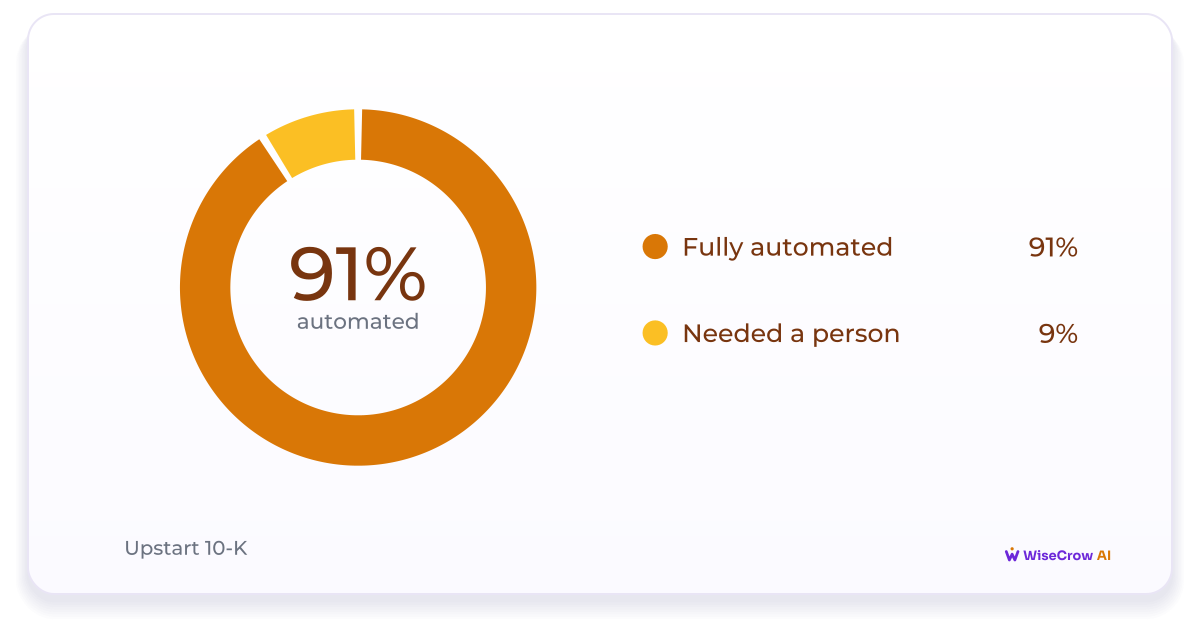
- Upstart reports that 91% of the nearly 1.5 million loans on its platform in 2025 went through with no human involvement required.
- Fraud results hold up best when they’re measured at a fixed point, like Plaid’s 126% more risky dollars caught at a 5% decline rate.
- Nubank, Chime and Plaid all moved to transformer models that read customer behavior in time order.
- Support and back-office results, like SoFi’s 61% chat containment, come from vendor and company sources, so test them on your own data.
Fintech AI claims are easy to find and hard to pin down. A launch post says “up to,” a conference slide drops the baseline, and six months later the number gets quoted as fact. For this list I kept only fintechs that published a figure I could trace to the company, a filing or a named customer story. It’s the same first pass I run in any fintech AI consulting project, because a credit or risk committee always asks who has done it already and what they measured.
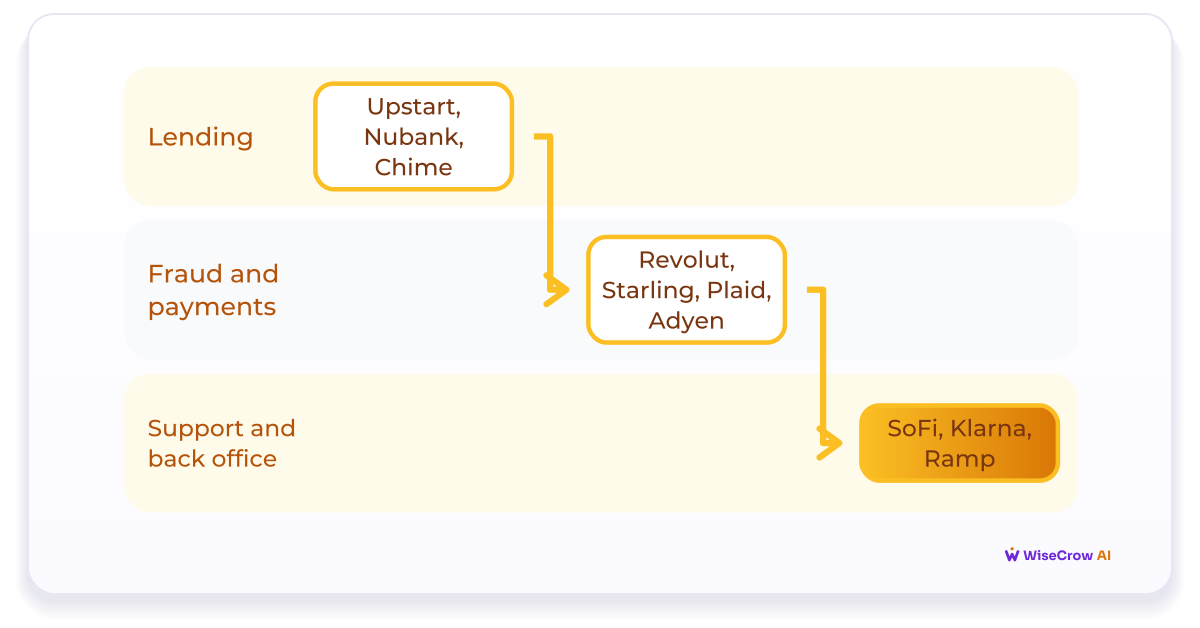
The ten are grouped by what AI improved: lending decisions first, then fraud and payment risk, then support and back-office work. Each one covers what the company did, how it works as far as it’s public and what you can borrow. Where I fill a gap with my own inference, I mark it “my reading.” If you’d rather see the ideas sorted by function with typical returns, my guide to AI in fintech use cases covers twelve of them.
Ten Fintechs and the AI Result Each One Published
One headline figure per company. Every one is company-reported in some form, from an SEC filing to a launch post, and the item text says which. Click a name to jump to the details.
| Company | Type | AI use | Reported result |
|---|---|---|---|
| 1. Upstart | Lending platform | Loan underwriting | 91% fully automated |
| 2. Nubank | Neobank | Credit card risk model | 70% risk reduction |
| 3. Chime | Neobank | Default and fraud models | 12% more defaulters caught |
| 4. Revolut | Neobank | Card scam detection | 30% lower scam losses |
| 5. Starling Bank | Neobank | Scam advice agent | 300% more cancellations |
| 6. Plaid | Data network | ACH risk scores | 126% more risky dollars |
| 7. Adyen | Payments | Checkout optimization | 86% fewer manual rules |
| 8. SoFi | Digital bank | Support agent | 61% containment |
| 9. Klarna | BNPL and payments | Staff AI tools | 96% daily staff use |
| 10. Ramp | Spend management | Accounting agents | 50% faster close |
Lending Decisions: Three Fintechs Scoring Credit With Machine Learning
Credit is where fintechs have used machine learning longest, and where results tie most directly to money. All three lenders below train on their own repayment history. Nubank and Chime recently moved to models that read raw customer behavior in time order, and Plaid did the same for payments. It’s one of the shifts I follow in my roundup of AI in fintech trends.
Upstart: Nine in Ten Loans With No Human Step
Upstart runs an AI lending marketplace. Banks and credit unions set their credit rules, and Upstart’s models price and approve the loans. In its 2025 annual report on Form 10-K, the company says 91% of Upstart-powered loans were fully automated in 2025, the same share as in 2024. It defines that as loans originated end to end with no human involvement required by the company. Upstart counted just under 1.5 million loans that year, so by my math about 135,000 still needed a person.
The model behind it grew from 23 variables at the end of 2014 to more than 2,500 at the end of 2025, trained on nearly 104 million repayment events. The flat 91% is the detail I find most useful. My guess is that the last 9% are files with odd income documents or identity flags, where a person still has to look.
How a Loan Moves Through Upstart
- The lending partner’s hard credit rules are applied first.
- The underwriting model estimates the chance of default and of early repayment.
- A pricing engine combines that estimate with the lender’s pricing requirements.
- Most applications finish without anyone at Upstart stepping in.
- My reading: the rest go to staff for document, identity or income checks.
- Every repayment event becomes training data for the next model version.
What a Lender or Credit Union Can Take From It
Track the share of applications that finish with no manual touch and report it every quarter next to loss rates. When the share stops rising, study the exceptions one by one, because they show you which data your model is missing.
Nubank: A Transformer Model for Credit Risk
Nubank’s newest credit risk model is a transformer, the same family of models behind large language models. In a May 2026 newsroom post based on its Nu Videocast, Nubank said the model, nuFormer, delivered a 70% risk reduction for an equivalent population compared with earlier model generations.
Read the 70% carefully. It compares predicted risk for the same kind of customer across model versions, so it isn’t a drop in real losses. The business numbers around it are steadier: write-offs held at 2.8% to 2.9% of the book while the credit book grew about 40% from Q4 2024 to Q4 2025, by the company’s figures. Nubank also says its teams review more than 1,000 risk-monitoring artifacts every week, the habit I see smaller lenders skip most often.
What Changed in Nubank’s Credit Models
- Nubank built 17 generations of limit-increase models and 10 of acquisition models first.
- nuFormer applies a transformer to more than 100 terabytes of behavioral data.
- My reading: it scores the same decisions those earlier models made, like limit increases.
- It runs inside Nubank’s existing risk framework, with the same underwriting bar.
- Teams review over 1,000 monitoring artifacts each week to catch drift early.
The Lesson for a Smaller Card Issuer
Judge a new credit model on the same customer population as the old one, and report write-offs next to growth so nobody mistakes looser lending for a better model. Set up the weekly monitoring routine before the new model goes live.
Chime: Event Models That Catch More Defaulters
Chime published one of the more open write-ups on this list. In an August 2026 engineering post, two of its machine learning engineers describe replacing gradient-boosted tree models with transformers that read each member’s events in time order: direct deposits, card transactions, repayments, balances, disputes and logins. Across four production use cases, the new design beat the existing models by 13% to 35% in relative PR-AUC, a measure of how well a model ranks rare events like defaults.
The plain-language results are easier to use. For lending, the model caught 12% more defaulters in the top risk decile. For first-party fraud, where members dispute their own genuine transactions, recall for the riskiest 1% of users improved by 20%, and that score now runs daily to route disputes and prioritize account reviews. These are company-reported test comparisons, and I still trust them more than most, because Chime names its baseline and shows where the gain was small.
How Chime’s Event Model Builds a Score
- Each event family, such as deposits or logins, is pulled in time order and turned into tokens.
- A small transformer encodes each stream on its own.
- A shared timeline model merges all streams to find links between them.
- Real-time data, like the current transaction, joins in a final fusion layer.
- Summaries of each member’s history are precomputed daily, so only the newest event is encoded at request time.
- Attribution tools explain which streams drove an individual score.
Before You Replace Your Tree Models
Test a sequence model on one use case where you already have a strong baseline, and report the gain in business terms like defaulters caught per decile. Plan the explainability work at the same time, since your credit team will need reasons for every declined applicant.
Fraud and Payment Risk: Four Ways to Stop Bad Money Earlier
Fraud is the second big home for AI in fintech, and these four attack it at different points. Revolut and Starling talk to the customer before money leaves. Plaid scores the bank account behind a debit. Adyen tunes the whole checkout, so fewer good payments get blocked along with the bad ones.
Revolut: Interrupting Card Scams Mid-Payment
Card scams are hard for a bank to stop because the customer approves the payment. Revolut’s in-house financial crime team built a feature that spots card payments with a high chance of being part of a scam, declines them and walks the customer through an interactive check in the app. When Revolut announced it in February 2024, it said fraud losses from card scams tied to investment opportunities had fallen by 30% since launch, as Qorus reported from the announcement.
The intervention matters as much as the model. The app asks the customer about the payment and shows short educational content about the scam pattern. In my experience, a plain warning pop-up does little, because scammers coach victims to click through it. Mind the scope, though. The 30% covers investment scams paid by card, with no stated baseline period, so don’t stretch it to all fraud.
What the Customer Sees When a Payment Is Flagged
- The model reviews the card payment against the account’s recent activity.
- A payment that looks highly likely to be a scam is declined.
- The app opens an interactive intervention and asks about the payment.
- Educational content explains the scam the customer may be facing.
- My reading: the answers become labels that help train later versions.
A Pattern Worth Testing in Your App
Pair every high-risk decline with a short conversation in the app, so the customer learns why and doesn’t simply retry on another card. Measure the result per scam type, as Revolut did, so one strong number can’t hide weak ones.
Starling Bank: A Gemini Agent That Checks Scam Messages
Starling took a different route to the same problem. In October 2025 it launched Scam Intelligence, an opt-in tool where customers upload a marketplace listing, a seller’s message or screenshots of texts asking for money. Google’s Gemini models read the images and text, Starling’s own systems add a risk assessment, and within seconds the customer hears what looks wrong: a price that’s too good, a photo that may not be genuine or bank details that don’t match the seller.
In June 2026, Starling extended it to romance, investment and other scams inside Starling Assistant, available to its 5 million customers. The June release says the original tool raised the rate at which customers cancel marketplace payments by 300%. No baseline or time period is given, so I read it as direction only. Starling says customer data stays in its Google Cloud environment and isn’t used for training.
How a Customer Uses Scam Intelligence
- The customer opts in to the feature.
- They upload a listing, message or screenshot, or describe the request to Starling Assistant.
- Gemini reads the content, and Starling’s systems produce a risk view.
- For romance cases, it asks where the couple met and why the partner can’t pay themselves.
- When the risk looks high, it suggests a call with Starling’s support team.
- The customer makes the final call on the payment.
What a Smaller Bank Can Borrow
Give customers a way to ask before they pay, because by the time money moves, most scam victims have already decided to trust the scammer. Keep it opt-in and say plainly where the data goes, as Starling did, so privacy questions don’t stall the launch.
Plaid: A Foundation Model for ACH Payment Risk
Plaid sits between apps and bank accounts, which gives it a view of payment behavior across millions of accounts. Its Signal product scores ACH debits for the chance they’ll be returned. In October 2026 Plaid launched Signal 4, built on a sequential foundation model pretrained across its network. In testing, Plaid says the new bank risk score caught 126% more risky dollars than version 3 at a 5% decline rate, and the customer risk score caught 26% more unauthorized returned dollars at a 1% decline rate.
The decline rate is what makes those figures usable. Any model can catch more fraud by blocking more payments, so Plaid fixes the share of payments declined and compares what each version catches at that level. By Plaid’s count, Signal already covers about $7 billion in transactions a month. These are launch test results with no sample size published, so ask for a back-test on your own traffic before you change thresholds.
What Signal 4 Checks Before a Debit Clears
- The model reads the account’s transactions in order, with timing and context.
- Cash flow features add income patterns, spending swings and if it’s the holder’s main account.
- AI reads raw transaction descriptions to find past returns, even from businesses outside Plaid.
- Signal returns a bank risk score and a customer risk score.
- Clients send decisions and return outcomes back, and the model retrains on them.
Before You Buy an ACH Risk Score
Ask every vendor to state results at a fixed decline rate, or the percentages can’t be compared. Send your return outcomes back to the vendor, since Plaid says clients who share return data by API saw dollar recall rise two to three times.
Adyen: Fewer Manual Fraud Rules and Higher Conversion
Adyen processes payments for large merchants, and in January 2025 it launched Uplift, an AI suite that tunes fraud checks, authentication, routing and checkout together. Adyen says the models draw on more than a trillion dollars of global transactions. In the pilots, companies cut their manual risk rules by 86% on average and 35% of pilot customers dropped them entirely, according to eCommerceNews’s launch coverage. The US pilot showed potential savings of up to 5% on transaction costs.
Conversion gains vary by merchant. Nord Security’s head of payments said conversion on customer-initiated transactions rose 10%, and the running shoe brand On reported up to 2%. Adyen’s Uplift page now says up to 6% higher conversion. I put the most weight on the rule cut. In my client work, merchant risk teams spend hours each week maintaining rules that block good customers, and a model trained on network-wide data takes much of that work off their plate.
How Uplift Weighs One Checkout
- A shopper reaches checkout, and Uplift orders the payment methods for that shopper.
- Models trained on Adyen’s network separate likely fraud from genuine shoppers.
- Automated fraud controls replace many of the merchant’s manual rules.
- The payment goes down the route Adyen’s AI expects to cost least.
- Dashboards show the merchant results and suggest next steps.
What Merchants and Platforms Can Copy
List every manual fraud rule you maintain and the revenue each one blocks, then test which rules a model can replace. Judge the result on conversion, fraud and cost together, since tuning one alone tends to hurt the other two.
Support and Back-Office Work: Three Fintechs Handing Routine Tasks to AI
The last three are about time and effort. SoFi put an AI agent in front of member support, Klarna got AI tools into almost every employee’s day, and Ramp sells agents that close the books for accounting firms. The evidence here is softer than in lending, since it comes from a vendor case study, an IPO filing and a product launch.
SoFi: An AI Agent for Member Support Chats
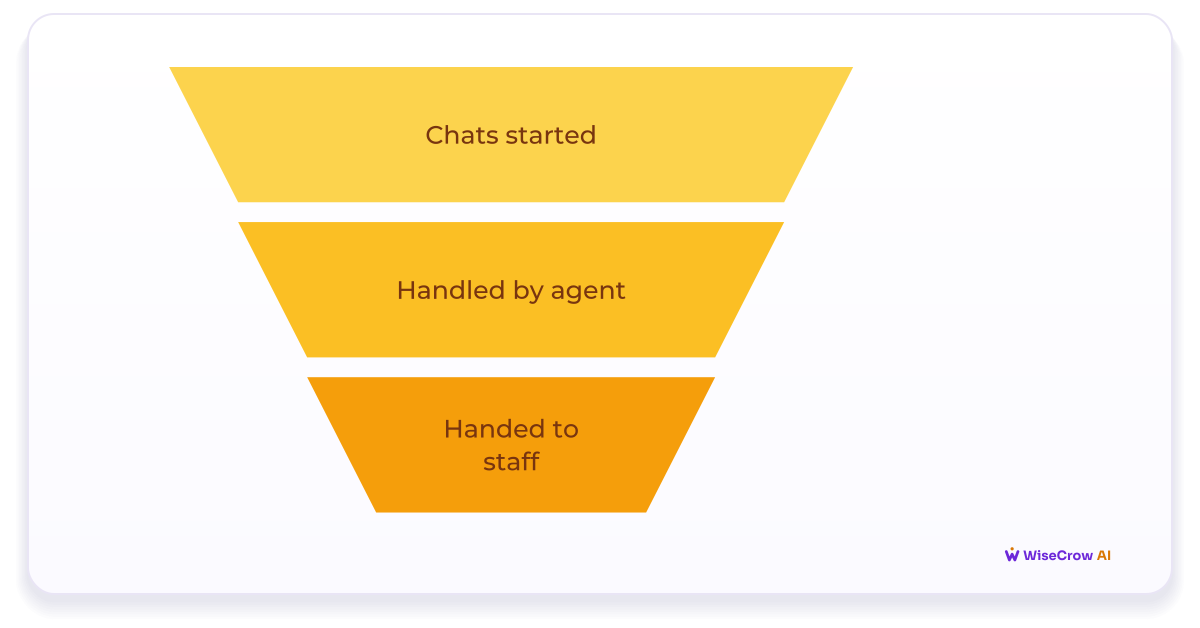
SoFi serves more than 13.7 million members across banking, investing and lending, and its support chat runs through an AI agent built with Sierra. The agent handles more than 50,000 conversations a week on topics like account balances, card rewards, loan application status and travel benefits. Three months after launch, it contained 61% of conversations and chat NPS rose 33 points, according to Sierra’s SoFi case study.
Containment means the member didn’t need a human agent, which says less than “problem solved.” The NPS jump is the better clue that members liked the answers, though both figures come from a vendor’s case study. SoFi’s teams can inspect the agent’s reasoning traces and watch live conversations, and the agent reaches SoFi’s systems through internal APIs with guardrails for sensitive data. That inspection access is the first thing I’d ask any support AI vendor for.
How SoFi Set Up Its Support Agent
- SoFi compared vendors on end-to-end resolution, scale and transparency.
- It picked a platform built for regulated environments.
- The agent was connected to internal APIs, with guardrails for sensitive data.
- Support staff kept the most complex cases.
- Teams review reasoning traces and live chats to make targeted fixes.
- Results were measured three months after launch.
Set Your Support Benchmarks First
Measure containment and chat satisfaction before launch, so a three-month comparison means something. Ask any vendor for full conversation logs and reasoning traces, because you’ll need them for complaints and audits.
Klarna: AI Tools in Almost Every Employee’s Day
Klarna’s customer service assistant is the AI story most people know, and its launch numbers get quoted everywhere. Its IPO filing tells a less quoted story about staff. In the F-1 registration statement filed with the SEC in September 2025, Klarna says 96% of its employees used generative AI in their daily work as of August 31, 2024, based on data from OpenAI and its internal tools. By June 2025, 80% of its engineers and data scientists had an AI copilot connected to their work software that can write and review code.
Klarna also says its internal AI tools have raised average revenue per employee, without a figure in the sections I checked. Read the 96% as an adoption number. It shows people opened the tools every day and says nothing yet about hours saved. Still, adoption that broad is rare, and in my experience it only happens when leaders use the tools in the open first.
Where AI Sits in Klarna’s Internal Work
- Staff use generative AI through OpenAI and Klarna’s own internal tools.
- Engineers and data scientists work with a copilot connected to their software.
- Legal teams use AI to speed up document review.
- Kiki answers employee questions from internal systems.
- Usage is tracked, which is how Klarna can report a daily-use share.
How to Track Adoption the Klarna Way
Track daily use of your approved AI tools by team and share the number internally every month. Pair it with one time or cost measure per team, so you can show more than adoption at the next budget review.
Ramp: Accounting Agents That Speed Up the Close
Ramp started with corporate cards and expense software, and it now sells AI agents for accounting work. In June 2026 it launched Stack, a platform where accounting firms set up their clients, describe their processes in plain English and let agents run reconciliations, journal entries and flux analyses. Ramp says it works with more than 4,500 accounting firms, and its launch post says firms running on Stack are closing books 50% faster.
I’d hold that figure loosely. The same page says 60% faster in its opening line, and the one named customer, Tyler Otto of Specialized Accounting, says month-end close time has dropped by 50% “on some clients.” What I like is the control model. The firm decides which tasks an agent runs alone and which pause for review, every action is logged, and recurring entries can post automatically while discrepancies wait for an accountant.
How a Firm Runs a Close With Stack
- The firm adds each client and connects the accounting system, bank accounts and cards.
- Staff describe processes in plain English, like reconciling a clearing account against the ledger.
- Agents confirm what they understood and ask when a rule is unclear.
- Close checklist tasks are assigned to staff or agents.
- Agents build workpapers and journal entries and sync them to the client’s books.
- A console shows what’s done, running or waiting for sign-off.
What Your Finance Team Can Copy
Write your close procedures as plain rules, with the thresholds where a person must review, before you buy any accounting agent. Then time two closes before and two after, because a vendor’s 50% or 60% won’t tell you what your own books will do.
What Each Example Needed to Work
When a client wants to copy one of these, the first thing I map is what the company fed the AI, who built it and where a person still steps in. The answers decide what you can buy and what you’d have to build.
| Company | Main data | Built by | Human role |
|---|---|---|---|
| Upstart | Repayment history | In-house models | Exceptions only |
| Nubank | Behavioral data | In-house models | Weekly monitoring |
| Chime | Member event streams | In-house ML team | Dispute reviews |
| Revolut | Card payments | Financial crime team | Customer answers |
| Starling Bank | Customer uploads | Gemini plus own systems | Customer decides |
| Plaid | Network transactions | In-house models | Client sets thresholds |
| Adyen | Network payments | In-house models | Merchant reviews results |
| SoFi | Member accounts via APIs | Vendor agent | Complex cases |
| Klarna | Internal systems | OpenAI and own tools | Staff use outputs |
| Ramp | Client ledgers | Ramp’s agents | Accountant sign-off |
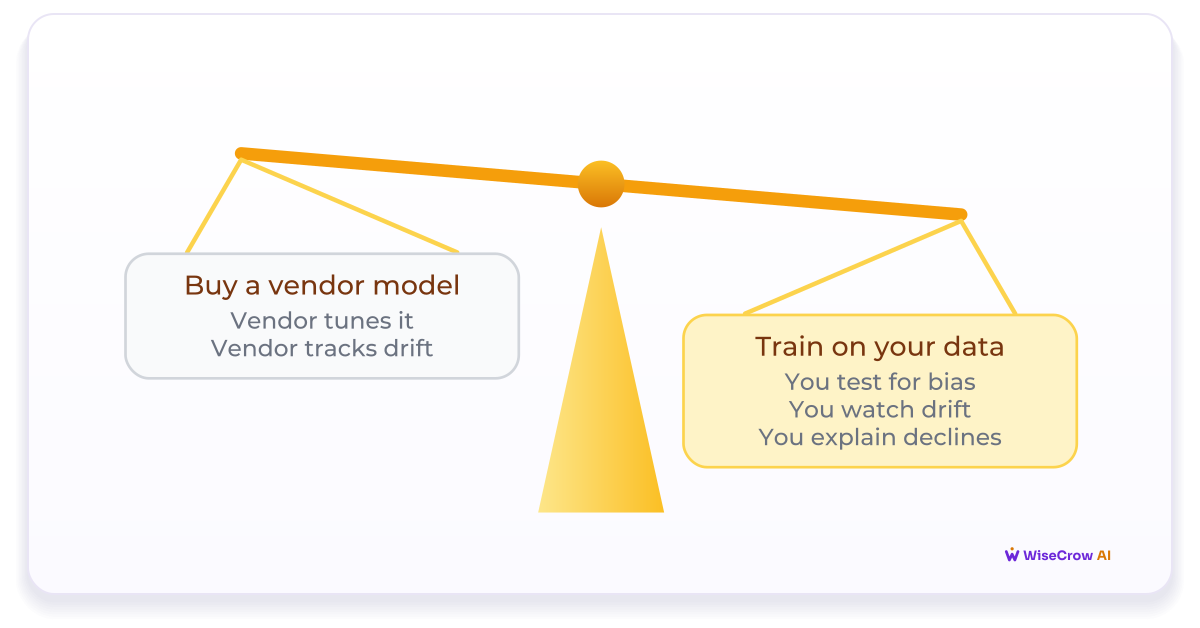
Read down the “Built by” column and a split appears. Every risk model on the list was built in-house on years of the company’s own outcomes. The support and back-office examples lean on outside models or vendors, from Gemini at Starling to Sierra at SoFi. For a mid-sized fintech, that split is the practical answer to build versus buy: you rent the language model and own the risk data.
Owning the risk data also means owning the model risk. Bias testing, drift monitoring and reasons for declined applicants all land on your team, and they’re where I see fintech AI projects stall most often. I cover how to handle them in my piece on AI in fintech challenges.
How to Choose Which Fintech Example to Copy First
You won’t copy all ten, and you shouldn’t try. When I help a lender, neobank or payments company pick a starting point from a list like this, I run each candidate through five questions:
- Do you hold the outcome data the model needs, such as repayments, returns or confirmed scams?
- Can you state today’s baseline at a fixed point, like a decline rate or a customer segment?
- Could a vendor you already pay switch it on, or would you build it?
- Is it clear where a person reviews, approves or takes over?
- Will your model risk and compliance teams sign off within a quarter?
For most mid-sized fintechs, the quickest win is a risk score or support agent from a provider you already use, measured against a baseline you set before launch. Scam checks like Revolut’s and Starling’s come next if your customers face authorized push payment fraud. Credit models like Upstart’s and Nubank’s pay the most, and they come later, once your repayment data and governance can carry them.
Before you build anything, check what your current providers already include. My ranking of fintech AI tools compares options for KYC, fraud and credit, so you can see where buying beats building.
Questions About AI in Fintech Examples
What Is the Best Example of AI in Fintech?
For hard evidence, I’d pick Upstart. It reports in its 10-K that 91% of the nearly 1.5 million loans on its platform in 2025 were originated with no human involvement required, and it defines the metric in the filing.
How Do Neobanks Use AI?
The neobanks here use it in three places. Nubank and Chime score credit and first-party fraud with transformer models. Revolut and Starling stop scams by talking to the customer before money leaves. SoFi, a digital bank, runs member support chats through an AI agent that contained 61% of conversations three months after launch.
How Do Fintech Lenders Use AI in Underwriting?
At Upstart, the lender’s hard credit rules run first, then a model estimates the chance of default and early repayment, and a pricing engine sets the terms. Nubank uses a transformer model for credit card limits and new credit. In both cases the model works inside a risk framework that people set and monitor.
Are These AI Results Independently Verified?
Not as far as I can find. They come from SEC filings, company newsrooms, an engineering blog, a vendor case study and launch posts. Upstart’s and Klarna’s figures sit in SEC filings, though the companies still define the metrics. Treat all ten as proof something can work and measure your own pilot.
Can a Small Fintech or Credit Union Copy These Examples?
Yes, mostly by buying the layer you need. Payment and data providers like Adyen and Plaid ship risk scores you can switch on, and support agents come from vendors like the one SoFi used. Building your own credit model like Upstart’s or Nubank’s needs years of repayment data, so it usually comes later.
Does AI Replace Fraud and Support Teams at Fintechs?
Not in these examples. SoFi’s support staff kept the complex cases, Starling’s assistant suggests a call with its support team when the risk looks high, and Ramp’s agents pause for an accountant on discrepancies. The work shifts toward exceptions, reviews and monitoring, and you need people who can do that well.
How Long Does It Take to See Results from AI in Fintech?
It depends on the use case. SoFi measured its support agent three months after launch. Credit models take far longer: Upstart’s model grew from 23 variables in 2014 to more than 2,500 in 2025, and Nubank went through 17 generations of limit-increase models. Start with a narrow pilot you can measure within a quarter.
Sources
- Upstart Holdings, Form 10-K for fiscal year 2025: sec.gov
- Nubank, AI-powered credit model extends access while maintaining portfolio quality (May 2026): nu.com
- Chime, From Tabular to Transformers: Event Sequence Models for Financial Intelligence (August 2026): chime.com
- Revolut unveils AI-powered defense against card scams (February 2024): Qorus
- Starling Bank, Scam Intelligence launch (October 2025): starlingbank.com
- Starling Bank, new AI feature detects romance scammers (June 2026): starlingbank.com
- Plaid, Signal 4 ACH risk model launch (October 2026): plaid.com
- Adyen Uplift launch and pilot results (January 2025): eCommerceNews
- Adyen Uplift product page: adyen.com
- Sierra, SoFi customer story: sierra.ai
- Klarna Group plc, Form F-1/A registration statement (September 2025): sec.gov
- Ramp, Stack launch for accounting firms (June 2026): ramp.com
Disclaimer: This article is for general information only and isn’t financial, investment or legal advice. The results come from SEC filings, company announcements, an engineering blog, a vendor case study and press coverage, are mostly not independently audited and may have changed since publication, so check the original sources before you rely on them.
Did you find this helpful?
Thank you for your feedback.
Marlena leads the WiseCrow editorial team and works with our consultants to turn real client projects into practical guides on AI strategy, automation and governance. Before joining WiseCrow, she spent 12 years in B2B operations and SaaS content. She has since edited more than 400 articles on AI and automation and reviewed workflows from over 60 client projects. She is based in Austin, Texas.