Summary
- Alloy and Sardine cover the widest stretch of the onboarding, fraud and AML chain, so they suit fintechs that want fewer vendors.
- Socure, Persona, Sumsub and Veriff handle identity checks, and Socure, Sumsub and Veriff publish self-serve per-check prices.
- Unit21, Feedzai and ComplyAdvantage focus on AML monitoring and screening, with AI agents that triage alerts and draft case notes.
- Taktile and Zest AI handle credit decisions, and both need clear reason codes so you can explain every decline.
The Best Fintech AI Tools at a Glance
| Tool | Main job | Pricing | Best for |
|---|---|---|---|
| 1. Alloy | Identity and fraud orchestration | Contact sales | Banks and scaling fintechs |
| 2. Sardine | Fraud, AML and KYC | Contact sales | Payments-heavy fintechs |
| 3. Socure | Identity and fraud | From $0.80/check | US consumer onboarding |
| 4. SEON | Fraud and AML | From $699/mo | Lean risk teams |
| 5. Persona | Identity verification | Ask vendor | Custom onboarding flows |
| 6. Sumsub | KYC, KYB and AML | From $1.35/check | Global and crypto fintechs |
| 7. Veriff | ID and biometric checks | From $0.80/check | High-volume ID checks |
| 8. Unit21 | AML and fraud monitoring | Contact sales | Compliance teams |
| 9. Feedzai | Transaction fraud and AML | Request a demo | Banks and processors |
| 10. ComplyAdvantage | AML screening | From $99/mo | Sanctions and PEP checks |
| 11. Taktile | Credit and risk decisions | Contact sales | Lenders building policies |
| 12. Zest AI | Credit underwriting models | Contact sales | Credit unions and banks |
The 12 Best Fintech AI Tools, Ranked
I ranked these tools by how much of the onboarding, fraud, AML and credit chain each one covers for a typical fintech, with published pricing and review depth as tiebreakers. I compared them on vendor product pages and documentation, published prices and G2 or Capterra review data. I didn’t run hands-on tests of each product, so treat the list as a shortlist for demos. In the fintech AI consulting work I review, the tool is half the story. The other half is the decision policy behind it: which signals block a sign-up, which ones send it to a person, and who signs off on those rules.
Alloy
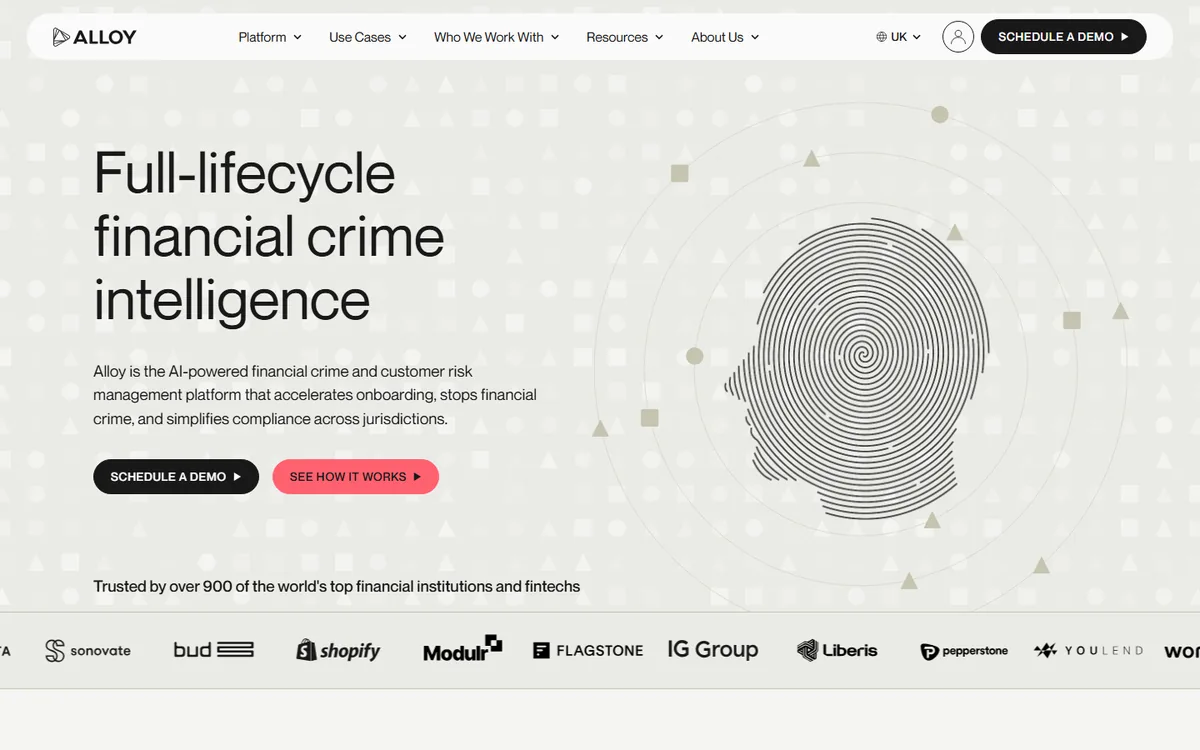
The Widest Coverage From Onboarding to Credit Decisions, Run From One Policy Engine
Alloy connects identity, fraud, KYB, AML and credit data sources through one orchestration layer, with AI agents that look at case triggers and suggest the next step.
Most fintechs don’t buy one identity vendor. They end up with three: one for documents, one for data checks, one for fraud scores. Alloy sits above them. Its platform gives you access to more than 300 partner data solutions, according to Alloy, and a decision engine that decides which checks to call, in which order and what to do with the answers. Use cases run from consumer and small business onboarding to transaction monitoring on ACH, wires, RTP and card, plus credit decisioning and line management.
I put Alloy first because it lets a risk team change policy without a sprint. You can swap a data vendor, add a step-up check for risky applicants or tighten rules during a fraud attack from the dashboard. The newer AI layer adds Fraud Signal, a machine learning model for fraud risk, and Fraud Attack Radar, which flags coordinated attacks across your portfolio. In my client work, the catch is cost and effort. You still pay each data vendor, you need someone who understands risk policy to configure it, and its public review base is tiny, so ask for reference calls with a company your size.
What Alloy Does Well
- One policy engine for onboarding, monitoring and credit
- Data vendors can be swapped without rebuilding the flow
- Every decision step is logged for audits
What Alloy Could Do Better
- Data vendor fees come on top of the platform
- Very few public reviews to check against
Alloy Pricing
Alloy doesn’t publish prices. You schedule a demo and get a quote, which depends on the products you use, your application and transaction volumes, and the third-party data sources you connect.
Alloy Reviews
- G2: score of 4.4 out of 5 (from 4 customer reviews)
Sardine
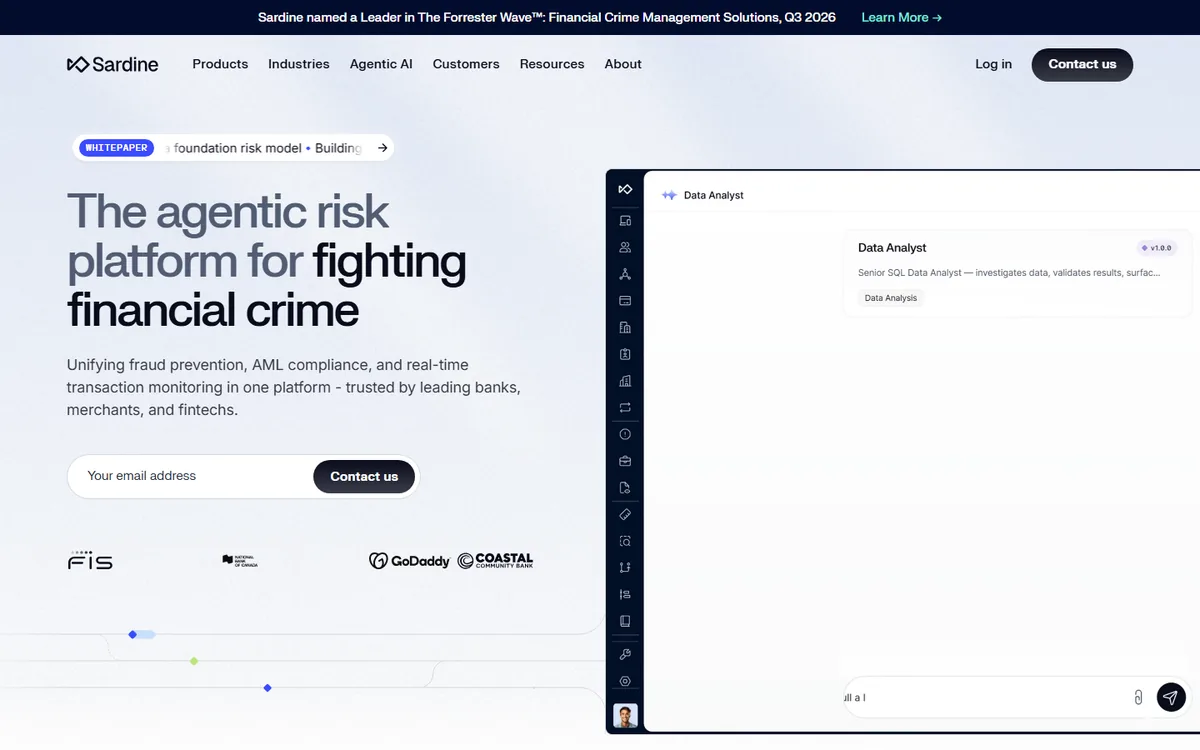
The Strongest Device and Behavior Signals, Now With Ten Agents for Fraud and AML Work
Sardine combines device intelligence and behavior biometrics with KYC, KYB, payment fraud, AML monitoring and credit underwriting, plus an agent hub for investigations.
Sardine started from the device. It looks at how someone types, swipes and moves through your app, flags emulators and remote access tools, and spots users hiding their real location. Those signals catch scams where the victim is the one logging in, which document checks alone will miss. On top sits a broad product range: onboarding with KYC, KYB and bank account verification, payment and card fraud, transaction monitoring across ACH, wires, RTP, FedNow and Zelle, sanctions screening and case management. You can also build credit models in Sardine without engineering help.
The agent layer is the newest piece. Sardine lists ten agents, from OSINT search and sanctions screening to graph analysis and SAR drafting, and an Agent Hub where you run them against alert queues or call them from your own systems. I rank it second because it covers almost as much ground as Alloy with its own signals built in. G2 reviewers praise its fraud prevention, and several say the rules engine takes time to learn when you start.
What Sardine Does Well
- Behavior signals catch scams where the real user is coached
- Fraud, AML and onboarding share one data model
- Agents can run on alert queues on a schedule
What Sardine Could Do Better
- The rules engine has a learning curve, per reviewers
- No published prices
Sardine Pricing
Sardine doesn’t list prices on its site. You contact sales or book a demo, and the quote depends on the modules you license, such as onboarding, payment fraud or AML, and on your event volume.
Sardine Reviews
- G2: score of 4.8 out of 5 (from 35 customer reviews)
Socure
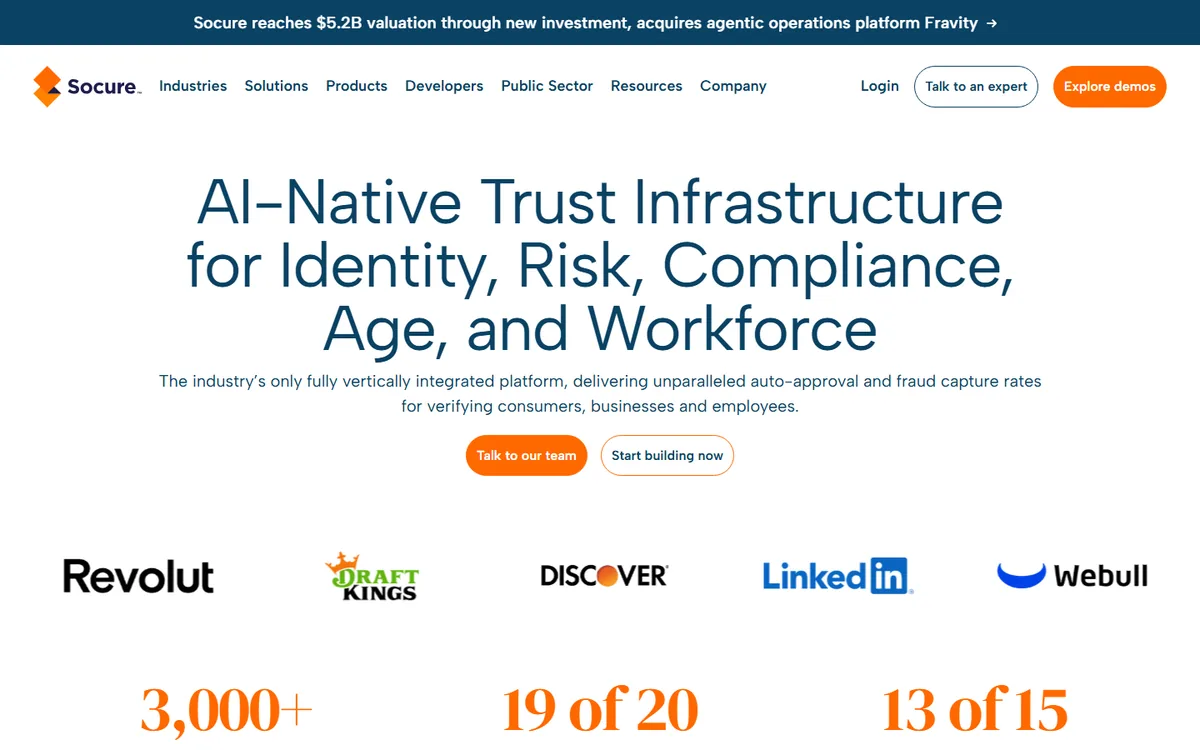
The Identity Graph Most Big US Banks Already Trust, With a Self-Serve Way In
Socure runs identity verification, document checks, synthetic and first-party fraud scores and watchlist screening on RiskOS, its decisioning and orchestration platform.
Socure’s pitch is scale. The company says it serves more than 3,000 customers, including 19 of the top 20 US banks, and that its identity graph learns from about 40 billion historical outcomes. For a US consumer fintech, that history matters most on the hard cases: synthetic identities built from real Social Security numbers, and first-party fraud where a real person never plans to repay. The Sigma products score those risks, Predictive DocV handles documents and selfies, and Global Watchlist Screening covers sanctions checks.
What changed my view of Socure is Socure Launch, a self-serve tier with published per-check prices. Early-stage teams used to face an enterprise sales cycle, and now they can test the same models on live traffic. RiskOS also lets you add your own rules and other data sources. I’d look elsewhere if most of your users sit outside the US, because the graph’s depth is strongest there. Some reviews mention repeated document rejections without clear guidance for the end user, so test your pass rate on real applicants.
What Socure Does Well
- Deep US identity data for synthetic fraud
- Self-serve tier with published per-check prices
- Watchlist and deceased checks in the same platform
What Socure Could Do Better
- Coverage is strongest for US consumers
- Enterprise pricing still needs a sales call
Socure Pricing
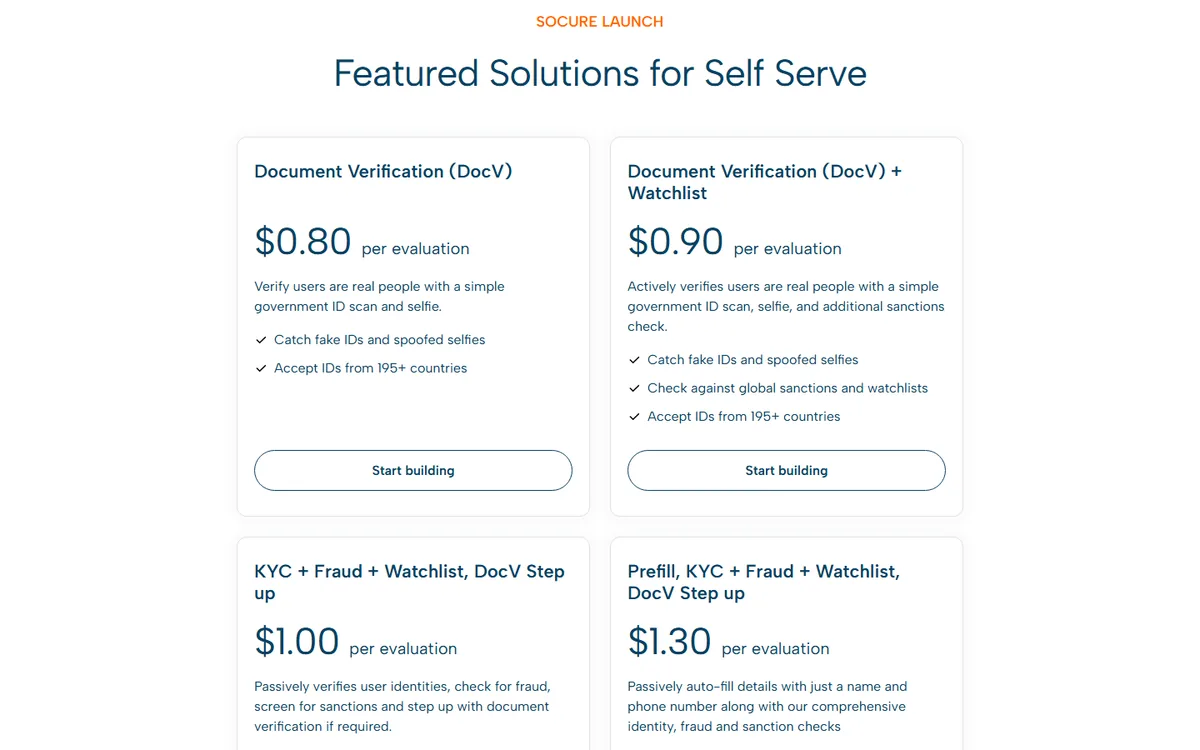
Socure Launch includes $1,000 in free monthly credits, then bills per evaluation: $0.80 for document verification, $0.90 for DocV plus watchlist, $1.00 for KYC, fraud and watchlist with a DocV step-up, and $1.30 when you add prefill. Socure Enterprise uses volume and spend-based pricing by quote.
Socure Reviews
- G2: score of 4.5 out of 5 (from +100 customer reviews)
SEON
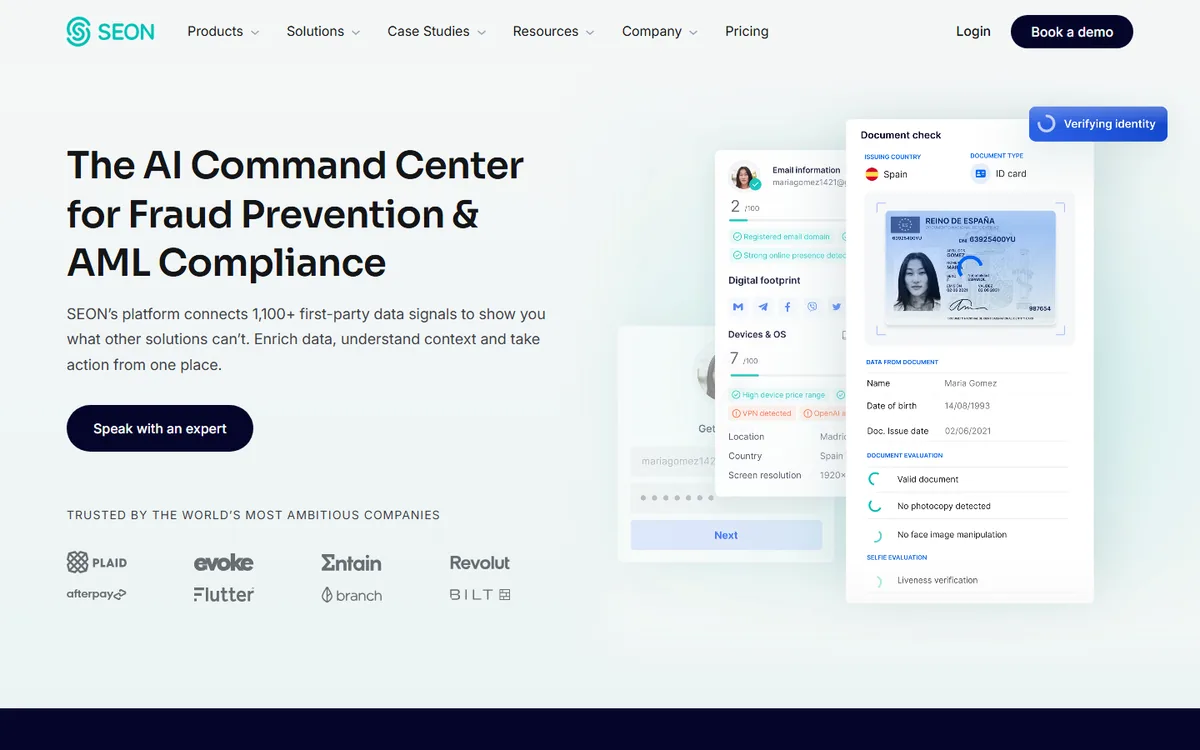
The Fastest Fraud Platform to Stand Up When Your Risk Team Is Two People
SEON scores users from their email, phone, IP and device data, then adds identity checks, AML screening, transaction monitoring and case management in one platform.
SEON looks at what a person leaves behind online. An email address with no history, a phone number created last week or a device that has opened twenty accounts tells you a lot before any document check runs. SEON says it uses more than 1,100 first-party signals, and you can tune the rules or let its AI scoring handle them. Its AI writes short summaries of why a user was approved, flagged or blocked, ranks the signals behind each score, and can turn a plain-language description into a new rule. An AML screening agent flags likely false positives in sanctions hits.
I like SEON for lean teams at lenders, BNPL providers and payment companies, which is why it shows up often when I map out AI in fintech use cases for new clients. You can start on a published plan and get scores flowing within days. The Starter plan leaves out case management and AML, though, so most regulated fintechs will need Premium. G2 reviewers rate the ease of use highly and mention limited customization and strict default settings that cause false positives during onboarding.
What SEON Does Well
- Digital footprint signals work before any document check
- AI explains each score in plain words
- A published starting price, rare in fraud tools
What SEON Could Do Better
- Starter leaves out case management and AML
- Default rules can be strict until you tune them
SEON Pricing
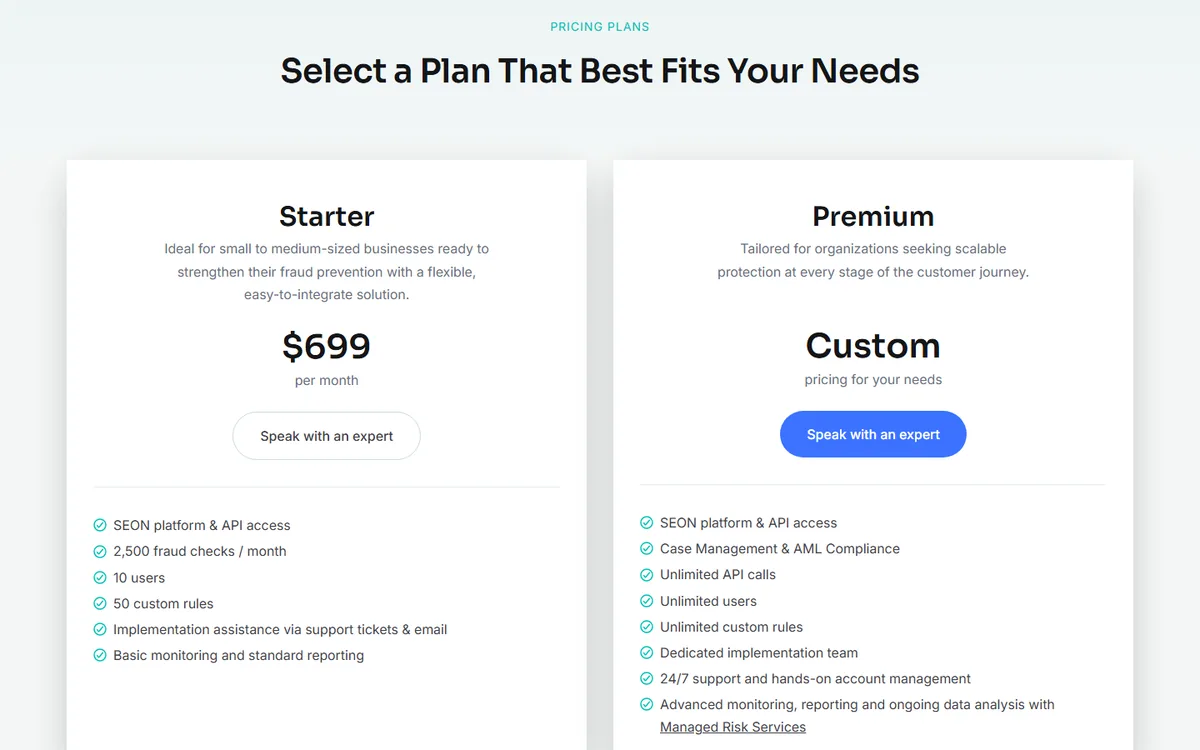
SEON Starter costs $699 per month and includes 2,500 fraud checks, 10 user accounts and 50 custom rules. Premium is custom-priced and adds case management, AML compliance, unlimited API calls, users and rules, a dedicated implementation team and 24/7 support. You can request a free trial.
SEON Reviews
- G2: score of 4.6 out of 5 (from +370 customer reviews)
Persona
The Most Flexible Way to Design Your Own Identity Flow Without Writing Much Code
Persona lets you build identity verification flows from ID, selfie and data checks, and run them through a hosted page, an embedded web flow or mobile SDKs.
Persona appeals to product teams who care how onboarding feels. You can decide which checks a user sees, in what order, and which ones only appear when a risk signal fires. Its documentation describes three ways to ship it: Hosted Flow, a no-code page you can link to on day one, Embedded Flow inside your web app, and mobile SDKs for native apps. The API covers the rest for teams that want full control. Fintechs that serve both consumers and small businesses tend to like being able to run several flows from one account.
Reviews are more mixed than for the tools above it. G2 reviewers praise responsive support, a clean interface and real-time selfie checks that catch fraud, while a few report verifications that failed for genuine users. In my client work, that split usually comes down to configuration. A flow tuned for a crypto exchange will reject too many people at a payroll app. I rank Persona fifth because flexibility cuts both ways: you get control, and you also own more of the tuning.
What Persona Does Well
- A no-code hosted flow gets you live quickly
- Flows can branch based on risk signals
- Embedded and mobile options for a native feel
What Persona Could Do Better
- Mixed reviews on false rejections
- More tuning work falls on your team
Persona Pricing
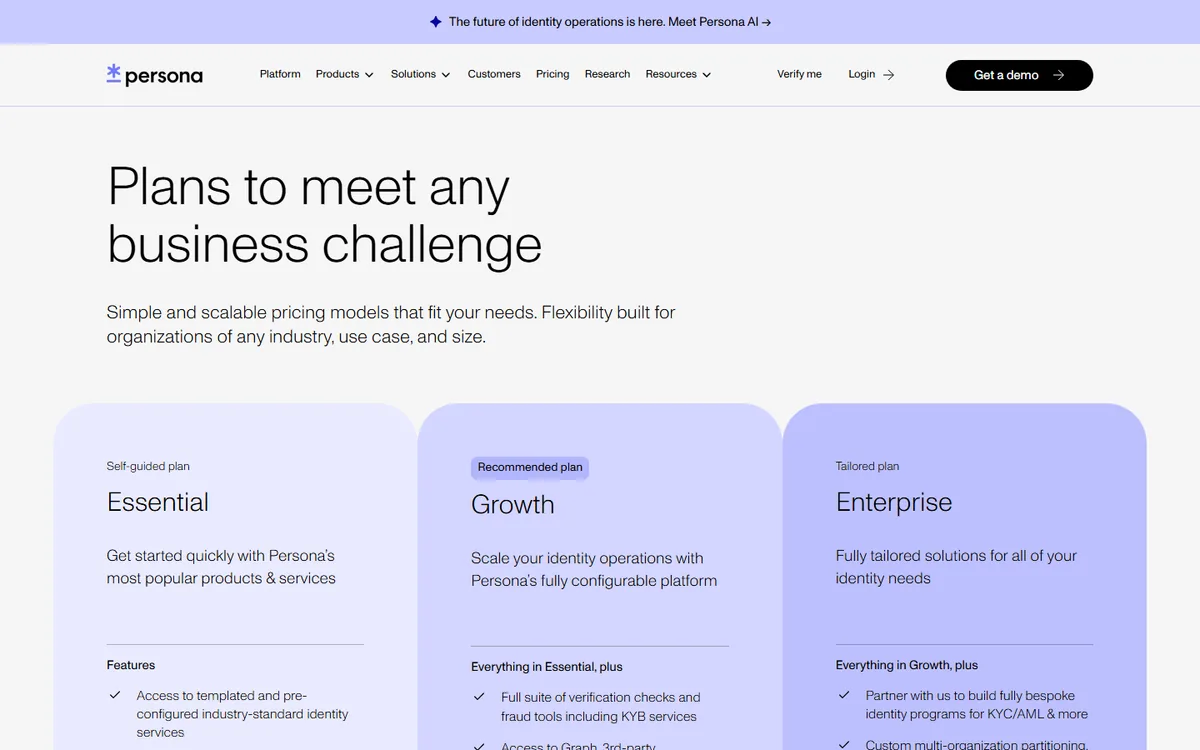
Persona has a pricing page, but I couldn’t confirm its current plans and prices for this update, so I’ve left figures out. Ask Persona’s sales team for a quote based on your verification volume and the checks you need.
Persona Reviews
- G2: score of 4.3 out of 5 (from 45 customer reviews)
Sumsub
The All-in-One Compliance Stack for Fintechs Onboarding Users in Many Countries
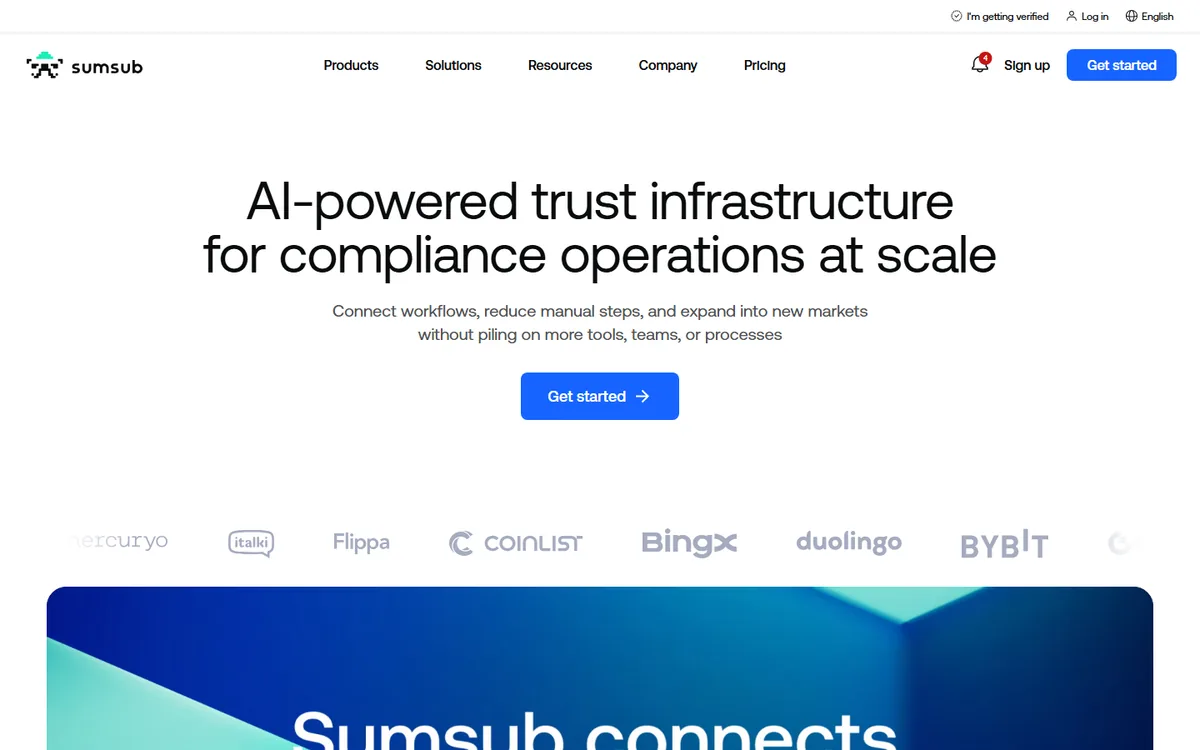
Sumsub covers KYC, KYB, AML screening, transaction monitoring, fraud prevention and the crypto Travel Rule, with a workflow builder and an AI copilot called Summy.
Sumsub fits fintechs that onboard people across many markets at once. The KYC side includes ID checks, liveness with deepfake detection, proof of address, bank account checks, AML screening, device intelligence and video identification. Reusable KYC lets a verified user carry their check to another Sumsub client, which speeds up sign-ups in crypto. KYB, transaction monitoring and fraud prevention sit in the same dashboard, and the workflow builder lets you set different steps per country or risk level.
I rank Sumsub sixth because it’s the broadest of the pure identity vendors here, and its prices are public. Sumsub says it has more than 4,000 clients, many in crypto, trading and iGaming, where rules change often between countries. Summy, its AI copilot, helps with setup and data questions. Two things to check: you pay the full verification price even if you use only part of the bundle, and the review site SaaSWorthy notes that the cost can feel high for startups with small volumes.
What Sumsub Does Well
- KYC, KYB, AML and Travel Rule in one contract
- Published per-check prices and a free trial
- Country-specific flows from one workflow builder
What Sumsub Could Do Better
- Bundles are billed in full even when partly used
- Monthly minimums weigh on very small volumes
Sumsub Pricing
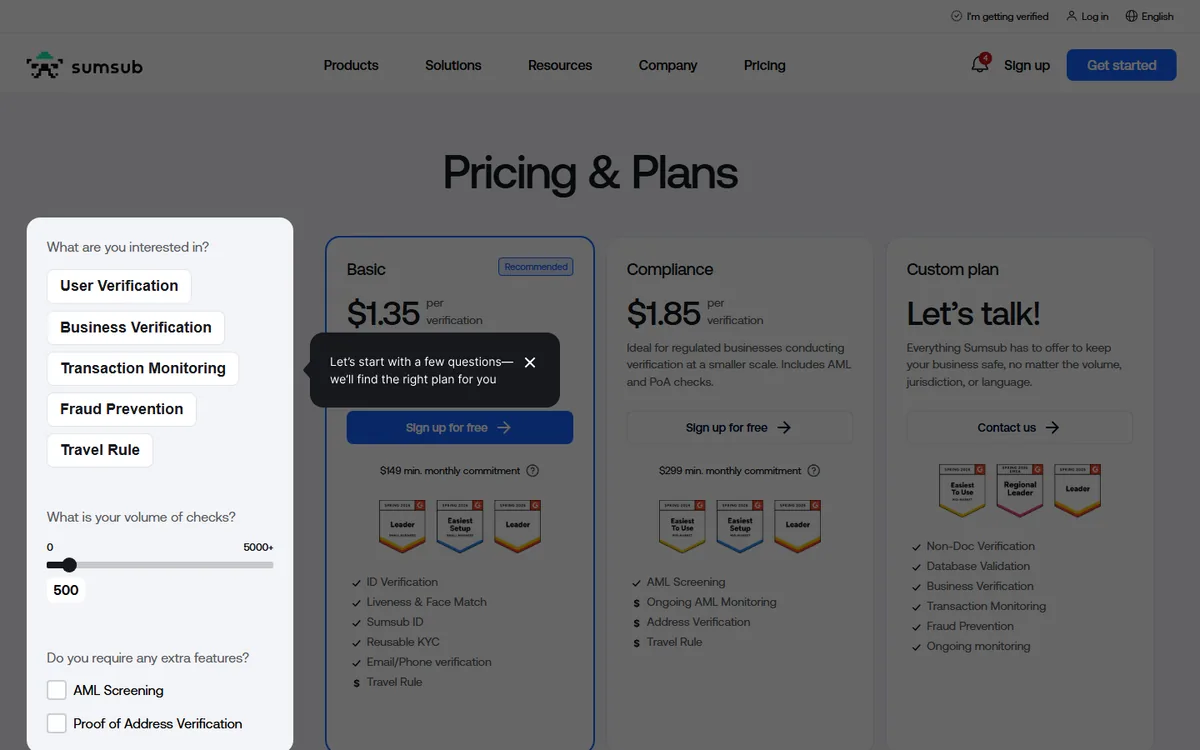
Sumsub Basic costs $1.35 per verification with a $149 monthly minimum and covers ID checks, liveness, reusable KYC and email or phone checks. Compliance costs $1.85 per verification with a $299 minimum and adds AML screening, ongoing monitoring and address checks. A custom plan covers KYB, transaction monitoring and fraud prevention. Sumsub offers a 14-day trial with 50 free checks.
Sumsub Reviews
- G2: score of 4.6 out of 5 (from +120 customer reviews)
Veriff
The Cheapest Published Entry Price for Document and Selfie Checks at Scale
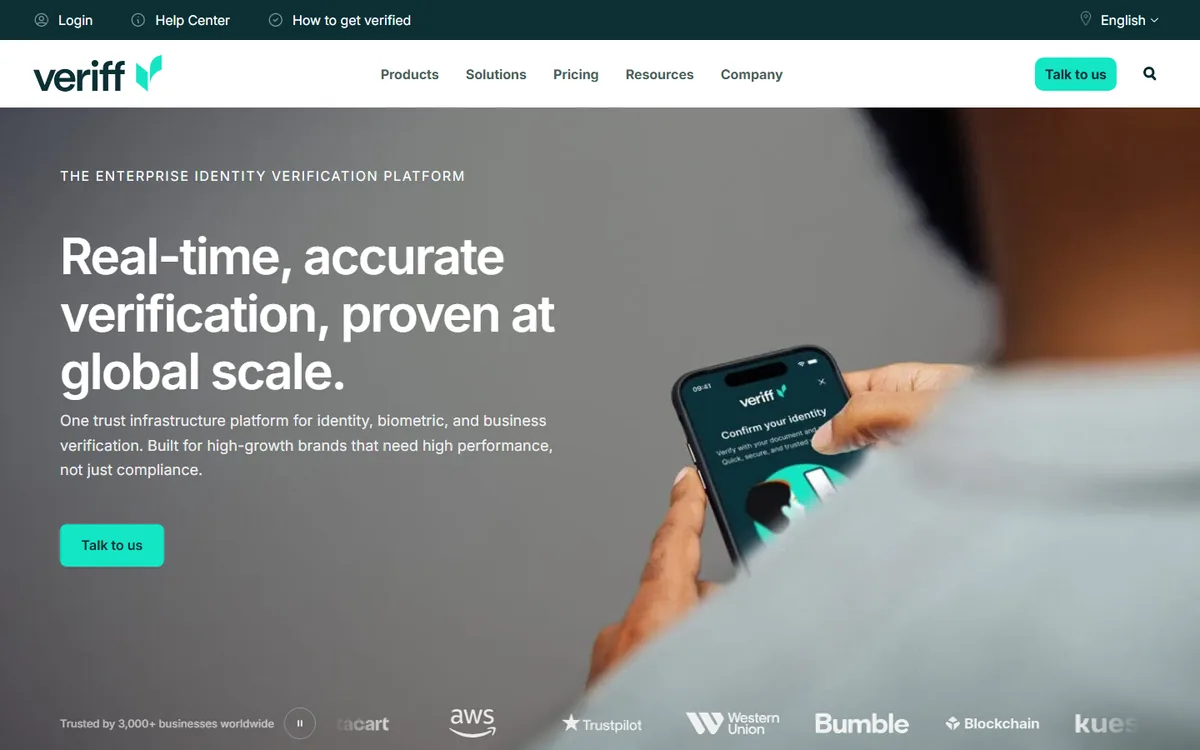
Veriff verifies ID documents, faces and liveness, and adds business verification, AML screening, age checks and fraud signals for returning users.
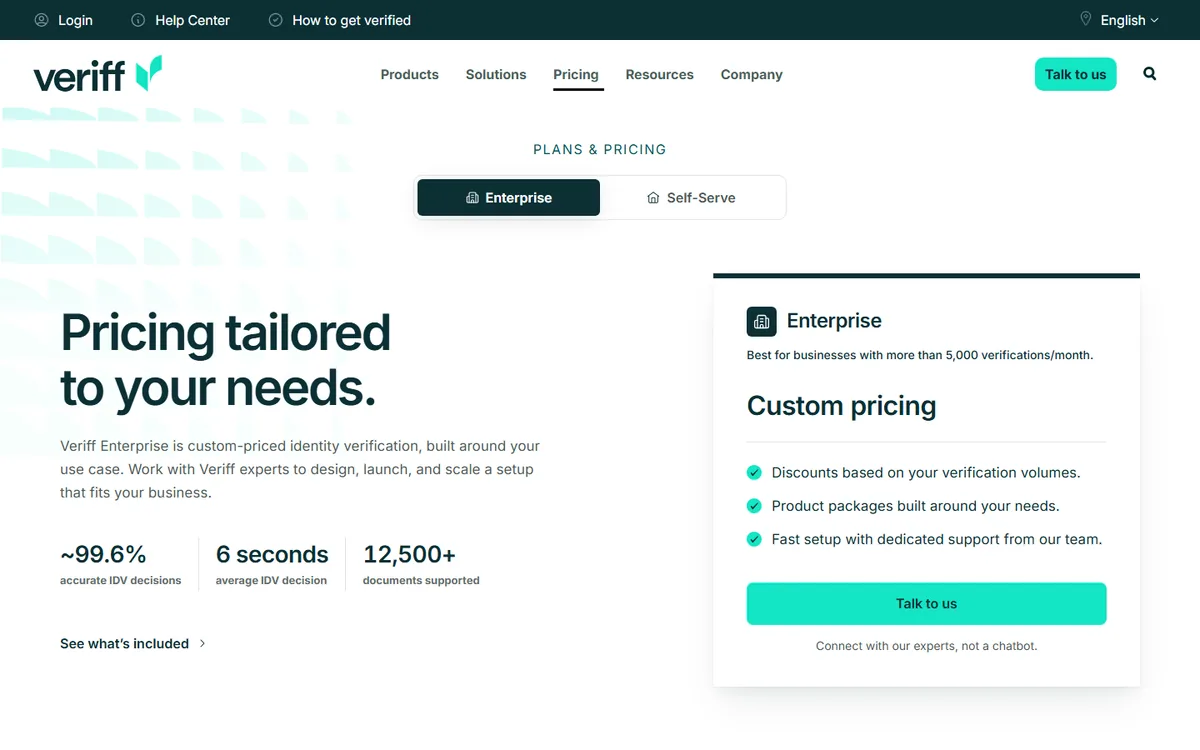
Veriff is a focused identity vendor with wide document coverage. The company says it supports more than 12,500 document types in over 230 countries and territories, with an average decision time of six seconds. Assisted image capture tells users about glare or a cropped ID while they take the photo, which cuts the retries that kill sign-up rates. Passive liveness confirms a real person without head turns. When the automation can’t decide, trained specialists review the session on the Plus plan and above.
I rank Veriff seventh because it does one job very well and publishes clear prices for it. It suits payment apps, BNPL providers and neobanks with high volumes of document checks and users from many countries. Veriff says it builds its core models in-house and uses partners for AML and database checks, so ask which partner screens your users. Fraud detection features such as CrossLinks start on Plus, which makes Essential a thin choice for a regulated fintech.
What Veriff Does Well
- Real-time capture feedback reduces failed attempts
- Human review steps in when automation can’t decide
- Clear per-check prices published on its site
What Veriff Could Do Better
- Fraud features start on the Plus plan
- AML screening costs extra per check
Veriff Pricing
Veriff Essential costs $0.80 per verification with a $49 monthly minimum. Plus costs $1.39 with a $99 minimum and adds human review and fraud detection. Premium costs $1.89 with a $209 minimum and adds branding and analytics. PEP and sanctions screening adds $0.64 per check. A 15-day Premium trial includes 50 free live checks, and Enterprise pricing applies above 5,000 checks a month.
Veriff Reviews
- G2: score of 4.5 out of 5 (from +60 customer reviews)
Unit21
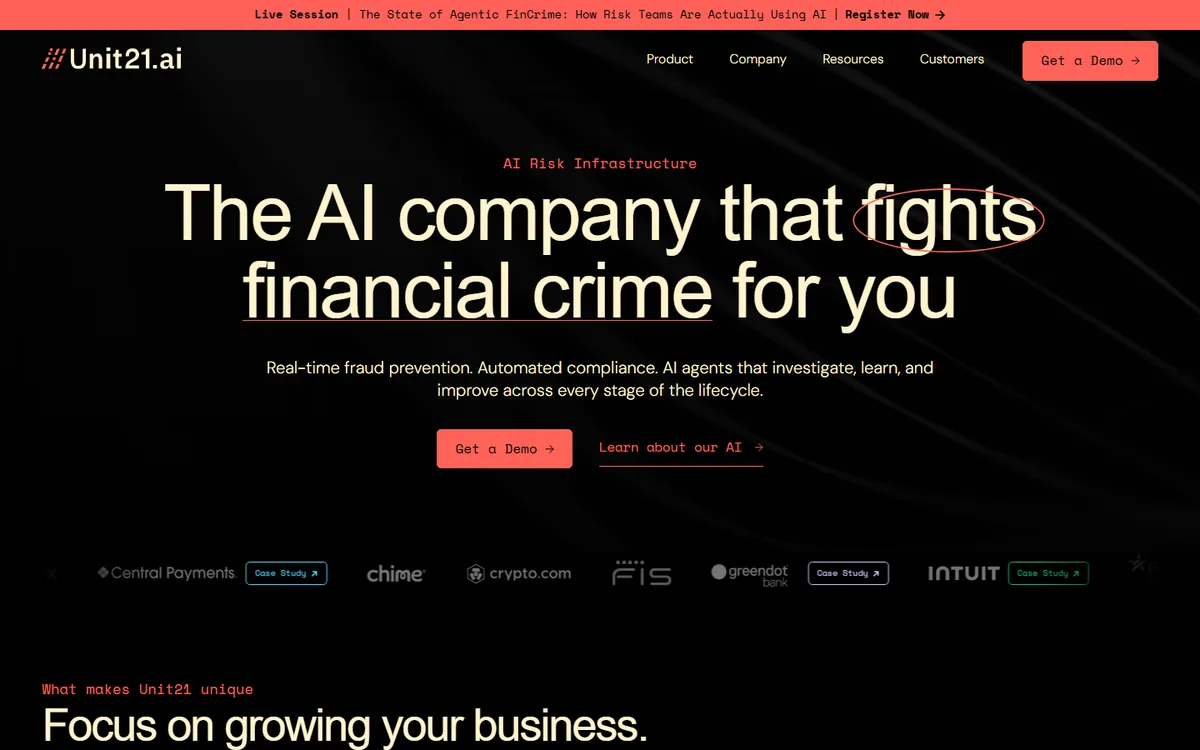
The Compliance Team’s Pick for AML Monitoring With Agents That Draft the Case
Unit21 runs AML transaction monitoring, fraud monitoring, case management and regulatory filings, with a Detection Agent and an Investigation Agent on top.
Unit21 is built for the people who clear alerts all day. Rules are written without code, so compliance analysts can adjust them without waiting for engineers. The AML side covers transaction monitoring, payment and sanctions screening, customer risk rating and filings such as SARs and CTRs. The fraud side adds real-time monitoring, device risk scores and a fraud consortium that Unit21 says covers more than 80 million US adults. Its Detection Agent learns from analyst feedback, and the Investigation Agent summarizes risk and drafts the case narrative for review.
The names on its site include Chime, Brex, Green Dot and Crypto.com, which matches the fintech and sponsor bank programs I see it in. Neobanks and card programs like these feature heavily in my AI in fintech examples, and alert fatigue is the common thread. I rank Unit21 eighth because it does less at onboarding than the tools above. G2 reviewers praise support and compliance features, and some describe a clunky interface, weak exports and a long implementation.
What Unit21 Does Well
- Analysts can write and change rules without code
- Agents draft case narratives for human review
- SAR and CTR filing built into the same workflow
What Unit21 Could Do Better
- Exports and case narratives draw complaints
- Implementation can take longer than planned
Unit21 Pricing
Unit21 doesn’t publish prices. You request a demo, and the quote depends on the modules you need, such as AML, fraud or the AI agents, and on the number of events you monitor each month.
Unit21 Reviews
- G2: score of 4.6 out of 5 (from 31 customer reviews)
Feedzai

Bank-Grade Transaction Fraud Detection for Fintechs That Process Serious Volume
Feedzai’s RiskOps platform covers transaction fraud, scams, account opening, AML monitoring and watchlist screening, with Farol, an AI agent for fraud teams.
Feedzai comes from the bank side of the market. Its customer list includes Mastercard, Fiserv, CaixaBank and Jack Henry, and the company says it processes about 140 billion events a year. For a fintech, that history means models trained on payment patterns at a scale few vendors see. The platform runs transaction fraud, new account fraud, scam prevention and AML monitoring from one place, and Feedzai IQ adds network intelligence drawn from that wider customer base. Farol, the newest addition, is an AI agent that helps teams manage rules, alerts and SARs.
Agents like Farol are one of the shifts I track in AI in fintech trends, and Feedzai is one of the few vendors putting them in front of large banks. I rank it ninth because it fits payment processors, acquirers and card issuers with high volume better than a young app. Expect an enterprise sales process and a longer setup. Feedzai’s public review base is small, with a handful of Capterra reviews and almost nothing on G2.
What Feedzai Does Well
- Proven at very high transaction volumes
- Fraud and AML share one risk platform
- Network intelligence from a large bank customer base
What Feedzai Could Do Better
- Built for large institutions, heavy for small teams
- Very few public user reviews
Feedzai Pricing
Feedzai doesn’t publish prices. You request a demo, and pricing depends on the solutions you license, such as transaction fraud or AML, plus your transaction volume and deployment model.
Feedzai Reviews
- Capterra: score of 4.7 out of 5 (from 11 customer reviews)
ComplyAdvantage
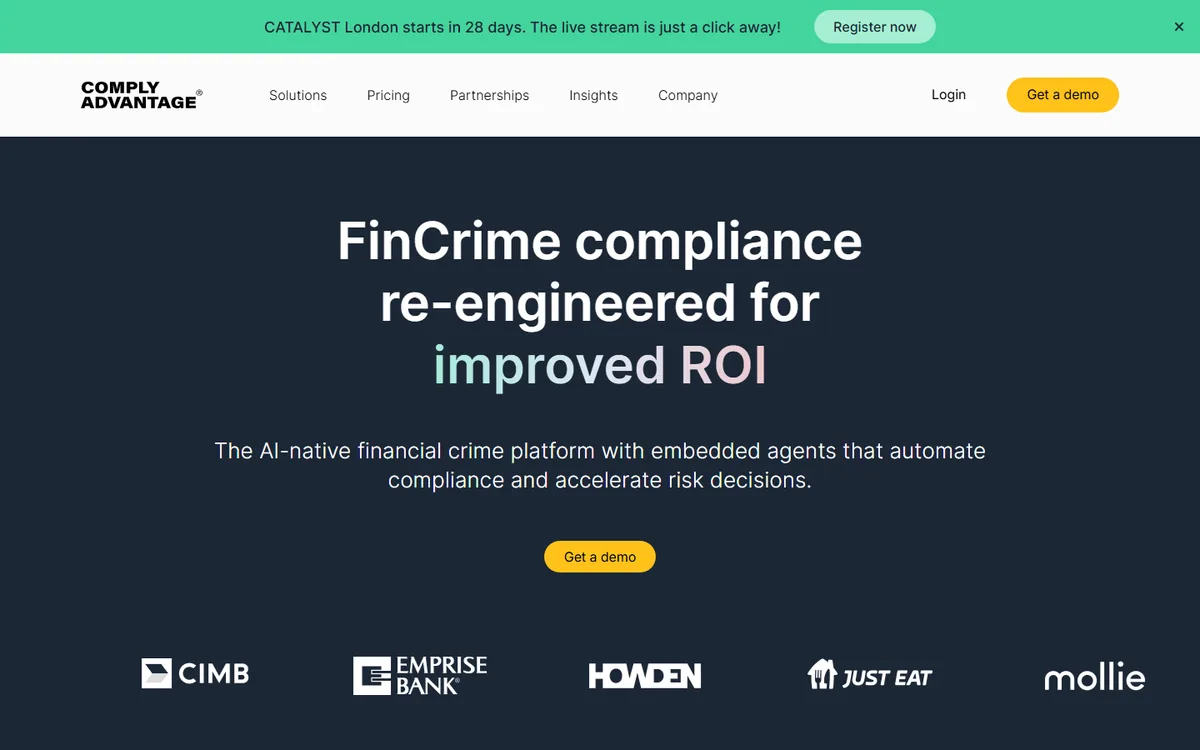
The Specialist for Sanctions, PEP and Adverse Media Screening With Agentic Alert Triage
ComplyAdvantage Mesh screens customers, companies and payments against sanctions, PEP and adverse media data, and adds transaction monitoring on its Enterprise plan.
Screening is the part of AML that floods teams with noise. A common name returns dozens of possible sanctions or PEP matches, and every one needs a person to clear it. ComplyAdvantage sells its own risk data for sanctions, watchlists, PEPs and adverse media, and its Mesh platform runs customer, company and payment screening plus ongoing monitoring. Its Agentic Workflows resolve routine alerts on their own, and ComplyAdvantage says they can close up to 85% of them. Treat that as the best case and measure your own rate during a pilot.
I like that a small fintech can start on a self-service plan with a published price. Sumsub lists ComplyAdvantage among its integration partners, so you can also reach its data through an identity vendor you already use. I rank it tenth because it covers screening and monitoring well and leaves onboarding and credit to other tools. Transaction monitoring and payment screening sit only in Enterprise, so price that tier if you need them.
What ComplyAdvantage Does Well
- Own risk data for sanctions, PEPs and adverse media
- Self-service plan with a published starting price
- Agents clear routine screening alerts
What ComplyAdvantage Could Do Better
- Transaction monitoring only on Enterprise
- No identity checks or credit features
ComplyAdvantage Pricing
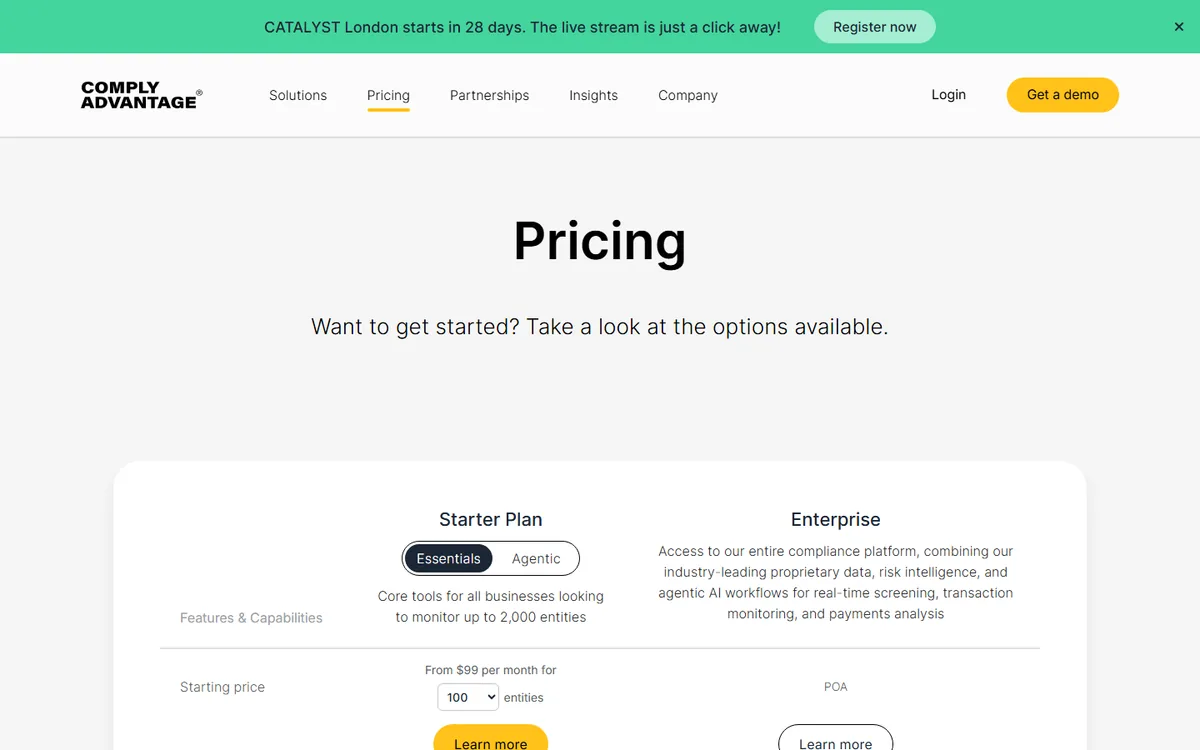
The ComplyAdvantage Starter plan starts at $99 per month, with tiers from 100 to 2,000 monitored entities. Its Essentials version covers screening and ongoing monitoring, and the Agentic version adds Agentic Workflows. Enterprise is priced on application and adds unlimited usage, transaction monitoring, payment screening and premium support.
ComplyAdvantage Reviews
- G2: score of 4.3 out of 5 (from +75 customer reviews)
Taktile
The Decision Platform for Lenders Who Want to Own Their Credit Policy and Test It
Taktile combines rules, machine learning models, AI agents and human review in one decision platform for underwriting, onboarding and fraud checks.
Taktile gives your risk team a canvas for decisions. You connect data sources from more than 200 integrations, chain rules and models into a credit or onboarding flow, and decide which cases go to an underwriter. Version control and audit trails record every change, and A/B tests and backtests show how a new rule would have performed on past applications. AI agents handle routine cases and help experts on complex files, such as small business underwriting with bank statements and tax documents.
Named customers include Mercury, Monzo, Zilch and Capchase, so the platform clearly runs at fintech scale. I rank Taktile eleventh because you bring the credit model, the data and the policy. Taktile makes them faster to change and easier to defend. If you don’t have a credit risk lead yet, Zest AI or a broader tool will get you further. G2 reviewers praise ease of use, flexible data integrations and personal support.
What Taktile Does Well
- Backtests show a rule’s impact before it goes live
- Full version history for model risk reviews
- Rules, models and agents in one flow
What Taktile Could Do Better
- You need your own credit risk expertise
- No published prices
Taktile Pricing

Taktile doesn’t publish prices. You request a demo, and Taktile says it sizes the business case upfront and won’t start a project if the return isn’t there. The quote depends on your use cases and decision volume.
Taktile Reviews
- G2: score of 4.7 out of 5 (from +80 customer reviews)
Zest AI
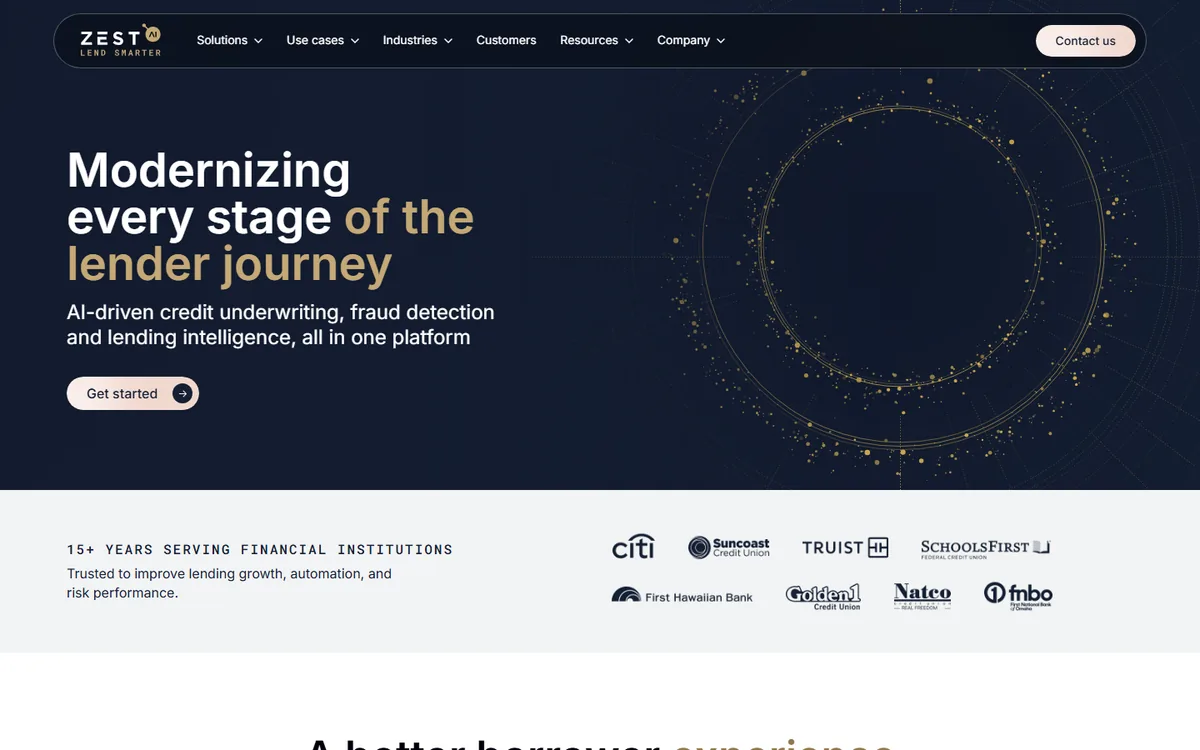
Ready-Made AI Credit Models for Credit Unions and Banks That Want More Instant Approvals
Zest AI builds credit underwriting models that run inside your loan origination system, adds fraud models and offers LuLu, an AI assistant for lending questions.
Zest AI fills a gap the other tools leave open: the credit model itself. Zest builds risk scores for each product line, such as auto, card or personal loans, and delivers them inside the loan origination system you already use. The company says it has supported more than 100 million credit decisions and runs over 1,500 active models. Its customer stories come mostly from credit unions, where Truliant FCU, for example, reports doubling its instant approvals. Fraud models backed by a consortium data network and LuLu, a chat assistant for lending and operational questions, round out the product.
I rank Zest AI last for one reason: most fintechs reading this aren’t its core buyer. Zest focuses on credit unions, banks and point-of-sale lenders. If that’s you, it may belong near the top. Any AI credit model still needs to explain every decline in terms a regulator accepts, which I cover in my piece on AI in fintech challenges. Ask Zest for its reason codes, fair lending testing and model documentation before your model risk team signs off.
What Zest AI Does Well
- Models delivered inside your existing loan system
- Separate scores for each product line
- Long track record with credit unions
What Zest AI Could Do Better
- Built for lenders, less for payment or banking apps
- No public user reviews to check
Zest AI Pricing
Zest AI doesn’t publish prices. You request a proof of concept or talk to its team, and pricing depends on the loan products, model scope and volume of decisions you need.
Zest AI Reviews
Zest AI’s G2 profile showed no user reviews when I checked, and I found no Capterra listing with ratings. Ask for reference calls with lenders of your size.
Estimate the Return on a Fintech AI Tool
Risk tools pay back in two ways: fewer manual reviews and lower fraud losses. The calculator below handles the first part. Enter the analyst hours you spend each month on the work you want to automate, such as clearing screening alerts or reviewing ID checks, plus the monthly price of the tool. Add your expected fraud savings on top when you build the business case.
Will It Pay for Itself?
Move the sliders to match the work you want to automate and the plan you are considering.
How to Choose a Fintech AI Tool for Your Risk Stack
Map your customer journey first. Mark where a person signs up, where money moves and where you extend credit. Each point needs a check, and the gaps between tools are where fraudsters get in. Answer these four questions before you book demos:
- Which check does your sponsor bank or regulator ask about first?
- Do you serve consumers, businesses or both, and in which countries?
- Who will tune rules and clear alerts: product, fraud or compliance?
- How will you explain a blocked user or a declined loan to an examiner?
If you want one engine across onboarding, fraud and credit, start with Alloy or Sardine. For US consumer identity, look at Socure. For global sign-ups, compare Sumsub and Veriff, and pick Persona when you want to design the flow yourself. SEON suits a lean team that needs fraud scores this month. Unit21, Feedzai and ComplyAdvantage cover AML monitoring and screening at different scales. Lenders choose between Taktile, if they own the credit policy, and Zest AI, if they want the model built for them. Run every pilot on your own declined and approved traffic. A vendor’s demo data always looks clean.
Questions About Fintech AI Tools
Which Fintech AI Tool Should an Early-Stage Fintech Start With?
Start with the check your sponsor bank or regulator asks for first, which is almost always identity verification at onboarding. Socure Launch, Veriff and Sumsub publish self-serve prices, so you can go live without a long sales cycle. Add a fraud layer such as SEON or Sardine once real money moves through your product.
What Is the Difference Between KYC and KYB Tools?
KYC tools check a person: their ID document, a selfie, and data such as name, address and date of birth against trusted sources. KYB tools check a business: its registration, its directors and its beneficial owners, and then run KYC on those people. If you serve small businesses, you need both, and tools like Alloy, Sumsub and Veriff cover both in one contract.
Do I Need Separate Tools for Fraud and AML?
Not always. Sardine, SEON, Unit21 and Feedzai now cover fraud and AML transaction monitoring in one platform, which means one data model and one case queue. Larger fintechs sometimes keep them apart, because the fraud team and the compliance team have different owners, rules and reporting duties. Pick the setup your org chart can actually run.
Can AI Make Lending Decisions Without a Human?
It can automate many approvals, and Zest AI and Taktile both sell that capability. You still own the decision under fair lending rules. In the US, that means you must be able to explain why an applicant was declined and send an adverse action notice. Ask every credit vendor how its model produces reason codes before you sign, and check the current guidance with your compliance lead.
How Much Do Identity Verification Checks Cost?
Published prices start below $1 per check. Veriff’s Essential plan lists $0.80 per verification with a $49 monthly minimum, Sumsub’s Basic plan lists $1.35 with a $149 minimum, and Socure Launch lists $0.80 for document verification on top of $1,000 in free monthly credits. Enterprise volumes are priced by quote, and AML screening usually costs extra.
What Do Sponsor Banks Expect from a Fintech’s Risk Tools?
In my client work, sponsor banks want to see three things: clear onboarding rules, transaction monitoring with documented alerts, and a case trail that shows who reviewed what and why. Several tools on this list, including Alloy, Sardine, Socure and Unit21, now sell controls aimed at sponsor bank programs. Ask your bank for its vendor due diligence list before you shortlist.
Should a Fintech Build Its Own Fraud Models?
Rarely at the start. Vendors like Sardine, Socure, Feedzai and Unit21 see fraud patterns across many companies, which a single young fintech can’t match with its own data. Build in-house once you have enough labeled fraud cases and a data team to maintain the models. Until then, a decision platform like Taktile or Alloy lets you combine vendor signals with your own rules.
Sources
- Alloy platform, data partners and use cases: alloy.com
- Socure customer figures and Socure Launch prices: socure.com and socure.com/pricing
- SEON signals, AI features and plans: seon.io and seon.io/pricing
- Sumsub products, client count and plans: sumsub.com and sumsub.com/pricing
- Veriff coverage figures and plans: veriff.com and veriff.com/pricing
- Unit21 products and consortium figure: unit21.ai
- Feedzai products, customers and event volume: feedzai.com
- ComplyAdvantage plans and Agentic Workflows claim: complyadvantage.com/pricing
- Taktile platform and customers: taktile.com
- Zest AI decision and model figures: zest.ai
- Persona integration options: docs.withpersona.com
Disclaimer: Prices, plans, AI features and ratings change often. They were checked when this article was last updated and follow each vendor’s own materials and public review listings, so confirm them with the vendor before you buy. Nothing here is legal, compliance or financial advice.
Did you find this helpful?
Thank you for your feedback.
Marlena leads the WiseCrow editorial team and works with our consultants to turn real client projects into practical guides on AI strategy, automation and governance. Before joining WiseCrow, she spent 12 years in B2B operations and SaaS content. She has since edited more than 400 articles on AI and automation and reviewed workflows from over 60 client projects. She is based in Austin, Texas.