Summary
- Google says AI Overviews reach over 2.5 billion monthly users and AI Mode has passed 1 billion, and top rankings earn fewer clicks where those answers appear.
- AI assistants send about 0.32% of all website traffic, a small share that has grown sixteenfold since 2024.
- Mentions of your brand across the web track closely with AI visibility, while link metrics show only weak links to it.
- Search Console now reports AI feature impressions and offers an opt-out, so you can finally measure and control your AI search presence.
Every SEO newsletter has a trend list, and most of it is guesswork about next year. I wanted a list where each trend already shows up in data you can check yourself. When clients come to me for AI SEO consulting, the first question is almost always the same: which of these shifts is real enough to change our plan this quarter?
So I rated each trend by the strength of its evidence. The table comes first. After it, the eight trends sit in four groups: where answers appear, who gets named, what Google checks and how you measure and control your presence. Every figure links to its source, and the full list is at the end.
Signal Strength of the 8 AI SEO Trends
Strong means several independent sources point the same way. Moderate means one good study or clear documentation. Early means the numbers are real but small, or the change is only months old.
| Trend | Evidence so far | Signal | Do now |
|---|---|---|---|
| AI answers at scale | Google, Ahrefs | Strong | Rebase traffic goals |
| Zero-click search | SparkToro, Pew | Strong | Value on-page visibility |
| LLM referrals | SE Ranking | Early | Tag AI referrers |
| Brand mentions | Ahrefs | Moderate | Earn outside mentions |
| Scaled content enforcement | Strong | Prune thin pages | |
| Entity clarity | Google docs | Moderate | Match schema to page |
| AI visibility tracking | Search Console | Early | Set a baseline |
| Crawler and licensing control | Google, Cloudflare, RSL | Early | Decide per section |
Where Answers Now Appear Before the Click
The first two trends are about the results page itself. They’re the best documented of the eight, and they hit informational content hardest.
1. AI Overviews and AI Mode Reach Billions and Cut Click-Through Rates
Google’s AI answers left the test phase a while ago. At I/O 2026, Sundar Pichai said AI Overviews now has over 2.5 billion monthly active users, and AI Mode passed 1 billion within about a year of launch.
The click data moves the other way. Ahrefs compared Search Console data for 300,000 keywords and found that an AI Overview correlated with a 58% lower click-through rate for the top-ranking page in December 2025, measured against December 2023. The first run of the same study, published in April 2025, put the drop at 34.5%. Both are correlations, and Ahrefs says so. The gap between the two runs still tells you the effect grew as the feature spread.
Google’s position is that clicks from results pages with AI Overviews are higher quality, with visitors more likely to spend time on the site. In my client work, both things look true at once. Informational pages lose sessions, and the visitors who still arrive tend to read further. If your reports only show sessions, you’ll see the loss and miss the rest.
Start by splitting your tracked keywords into two groups: queries that show an AI answer and queries that don’t. Set traffic targets for each group separately. For the first group, judge pages on impressions, assisted conversions and growth in branded searches. A flat session count there can still be a healthy page.
2. Zero-Click Searches Become the Normal Outcome
Searches that end without a click were common long before generative answers. SparkToro and Datos found that in 2024, 58.5% of US Google searches and 59.7% of EU searches ended with zero clicks. In both regions, fewer than 380 of every 1,000 searches sent a click to the open web.
AI summaries push in the same direction. In a Pew Research study that tracked the browsing of 900 US adults in March 2025, people clicked a regular search result in 8% of visits to a results page with an AI summary, against 15% when no summary appeared. They clicked a link inside the summary itself in just 1% of visits. And 26% of visits to a page with a summary ended the browsing session, compared with 16% without one.
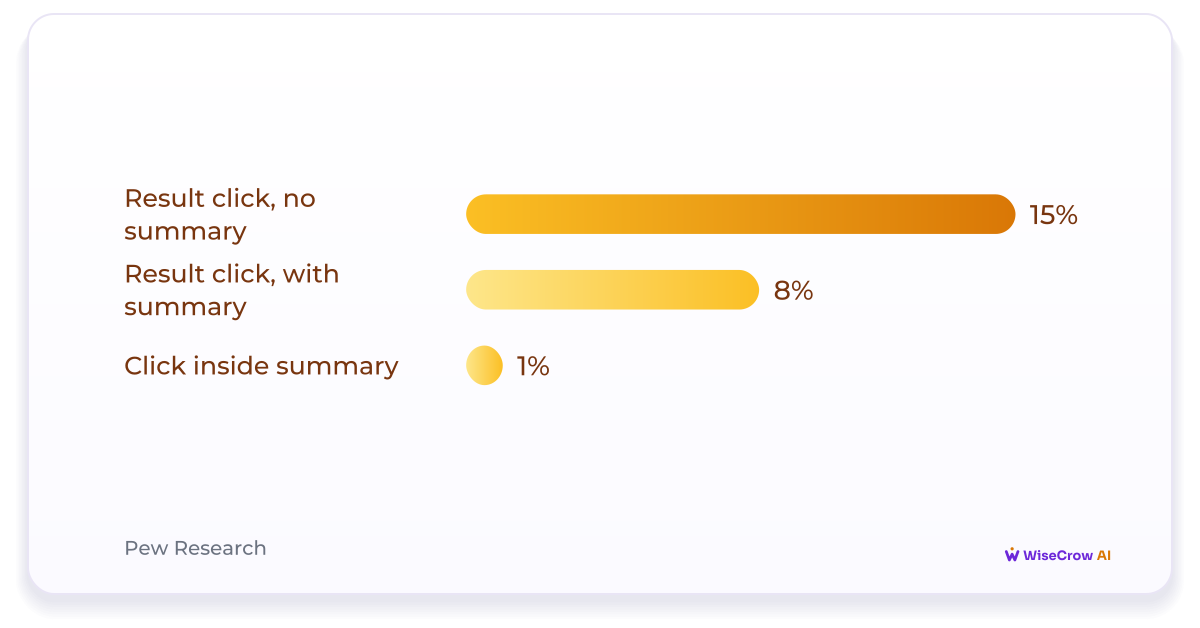
One detail from the Pew data often gets lost. Only 18% of the searches in its sample produced an AI summary at the time. The share has almost certainly grown since then, but plenty of searches still show classic results, mostly the ones closer to a purchase.
The practical shift is to treat the results page as a channel in its own right. Your title, description, product facts and the sentence an AI answer quotes from you all do work before anyone clicks. I now ask clients to review their top 20 pages as a searcher would see them on the results page, before anyone opens the page itself.
Who Gets Named in AI Answers
Trends three and four move away from Google’s results page and toward the assistants people ask directly. The data here is younger, and the tactics are still settling.
3. LLM Search Sends Small but Fast-Growing Traffic
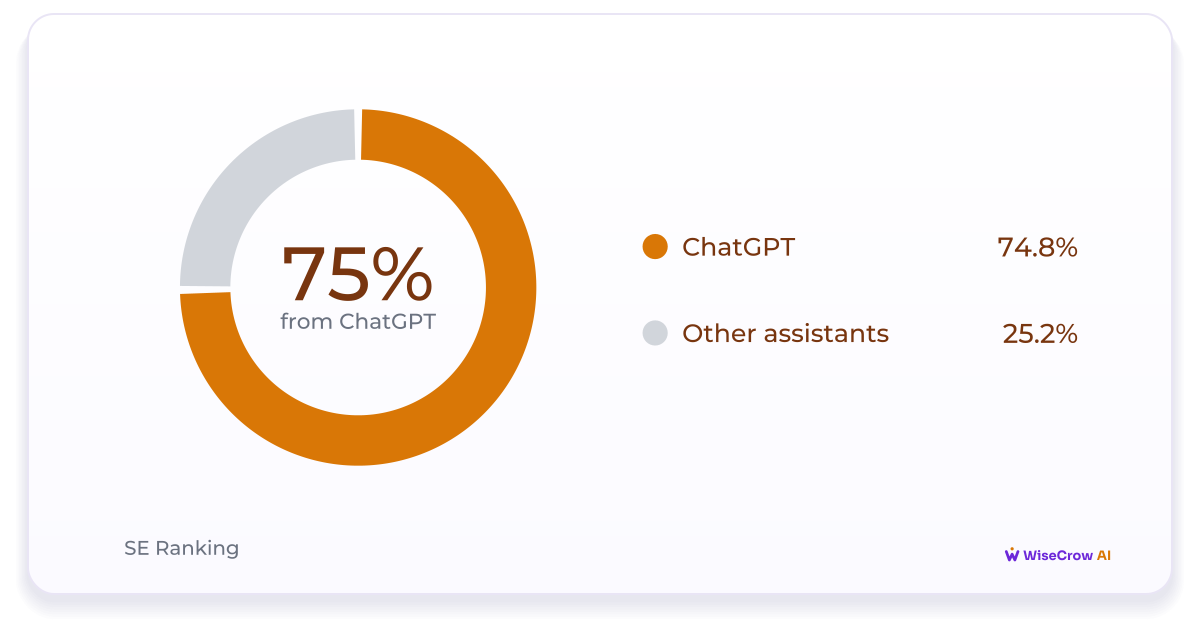
ChatGPT, Perplexity, Gemini and Copilot do send visitors, just not many yet. SE Ranking tracked 101,574 websites and found that AI platforms account for 0.32% of all website traffic in 2026, up from 0.24% in 2025 and 0.02% in 2024. The share grew sixteenfold in two years, from a tiny base. ChatGPT sent 74.78% of the AI referral traffic, down from 79.74% a year earlier, as other assistants grew.
Small totals hide uneven spread. On B2B sites with detailed comparison and pricing pages, I’ve seen AI referrals land on a narrow set of URLs and convert above the site average, because the visitor has already had their shortlist explained to them. Content sites with broad, general articles see far less.
Measurement is the first fix. Some AI visits arrive without a referrer and fall into direct traffic, so your analytics undercount them. Create a custom channel for the main assistant domains, check which landing pages they reach and compare their conversion rate with organic search. Two or three months of that data will tell you more than any industry average.
4. Brand Mentions Shape Who AI Answers Recommend
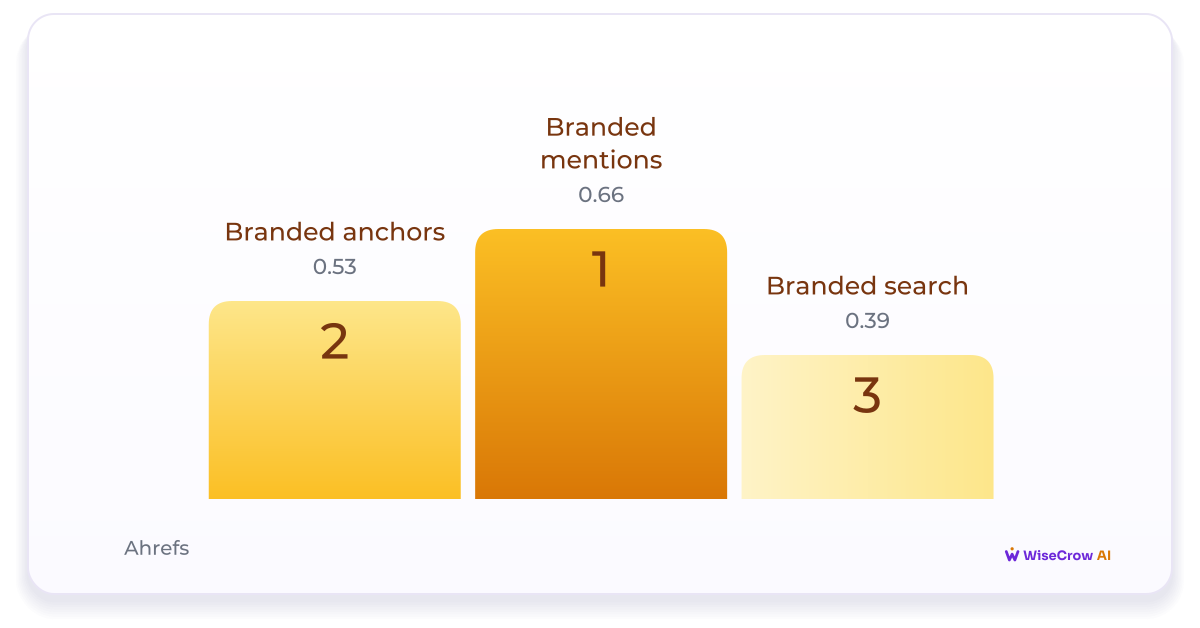
Links built classic SEO. AI answers seem to lean on something else. In a study of 75,000 brands published in December 2025, Ahrefs found that branded web mentions had a correlation of about 0.656 with visibility in AI Overviews. Branded anchors came in at about 0.527 and branded search volume at 0.392. YouTube mentions correlated even more strongly across the AI platforms it checked, while link metrics showed only very weak correlations.
Correlation isn’t causation, and big brands get mentioned more for reasons that also make them visible. Still, the mechanism makes sense. A language model builds its sense of who matters in a category from how often and where a brand comes up in text it has read or retrieves.
The work looks a lot like old-school PR. Get your product into independent reviews, comparison articles, industry roundups and forum threads where buyers ask for advice. Keep your company description identical across directories and profiles. A client in professional services saw their name start to appear in AI answers for their core service only after two trade publications covered them. Months of on-site content before that hadn’t moved it.
What Google Checks More Closely
The next two trends come from Google’s own policies and documentation. They’re less about new features and more about what stops working.
5. Enforcement Against Scaled Content Keeps Tightening
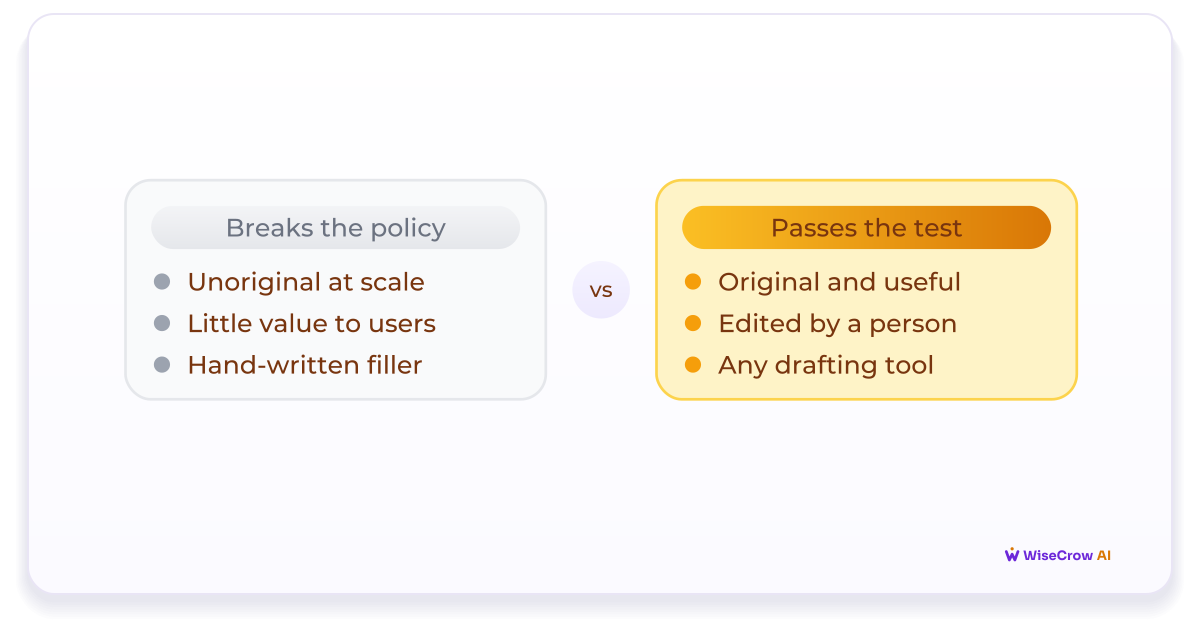
Cheap AI drafting created a flood of near-identical pages, and Google answered with policy. In March 2024 it added new spam policies, among them scaled content abuse: creating large amounts of unoriginal content that gives users little to no value, however it was produced. When the core update that came with it finished in April 2024, Google said searchers would see 45% less low-quality, unoriginal content, above the 40% it first expected.
The policy is tool-neutral. Hand-written filler at scale breaks it too. What draws trouble is a pattern: hundreds of pages built from one template with the city or product name swapped, or articles that restate what already ranks and add nothing.
In audits I run, the riskiest sites share one habit: they publish faster than anyone can edit, with or without AI. The fix is unglamorous. List every page that gets no traffic and no links, then merge, improve or remove it. Most of the errors I find repeat the same few patterns, and I’ve grouped them in my list of common AI SEO mistakes.
6. Entity Clarity Matters More Than Extra Schema
A lot of advice says AI search needs special markup. Google’s documentation on AI features says the opposite: there are no additional technical requirements and no special schema.org structured data needed for AI Overviews or AI Mode. What it does ask is that your structured data matches the visible text on the page. The same page notes that both features may run several related searches across subtopics to build one answer, a technique Google calls query fan-out.
Google has also trimmed the rich results it supports. In June 2025 it announced it would phase out several lesser-used structured data features, such as Course Info, Claim Review and Estimated Salary, and stated the change wouldn’t affect rankings.
Put together, the signal points toward clarity over volume. Search systems and language models need to know which company you are, what you sell, who writes for you and how those facts connect. Use the schema types that still produce features for your pages, keep them true to the page and make sure your name, address, products and people read the same on your site and everywhere else. Query fan-out also rewards sites that cover the follow-up questions around a topic on well-linked pages. My 10-point AI SEO checklist covers how to audit these points page by page.
How You Measure and Control Your AI Visibility
The last two trends are the newest. Both arrived in 2025 and 2026, and both hand site owners tools they’ve asked for since AI answers launched.
7. AI Visibility Tracking Gets Real Data
For two years, Google counted AI feature traffic inside the regular Web numbers in Search Console, with no way to separate it out. In June 2026 Google announced new Search Console insights for its generative AI features: impression metrics, which of your pages appear in AI responses and in which countries. Google says more metrics will follow. As of August 31, 2026, the features are live for all websites worldwide.
Google’s data covers Google only. For ChatGPT, Perplexity and the rest, you still need prompt tracking: a fixed list of questions your buyers ask, run on a schedule, with a record of which brands and pages each answer names. Answers vary from run to run, so trends over several weeks count for more than one snapshot. The trackers that do this well sit in their own category of AI SEO tools, next to the classic rank trackers.
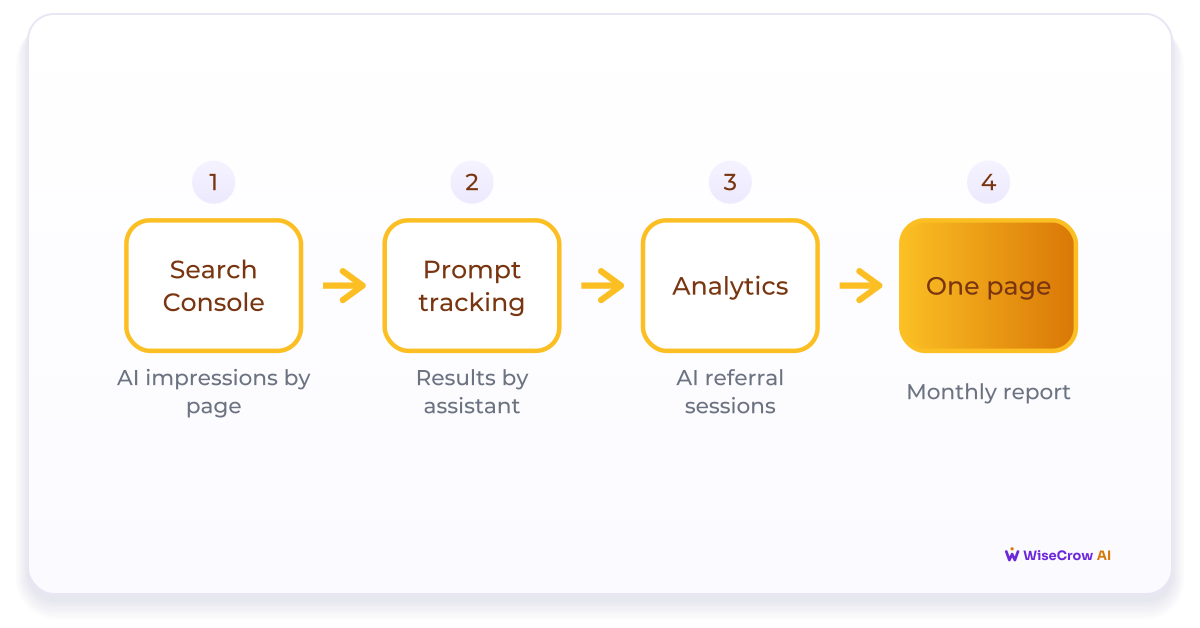
I set up one combined monthly view for clients: Search Console AI impressions by page, tracked prompt results by assistant and AI referral sessions from analytics. Three sources, one page. The first version is always messy. By the third month, it’s the report leadership actually reads.
8. Site Owners Take Control of AI Crawlers and Licensing
The same Google announcement added a control many publishers had asked for. A Search Console toggle lets you choose if your site appears in, and helps ground answers for, Google’s generative features, including AI Overviews and AI Mode. Google says sites that opt out won’t receive traffic or impressions from those features, and that the setting isn’t used as a ranking signal for other results. Separately, the Google-Extended control still covers training and grounding for Google’s other AI systems.
Outside Google, the infrastructure layer moved first. On July 1, 2025, Cloudflare changed its default to block AI crawlers unless they pay creators, backed by a group of major publishers. In December 2025, the RSL 1.0 licensing standard was released as an official specification, endorsed by more than 1,500 media organizations, brands and technology companies, Cloudflare and Akamai among them. RSL lets a site state machine-readable terms for AI use, including allowing search indexing while opting out of AI search features. Compliance is voluntary for the AI companies that read it.
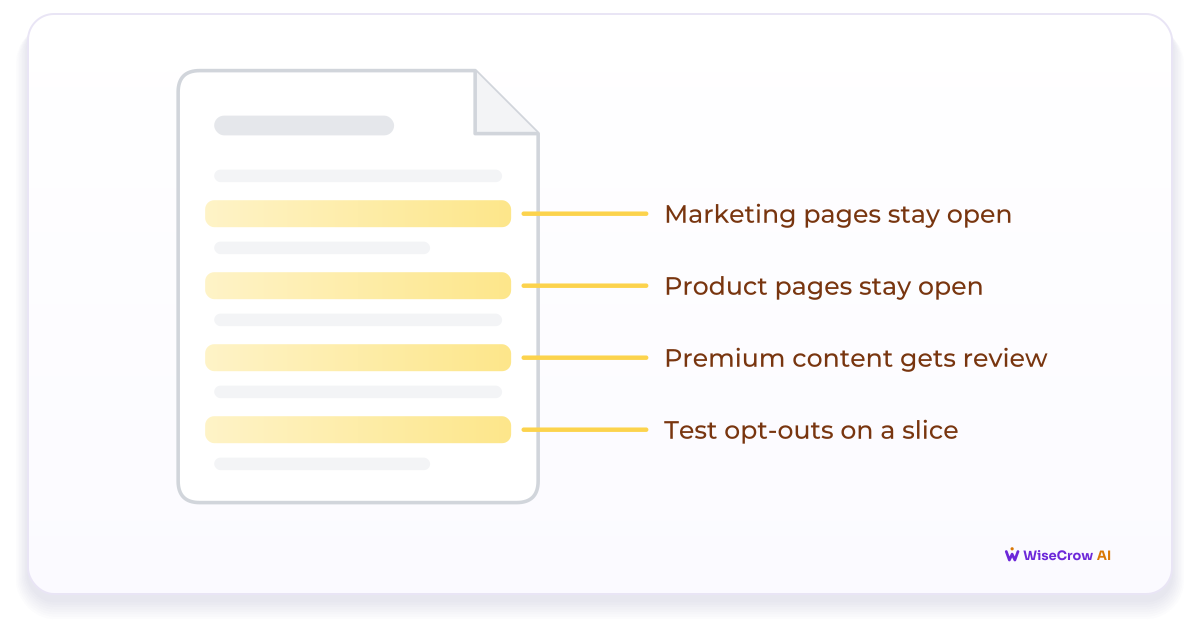
For most businesses, blocking AI systems costs more than it protects. If buyers ask assistants for recommendations, you want to be readable. Publishers and anyone selling paid content face a harder call. My advice is to decide section by section: keep marketing and product pages open, review premium or member content separately and test any opt-out on a slice of the site before you apply it everywhere.
How to Choose Which AI SEO Trends to Act On
Eight trends is too many to chase in one quarter. I run each one through four questions, in this order:
- Does it touch your revenue pages? A shift that affects informational blog traffic matters less than one that changes how buyers find your product or service pages.
- How strong is the signal? Act on the strong ones now. Put tracking and a review date on the early ones.
- Can you measure the result? If you can’t see a baseline today, set up the measurement before you spend on the change.
- Who will do the work? PR, developers and editors own different trends. A trend with no owner won’t move, however strong its data.
For most of the sites I work on, the answer lands on the same three: rebase traffic goals for AI-answered queries, clean up thin pages and start tracking AI visibility. Brand mentions come next, because they take longer to build. If you want ideas for putting AI to work on the tasks behind those priorities, my roundup of AI SEO use cases ranks them by return.
Questions About AI SEO Trends
What Is the Biggest AI SEO Trend in 2026?
The scale of Google’s own AI answers. Google says AI Overviews have over 2.5 billion monthly active users and AI Mode has passed 1 billion. Those answers sit above the classic results for many informational searches, and they change how many clicks a top ranking brings in.
Do AI Overviews Reduce Organic Traffic?
For many informational queries, yes. Ahrefs found that an AI Overview correlated with a 58% lower click-through rate for the top-ranking page between December 2023 and December 2025, and Pew Research saw people click a regular result in 8% of visits with an AI summary versus 15% without one. Commercial and branded searches are usually hit less.
How Much Traffic Do ChatGPT and Other AI Assistants Send to Websites?
Still a small share. SE Ranking’s 2026 study of 101,574 websites puts AI platforms at 0.32% of all website traffic, up from 0.02% in 2024. ChatGPT sends about three quarters of that AI referral traffic. Some AI visits show up as direct traffic, so the real share is likely a little higher.
Can I See AI Overviews Data in Google Search Console?
Yes. Google has added impression metrics for its generative AI features to Search Console, along with which of your pages appear in AI responses and in which countries. As of August 31, 2026, Google says these features are live for all websites worldwide.
Should I Opt Out of Google’s AI Features?
For most businesses, no. Google says sites that opt out won’t receive traffic or impressions from its generative AI features. Opting out can make sense for publishers whose revenue depends on people reading the full article, or for paid content. Test it on one section first and compare the numbers.
Does Schema Markup Help with AI Overviews?
Google says no special schema.org markup is needed to appear in AI Overviews or AI Mode. Structured data still helps search engines read your page, as long as it matches the visible text. Clear, consistent facts about your company and products matter more than adding extra markup types.
Is AI-Written Content Against Google’s Rules?
Using AI isn’t against the rules. Google’s scaled content abuse policy targets large amounts of unoriginal content that adds little value, however it was made. A page that a person has edited, fact-checked and filled with real expertise is fine. Hundreds of near-identical generated pages are the risk.
Sources
- Google, Sundar Pichai’s I/O 2026 keynote (May 2026): blog.google
- Ahrefs, AI Overviews reduce clicks, 2026 update (February 2026): ahrefs.com
- Ahrefs, AI Overviews reduce clicks by 34.5% (April 2025): ahrefs.com
- Pew Research Center, Google users are less likely to click on links when an AI summary appears (July 2025): pewresearch.org
- SparkToro, 2024 zero-click search study (July 2024): sparktoro.com
- SE Ranking, AI traffic research study (June 2026): seranking.com
- Ahrefs, AI brand visibility correlations across 75,000 brands (December 2025): ahrefs.com
- Google Search Central, March 2024 core update and new spam policies: developers.google.com
- Search Engine Roundtable, Google March 2024 core update finished (April 2024): seroundtable.com
- Google Search Central, AI features and your website: developers.google.com
- Google Search Central, Simplifying the search results page (June 2025): developers.google.com
- Google, New opportunities, control and insights for website owners (June 2026, updated August 2026): blog.google
- Cloudflare, Content Independence Day (July 2025): blog.cloudflare.com
- RSL Collective, RSL 1.0 specification release (December 2025): rslstandard.org
Disclaimer: This article is for general information only. Search features, traffic studies, platform policies and tool data change often, so check the original sources for the latest figures before you act on them.
Did you find this helpful?
Thank you for your feedback.
Marlena leads the WiseCrow editorial team and works with our consultants to turn real client projects into practical guides on AI strategy, automation and governance. Before joining WiseCrow, she spent 12 years in B2B operations and SaaS content. She has since edited more than 400 articles on AI and automation and reviewed workflows from over 60 client projects. She is based in Austin, Texas.