Summary
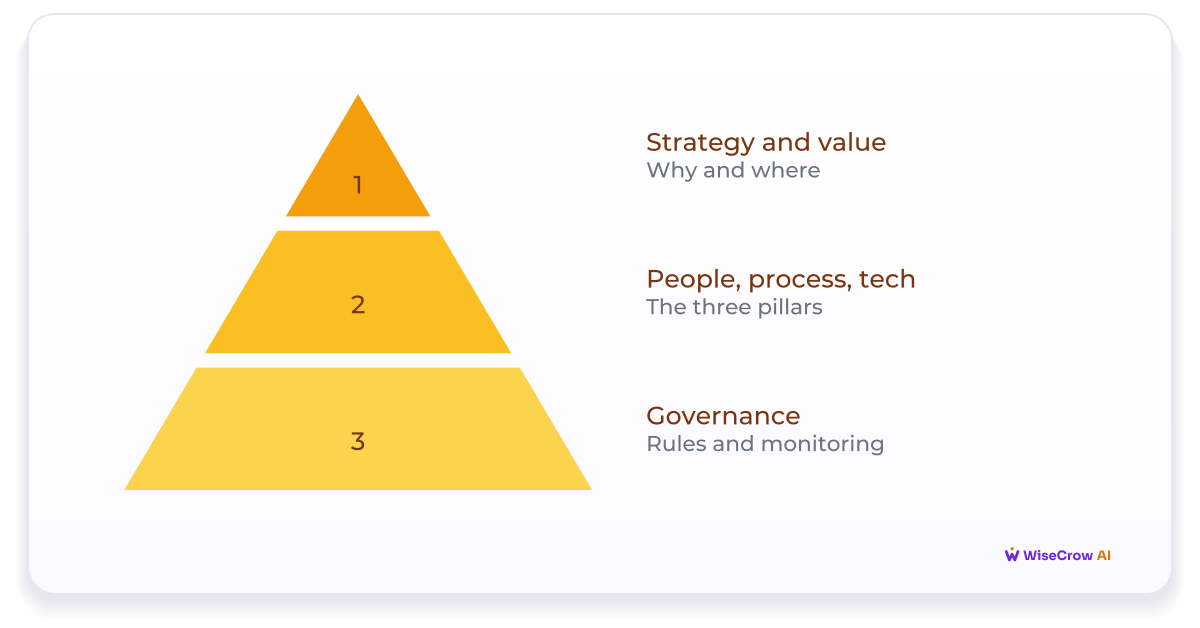
- Model AI transformation as three pillars, people, process and technology, joined by strategy on top and governance below.
- Break each part into dimensions you can score, such as ownership, workflow redesign or data access.
- Rate every part on four maturity levels, and watch the spread between parts more than the average.
- Lift your weakest part one level before you push any other part toward the top.
Most AI programs I’m asked to review have plenty going on. A chatbot here, copilot licenses there, a few pilots in finance. What they lack is a shared picture of everything that has to change around the tools. When I start an AI transformation consulting engagement, the first thing I put in front of the leadership team is a one-page model of that picture.
Below is the model I use. It has three pillars, people, process and technology, held together by two connecting parts: strategy and value at the top, governance underneath. Each part breaks into dimensions, a four-level maturity table shows where you stand, and a short self-assessment gives you a first score in about fifteen minutes.
The Framework at a Glance
Read the table as a quick diagnostic. If you can’t honestly claim the signs in the right-hand column, that part of the framework is where your next quarter should go.
| Part | What it covers | Signs you’re ready |
|---|---|---|
| Strategy and Value | Ambition, use case portfolio, value tracking | Goals tied to AI, baselines recorded |
| People | Leadership, skills, culture and trust | Named sponsor, trained managers |
| Process | Workflow redesign, operating model, delivery | One intake and real go-live gates |
| Technology | Data, platforms, integration | Approved tools reach real data |
| Governance | Policy, risk tiers, monitoring | A short policy people follow |
Why Three Pillars Need Two Connectors
People, process and technology is an old model. It comes from IT change programs long before generative AI, and it still holds up. The trouble sits between the pillars. A company can train every manager, redraw a dozen workflows and buy a strong platform, and still have nothing to show the board, because nobody decided what AI was meant to achieve or who may approve a risky use case.
So I add two connectors. Strategy and value sits above the pillars and tells them where to point. Governance sits below and keeps them safe enough to scale. Skip the top one and you get busy pillars with no direction. Skip the bottom one and you get a few brave teams and a nervous legal department that slows down everyone else.
The weighting matters too. BCG’s 2024 research on AI adoption found that about 70% of AI challenges come from people and processes, around 20% from technology and only about 10% from algorithms. I use that split as a budget check. If four out of five AI dollars go to the technology pillar, the framework will feel lopsided within a year.
Strategy and Value: The Top Connector
Strategy and value answers three questions. What should AI change in the business, which use cases come first and how will you know it worked? It’s the part leaders often believe they’ve finished, because there’s a slide about it.
Ambition Tied to Business Goals
Write down two or three business outcomes AI should move in the next 18 months, such as a shorter claims cycle, a faster month-end close or more selling time per rep. Give each one an executive owner. “Become AI-first” doesn’t count as an outcome. It’s a mood.
A Ranked Use Case Portfolio
Keep one register of every AI idea, with its owner, expected value, effort and status. Rank it by value and feasibility, and review the ranking every quarter. In my client work, the register alone retires about a third of the ideas within two months, mostly duplicates and pet projects nobody wants to own. Good riddance.
Value Tracking From Day One
Record a baseline before each use case goes live, then report results in hours, money or quality. Logins and prompt counts don’t belong in a value report. Once the portfolio is ranked, a 12-month AI transformation roadmap puts each use case and each pillar fix on the calendar.
Pillar 1: People
The people pillar decides if anyone uses what you build. It has three dimensions, and the first one carries the other two.
Leadership and Ownership
Someone at the top has to own AI outcomes, with a budget and the authority to stop projects. Gartner’s 2025 survey on AI maturity found that 91% of leaders at high-maturity organizations had already appointed dedicated AI leaders. Below that person, each business unit needs a named owner for its own use cases. Ownership spread across a committee tends to mean nobody fixes anything.
Skills and Roles
Map what each role needs. Most staff need safe everyday use and the habit of checking output. Managers need to judge AI work in their own field. A small group needs deeper skills, such as workflow design, data work and testing AI output at scale. Train on real tasks, one team at a time. My list of AI adoption best practices covers how to time that training with each rollout wave.
Culture and Trust
Trust can be measured, and it tracks closely with results. The same Gartner survey reported that business units at 57% of high-maturity organizations trusted and were ready to use new AI solutions, compared with 14% at low-maturity ones. Trust grows when leaders say plainly what AI will change in each role, and when early wins reach the team before they reach the board deck.
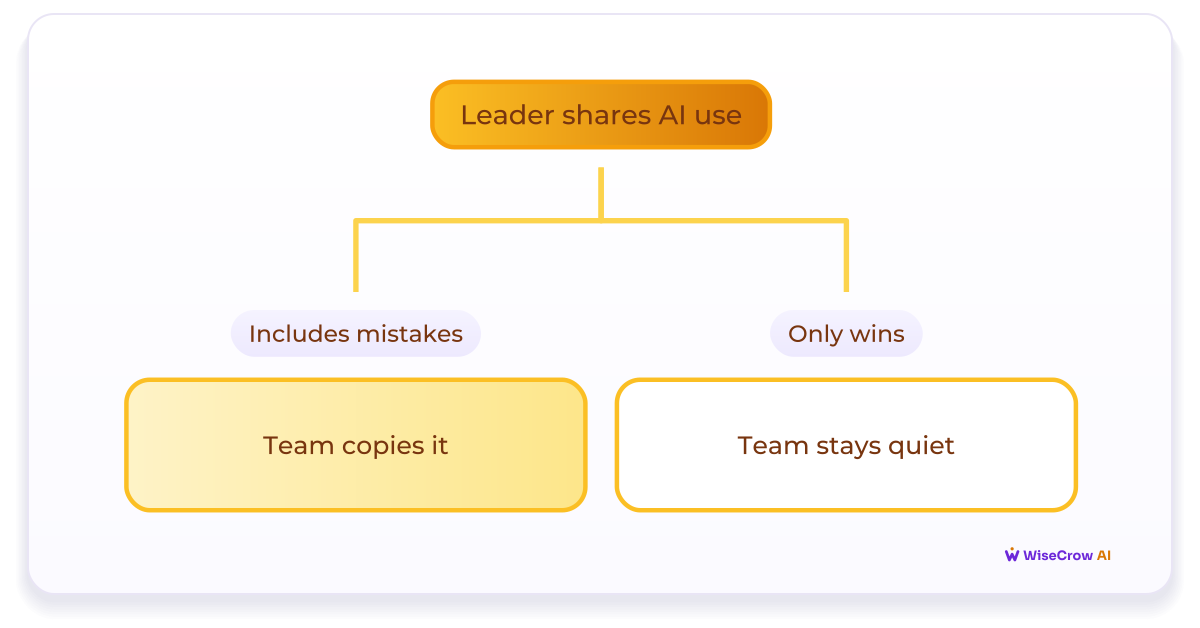
At a regional bank I worked with, the people score rose a full level in one quarter with no new training at all. The COO started every operations meeting with one thing she’d used AI for that week, mistakes included. Her team copied her within a month.
Pillar 2: Process
Process is where AI stops being a tool people try and becomes a different way of doing the work. I split it into three dimensions.
Workflow Redesign
Dropping AI into an unchanged process gives you small gains. Redrawing the process around it gives you the large ones. Picture claims intake. In the old version, a person reads every email, keys the data and routes the case. In the redesigned one, AI extracts and routes, and people handle exceptions and approvals. Same team, different job. Pick a few core workflows and redraw them end to end, with the people who run them in the room.
Operating Model
Decide where AI work lives. A central team, often called a center of excellence, works well early, because standards and scarce skills sit in one place. As you scale, most companies I work with move to a hub-and-spoke setup. The hub owns tools, standards and risk. Spokes in each business unit own delivery and the business result.
Delivery From Idea to Production
Every use case should travel the same path: intake, a quick feasibility check, a pilot with agreed success criteria, a go or no-go decision, then production with a named owner. Pilots that skip the go-live criteria pile up in pilot purgatory, one of the AI transformation challenges I run into most. Gartner found that 45% of high-maturity organizations keep AI projects running for at least three years, against 20% of low-maturity ones, and a repeatable delivery path is a large part of that gap.
Pillar 3: Technology
Technology is the pillar companies spend most on and, in my experience, the one they overrate. It still has to be good enough. Three dimensions cover it.
Data Foundations
AI is only as useful as the data it can reach. For each priority use case, list the data it needs, where it lives, who owns it and how clean it is. Then fix the data behind your first two or three use cases. Waiting for a full company-wide cleanup before any use case starts is the slowest path I know.
Platforms and Tools
Settle on a small approved stack: an enterprise assistant for everyday work, a platform for building custom apps and agents, and the AI features inside the systems you already run. Check data terms, admin controls, logging and single sign-on before you look at price. My comparison of enterprise AI platforms weighs security and scale for the main options.
Integration and Architecture
The value shows up once AI can read from and write to your core systems. Map how each system shares data: API, export, file drop or screen only. Route new tools through one integration layer, so each one doesn’t need its own set of connectors. Start with use cases that read from older systems, and add write-back once you trust the output.
Governance: The Bottom Connector
Governance makes AI safe enough to scale. Done well, it speeds teams up, because they know what’s allowed without asking legal every time.
Policy and Risk Tiers
Start with a one-page usage policy: approved tools, data that never goes in and work that needs a human check. Then sort use cases into risk tiers. Drafting an internal email is low risk. Anything that touches hiring, credit, health or legal decisions is high risk and gets a formal review. The free NIST AI Risk Management Framework gives you a solid structure for those reviews. Check which regulations apply in each market you serve, and their current status, with your legal adviser.
Monitoring and Accountability
Every live use case needs an owner, a log of what the AI did and a regular check of output quality. Vendors update their models without much notice, so keep a test set of real cases and rerun it after each change. Agree on a simple incident path as well: who hears about it when the AI gets something wrong, and who can pause it.
The Four-Level AI Maturity Model
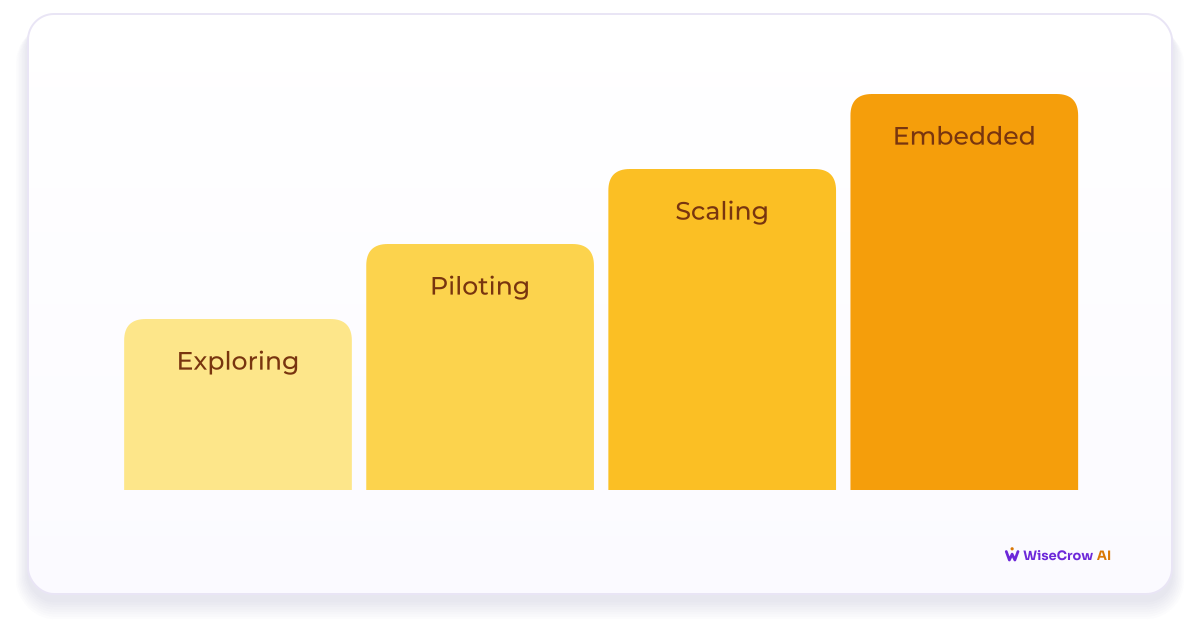
Score each pillar on four levels. Most companies sit at different levels per pillar, and the spread tells you more than the average.
| Level | People | Process | Technology |
|---|---|---|---|
| 1. Exploring | Scattered enthusiasts | Ad hoc experiments | Free and personal tools |
| 2. Piloting | Sponsor named, few trained | Pilots with success criteria | Approved tools, data extracts |
| 3. Scaling | Champions in most teams | Shared intake and gates | Shared platform, key integrations |
| 4. Embedded | AI skills in every role | Core workflows redesigned | Governed data, monitored models |
The two connectors climb the same ladder:
- Strategy and value: loose ideas at level 1, a ranked portfolio at level 2, tracked value per use case at level 3 and AI targets inside the business plan at level 4.
- Governance: no policy at level 1, a usage policy at level 2, risk tiers with reviews at level 3 and ongoing monitoring with clear accountability at level 4.
Climbing the levels pays off. MIT CISR’s Enterprise AI Maturity Model, built on a survey of 721 companies, found that enterprises in the first two stages performed below their industry average financially, while those in stages three and four were well above it. Only 7% had reached the top stage. The researchers point out that their survey mostly reflects traditional analytical AI, so treat it as a signal of direction.
A 15-Minute AI Maturity Self-Assessment
Answer each statement with yes or no. Be strict with yourself. “Partly” counts as no.
- Strategy: AI goals are tied to two or three named business outcomes, each with an executive owner.
- Strategy: Every live use case has a recorded baseline and a reported result.
- People: One executive owns AI outcomes and has a budget to match.
- People: Managers in at least half your teams have had role-based AI training.
- Process: New AI ideas go through one intake with a named owner.
- Process: At least one core workflow has been redrawn around AI from start to finish.
- Technology: Approved AI tools can reach the data your top use cases need.
- Technology: New AI tools connect through a shared integration layer.
- Governance: A short usage policy exists, and staff can tell you what it says.
- Governance: High-risk use cases get a review before launch and monitoring after.
Count your yes answers. Zero to three puts you at level 1, four to six at level 2, seven or eight at level 3 and nine or ten at level 4. Then check which part scored zero. A total of six with both governance answers at no is a riskier place to be than an even five.
Three Lopsided Profiles I See Often
When I score a company, the five parts usually fall into one of three shapes. Each one has a fix that feels wrong at first.
Strong Tech, Weak People
The platform is live, the integrations work and weekly use covers a small slice of the licenses. IT built it, and the business got an announcement email. The fix is a business owner on each use case and a quarter spent on managers and champions. Pausing new tech spend for that quarter is the hardest advice I give, and it’s usually right.
Eager People, No Process
Enthusiasm everywhere, dozens of ideas in flight and nothing in production. Every team runs its own pilot with its own tool. The fix is one intake, real go-live gates and a short approved tool list. Expect some grumbling. The teams with the best ideas tend to come round once their use case is the first to reach production.
Heavy Governance, Nothing to Govern
A thorough policy, a review board and a risk register, with two use cases live. Every request waits months. The fix is tiered reviews, so low-risk uses get approved in days and the full process is kept for high-risk work.
How to Choose Where to Invest First
Your self-assessment shows the starting point. These rules decide the first moves:
- If strategy scored zero, fix it first. Every pillar needs a target to aim at.
- If people and process trail technology, hold new tool purchases for a quarter and put the money into owners, training and intake.
- If technology trails, fix data access for your top two use cases before you buy a new platform.
- If governance scored zero, publish a one-page policy within a month. It costs little and calms everyone down.
- If you sit at level 2 or higher everywhere, pick one core workflow and redesign it end to end.
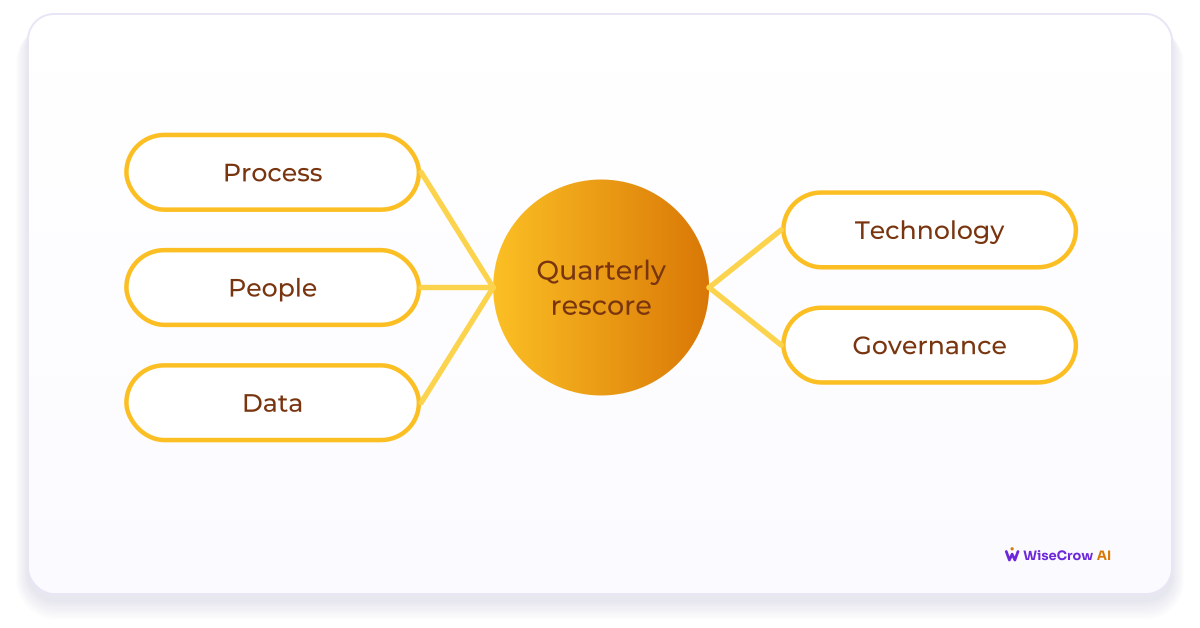
Rescore every quarter with the same people in the room. The movement between scores tells you more than any single number. If you’re the executive sponsor, my AI transformation leadership playbook covers the decisions that sit with you, from funding to the hard conversations about roles.
Questions About AI Transformation Frameworks
What Is an AI Transformation Framework?
It is a model that shows everything that has to change for AI to work across a company, beyond the tools themselves. Mine has three pillars, people, process and technology, plus two connectors: strategy and value on top, governance underneath. Each part breaks into dimensions you can score on a four-level maturity scale.
What Are the Pillars of AI Transformation?
The three classic pillars are people, process and technology. People covers leadership, skills and trust. Process covers how work gets redesigned and how AI projects move from idea to production. Technology covers data, platforms and integration. I add strategy and governance as connectors, because the pillars drift apart without them.
How Is a Framework Different from an AI Transformation Roadmap?
A framework tells you what has to be in place and how mature each part is today. A roadmap puts those gaps on a calendar, with owners, budgets and decision dates. Score yourself against the framework first, then build the roadmap from your weakest parts.
How Do You Measure AI Maturity?
Score each part of the framework on a scale from exploring to embedded, using concrete evidence such as a named owner, a recorded baseline or a live integration. Look at the spread across the parts as well as the average. A short yes or no checklist, rescored every quarter by the same group, is enough for most companies.
Which Pillar Should a Company Start With?
Start with strategy and value if nobody can name the outcomes AI should move. After that, work on whichever pillar scores lowest. In my client work, that’s usually people or process, since most companies have already bought more technology than they use.
How Long Does It Take to Move Up One Maturity Level?
For a mid-sized company, moving one pillar up one level often takes somewhere between two and four quarters. Governance and strategy can move faster, because a policy or a ranked portfolio is mostly a decision. Data and integration work tends to take longest.
Do Smaller Companies Need a Formal AI Framework?
They need the thinking, if not the paperwork. A company with 80 people can cover all five parts on a single page: one owner, a short use case list, an approved tool, a usage policy and a baseline for each use case. The same gaps that stall large programs stall small ones, only faster.
Sources
- BCG, AI Adoption in 2024: 74% of Companies Struggle to Achieve and Scale Value (October 2024): bcg.com
- Gartner, Survey Finds 45% of Organizations With High AI Maturity Keep AI Projects Operational for at Least Three Years (June 2025): gartner.com
- MIT CISR, Enterprise AI Maturity Model press release (December 2024): cisr.mit.edu
- NIST, AI Risk Management Framework: nist.gov
General information only: this is not legal, financial or tax advice. Examples and numbers reflect typical projects; check the specifics with your advisers before deciding.
Did you find this helpful?
Thank you for your feedback.
Marlena leads the WiseCrow editorial team and works with our consultants to turn real client projects into practical guides on AI strategy, automation and governance. Before joining WiseCrow, she spent 12 years in B2B operations and SaaS content. She has since edited more than 400 articles on AI and automation and reviewed workflows from over 60 client projects. She is based in Austin, Texas.