Summary
- Plan the year in four quarters, and close each one with an exit test before the next starts.
- Run seven workstreams side by side: leadership, portfolio, platform, governance, skills, waves and value.
- Get a first wave of about five use cases into production by month 6, then scale in two more waves.
- Check a short KPI list at months 3, 6 and 12, and stop use cases that miss their targets.
Most large companies I meet have an AI strategy deck and a dozen pilots. What they lack is a calendar: who does what in which month, and what has to be true before the next step starts. A 12-month roadmap gives a big organization that rhythm, and it sits at the center of the AI transformation consulting work I do with leadership teams.
Below you get the whole year in one table, with the workstreams as columns. Each quarter then gets its own section, split by workstream, and a KPI table shows what to check at months 3, 6 and 12. The plan assumes a mid-sized or large company with a sponsor willing to commit for a year. Smaller firms can squeeze it into less time.
The 12-Month Roadmap at a Glance
Read across a row to see what happens in a given month. Read down a column to follow one workstream through the year. Value tracking runs through every month, so it gets its own KPI table further down.
| Month | Leadership and portfolio | Platform and governance | Skills and waves |
|---|---|---|---|
| Month 1Q1 | Sponsor and AI council named | Current AI tools audited | Leadership briefing |
| Month 2Q1 | Use case inventory | Interim usage policy | Skills baseline survey |
| Month 3Q1 | Top five bets funded | Platform shortlist | Champions picked |
| Month 4Q2 | Wave 1 kickoff | Platform contract signed | Wave 1 teams trained |
| Month 5Q2 | Monthly portfolio review | Risk tiers in use | Wave 1 build |
| Month 6Q2 | Half-year review | Cost and quality monitoring | Wave 1 in production |
| Month 7Q3 | Wave 2 funded | Shared components reused | Role academies open |
| Month 8Q3 | Stop or scale calls | AI inventory complete | Wave 2 build |
| Month 9Q3 | Operating model agreed | Audit trail tested | Wave 2 in production |
| Month 10Q4 | Gains booked with finance | Cost controls tuned | Wave 3 launched |
| Month 11Q4 | Board update | Agent guardrails tested | Wave 3 in production |
| Month 12Q4 | Year-two roadmap signed | Platform fit review | Skills re-survey |
Why a Year, and Why in Quarters
Twelve months is long enough to get two or three waves of use cases live. It’s also short enough that the sponsor who signed the plan is still in the room at the end. Shorter plans tend to stop at pilots. Longer ones drift, because the tools change under them every few months.
The pressure to move is real. In Microsoft’s 2025 Work Trend Index, 82% of leaders said this is the year to rethink key parts of strategy and operations. The gap between starting and getting value is just as real. BCG’s 2025 survey of 1,250 senior executives found only 5% of companies were getting AI value at scale. Another 35% were scaling and starting to see value, and the other 60% reported minimal revenue and cost gains.
Quarters give you four fixed points to check which group you’re heading for. Each quarter below ends with an exit test. If you can’t pass it, extend the quarter by a few weeks. Pushing ahead with an open gap costs more in the quarter after.
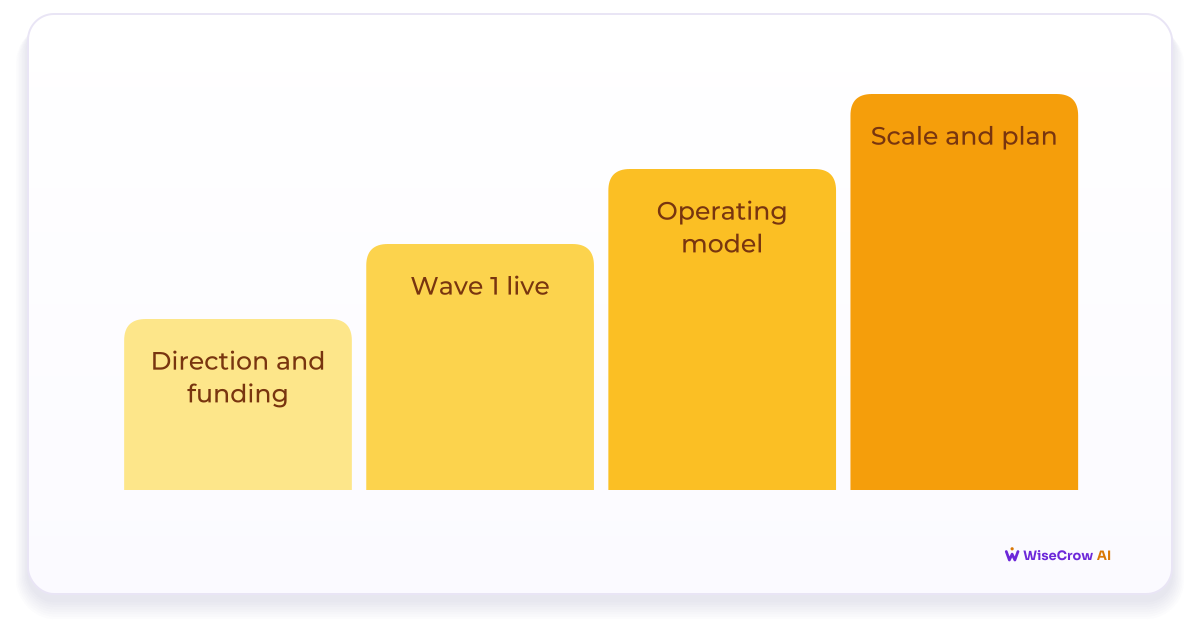
Quarter 1, Months 1 to 3: Set Direction and Fund the First Bets
The first quarter builds almost nothing. It decides who leads, what you’ll work on and which rules apply while the bigger choices get made. Leadership teams get restless here. Hold the line anyway, because every shortcut in Q1 comes back as rework in Q3.
Leadership: A Sponsor and a Small AI Council
Name one executive sponsor with budget authority. Put a council around them: heads of two or three business units, the CIO or CTO, someone from risk or legal and someone from HR. Keep it to seven people or fewer and meet every two weeks in Q1.
The council’s first job is to agree on two or three business outcomes for the year, such as shorter claim cycles or more revenue per sales rep. Every later choice gets tested against them. For the sponsor’s side of the work in more depth, my leadership playbook for AI transformation covers the decisions that sit with the executive team.
Portfolio: From Idea List to Five Funded Bets
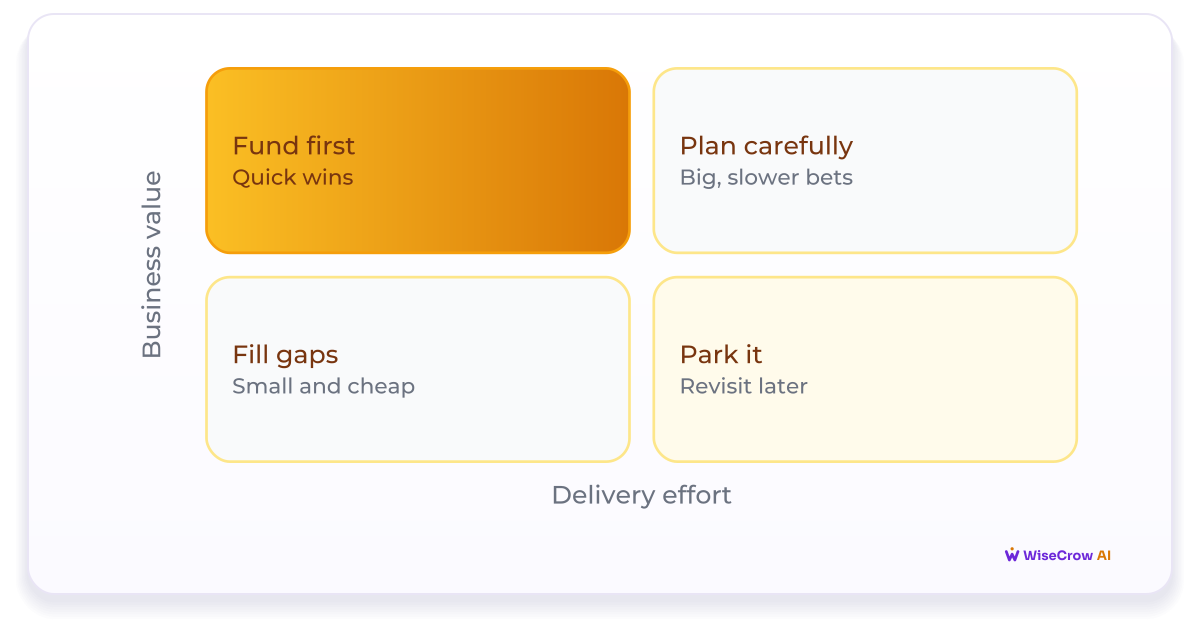
In month 2, collect every AI idea and every pilot already running. In my client work, the first inventory usually turns up two to three times more pilots than leadership knew about. Score each one on value, feasibility and risk, then fund the top five for Q2. Park the rest in a visible backlog so nobody feels ignored.
Mix the five. I like three that improve an existing process with clear numbers and one or two that test something harder, like an agent that handles a full workflow. Five safe bets give you a dull year. Five moonshots give you a year of excuses.
Platform: Audit What You Already Own
List the AI you already pay for. Most enterprises own Copilot seats, a cloud AI service and AI features inside their CRM or ERP that nobody switched on. By month 3, write a shortlist of two or three platforms for the core build work, with clear criteria: data residency, identity integration, model choice and cost per use. My comparison of enterprise AI platforms ranks the main options on security and scale.
Governance: An Interim Policy Within Weeks
Publish an interim usage policy in month 2. It doesn’t need to be final. It needs to name the approved tools, the data that stays out and the uses that need a review first.
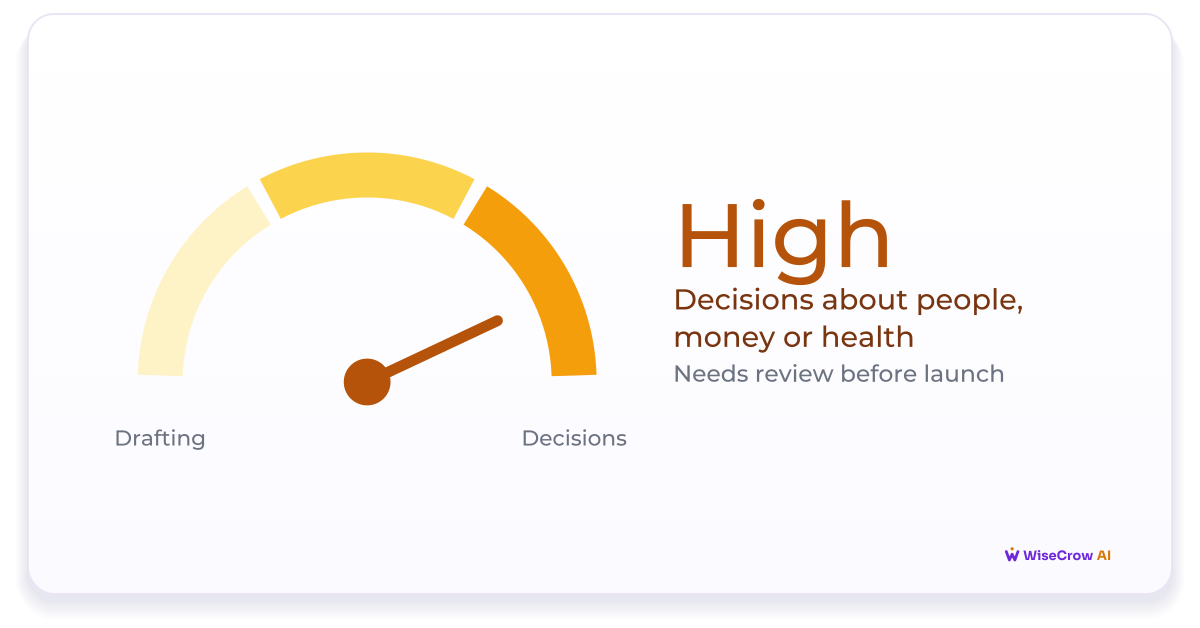
Draft your risk tiers at the same time. A simple version has three levels: internal drafting is low risk, customer-facing content is medium and decisions about people, money or health are high. You’ll sharpen the tiers in Q2, once real use cases test them.
Skills: Brief Leaders First, Then Survey Everyone
Give your top leaders a half-day session in month 1 on what AI does well, where it fails and what the plan is. Then run a short skills survey across the company in month 2. You need the baseline to show progress at month 12, and the answers tell you where your first champions sit.
Exit test for Q1: a sponsor and council in place, five funded use cases with owners and baselines, an interim policy and a platform shortlist.
Quarter 2, Months 4 to 6: First Wave Into Production
Q2 is where the plan meets real systems. The goal is easy to state and hard to hit: the five funded use cases running in production, with real users and real data, by the end of month 6.
Scaling Wave 1: Five Use Cases With Real Users
Give each use case a small team: a business owner, a product lead and two or three builders. Set go-live criteria before the build starts, including who pays the running costs once it’s live. Expect one or two of the five to slip or stop. Stopping a weak use case in month 5 is a good result. Carrying it to month 12 isn’t.
Launch each use case with the team that will use it, one team at a time. The order of those teams decides if usage lasts past the first month, and my guide to team-by-team AI adoption covers champions, training and support for each launch.
Platform: Sign, Connect and Watch the Costs
Sign the core platform contract in month 4, on terms that let you add seats and usage over the year. Connect identity and the first data sources. By month 6, put basic monitoring in place: cost per use case, regular quality checks on outputs and an alert when usage spikes. A surprise cloud bill is the fastest way I know to lose your CFO.
Governance: Risk Tiers Meet Real Use Cases
Run every wave 1 use case through the risk tiers. Low-risk ones get a light checklist. High-risk ones get a review panel and a person approving the output before it leaves the building.
The NIST AI Risk Management Framework is a free, practical structure for those reviews. ISO/IEC 42001 gives you a management system standard if you want certification later. Pick one as your reference and stop debating frameworks in council meetings.
Leadership: The Half-Year Review
In month 6, hold a half-year review with the full leadership team. Show the KPI table, what went live, what stopped and why. Ask for the wave 2 budget in the same meeting, while the evidence is fresh and the people who built it are in the room.
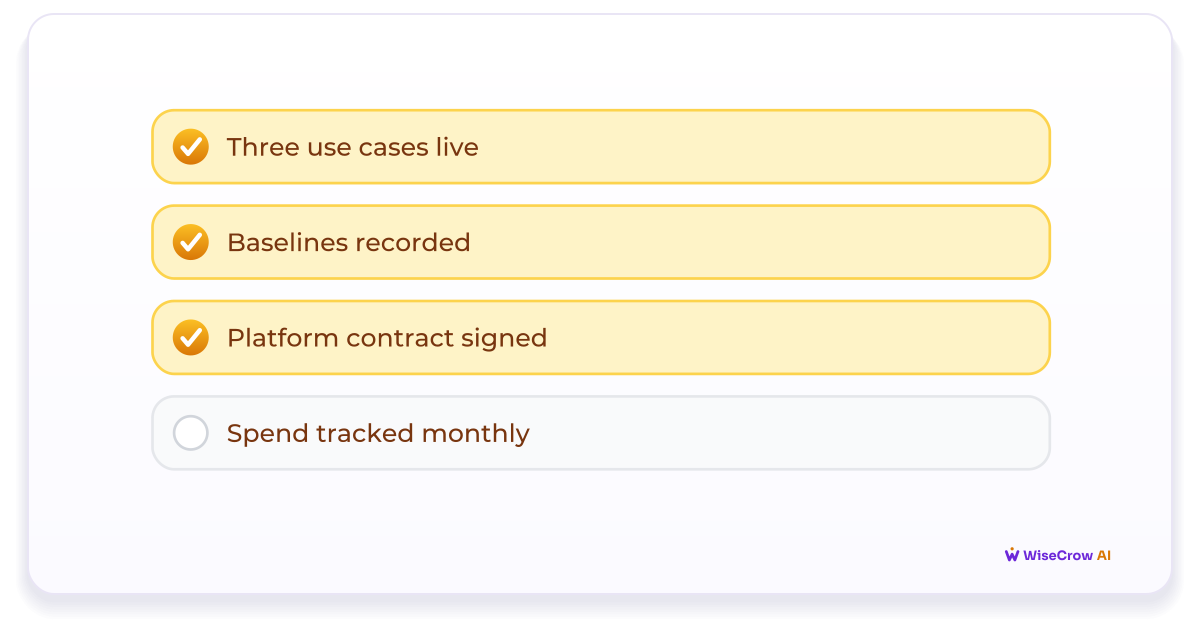
Exit test for Q2: at least three use cases live with measured results, a signed platform, risk tiers in daily use and a funded second wave.
Quarter 3, Months 7 to 9: Second Wave and a Lasting Operating Model
By month 7, the question changes from “does AI work here?” to “how do we run it at scale?” Q3 sets up the structure that will outlast the roadmap itself.
Scaling Wave 2: Reuse What Wave 1 Built
Pick five to eight use cases for wave 2 and favor the ones that reuse wave 1’s parts: the same document pipeline, the same search over company data, the same approval flow. In my client work, a second-wave use case built on shared parts goes live in roughly half the time of a first-wave one. Make reuse a selection criterion, or the portfolio drifts toward shiny new ideas.
Month 8 is stop-or-scale month for wave 1. Each live use case either expands to more teams or gets switched off, with the reasons written down.
Operating Model: Hub and Spoke
Write down what has worked so far and make it official. Most enterprises I work with land on a hub and spoke model. A central AI team owns the platform, standards and shared components. Each business unit has its own product owner and builders.
Agree on funding at the same time. Central teams paid only from the IT budget tend to lose business priority within a year. The people, process and tech model I use shows how the hub, the spokes and the data layer fit together.
Skills: Role Academies for the Next Wave
Open short academies per role family in month 7: managers, analysts, frontline staff and builders. Each one runs four to six weeks and uses real tasks from the job. In the same Work Trend Index, 47% of leaders listed upskilling existing employees as a top workforce strategy for the next 12 to 18 months. Treat your academies like a project, with an owner and a completion target per role.
Governance: One Inventory of Every Model and Agent
By month 8, keep one inventory of every AI system in use, with its owner, the data it touches, its risk tier and the date of its last review. In month 9, test the audit trail on one high-risk use case as if a regulator had asked for it. Rules for AI differ by market and keep changing, so ask legal to check the current status in each region you serve.
Exit test for Q3: wave 2 live, wave 1 stop-or-scale calls made, an operating model with funding agreed and a complete AI inventory.
Quarter 4, Months 10 to 12: Scale Wide and Plan Year Two
Q4 turns the program into normal business. The roadmap ends, and AI becomes part of the yearly plan and budget like any other capability.
Scaling Wave 3: Wider Rollout and the First Agents
Wave 3 spreads the proven use cases to more units and regions. It can also add a small number of agent use cases, now that you have logging, risk tiers and an inventory. Give agents narrow permissions and full logs, and keep a person approving any action that touches money or customers.
BCG found that future-built companies already put 15% of their AI budgets into agents. I wouldn’t copy that share in year one. One or two well-scoped agent use cases are plenty to learn on.
Value: Book the Gains With Finance
Hours saved that never show up in a budget get questioned in year two. In month 10, sit down with finance and turn each live use case’s results into budget lines: lower contractor spend, slower headcount growth in a function, more cases handled per team. Agree on the numbers both sides trust before the budget round starts.
Leadership: Board Update and the Year-Two Plan
Give the board an honest update in month 11: what went live, what it delivered against baseline, what stopped and what you learned. Then draft the year-two roadmap in month 12 and rerun the skills survey from month 2, so you can show the change.
Year two usually has fewer, bigger bets in core processes. BCG’s research puts 70% of AI’s potential value in core business functions such as sales and marketing, and by now you have the platform and the governance to go after it.
Platform: A Year-End Cost and Fit Review
Check cost per use case, seat usage and the gaps that forced workarounds. Cut unused licenses, renegotiate on real volumes and decide if specific work needs a second platform. Almost every company I’ve reviewed at this point finds seats nobody has opened in months.
Exit test for Q4: gains agreed with finance, a board update delivered and a signed year-two roadmap with a budget.
KPIs to Check at Months 3, 6 and 12
Value tracking starts in month 1 with baselines and runs to the last day of the plan. The table shows the targets I set with clients for a mid-sized enterprise. Adjust the numbers to your size, but keep the order: baselines first, usage second, booked value last.
| KPI | Month 3 | Month 6 | Month 12 |
|---|---|---|---|
| Use cases in production | None, five funded | Three to five | Ten to fifteen |
| Live use cases with a baseline | All five funded | Every live one | Every live one |
| Weekly active users | Leaders and pilots | Wave 1 teams | Most target roles |
| Value against baseline | Targets agreed | First measured gains | Gains in the budget |
| AI systems in the inventory | Draft list | All of wave 1 | Every system |
| Staff trained by role | Leaders briefed | Wave 1 teams | Most target roles |
| Spend against plan | Budget set | Tracked monthly | Within agreed range |
Usage numbers rise long before value does. If month 6 shows high usage and no measured gain, look at the baseline first. In most programs I review, nobody recorded one for at least one of the live use cases, and that use case can’t prove anything.
To set a value target for a wave 1 use case, enter how long the task takes today, how often it runs and how many people do it. The result gives you a number to agree with finance before the build starts.
How Much Time Could You Save?
Move the sliders to match one repetitive task in your business.
Running the End-of-Quarter Review
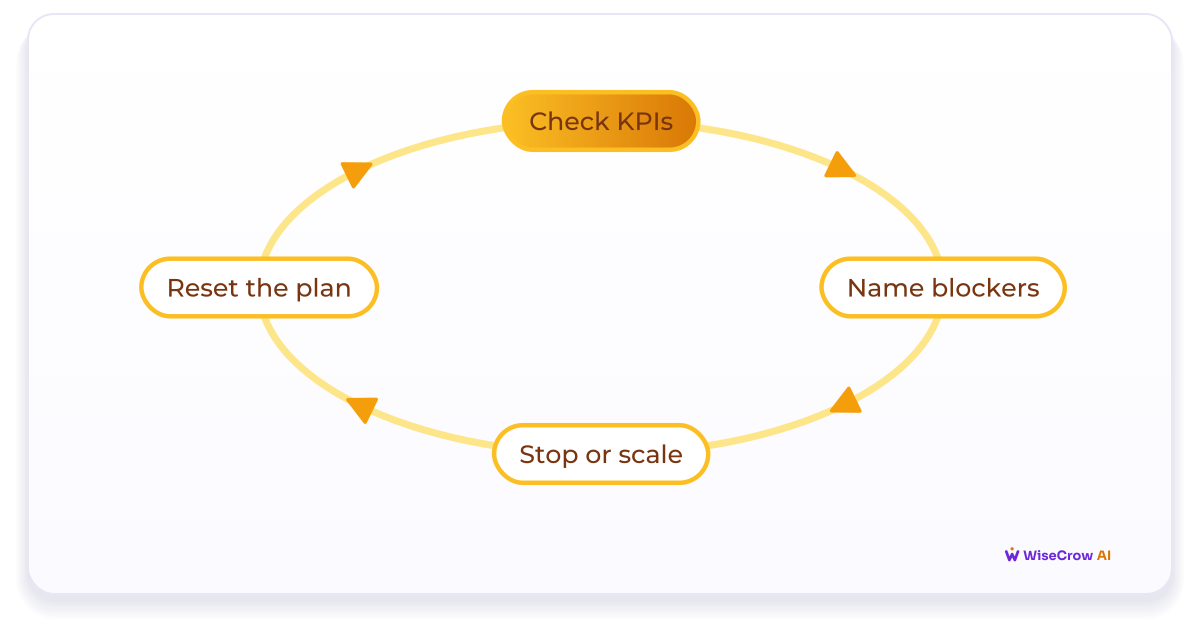
Each quarter closes with a two-hour review led by the sponsor. I keep the agenda the same every time, so people know what to prepare and nobody can hide a gap behind a new format:
- Exit test: pass, partial or fail, with one line per item.
- KPI table against the targets for that month.
- Use cases to stop, with the reason and what was learned.
- Blockers that need a council decision, each with a proposed answer.
- Changes to the next quarter’s plan, with dates.
If the same blocker shows up in two reviews in a row, it’s structural. My list of common AI transformation challenges pairs the usual suspects with early warning signs and fixes.
How to Choose the Right Pace for Your Roadmap
The 12-month plan is my default for a mid-sized or large company starting with a few pilots. Adjust it to where you stand today:
- Pilots already live and a sponsor in place: squeeze Q1 into about six weeks.
- Heavily regulated industry: add a month to Q2 for risk reviews and documentation.
- Data spread across many old systems: make data access a wave 1 deliverable in its own right.
- A smaller company with a handful of departments: run two waves and finish in about nine months.
- No sponsor yet: don’t start month 1 until you have one.
One trade-off I’d push back on: many leadership teams want to run all seven workstreams at full speed from day one. In my experience, the platform and governance work should run slightly ahead of the use cases, and skills should run slightly behind them, so training lands just before each team needs it. Speed up the use cases and you build on rules nobody has written yet. Slow them down and the business loses interest by month 4.
Questions About AI Transformation Roadmaps
What Is an AI Transformation Roadmap?
It’s a dated plan that moves a whole company from scattered AI pilots to AI running in core processes. A good one names the workstreams, the owner of each, what happens in which month and the test that has to be passed before the next quarter starts.
How Long Does an AI Transformation Take?
A first year can set up leadership, governance, a platform and two or three waves of live use cases. Getting AI into most core processes takes longer, usually a few years. Plan the first 12 months in detail and the years after that at a higher level, then refresh the plan every quarter.
What Should Happen in the First 90 Days?
Name a sponsor and a small AI council, agree on two or three business outcomes, take an inventory of existing pilots and fund the best five. Publish an interim usage policy and shortlist your core platform. Very little gets built in the first quarter, and that’s fine.
Who Should Own the AI Transformation Roadmap?
One executive sponsor with budget authority should own it, backed by a small council from the business, IT, risk and HR. A central AI team runs the day-to-day work. If the roadmap sits only in IT, the business tends to treat it as an IT project and usage stays low.
How Many AI Use Cases Should We Run in the First Year?
I plan for about five in the first wave and five to eight in the second, with a smaller third wave that spreads proven ones further. Expect some to stop. Ten to fifteen live use cases with measured results by month 12 is a solid first year for a mid-sized enterprise.
How Is an AI Transformation Roadmap Different from an AI Strategy?
The strategy says where AI should create value and why. The roadmap turns that into a calendar with owners, budgets, waves and checkpoints. You need both, and the roadmap should change every quarter as results come in, while the strategy changes far less often.
What KPIs Show an AI Transformation Is Working?
Track use cases in production, value measured against a baseline, weekly active users in target roles, staff trained by role, the share of AI systems in your inventory and spend against plan. Check them at months 3, 6 and 12. Value against baseline matters most, and usage alone can look good for months while nothing changes.
Sources
- Microsoft WorkLab: 2025 Work Trend Index, The Year the Frontier Firm Is Born (2025)
- BCG: The Widening AI Value Gap, press release on AI leaders and laggards (September 2025)
- NIST: AI Risk Management Framework
- ISO: ISO/IEC 42001 Artificial Intelligence Management System
General information only: this is not legal, financial or tax advice. Examples and numbers reflect typical projects; check the specifics with your advisers before deciding.
Did you find this helpful?
Thank you for your feedback.
Marlena leads the WiseCrow editorial team and works with our consultants to turn real client projects into practical guides on AI strategy, automation and governance. Before joining WiseCrow, she spent 12 years in B2B operations and SaaS content. She has since edited more than 400 articles on AI and automation and reviewed workflows from over 60 client projects. She is based in Austin, Texas.