Summary
- AI transformation changes how the company works and decides, so the executive team owns it, with IT in support.
- Four leadership calls shape everything else: ambition, funding model, operating model and risk appetite.
- Employees adopt AI faster when leaders share a clear plan and say honestly what changes in each role.
- Boards need a short quarterly scorecard covering value, adoption, risk and skills, measured against baselines.
Most executives I meet already have AI in the building. There are licenses, a few pilots and a slide in the strategy deck. What they lack is a shared view at the top of what the company is trying to become, and who decides. In my AI transformation consulting work, the first sessions are almost always with the leadership team, before anyone looks at a model.
I wrote this guide for that leadership team. You’ll get a plain definition, the four decisions only you can make, a comparison of the three common ways to organize AI talent, advice on talking to employees and the few numbers your board should see each quarter. It ends with a checklist you can bring to your next executive meeting.
What AI Transformation Means for a Leader
AI transformation is a planned change in how your company works, decides and competes, with AI built into its core processes. The key word is planned. Usage that spreads on its own, one team and one tool at a time, is adoption. It helps, and it can stall at the edges of the business for years.
The gap between the two shows up in the numbers. PwC’s 2026 Global CEO Survey of 4,454 chief executives found that 56% saw neither higher revenue nor lower costs from AI over the previous 12 months. Only 12% got both. PwC describes that small group as having stronger foundations, including defined roadmaps and technology built for integration. Those are leadership choices.
For you as an executive, transformation means three shifts. You set a direction for AI that ties to the company strategy. You change how money, people and authority flow, so the direction can happen. And you stay visibly involved long after the launch event, because the hard part comes in year two, when the easy wins are gone and the remaining work cuts across departments.
AI Transformation vs Digitization vs Automation Projects
Leaders often use these three terms as if they meant the same thing. They don’t, and mixing them up leads to the wrong owner, the wrong budget and the wrong timeline. Here’s how I separate them with clients.
| Aspect | Digitization | Automation project | AI transformation |
|---|---|---|---|
| Main question | Can we do it online? | Can a machine do this step? | How should the work run now? |
| Scope | One process or channel | One task or workflow | Many functions at once |
| Owner | IT | Process or ops lead | CEO and executive team |
| What changes | The medium | Who does a step | Roles, decisions, offers |
| Typical horizon | Months | Weeks to months | Several years |
Digitization moved paper and phone calls onto software. A claims form went online, and a sales process moved into a CRM. The work itself stayed mostly the same.
An automation project takes one task or workflow and hands some or all of it to software. It has a clear scope, a project lead and an end date. Invoice matching, ticket routing and report drafting are typical examples. Most companies need dozens of these, and they’re a big part of any transformation.
Transformation sits one level up. It asks how a whole function should work once AI can read, write, predict and act. A finance team that closes the books in three days with half the manual checks has different roles, different controls and a different relationship with the business. You get there through a portfolio of projects, held together by decisions about people, process and technology, which my AI transformation framework lays out layer by layer.
The Four Decisions Only Leaders Can Make
Most of an AI program can be delegated. These four calls can’t. When I see a program drifting, one of them is usually missing or was made by default.
Ambition: How Far You Want AI to Go
Decide what role AI plays in your strategy over the next three years. I give leadership teams three levels to choose from. Efficiency means doing today’s work faster and cheaper. Reinvention means redesigning core processes, like claims, underwriting or customer service, around AI. New business means AI-based products or services you can sell.
Pick one level as your main bet, and pick a small number of areas to pursue it. BCG found that AI leaders pursue about half as many opportunities as less advanced peers, and that 62% of AI’s value sits in core business functions. Ambition is as much about what you say no to as what you say yes to.
Funding Model: Who Pays and When
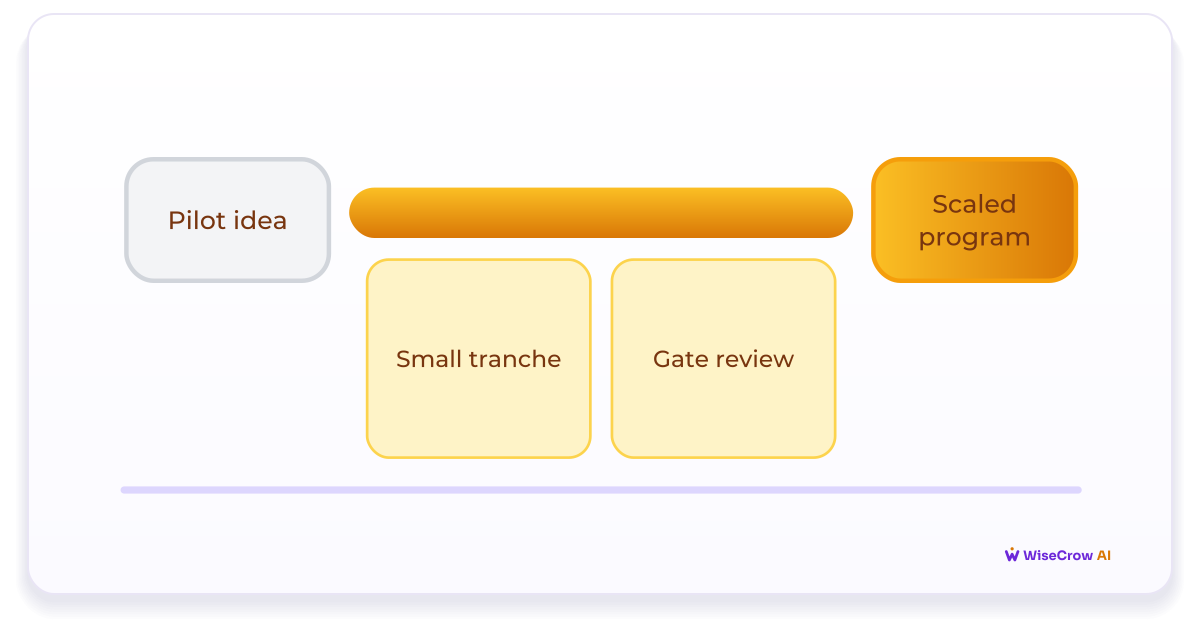
AI work dies quietly when every use case has to fight for money inside a department budget. I usually recommend a split. A central fund pays for the shared platform, governance, security reviews and training. Each use case gets funded in stages, with a small amount to test, a larger amount to build and a running budget once it proves value against a baseline.
Stage gates matter more than the total. They give you a natural moment to stop weak ideas and move money to the strong ones. Also decide early who pays the running costs once a use case is live. In my client work, that question has stopped more finished pilots than any technical problem.
Operating Model: Where the AI People Sit
You need to decide who builds and runs AI, who sets the rules and how the business units take part. The three common models are compared in the next section. The choice affects hiring, reporting lines and how fast a business unit can move, so it belongs at the executive table.
Risk Appetite: What You Will and Won’t Let AI Do
Write down where AI may act alone, where a person must review its output and where it isn’t allowed at all. A tiered approach works well: low-risk internal drafting gets light rules, customer-facing answers get review and testing, and decisions about credit, hiring, health or safety get the strictest controls or stay with people.
Legal duties are part of the picture. The EU AI Act, for example, includes an AI literacy duty in Article 4 that has applied since 2 February 2025 to providers and deployers of AI systems. Parts of the Act have been proposed for change since then, so check the current status with your advisers. Your risk appetite should also cover reputation, because a wrong answer from your chatbot is your company’s answer.
Centralized vs Hub-and-Spoke vs Federated AI Teams
Every company ends up with some version of these three models. None is right forever. Most of my clients move from one to the next as they mature.
| Model | Best fit | Main strength | Main risk |
|---|---|---|---|
| Centralized | Early stage, tight rules | Strong standards | Slow queue |
| Hub-and-spoke | Most mid-size and large firms | Shared tools, local speed | Unclear hand-offs |
| Federated | Mature, diverse units | Close to the business | Duplicate spend |
Centralized
One central team owns AI for the whole company: the people, the tools, the standards and the delivery. It’s a good starting point when skills are scarce and your risk appetite is low, because quality and governance stay in one place. The downside appears within a year. Requests pile up, and business units start buying their own tools to get around the queue.
Hub-and-Spoke
A central hub owns the platform, standards, security and specialist skills. Each business unit has its own spoke: a product owner and a few people who know the work and can build or configure solutions on the shared platform. It’s the model I recommend most often for mid-sized and large companies. The hard part is the hand-off. Write down who owns what, from data access to model monitoring, or the hub and the spokes will each assume the other one has it covered.
The hub also usually picks the shared platform. If that choice is still open, my comparison of enterprise AI platforms covers the security and scale points a hub team should check.
Federated
Each business unit runs its own AI team, and a thin central group sets minimum standards. It suits large groups with very different businesses, such as a conglomerate with a bank and a manufacturer under one roof. The risk is duplication: three units paying for three similar tools and solving the same problem three times. Federated works only when the central standards are short, clear and enforced.
How to Talk About AI With Your Employees
Your people are already using AI and already worried about it, often at the same time. What they lack is a clear story from the top. Gallup found that 44% of U.S. employees say their organization has begun integrating AI, while only 22% say it has shared a clear plan or strategy. Employees who strongly agree that leadership has shared a clear plan are three times as likely to feel very prepared to work with AI.
Say What You Know and What You Don’t
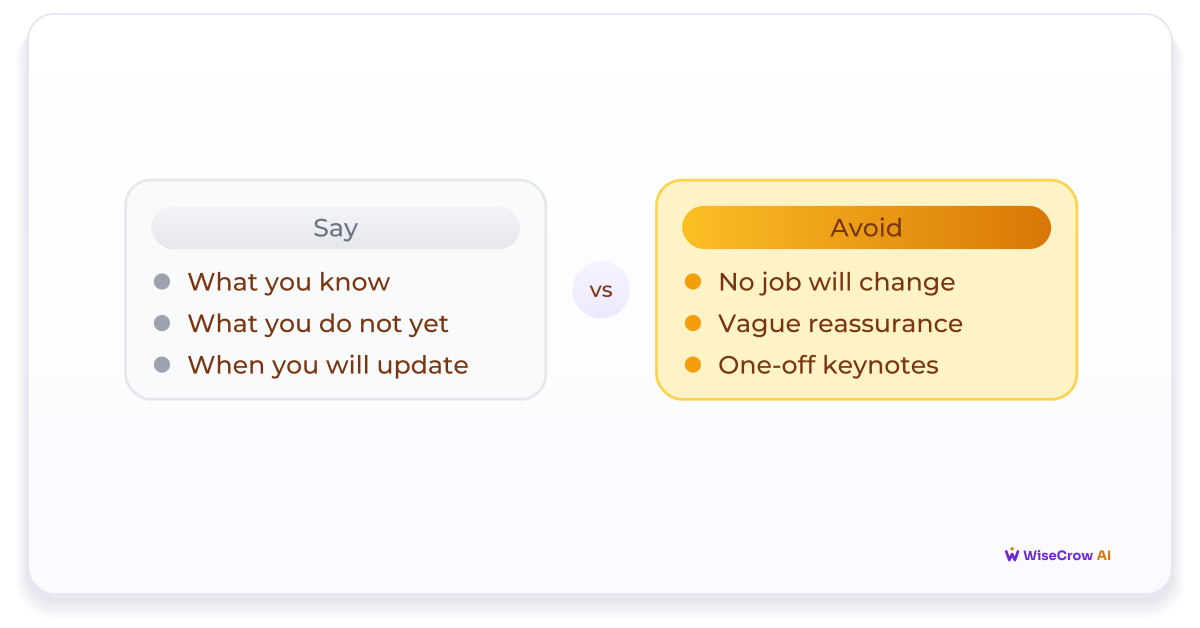
Open with why the company is doing it, in business terms people can repeat. Then be specific about what changes this year and which teams go first. Be honest about the open questions too. “We don’t know yet how the claims team will look in three years, and here’s how we’ll decide it with you” lands better than a vague promise.
On jobs, only commit to what you can keep. If roles will shrink, say how you’ll handle it: retraining, redeployment, notice periods. People can live with hard news far better than with silence and rumor.
Let Managers Carry the Message
A CEO email reaches everyone and convinces few. Brief your managers a week before any announcement, give them a short set of answers to the questions they’ll get and ask them to use AI in their own work where the team can see it. Team-level rollout has its own playbook, and my list of AI adoption best practices covers the champions, training and support that make it stick.
Keep Talking After the Launch
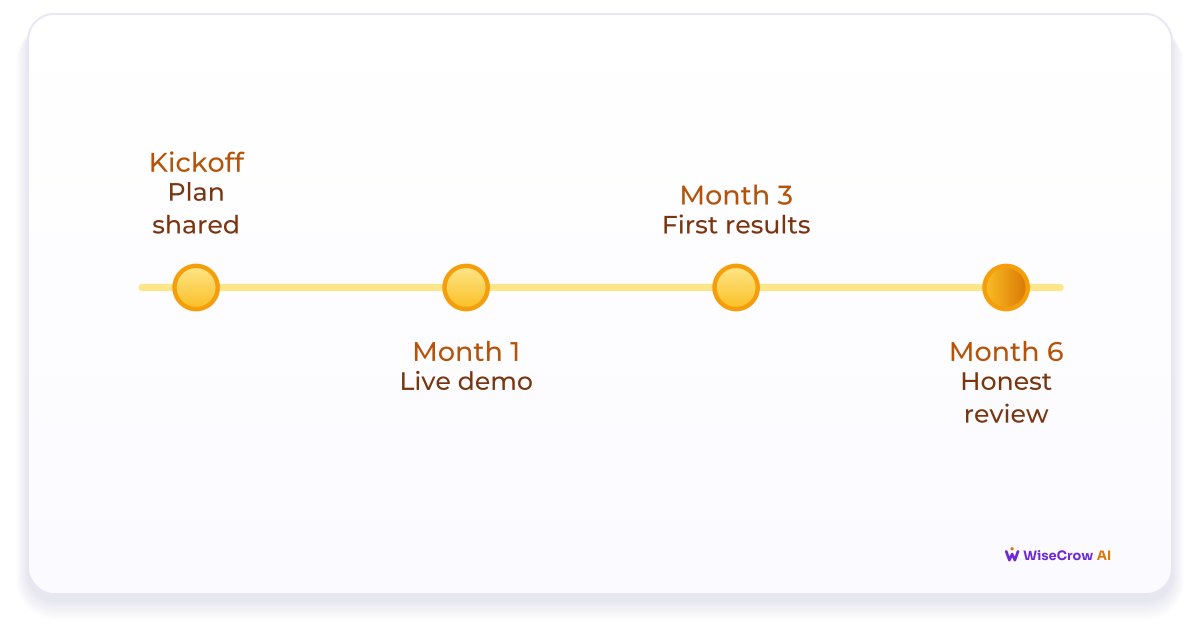
Communication fades after the kickoff in almost every program I see. Set a rhythm: a short update every month, a town hall each quarter with real numbers and an open channel for questions. Share the misses as well as the wins. When people see a leader admit that a pilot failed and explain what happens next, trust goes up.
What to Measure at Board Level
Many boards are still catching up. Deloitte’s 2025 survey of board members and executives found that 31% say AI isn’t on the board agenda, and 66% say their boards have limited to no knowledge or experience with AI. A short, steady scorecard is the fastest way to close that gap.
I keep the board view to one page and four areas. Each metric is measured against a baseline taken before launch, and the same page comes back every quarter.
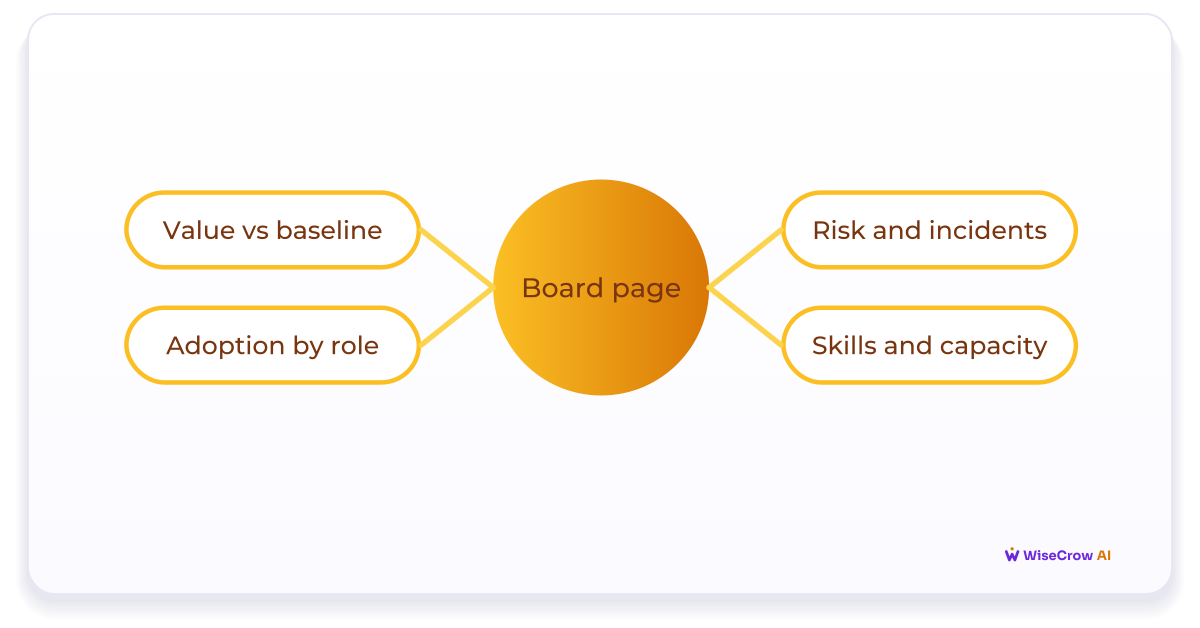
- Value: money and hours gained per priority use case, net of licenses, running costs and review time. Show the cumulative figure and the trend.
- Adoption: the share of target employees using AI for real work every week, by function. Logins alone don’t count.
- Risk: the number of high-risk use cases, how many passed review, and any incidents with what was done about them.
- Capability: the share of staff trained for their role, key AI roles filled and progress on the data behind the priority use cases.
Leave pilot counts, prompt counts and model names off the board page. They tell directors about activity. A board needs to see if the strategy is working and if the risk is under control. In my experience, boards that see the same four lines every quarter start asking far sharper questions by the third meeting.
Common Leadership Mistakes in AI Transformation
The same handful of leadership errors show up across industries. None of them is technical, which is part of why they’re easy to miss from the top.
Delegating it all to IT. IT can build and secure the platform. It can’t decide how underwriting or sales should work. When the business doesn’t own the outcome, you get impressive tools with weak usage.
Announcing the vision, then disappearing. A keynote at the kickoff and silence for six months tells employees the program has lost priority. Put AI on the executive agenda every month, with the same scorecard the board sees.
Funding pilots without a path to production. Pilots are cheap and fun. Running costs, support and process change are not. Agree on the go-live criteria and who pays before a pilot starts.
Counting savings that never land. Hours saved on paper disappear unless someone decides what happens to them. Decide upfront if freed time goes to growth, service quality or lower hiring, and track it.
Treating the risk policy as a brake. A policy that only lists bans pushes people toward personal accounts. Pair each rule with an approved way to get the job done.
Each of these has a fix at team and process level, too. My guide to AI transformation challenges goes through the warning signs and the practical steps for the eight problems I see most.
AI Transformation Leadership Checklist
Bring this list to your next executive meeting. Every item is a decision or a habit at the top of the company, and each one should have a name next to it.
- One executive owns AI outcomes and reports on them to the CEO and the board.
- The leadership team has agreed on the main ambition level and the three or four areas to focus on.
- A central fund exists for the platform, governance and skills, and use cases are funded in stages.
- Someone has decided who pays running costs once a use case goes live.
- The operating model is chosen and written down, including who owns data, models and monitoring.
- Risk tiers are defined, with a named approver for high-risk uses.
- Employees have heard the plan from leadership, including what changes in their roles this year.
- Managers have been briefed and use AI visibly in their own work.
- Each priority use case has a baseline and a target before it launches.
- The board sees the same one-page scorecard every quarter.
- The executive team reviews the AI portfolio monthly and stops weak initiatives.
If you can tick fewer than six, fix the gaps before you add new pilots. The phasing of these steps over a year is what my 12-month transformation roadmap covers in detail.
Choosing Your Starting Point as a Leader
You can’t make every decision in the first month, and you don’t need to. Start from where your company is today.
- Scattered pilots and no owner: name the executive owner and agree on the ambition level first.
- A clear strategy but stalled pilots: fix the funding model and the go-live criteria.
- Strong central team with a long queue: move toward hub-and-spoke and add business unit owners.
- Low usage and nervous staff: share the plan in person and brief your managers.
- Board asking questions you can’t answer: set baselines and build the one-page scorecard.
My default for most leadership teams is ownership and ambition first, then funding. Those two decisions take a few weeks of honest debate, and everything else gets faster once they’re made. A short assessment of where you stand on all four decisions is often the most useful first step, because it shows the leadership team where it actually disagrees.
Questions About Leading an AI Transformation
What Is AI Transformation in Simple Terms?
AI transformation is a planned change in how your company works, decides and competes, with AI built into the core processes. It goes further than adding AI tools to existing tasks. Roles, workflows, budgets and sometimes the products themselves change, and the executive team owns the result.
Who Should Lead an AI Transformation?
The CEO or a member of the executive team with real authority over budgets and priorities should own it. A Chief AI Officer, CIO or CDO can run the program day to day. If ownership sits only with IT, the program tends to produce tools without the changes in work that create value.
How Is AI Transformation Different from Digital Transformation?
Digital transformation moved processes and channels onto software and data. AI transformation builds on that base and changes who or what makes decisions and does the work. Many companies run both at once, because AI needs the data and systems that digital work created.
How Much Should We Budget for AI Transformation?
There’s no standard percentage. A sensible approach is a central fund for shared platforms, governance and skills, plus funding for each use case tied to its business case. Remember that people, training and process redesign usually take a larger share than the models and licenses.
Do We Need a Chief AI Officer?
Not always. You need one person with the mandate to run the program across functions and report on it to the executive team. In larger companies, that role often becomes a Chief AI Officer. In mid-sized firms, a CIO, CDO or COO with dedicated time and a small team can do the job.
What Should the Board Ask Management About AI?
Ask which three or four outcomes AI is meant to change, how value is measured against a baseline, which uses count as high risk and who approves them, and what the company is doing on skills. Ask for the same short scorecard every quarter, so the trend is visible over time.
How Long Before an AI Transformation Shows Results?
The first use cases can show measurable results within a few months if they’re well chosen and baselined. Changes across the whole company take several years. Plan in quarters, report progress honestly and expect some initiatives to be stopped along the way.
Sources
- PwC 29th Global CEO Survey (January 2026), as reported by Search Engine Journal: searchenginejournal.com
- BCG, AI Adoption in 2024: 74% of Companies Struggle to Achieve and Scale Value (October 2024): bcg.com
- Gallup, AI Use at Work Has Nearly Doubled in Two Years (2025): gallup.com
- Deloitte Global Boardroom Program, Governance of AI, 2nd edition (2025): deloitte.com
- EU AI Act, Article 4: AI Literacy: artificialintelligenceact.eu
Disclaimer: This article is for general information only and isn’t legal advice. AI rules such as the EU AI Act differ by country and are still changing, so check the current position with your advisers before you act.
Did you find this helpful?
Thank you for your feedback.
Marlena leads the WiseCrow editorial team and works with our consultants to turn real client projects into practical guides on AI strategy, automation and governance. Before joining WiseCrow, she spent 12 years in B2B operations and SaaS content. She has since edited more than 400 articles on AI and automation and reviewed workflows from over 60 client projects. She is based in Austin, Texas.