Summary
- Conversational AI ROI = cost per assisted contact × contacts the bot fully resolves, minus platform, build, maintenance and handover costs.
- Gartner puts the median assisted contact at $13.50 and a self-service contact at $1.84, so the savings per resolved contact can be large.
- Use resolution, never containment, in your math. Gartner found only 14% of service issues are fully resolved in self-service.
- Handovers and maintenance decide whether a bot pays back. A weak bot can lose money even when the vendor bill looks small.
Most support bot business cases I review fall apart on one number. Someone takes the vendor’s containment rate, multiplies it by every contact the team handles and gets a saving that never shows up in the budget. Before any conversational AI consulting work starts, I rebuild that math with numbers you can defend in front of your finance team.
Below you’ll find the formula I use, the published benchmarks that hold up, a worked example for a twelve-agent team and the places where the return quietly leaks away. Then you can plug in your own figures.
The Conversational AI ROI Formula
Every support bot return comes down to one subtraction. What the bot saves on one side, what it costs to run on the other:
Net yearly return = (Cost per assisted contact × Contacts the bot fully resolves) − (Platform + Build + Maintenance + Handover cost)
Four of those inputs are easy to get wrong, so here’s how I pin each one down.
Cost per Assisted Contact
Take your yearly support cost (wages, benefits, management, tools and outsourcing fees) and divide it by the number of contacts your people handled. Use contacts handled by humans only. If you can’t get the full budget, a workable shortcut is fully loaded hourly cost × average handle time in hours. For a reference point on wages, the U.S. Bureau of Labor Statistics lists a median of $21.53 an hour for customer service representatives (May 2025 data). Loaded costs sit well above that once you add benefits, supervision and software.
Contacts the Bot Fully Resolves
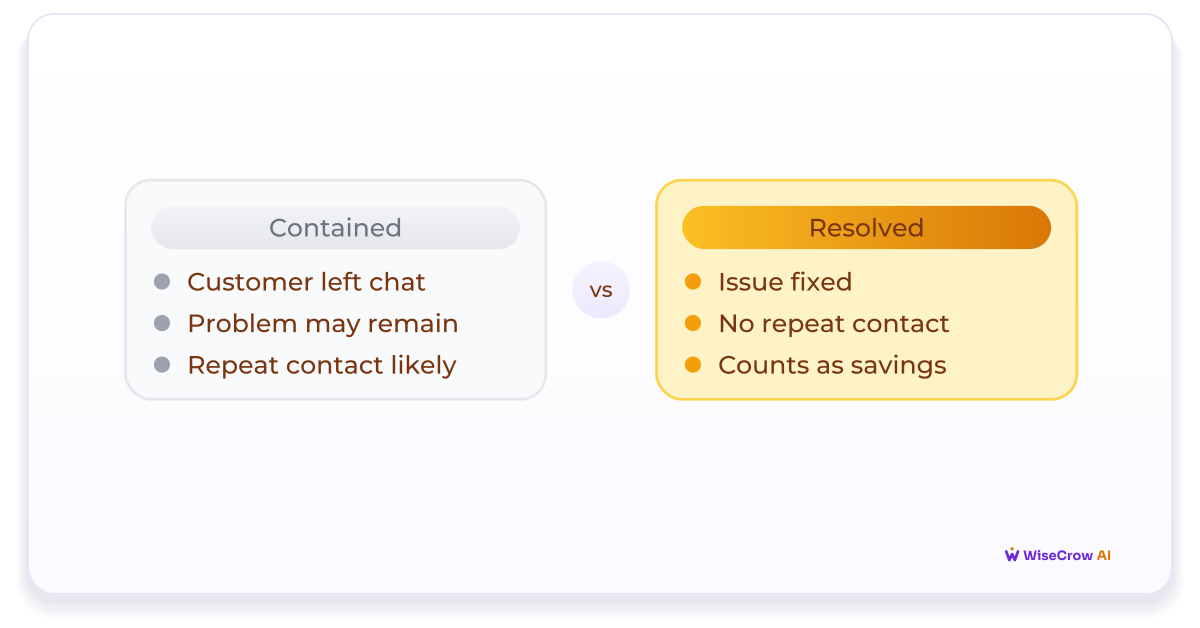
Count only conversations where the customer’s issue was solved and they didn’t come back through another channel within a few days. Vendors often report containment, meaning the chat never reached a human. A customer who gives up and calls you an hour later is contained. They’re also a cost.
Platform, Build and Maintenance
Platform is the yearly bill from your vendor. Build covers intent design, integrations and launch testing, and it lands mostly in year one. Maintenance is the person, or part of a person, who reads transcripts, fixes answers and updates flows when your products or policies change.
Handover Cost
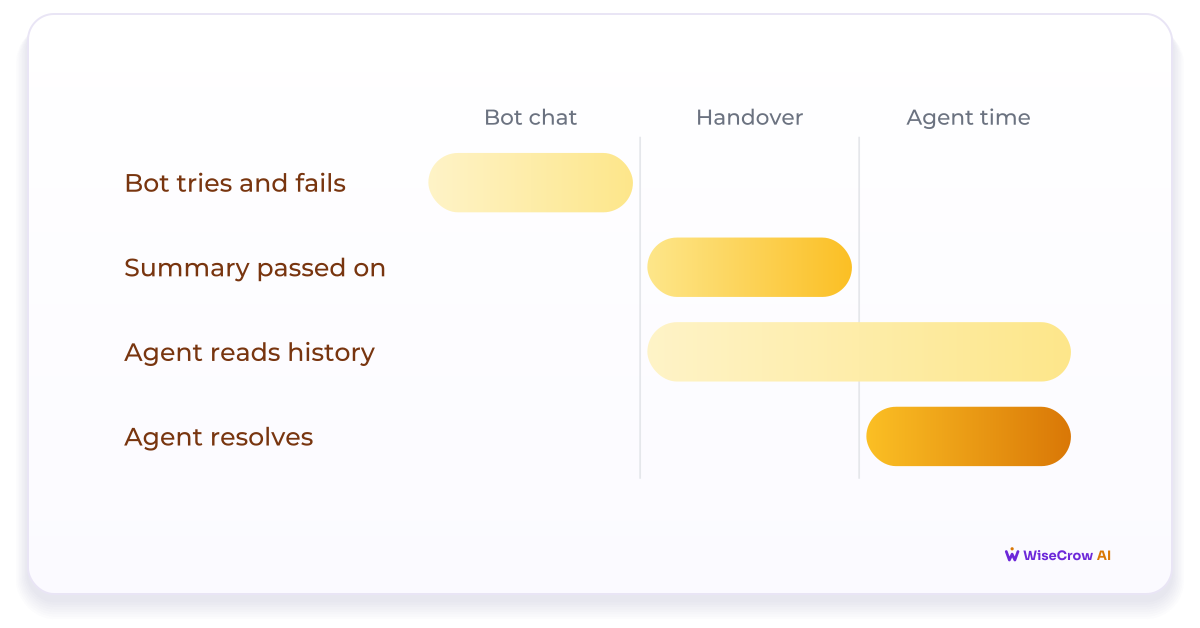
When the bot hands a chat to an agent, the agent reads what happened, often asks the same questions again and then solves the issue. Those extra minutes are real labor. I add them as their own cost line, because they grow when the bot is weak and shrink when it passes good context.
Published Numbers You Can Actually Use
There are a lot of support statistics floating around with no traceable origin. I only use figures I can link to the people who published them. Here are the ones I trust enough to put in a business case, plus what each one does and doesn’t tell you.
The Cost Gap Between Assisted and Self-Service Contacts
Gartner’s customer service cost benchmark puts the median assisted contact at $13.50 and the median self-service contact at $1.84. Gartner also notes that phone, chat and email tend to cost about the same per contact. The gap is the whole reason conversational AI makes financial sense. Each contact moved from a person to a bot that solves it saves most of the assisted cost.
Treat the $13.50 as a sanity check. A mid-sized team with fast chat handling might sit well under it, and a regulated business with long calls might sit above. Your own cost per contact always beats a median.
How Often Self-Service Really Solves the Problem
A Gartner customer survey published in August 2024 found that only 14% of service issues were fully resolved in self-service. Even issues customers called “very simple” were fully resolved only 36% of the time. Gartner also reported that 45% of customers who started in self-service said the company didn’t understand what they were trying to do, and that the most common failure was customers not finding content relevant to their issue.
Those numbers cover all self-service, including help centers and older bots. A well-built AI agent should beat them. They still tell you where to set expectations for a first release, and they show why content quality drives the return so strongly.
What a Strong Launch Looked Like at Klarna
Klarna is the most quoted case, so the original numbers matter. In February 2024, the company said its AI assistant had handled 2.3 million conversations in its first month, two-thirds of its customer service chats. Klarna said that equaled the work of 700 full-time agents, cut resolution time from 11 minutes to under 2 and reduced repeat inquiries by 25%. It estimated a $40 million profit improvement for 2024.
The follow-up matters just as much. In May 2025, CEO Sebastian Siemiatkowski said the company was hiring human support staff again, and he admitted cost had weighed too heavily in its evaluation, which led to lower quality. I read the two together as one lesson. A big automation share is possible, and it still needs a quality measure next to the cost measure.
What Bots Cost per Resolution
Several vendors now bill by results. Intercom lists its Fin AI agent at $0.99 per outcome, and its definition of an outcome includes confirmed resolutions, customers who don’t ask for more help and completed workflows, handoffs included. Zendesk bills AI agents by automated resolution, with a yearly allocation by plan and extra resolutions bought upfront or billed as overage. Compare those definitions with care, because they decide what you pay for. My comparison of conversational AI platforms covers the pricing models side by side.
A Worked Example for a Twelve-Agent Support Team
To show how the formula behaves, here’s an illustrative mid-sized team. The figures are made up for the example but sit in realistic ranges. Swap in your own before you show anyone.
The team has twelve agents handling 8,000 chats and emails a month, so 96,000 a year. Fully loaded, an agent costs about $33 an hour, or $0.55 a minute. Average handle time is 11 minutes, which puts the cost per assisted contact at roughly $6. That’s deliberately well below Gartner’s median, because I’d rather understate the savings than overstate them.
I’ve run two cases. In the strong case, the bot fully resolves 30% of contacts and 15% of all contacts start with the bot and then hand over. In the weak case, the bot resolves 12% and 30% of contacts hand over. Each handover adds 1.5 minutes of agent time. The platform bills $0.99 per resolution, the build costs $25,000 and a quarter of one $70,000 role covers maintenance.
| Line item | Strong case | Weak case |
|---|---|---|
| Contacts per year | 96,000 | 96,000 |
| Share the bot fully resolves | 30% | 12% |
| Contacts resolved by the bot | 28,800 | 11,520 |
| Savings at $6 per contact | $172,800 | $69,120 |
| Platform at $0.99 per resolution | −$28,512 | −$11,405 |
| Build, one-time | −$25,000 | −$25,000 |
| Maintenance, a quarter of one role | −$17,500 | −$17,500 |
| Handover cost | −$11,880 | −$23,760 |
| Net return, year one | $89,908 | −$8,545 |
Illustrative example. Handover cost: contacts that hand over × 1.5 minutes × $0.55 per minute.
The strong case earns about $1.08 of net value for every dollar spent in year one, and the build pays back in under three months. In year two the $25,000 build drops away, so the net return rises to about $114,900 if volumes hold.
The weak case loses money, even though its platform bill is the cheapest cost line in the whole column. The loss comes from low resolution combined with twice as many handovers, each one taking agent time the bot was supposed to save.
When Saved Hours Become Saved Money
In the strong case the bot resolves 28,800 contacts, about 5,280 agent hours a year. That’s roughly two and a half to three full-time agents. You only bank that money if you do something with it: avoid the next hires as volume grows, let natural attrition shrink the team, or move people to work that earns revenue. If all twelve agents stay and simply have quieter afternoons, your finance team will see a new cost line and no saving.
What Sits on the Cost Side
Vendor quotes cover the first row of the table below. The rest is where budgets slip, so I make every client put a number on each line before signing anything.
| Cost driver | What you pay for | What moves it |
|---|---|---|
| Platform fees | Seats, plus per-resolution or per-conversation charges | Volume and the vendor’s pricing model |
| Build and integration | Intent design and links to order, billing and CRM systems | Number of systems and actions the bot can take |
| Knowledge content | Writing and fixing the help articles the bot answers from | The state of your help center today |
| Tuning and testing | Transcript reviews, fixes for failed intents, regression tests | How often products and policies change |
| Handover time | Agent minutes spent reading the bot chat and re-asking questions | How much context the bot passes on |
| Voice extras | Telephony minutes and speech recognition | Call volume and average call length |
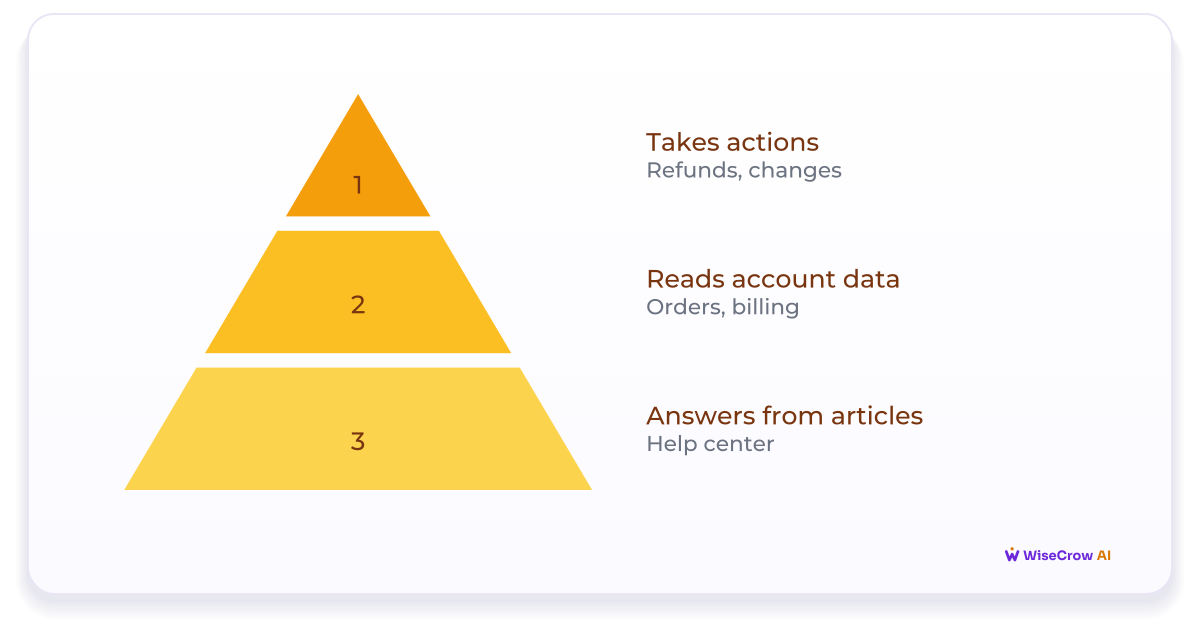
Build cost depends mostly on what you let the bot do. A bot that reads your help center can launch fast. A bot that checks order status, issues refunds or changes a booking needs secure connections to your back-end systems, plus testing for every edge case. Those actions usually drive resolution rates up, which is why they’re worth paying for. My guide to conversational AI implementation walks through the build steps and where time goes.
Knowledge content is the line people forget. If your help articles are out of date, the bot will repeat the mistakes with total confidence. In one ecommerce project, about a third of the first month’s budget went into rewriting return and shipping articles, and it raised resolution more than any change to the bot itself.
Voice adds its own layer. Phone bots carry telephony and speech costs and usually resolve less than chat at first, because callers ramble, interrupt and switch topics. If you’re deciding between channels, my explainer on chatbots versus voice bots covers the trade-offs.
Where Conversational AI ROI Breaks Down
The formula is simple. The returns go wrong in a handful of predictable places, and most of them come down to measurement and upkeep.
Counting Containment as Savings
The single biggest error. A bot that ends 60% of chats without a human can look like a triumph on a dashboard. Then you check repeat contacts and find many of those customers emailed or called within a day. I ask for a seven-day repeat-contact check on a sample of contained chats before anyone quotes a savings number.
Handovers That Start From Zero
When the bot passes a chat to an agent without the customer’s details, order number and what was already tried, the agent starts over. The customer repeats themselves and gets annoyed, so the handle time goes up. A good handover sends a short summary and the data the bot collected. On the weak case above, cutting each handover from 1.5 minutes to half a minute would recover about $15,800 a year.
Maintenance Nobody Budgeted
Products change, prices change and return policies change. Each change can break an answer. Without an owner who reviews failed conversations every week, resolution drifts down over a few months and nobody notices until customer satisfaction drops. Good dialogue design slows that drift, and my list of conversational AI best practices covers the habits that keep a bot accurate.
Billing Definitions You Didn’t Read
Per-resolution pricing sounds safe until you see what counts as a resolution. Some definitions include customers who simply stop replying, and some include completed handoffs. Run a month of transcripts against the vendor’s definition and compare the billable count with your own count of solved issues. The difference is money.
Workforce Cuts Planned Too Early
Some business cases assume a smaller team from month one. Gartner predicts that by 2027, half of the organizations that expected to significantly cut their customer service workforce will abandon those plans. Build your case on avoided hiring and attrition first. If the bot outperforms, the savings come anyway, and you won’t have cut people you later need back.
Estimate the Savings for One Contact Type
Use the calculator for one contact type at a time, such as order status or password resets. Enter the average handle time in minutes, how many of those contacts you get a week, the share you expect the bot to fully resolve and your fully loaded hourly cost. The yearly value is the savings side of the formula. Subtract the platform, build, maintenance and handover costs to get the net return.
How Much Time Could You Save?
Move the sliders to match one repetitive task in your business.
Be honest with the share slider. For a first release on a well-documented contact type, I’d start your estimate somewhere between 20% and 40% and move it up only after a few weeks of real transcripts.
How to Choose Which Contacts to Automate First
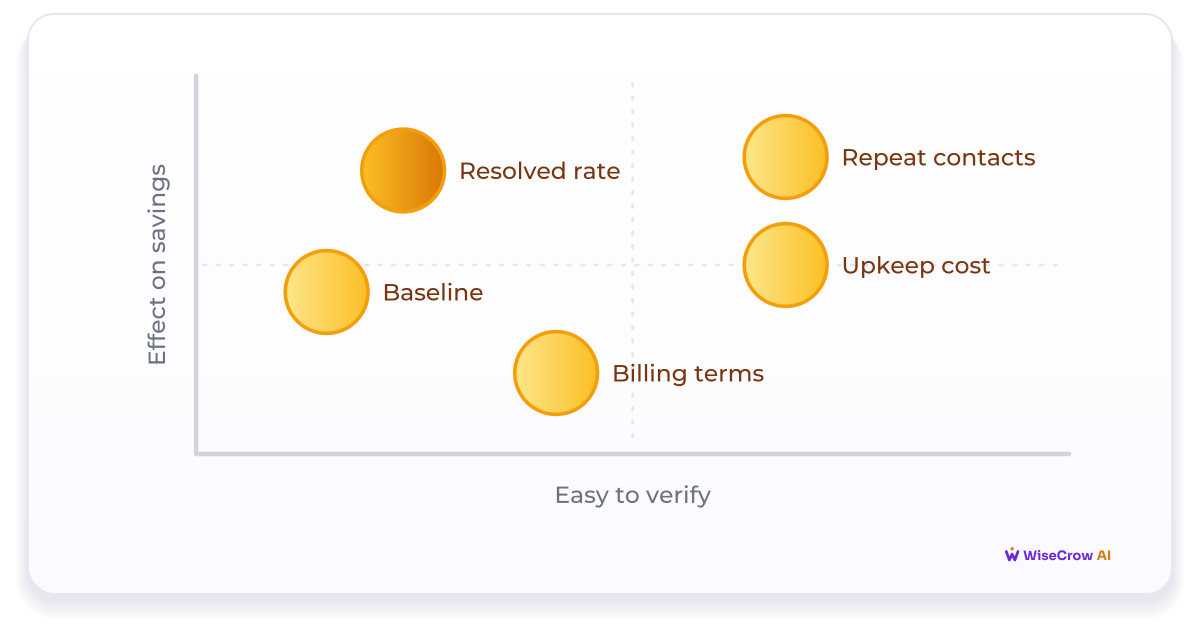
The best first targets combine high volume with simple, stable answers. Pull your last three months of tickets, group them by reason and score each group against these questions:
- Does the contact type make up a big share of your volume?
- Can it be solved with information or one action the bot can safely take?
- Is the answer stable, or does it change with every promotion or policy update?
- Do you already have accurate help content for it?
- Would a wrong answer cause real harm, such as a billing error or a compliance issue?
Order status, delivery questions, password resets and simple account changes usually win. Complaints, cancellations with retention offers and anything involving judgment usually belong with people, at least at first. If you need a way to map contact reasons to intents and flows, my conversational AI framework lays out the structure I use.
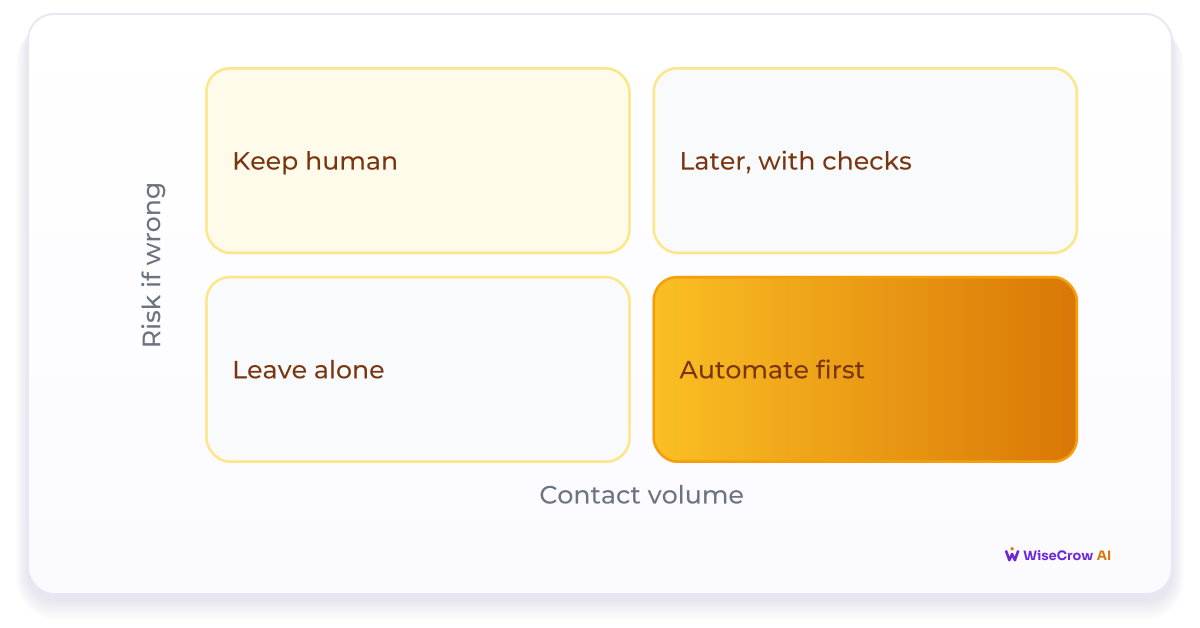
Start with two or three contact types, measure resolution and repeat contacts for a month, then add the next group. Each round gives you better numbers for the formula than any benchmark.
Questions About Conversational AI ROI
What Is a Good ROI for Conversational AI in Customer Support?
A healthy first-year result covers the build and running costs and leaves a clear surplus, with payback inside the first year. The bigger test is year two, when the build cost drops away. If the bot still needs heavy tuning every month and resolves only a small share of contacts, the return stays thin no matter what the vendor demo promised.
How Do I Calculate Conversational AI ROI?
Multiply your fully loaded cost per assisted contact by the number of contacts the bot fully resolves. Then subtract platform fees, the build, ongoing maintenance and the extra agent time spent on handovers. Divide the result by the total cost if you want a percentage.
What Is the Difference Between Containment and Resolution?
Containment counts every conversation that never reached a human. Resolution counts only the ones where the customer’s problem was solved. A customer who gives up and emails you the next day counts as contained, so resolution is the number your ROI should use.
How Much Does a Customer Service Contact Cost?
Gartner’s benchmark puts the median at $13.50 for an assisted contact and $1.84 for a self-service contact. Your own number depends on wages, channel mix and handle time, so work it out from your support budget and contact volume before you use any benchmark.
How Long Does Conversational AI Take to Pay Back?
With decent resolution rates and a modest build, payback can come within months. With weak resolution, it may never come. The deciding factors are how many contacts the bot truly resolves and what happens to the agent hours it frees up. Savings only count once those hours lower your costs or replace planned hires.
Should I Pay per Resolution or per Conversation?
Per-resolution pricing ties your bill to results, which suits most support teams. Read the vendor’s definition closely, though, because some count handoffs, completed workflows or silent customers as billable outcomes. Per-conversation pricing is easier to predict but charges you for failed chats too.
Can Conversational AI Replace My Support Team?
For most companies, no. It can take over a large share of simple, repeatable questions and free agents for complex cases. Gartner expects half of the organizations that planned big service workforce cuts to drop those plans by 2027, which matches what I see in client work.
Sources
- Gartner, Benchmarks to Assess Your Customer Service Costs: gartner.com
- Gartner, survey on self-service resolution (August 2024): gartner.com
- Gartner, prediction on customer service workforce plans (June 2025): gartner.com
- Klarna, AI assistant handles two-thirds of customer service chats in its first month (February 2024): klarna.com
- Klarna CEO on hiring human support staff again (May 2025): Entrepreneur
- Intercom pricing for Fin AI agent: intercom.com
- Zendesk, about automated resolutions for AI agents: zendesk.com
- U.S. Bureau of Labor Statistics, Customer Service Representatives: bls.gov
Disclaimer: This article is for general information only and isn’t financial advice. The worked example is illustrative, and vendor prices, benchmarks and wages change often, so check current figures with the original sources and your own data before you decide.
Did you find this helpful?
Thank you for your feedback.
Marlena leads the WiseCrow editorial team and works with our consultants to turn real client projects into practical guides on AI strategy, automation and governance. Before joining WiseCrow, she spent 12 years in B2B operations and SaaS content. She has since edited more than 400 articles on AI and automation and reviewed workflows from over 60 client projects. She is based in Austin, Texas.